Matter and its properties
Students learn that everything is made of particles too small to see. They weigh, measure, and test materials to identify them, and they check that weight stays the same when things are heated, cooled, or mixed.
This is the year science zooms out to Earth, space, and the building blocks of matter. Students argue that the sun looks brighter than other stars because it is closer, and they track how shadows and seasons shift. They model how air, water, land, and living things connect, and they show that matter is made of particles too tiny to see. By spring, students can explain how a plant grows from air and water and trace the energy in food back to the sun.
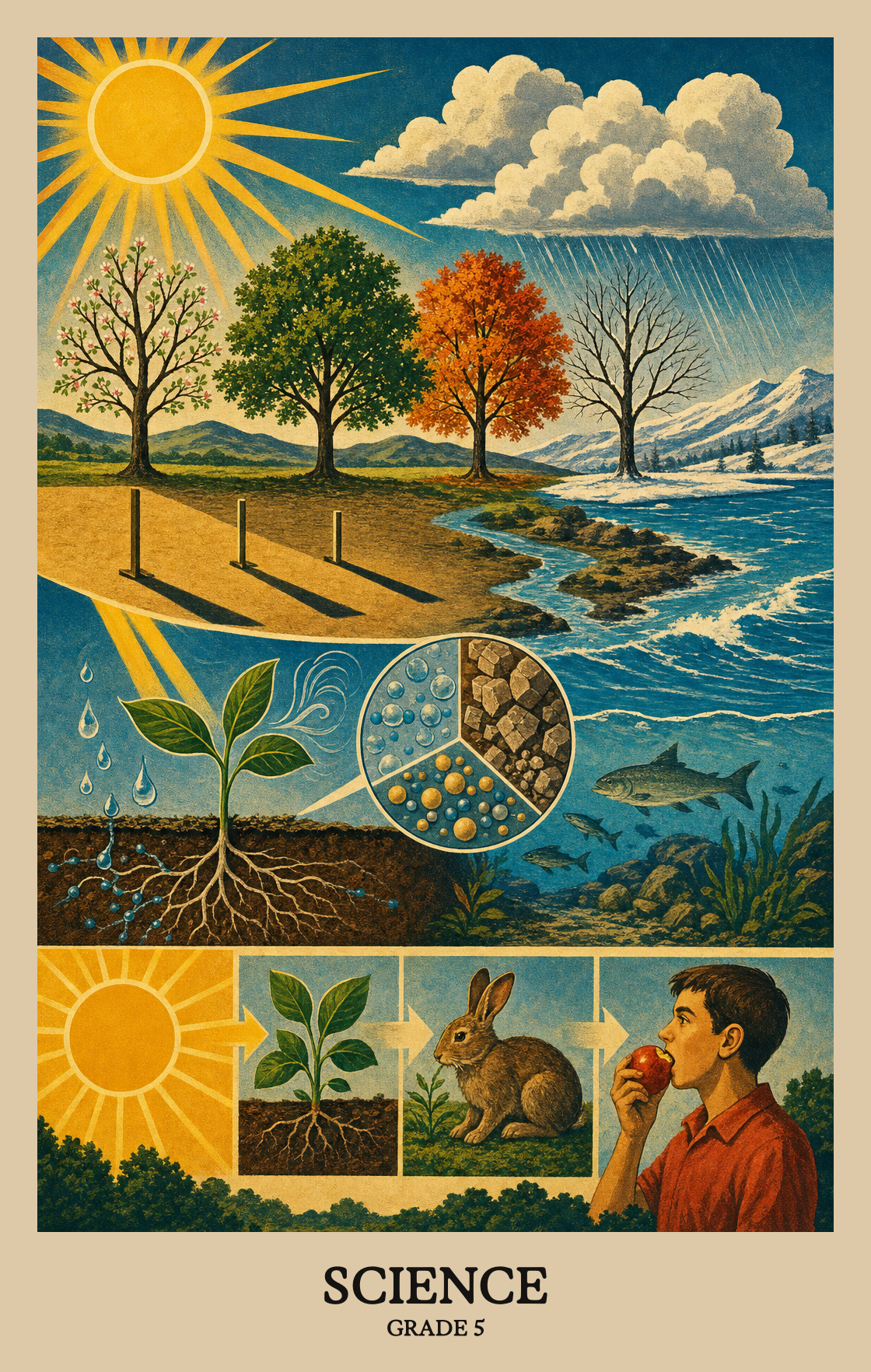
Students learn that everything is made of particles too small to see. They weigh, measure, and test materials to identify them, and they check that weight stays the same when things are heated, cooled, or mixed.
Students look at how the land, air, water, and living things affect each other. They graph how much of Earth's water is salty versus fresh and where that fresh water actually sits.
Students build the case that plants grow mostly from air and water, not from soil. They trace how food energy started as sunlight and how matter moves between plants, animals, and decomposers.
Students study why the sun looks so much brighter than other stars and graph how shadows, daylight, and the night sky change over a day and across seasons. They also show that gravity pulls objects down toward Earth.
Students take a real problem, write down what counts as success, and list the limits on time, cost, or materials. They sketch several possible solutions and compare which one fits the job best.
Students explain why the sun looks brighter than other stars, not because it is the biggest star in the sky, but because it is so much closer to Earth.
Students plot shadow lengths, day-and-night cycles, and seasonal star positions on graphs to find the repeating patterns. The data shows how Earth's movement drives those changes.
Students build a diagram or model showing how land, living things, water, and air affect each other. For example, they might show how rain soaks into soil, feeds plant roots, and then evaporates back into the air.
Students graph how much of Earth's water is salt water versus fresh water, comparing oceans, glaciers, rivers, and groundwater. The data shows why most of Earth's water is out of reach for drinking.
| Standard | Definition | Code |
|---|---|---|
| Support an argument that differences in the apparent brightness of the sun… | Students explain why the sun looks brighter than other stars, not because it is the biggest star in the sky, but because it is so much closer to Earth. | CA-5-ESS1-1.5 |
| Represent data in graphical displays to reveal patterns of daily changes in… | Students plot shadow lengths, day-and-night cycles, and seasonal star positions on graphs to find the repeating patterns. The data shows how Earth's movement drives those changes. | CA-5-ESS1-2.5 |
| Develop a model using an example to describe ways the geosphere, biosphere… | Students build a diagram or model showing how land, living things, water, and air affect each other. For example, they might show how rain soaks into soil, feeds plant roots, and then evaporates back into the air. | CA-5-ESS2-1.5 |
| Describe and graph the amounts of salt water and fresh water in various… | Students graph how much of Earth's water is salt water versus fresh water, comparing oceans, glaciers, rivers, and groundwater. The data shows why most of Earth's water is out of reach for drinking. | CA-5-ESS2-2.5 |
Students name a real problem they want to solve, then set the rules for what a good solution looks like, including limits on materials, time, or cost.
Students come up with more than one way to solve a problem, then compare their ideas to see which one best fits the rules and limits they were given.
| Standard | Definition | Code |
|---|---|---|
| Define a simple design problem reflecting a need or a want that includes… | Students name a real problem they want to solve, then set the rules for what a good solution looks like, including limits on materials, time, or cost. | CA-5-ETS1-1.5 |
| Generate and compare multiple possible solutions to a problem based on how well… | Students come up with more than one way to solve a problem, then compare their ideas to see which one best fits the rules and limits they were given. | CA-5-ETS1-2.5 |
Plants pull most of what they need to grow from air and water, not from soil. Students build an argument explaining where those materials come from and why soil plays a smaller role than most people think.
Students draw or diagram how matter moves through a food web, showing what plants absorb, what animals eat, and what decomposers break down and return to the soil.
| Standard | Definition | Code |
|---|---|---|
| Support an argument that plants get the materials they need for growth chiefly… | Plants pull most of what they need to grow from air and water, not from soil. Students build an argument explaining where those materials come from and why soil plays a smaller role than most people think. | CA-5-LS1-1.5 |
| Develop a model to describe the movement of matter among plants, animals… | Students draw or diagram how matter moves through a food web, showing what plants absorb, what animals eat, and what decomposers break down and return to the soil. | CA-5-LS2-1.5 |
Students learn that all matter, from a rock to a drop of water, is made of tiny particles invisible to the naked eye. They build or draw a model to show how those particles make up everyday objects.
Students weigh substances before and after heating, cooling, or mixing them, then plot the results on a graph. The total weight stays the same no matter what change happens.
Students sort real materials by measuring things like mass, temperature, or how they behave in water. The goal is to identify what something is made of based on evidence, not guesswork.
Gravity always pulls toward the ground, no matter where you stand. Students explain why dropped objects fall down and support that idea with examples, showing that Earth's pull goes in one direction.
Students trace the energy in food back to the sun. They use diagrams or models to show how sunlight powers plants, plants become food, and that food fuels an animal's growth, movement, and warmth.
| Standard | Definition | Code |
|---|---|---|
| Develop a model to describe that matter is made of particles too small to be… | Students learn that all matter, from a rock to a drop of water, is made of tiny particles invisible to the naked eye. They build or draw a model to show how those particles make up everyday objects. | CA-5-PS1-1.5 |
| Measure and graph quantities to provide evidence that regardless of the type of… | Students weigh substances before and after heating, cooling, or mixing them, then plot the results on a graph. The total weight stays the same no matter what change happens. | CA-5-PS1-2.5 |
| Make observations and measurements to identify materials based on their… | Students sort real materials by measuring things like mass, temperature, or how they behave in water. The goal is to identify what something is made of based on evidence, not guesswork. | CA-5-PS1-3.5 |
| Support an argument that the gravitational force exerted by Earth on objects is… | Gravity always pulls toward the ground, no matter where you stand. Students explain why dropped objects fall down and support that idea with examples, showing that Earth's pull goes in one direction. | CA-5-PS2-1.5 |
| Use models to describe that energy in animals’ food | Students trace the energy in food back to the sun. They use diagrams or models to show how sunlight powers plants, plants become food, and that food fuels an animal's growth, movement, and warmth. | CA-5-PS3-1.5 |
The grade 5 science test in the CAASPP suite, based on the California Next Generation Science Standards. Online test covering Physical, Life, Earth and Space, and Engineering science.
The state science test for students with the most significant cognitive disabilities. Replaces the CAST in grades 5, 8, and once during high school for the small group of students whose IEP teams qualify them.
Students study how the sun, stars, and shadows behave, how water moves around the planet, and how plants and animals depend on each other. They also look at matter, gravity, and how energy from the sun ends up in the food we eat. Most lessons involve building a model or running a small test.
Ask students to explain what they observed and why they think it happened. Watching shadows shift during the day, tracking the moon for a week, or weighing ice before and after it melts all reinforce what they study in class. Five minutes of real curiosity beats a worksheet.
A model is how students show their thinking about something they cannot see directly, like tiny particles in matter or water moving between oceans, rivers, and clouds. Drawing and labeling forces them to be precise. Expect lots of arrows, captions, and revisions.
Students should be able to argue from evidence, graph simple data, and build a model that explains a real phenomenon. They should also be able to design a fair test and weigh two possible solutions against given criteria. Sixth grade science builds directly on these habits.
Many teachers anchor each quarter around one system: matter and its properties, energy and food webs, Earth's water and spheres, then space patterns. Engineering design fits inside any unit as the way students apply what they learned. Coming back to graphing and modeling all year matters more than covering topics in a fixed order.
Conservation of matter trips students up, especially when something dissolves or a gas is released and they assume weight disappears. The idea that plants build themselves mostly from air and water also feels counterintuitive. Plan extra time for both, with hands-on measurements and clear before-and-after data.
It is a common idea, but no. Plants pull most of what they need from air and water, using sunlight as the energy source. Soil mainly provides support and a few minerals. A bean sprouting in a wet paper towel is a good way to show this at home.
Quite a bit. Students measure weights, lengths, and volumes, then graph the results to look for patterns. Comfort with decimals, simple fractions, and reading a bar graph helps a lot, so any math practice at home supports science too.
Students define a small problem, list what success looks like, and consider limits like time, cost, or materials. Then they compare two or three possible solutions before building. The goal is the thinking process, not a polished final product.