Moving the body safely
Students learn how to use their bodies in a dance space. They practice basic moves like jumping, stretching, and spinning while staying aware of the people around them.
This is the year movement becomes a way to tell a story. Students explore how their bodies can move through space, change speed, and show feelings like happy or sleepy. They learn to watch a classmate dance and say what they noticed. By spring, students can make up a short dance with a clear beginning and end and share it with the class.
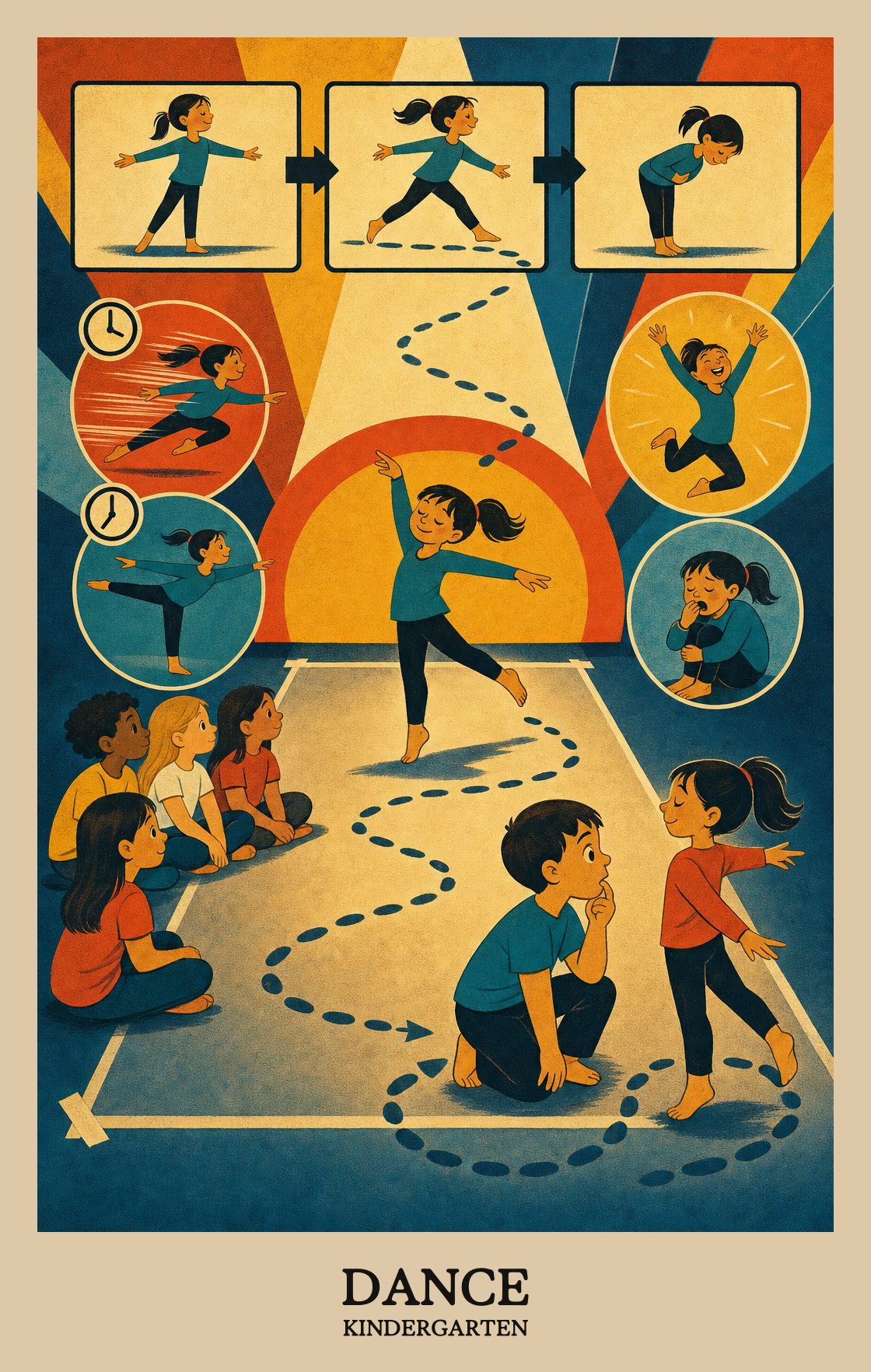
Students learn how to use their bodies in a dance space. They practice basic moves like jumping, stretching, and spinning while staying aware of the people around them.
Students start inventing their own movements based on ideas, feelings, and things they see. A parent might notice a child dancing out a story about a storm or an animal at home.
Students match their movements to a beat and explore fast and slow, high and low, heavy and light. They begin shaping short movement patterns they can repeat.
Students put movements together into a short piece and perform it for classmates. They practice starting, stopping, and finishing a dance with a clear ending.
Students watch other dancers and talk about what they noticed and liked. They begin connecting dances to feelings, stories, and traditions from different families and places.
Students connect something from their own life to what they're learning in dance class, then use that personal experience to shape how they move and create.
Dance comes from real life. Students notice how the dances people do connect to where they live, who they are, and the stories their families and communities carry.
| Standard | Definition | Code |
|---|---|---|
| Connect dance to your own life | Students connect something from their own life to what they're learning in dance class, then use that personal experience to shape how they move and create. | CA-DA:Cn10.k.K |
| Dance from different cultures and times | Dance comes from real life. Students notice how the dances people do connect to where they live, who they are, and the stories their families and communities carry. | CA-DA:Cn11.k.K |
Students make up their own movements and short dances by experimenting with how their body can move through space.
Students arrange simple movements into a short dance phrase, making choices about what comes first, next, and last.
Students look back at a dance they made, try it again with small changes, and then show it as a finished piece.
| Standard | Definition | Code |
|---|---|---|
| Making up new dance moves | Students make up their own movements and short dances by experimenting with how their body can move through space. | CA-DA:Cr1.k.K |
| Making a dance from your own ideas | Students arrange simple movements into a short dance phrase, making choices about what comes first, next, and last. | CA-DA:Cr2.k.K |
| Finishing a dance you made | Students look back at a dance they made, try it again with small changes, and then show it as a finished piece. | CA-DA:Cr3.k.K |
Students pick a movement or short dance to share with others, thinking about why that choice feels right to them.
Students practice a dance movement again and again to get it ready to show others. Repetition is how a step gets cleaner and more confident.
Students pick a dance they made and perform it for others, showing what they want the movement to mean.
| Standard | Definition | Code |
|---|---|---|
| Picking dances to share with others | Students pick a movement or short dance to share with others, thinking about why that choice feels right to them. | CA-DA:Pr4.k.K |
| Practicing moves before the big performance | Students practice a dance movement again and again to get it ready to show others. Repetition is how a step gets cleaner and more confident. | CA-DA:Pr5.k.K |
| Share what a dance means | Students pick a dance they made and perform it for others, showing what they want the movement to mean. | CA-DA:Pr6.k.K |
Students watch a dance and say what they notice, like how a dancer moves fast or slow, uses big gestures, or stays in one spot. Looking closely at movement is how students begin to think about dance.
Students say what a dance makes them think or feel, and explain why a movement or moment stood out to them.
Students say what they like about a dance and explain why, using simple words like "fast," "slow," or "big."
| Standard | Definition | Code |
|---|---|---|
| Watching and talking about dance | Students watch a dance and say what they notice, like how a dancer moves fast or slow, uses big gestures, or stays in one spot. Looking closely at movement is how students begin to think about dance. | CA-DA:Re7.k.K |
| What a dance means | Students say what a dance makes them think or feel, and explain why a movement or moment stood out to them. | CA-DA:Re8.k.K |
| Judging what makes dance good | Students say what they like about a dance and explain why, using simple words like "fast," "slow," or "big." | CA-DA:Re9.k.K |
Students explore how their bodies move through space, copy simple movement patterns, and make up short dances of their own. A lot of the year is about noticing how a fast move feels different from a slow one, or how a stretch feels different from a curl.
Put on music and let students show you a move that feels happy, sleepy, or strong. Five minutes of moving to a song, then talking about what their body did, builds the same skills they practice in class.
No. The work starts from scratch. Students are learning to control their own movement, follow simple directions, and share what they made with classmates.
Start with body awareness and basic movements like bend, stretch, twist, and jump. Move into combining moves with a beat, then into short made-up dances students can share and talk about by the end of the year.
Students can copy a short movement pattern, make up a few moves of their own with a clear beginning and end, and say something simple about what a dance reminded them of or made them feel.
They describe what they saw in plain words, like fast, low, or shaky, and share what they think the dance was about. The goal is honest observation, not formal critique.
Personal space and stopping on a signal. Most early lessons stall when students bump into each other or keep moving past the music, so freeze games and spacing routines are worth repeating all year.
Students use dance to act out stories, show what a word means, or move like something from a science lesson. This is how movement starts to carry meaning, not just energy.