Skip to content

What does a student learn in ?

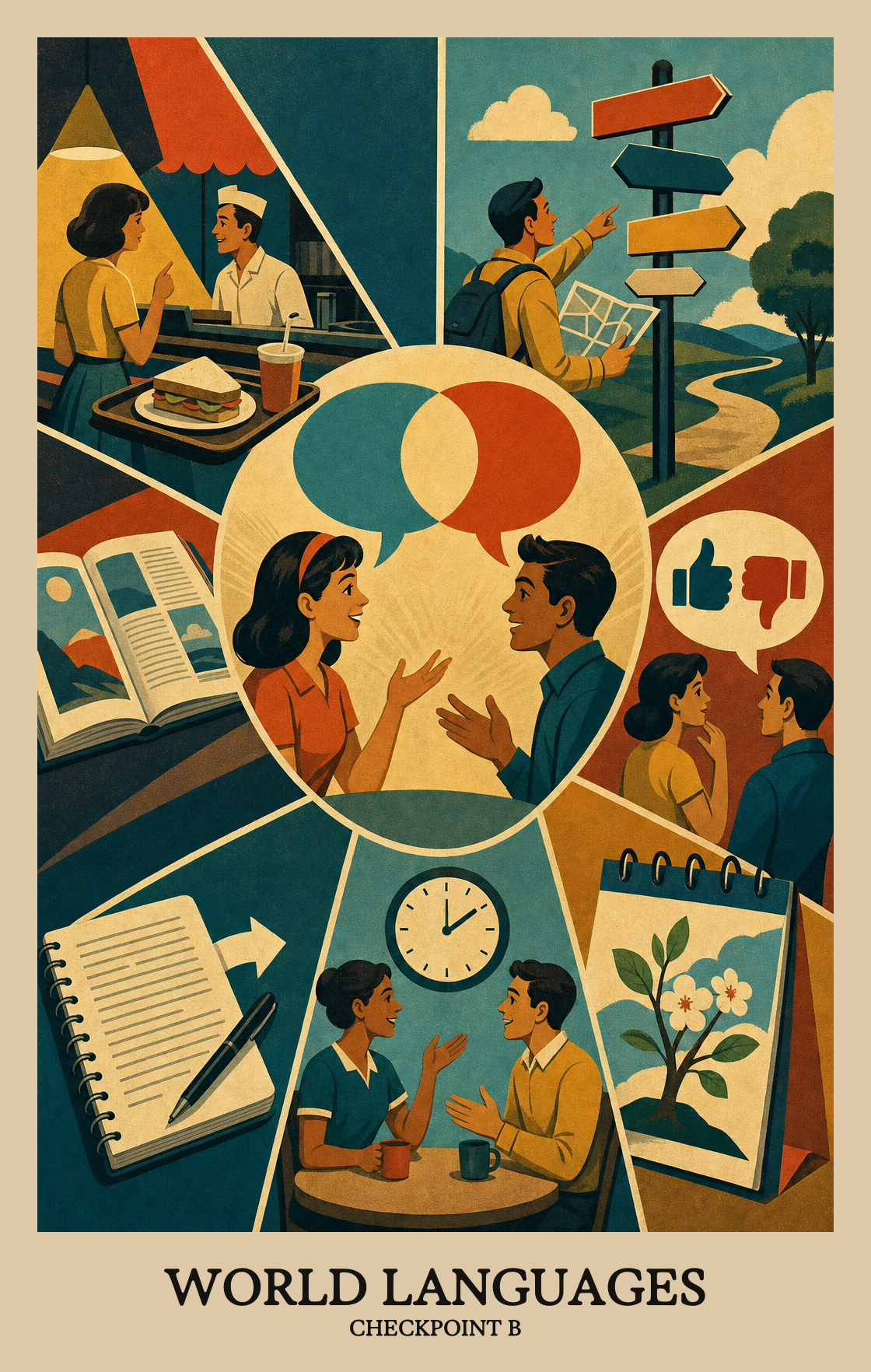
This is the year the new language stops being a list of words and starts being a way to actually talk. Students hold real conversations about familiar topics, share opinions, and handle everyday situations like ordering food or asking directions. They read short articles or stories and write paragraphs that inform or persuade a specific reader. By spring, students can chat with someone for several minutes about their life and interests without falling back on English.

Illustration of what students learn in Checkpoint B World Languages
  • Conversation skills
  • Reading short texts
  • Writing paragraphs
  • Culture and customs
  • Comparing languages
  • Real-world use
Source: California Content Standards for California Public Schools
Year at a glance
How the year usually goes. Every school and district set their own curriculum, so treat this as a guide, not official pacing.
  1. 1

    Everyday conversations and routines

    Students start the year holding short conversations in the new language about familiar topics like family, school, food, and weekend plans. They learn to ask questions, give opinions, and keep a chat going instead of just answering with one word.

  2. 2

    Reading, listening, and viewing

    Students work with real material in the language, such as short articles, videos, songs, and social media posts. They figure out the main idea, pick out details, and start to catch the tone and purpose behind what they read or hear.

  3. 3

    Culture, products, and practices

    Students look at how people in places that speak the language actually live, including holidays, food, music, and daily habits. They start to explain why people do things a certain way, not just what they do.

  4. 4

    Presenting and writing for an audience

    Students give short talks and write paragraphs to inform, persuade, or tell a story. They learn to adjust their words for different audiences, like a teacher, a classmate, or a pen pal, and to use media such as slides or video.

  5. 5

    Connections beyond the classroom

    Students use the language to explore other subjects like history, science, or art, and to look at topics from a new point of view. By the end of the year, they try out the language outside class, online or with people in the community.

Mastery Learning Standards
The required skills a student should display by the end of Grade 10.
Classical Languages - Communication
Standard Definition Code

Reading and listening in a classical language

Checkpoint B

Students read or listen to Latin or ancient Greek texts on a range of topics and work out the meaning using context and cultural knowledge.

CA-WL.CL.INT.1

Conversation in a classical language

Checkpoint B

Students hold back-and-forth conversations in a classical language, working through misunderstandings to share ideas, reactions, and opinions with a partner.

CA-WL.CL.INT.2

Speak and write for different audiences

Checkpoint B

Students write or speak in a classical language to share ideas, explain topics, or make an argument, adjusting their words and format based on who will read or hear them.

CA-WL.CL.INT.3

Using Latin in everyday and formal settings

Checkpoint B

Students practice Latin or Ancient Greek phrases suited to everyday situations: a market stall, a formal speech, a casual conversation. They learn how the language shifts depending on who is speaking and where.

CA-WL.CL.INT.4
Classical Languages - Cultures
Standard Definition Code

Communicating respectfully in another culture

Checkpoint B

Students adjust how they speak or write to fit the customs and expectations of the culture they're studying. That might mean choosing the right level of formality, greeting style, or tone for the situation.

CA-WL.CL.INT.5

How culture shapes what people make and do

Checkpoint B

Students look at objects, traditions, and beliefs from an ancient culture and explain how each one connects to the others. A Roman coin, a festival, and a cultural value don't stand alone; students work out why they fit together.

CA-WL.CL.INT.6
Classical Languages - Connections
Standard Definition Code

Using Latin to think through real problems

Checkpoint B

Students use Latin or Ancient Greek to explore ideas from history, science, or literature, connecting what they already know in English to what they're reading in the classical language.

CA-WL.CL.INT.7

Reading other cultures in the original language

Checkpoint B

Students read and compare ideas from ancient texts to see how people in other times and places understood the world differently than we do today.

CA-WL.CL.INT.8
Classical Languages - Comparisons
Standard Definition Code

How languages compare to each other

Checkpoint B

Students study how Latin or ancient Greek is built differently from English, noticing patterns in word endings, sentence order, and grammar that help explain how both languages work.

CA-WL.CL.INT.9

How cultures differ from your own

Checkpoint B

Students compare everyday life in ancient Roman or Greek culture to their own, using Latin or classical Greek to explain what they notice. They look at things like food, family, or beliefs and put the similarities and differences into words.

CA-WL.CL.INT.10
Classical Languages - Communities
Standard Definition Code

Using Latin beyond the classroom

Checkpoint B

Students use Latin or Ancient Greek to engage with classmates, clubs, or broader groups outside school walls. This standard is about using a classical language as a real tool for connection, not just a subject to study.

CA-WL.CL.INT.11
World Languages - Communication
Standard Definition Code

Understanding language on familiar topics

Checkpoint B

Students listen to, read, or watch material in another language on everyday topics and pull out the key meaning, using what they know about the culture to make sense of it.

CA-WL.WL.INT.1

Conversations where meaning gets worked out together

Checkpoint B

Students hold back-and-forth conversations in the language they are learning, working through any confusion together to share opinions, reactions, and information with a partner.

CA-WL.WL.INT.2

Presenting ideas to real audiences in a new language

Checkpoint B

Students prepare and deliver presentations in the language they are learning, adjusting their words and tone to fit different audiences, whether speaking, writing, or creating something visual.

CA-WL.WL.INT.3

Talking in everyday and formal settings

Checkpoint B

Students hold short, real-world conversations across everyday situations: ordering food, chatting with friends, or speaking politely in a more formal setting like a job interview or school presentation.

CA-WL.WL.INT.4
World Languages - Cultures
Standard Definition Code

Interacting respectfully across cultures

Checkpoint B

Students hold a conversation, write a message, or use gestures the way a person from that culture actually would, not just with correct grammar but with the manners and habits that fit the situation.

CA-WL.WL.INT.5

How cultures shape what people make and do

Checkpoint B

Students look at an everyday object or tradition from another culture, like a food, holiday, or piece of clothing, and explain what it reveals about how people in that culture see the world.

CA-WL.WL.INT.6
World Languages - Connections
Standard Definition Code

Using a new language to think through real problems

Checkpoint B

Students use the language they are learning to explore topics from other subjects, like science or history. Working in a second language pushes them to think through ideas more carefully and find new ways to solve problems.

CA-WL.WL.INT.7

Finding perspectives through another language

Checkpoint B

Students read, listen to, or watch real content in the language they're learning, then weigh what different people from that culture think or believe. They practice deciding what's reliable and what reflects a particular point of view.

CA-WL.WL.INT.8
World Languages - Comparisons
Standard Definition Code

How languages borrow from each other

Checkpoint B

Students compare the language they are learning with their own to notice how grammar, word order, or expressions work differently. Spotting those differences helps students understand how language itself works.

CA-WL.WL.INT.9

Comparing your culture to others in [target language]

Checkpoint B

Students compare their own cultural practices with those of the communities where the target language is spoken, then explain what those differences reveal about how each culture works.

CA-WL.WL.INT.10
World Languages - Communities
Standard Definition Code

Using [language] in the real world

Checkpoint B

Students use the language they are learning to talk and work with people outside of class, whether in their local community or with people from other parts of the world.

CA-WL.WL.INT.11
Assessments
The state tests students at this grade and subject take.
World language

California Spanish Assessment (CSA)

An optional reading and listening test of Spanish proficiency in the CAASPP suite. Districts use it to award the Seal of Biliteracy or to validate dual-language program placements.

When given:
Spring window each year
Frequency:
Annual (optional)
Official source
Common Questions
  • What should students be able to do in the language by the end of this checkpoint?

    Students should hold short conversations about familiar topics, read or listen to simple passages and explain the main idea, and write or speak in connected sentences. They should handle everyday situations like ordering food, asking for directions, or describing their weekend without needing English for every word.

  • How can families help at home if no one speaks the language?

    Ask students to teach one new word or phrase at dinner each night. Watch a short video or listen to a song in the language together and let them explain what it means. Five to ten minutes of regular exposure does more than long study sessions.

  • How should the year be sequenced for steady growth?

    Start with familiar personal topics like family, school, and routines, then move outward to community, travel, and culture. Build interpretive skills first through listening and reading, then push students into more open-ended speaking and writing as confidence grows.

  • Why is so much class time spent on culture and not just grammar?

    Language and culture are tied together. Students need to know how people actually greet each other, order coffee, or write a polite message, not just the rules of the grammar. Cultural context is what makes the language usable outside the classroom.

  • Which skills usually need the most reteaching at this level?

    Verb tense control and spontaneous speaking tend to stall first. Students can often write a sentence correctly when given time, but freeze in a real exchange. Build in short, low-stakes speaking tasks every class so fluency catches up with accuracy.

  • How can families support a student who is shy about speaking?

    Practice with low pressure at home. Ask students to narrate what they are doing in the kitchen, label objects around the house, or read a short passage aloud. Mistakes are part of learning a language, and confidence grows with repetition in a safe setting.

  • How can students get practice outside of class?

    Look for community events, restaurants, places of worship, or cultural centers where the language is spoken. Pen pal exchanges, language apps, and films with subtitles also help. Even ten minutes a day of real contact with the language adds up over a year.

  • How do teachers know a student is ready for the next checkpoint?

    Students should sustain a conversation on familiar topics, understand the gist of unfamiliar texts at their level, and produce connected paragraphs in writing or speech. They should also compare the target language and culture to their own with specific examples, not just translations.