Pretend play and imagination
Students step into make-believe. They try on characters, use their voices and bodies to become someone else, and turn simple ideas into short pretend scenes.
This is the year make-believe becomes the first taste of theatre. Students use their own life as raw material, pretending to be characters, animals, and people they have met. They try out voices, faces, and movements, then share short scenes with classmates and talk about what they saw. By spring, they can act out a simple story with a partner and say what they liked about someone else's performance.
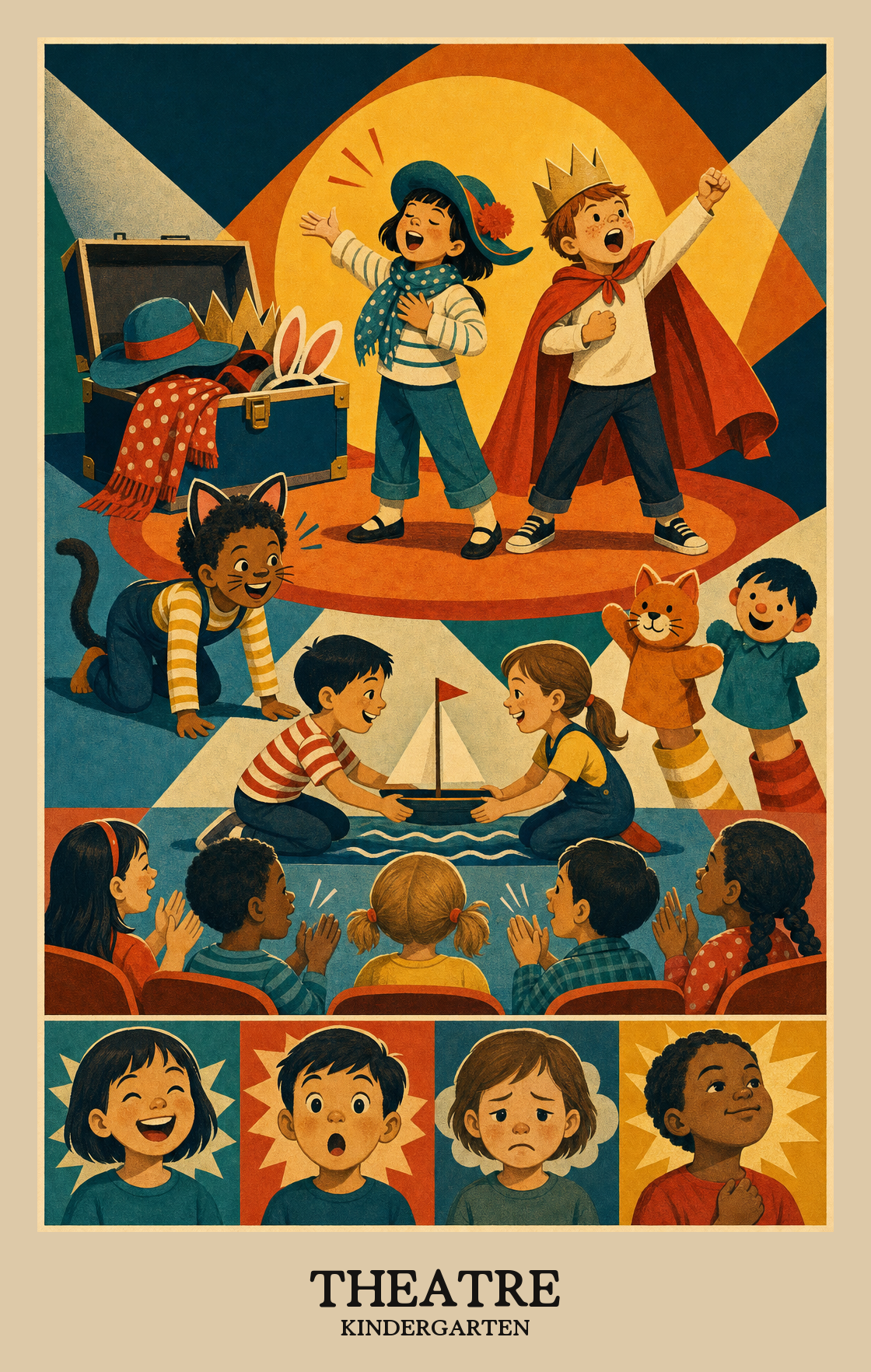
Students step into make-believe. They try on characters, use their voices and bodies to become someone else, and turn simple ideas into short pretend scenes.
Students work with classmates to shape a scene. They add a setting, a problem, and what happens next, then practice listening and taking turns as the story grows.
Students rehearse a short piece and perform it for the class. They practice speaking clearly, facing the audience, and showing feelings through the way they move and talk.
Students watch scenes, stories, and performances and talk about what they noticed. They share what they liked, what felt real, and what the story might mean.
Students connect something from their own life to a character or story in a play. That personal link shapes the choices they make when acting or creating a scene.
Students connect a story or character in a play to real life by talking about what people in their family or community do. Simple questions like "does this remind you of someone you know?" help them make that link.
| Standard | Definition | Code |
|---|---|---|
| Synthesize and relate knowledge and personal experiences to make art | Students connect something from their own life to a character or story in a play. That personal link shapes the choices they make when acting or creating a scene. | TH:Cn10.k |
| Relate artistic ideas and works with societal, cultural | Students connect a story or character in a play to real life by talking about what people in their family or community do. Simple questions like "does this remind you of someone you know?" help them make that link. | TH:Cn11.k |
Students come up with their own ideas for pretend play and short dramatic scenes, like deciding who a character is or what happens in a story they act out.
Students act out a story or idea, making choices about how characters move and speak before sharing it with others.
Students look back at their pretend play or short performance and make at least one thing better before they call it done.
| Standard | Definition | Code |
|---|---|---|
| Generate and conceptualize artistic ideas and work | Students come up with their own ideas for pretend play and short dramatic scenes, like deciding who a character is or what happens in a story they act out. | TH:Cr1.k |
| Organize and develop artistic ideas and work | Students act out a story or idea, making choices about how characters move and speak before sharing it with others. | TH:Cr2.k |
| Refine and complete artistic work | Students look back at their pretend play or short performance and make at least one thing better before they call it done. | TH:Cr3.k |
Students choose a character or story to act out and practice showing it to others.
Students practice a character or scene over and over until it feels ready to share with an audience. Rehearsal is how the performance gets better.
Students use movement, voice, and simple characters to share a story or feeling with an audience. The performance itself is how meaning gets across.
| Standard | Definition | Code |
|---|---|---|
| Analyze, interpret, and select artistic work for presentation | Students choose a character or story to act out and practice showing it to others. | TH:Pr4.k |
| Develop and refine artistic techniques and work for presentation | Students practice a character or scene over and over until it feels ready to share with an audience. Rehearsal is how the performance gets better. | TH:Pr5.k |
| Convey meaning through the presentation of artistic work | Students use movement, voice, and simple characters to share a story or feeling with an audience. The performance itself is how meaning gets across. | TH:Pr6.k |
Students watch a short performance or puppet show and share what they noticed, like a funny moment or a surprising costume.
Students describe what they think a story or performance is about and explain what a character feels or wants.
Students say what they liked in a classroom performance and give a simple reason why. They start to understand that opinions about a show can be explained, not just felt.
| Standard | Definition | Code |
|---|---|---|
| Perceive and analyze artistic work | Students watch a short performance or puppet show and share what they noticed, like a funny moment or a surprising costume. | TH:Re7.k |
| Interpret intent and meaning in artistic work | Students describe what they think a story or performance is about and explain what a character feels or wants. | TH:Re8.k |
| Apply criteria to evaluate artistic work | Students say what they liked in a classroom performance and give a simple reason why. They start to understand that opinions about a show can be explained, not just felt. | TH:Re9.k |
It looks like pretend play with a purpose. Students act out stories, take on characters, use their voices and bodies to show feelings, and watch each other perform. There is very little reading or memorizing of lines at this age.
Play pretend together for ten minutes a day. Act out a favorite picture book, take turns being different characters, or use stuffed animals as a puppet show. Ask what the character is feeling and why.
No. At this age the focus is on imagination, making choices about a character, and trying things out. Some classes share short scenes with classmates, but big performances with memorized lines are not expected.
Start with body and voice warm-ups and simple imitation games. Move into short pretend scenes built from familiar stories, then into students inventing their own characters and small scenes. Save sharing with an audience for later in the year once students are comfortable.
Staying in character for more than a few seconds, and being a good audience member. Both take steady practice. Short, repeated rounds work better than one long activity.
Ask simple questions on the way home. Who was your favorite character and why? What was the problem in the story? How did the actor show that the character was sad or scared? This builds the same thinking the class is doing.
By spring, students should invent a character with a voice and a way of moving, act out a short scene with a beginning and an end, and say something they noticed about a classmate's performance. Quiet students count too if they participate in their own way.