Imagining stories and characters
Students start the year by making up characters and short story ideas from their own lives. They try out voices, faces, and big feelings to see what a character could be.
This is the year pretend play turns into real storytelling on purpose. Students invent characters and short scenes from their own lives and from stories they know. They practice using their voice, face, and body to show how a character feels, then share scenes with classmates and talk about what worked. By spring, they can act out a short scene with a clear beginning, middle, and end.
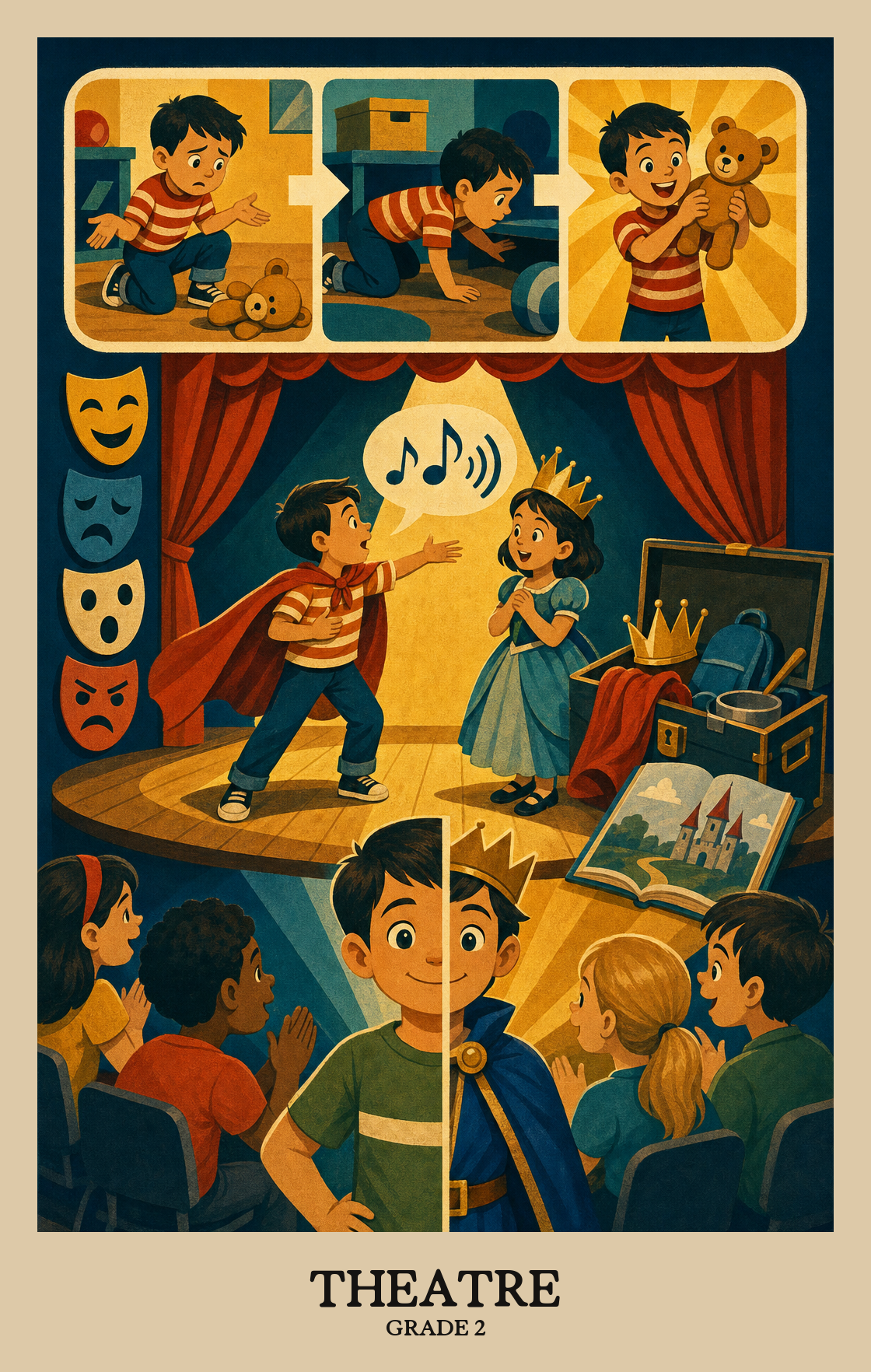
Students start the year by making up characters and short story ideas from their own lives. They try out voices, faces, and big feelings to see what a character could be.
Students take their ideas and shape them into short scenes with a beginning, middle, and end. They work with classmates to decide who plays whom and what happens next.
Students practice their scenes, try changes, and pick what works best. They learn that acting gets sharper when you do it more than once and listen to feedback.
Students share their work with classmates or families. They focus on speaking clearly, staying in character, and showing the feelings behind the story.
Students watch performances and stories from different places and times. They talk about what the play meant, what they liked, and how it connects to their own lives.
Students draw on something that happened to them, a book they read, or a feeling they know, and use it to build a character or scene in a play.
Students connect a play or story to the real world by asking where it came from, who made it, and why. Thinking about the time and place behind a performance helps students understand what it means.
| Standard | Definition | Code |
|---|---|---|
| Synthesize and relate knowledge and personal experiences to make art | Students draw on something that happened to them, a book they read, or a feeling they know, and use it to build a character or scene in a play. | TH:Cn10.2 |
| Relate artistic ideas and works with societal, cultural | Students connect a play or story to the real world by asking where it came from, who made it, and why. Thinking about the time and place behind a performance helps students understand what it means. | TH:Cn11.2 |
Students come up with characters, stories, and ideas for short plays or scenes. They imagine who a character might be and what that character might say or do.
Students take their story ideas and arrange them into a simple scene, deciding who the characters are, what they want, and what happens between them.
Students revisit a scene or character they created and make changes to improve it, then present their finished work to the class.
| Standard | Definition | Code |
|---|---|---|
| Generate and conceptualize artistic ideas and work | Students come up with characters, stories, and ideas for short plays or scenes. They imagine who a character might be and what that character might say or do. | TH:Cr1.2 |
| Organize and develop artistic ideas and work | Students take their story ideas and arrange them into a simple scene, deciding who the characters are, what they want, and what happens between them. | TH:Cr2.2 |
| Refine and complete artistic work | Students revisit a scene or character they created and make changes to improve it, then present their finished work to the class. | TH:Cr3.2 |
Students choose a short scene or character to perform and explain why it fits the story they want to tell.
Students practice a scene or short performance more than once, making small improvements each time to get it ready to share with an audience.
Students perform a short scene or puppet show and make choices about voice, movement, and expression to share a clear idea or feeling with the audience.
| Standard | Definition | Code |
|---|---|---|
| Analyze, interpret, and select artistic work for presentation | Students choose a short scene or character to perform and explain why it fits the story they want to tell. | TH:Pr4.2 |
| Develop and refine artistic techniques and work for presentation | Students practice a scene or short performance more than once, making small improvements each time to get it ready to share with an audience. | TH:Pr5.2 |
| Convey meaning through the presentation of artistic work | Students perform a short scene or puppet show and make choices about voice, movement, and expression to share a clear idea or feeling with the audience. | TH:Pr6.2 |
Students look at a short scene or puppet show and describe what they notice: what the characters did, how they moved, and what the story seemed to be about.
Students explain what a character or scene is trying to say and why the people who made it might have chosen to tell the story that way.
Students look at a scene or performance and explain what worked and what could be better, using simple rules like "Did the actors speak clearly?" or "Did the story make sense?"
| Standard | Definition | Code |
|---|---|---|
| Perceive and analyze artistic work | Students look at a short scene or puppet show and describe what they notice: what the characters did, how they moved, and what the story seemed to be about. | TH:Re7.2 |
| Interpret intent and meaning in artistic work | Students explain what a character or scene is trying to say and why the people who made it might have chosen to tell the story that way. | TH:Re8.2 |
| Apply criteria to evaluate artistic work | Students look at a scene or performance and explain what worked and what could be better, using simple rules like "Did the actors speak clearly?" or "Did the story make sense?" | TH:Re9.2 |
Most of the year is acting out short stories, playing pretend with a purpose, and making up scenes from a picture or an idea. Students try on characters, use their voice and body to show feelings, and share short performances with classmates.
Start small and silly. Read a picture book together and take turns being different characters with different voices. Five minutes of pretend play, puppets, or acting out a favorite story counts and builds confidence faster than pushing for a big performance.
Not really. The focus is on making up scenes, retelling stories, and improvising with a partner. If a short script comes home, practice reading it out loud with feeling rather than drilling memorization.
Start with imagination and pretend play to build comfort, then move into generating and shaping short scenes with a partner. Spend the middle of the year on rehearsing and refining, and save the last stretch for sharing work and giving feedback to classmates.
Staying in character for more than a moment, and giving feedback that is kind and specific. Students also tend to need extra practice using voice and body on purpose rather than just saying lines flatly.
Something concrete, like noticing that a character sounded scared or that a scene had a clear beginning. Model sentence starters such as I noticed or I wondered, and steer students away from just saying it was good or bad.
By spring, students should be able to make up a short scene with a partner, stay in a character for a minute or two, and say something specific about a classmate's performance. They should also connect a story or scene to something from their own life.