Finding ideas worth making
Students start the year by turning their own experiences, interests, and observations into starting points for art. They keep a sketchbook of ideas and learn that strong art usually begins with noticing something specific.
This is the year art shifts from learning techniques to using them on purpose. Students plan a piece around an idea that matters to them, pull from their own life and from artists they study, and revise the work instead of stopping at the first try. They also learn to talk about art with real reasons, not just whether they like it. By spring, students can show a finished piece, explain the choices they made, and judge their own work against clear criteria.
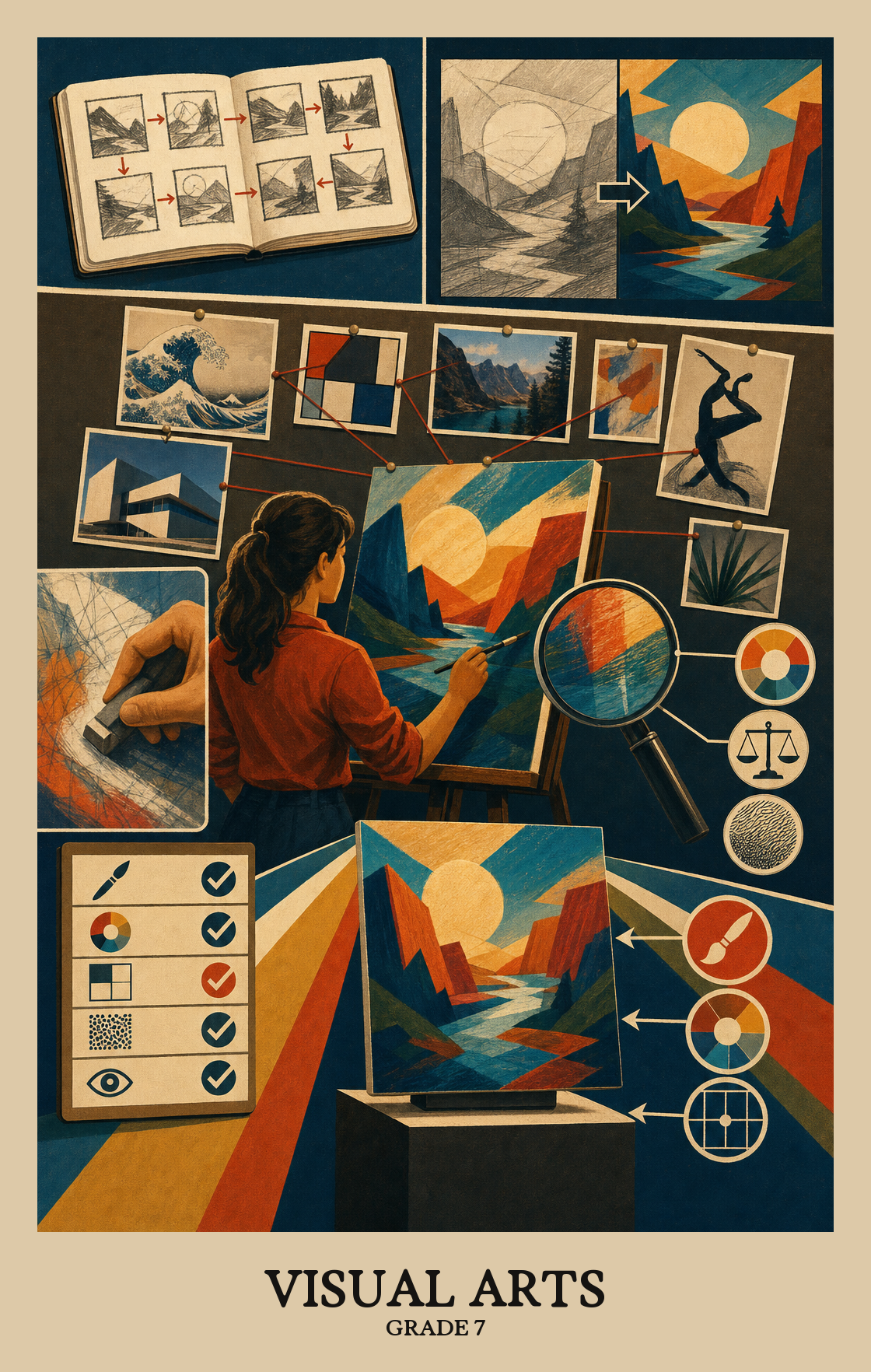
Students start the year by turning their own experiences, interests, and observations into starting points for art. They keep a sketchbook of ideas and learn that strong art usually begins with noticing something specific.
Students practice with materials like pencil, paint, clay, or digital tools. They learn how to plan a piece, try different approaches, and decide which technique fits the idea they want to show.
Students study artwork from different times and places. They describe what they see, talk about what the artist might have meant, and use clear reasons to judge whether a piece works.
Students return to pieces they started earlier, take feedback, and make real changes. They learn that finishing a work of art usually means cutting, redoing, and choosing on purpose, not just stopping.
Students choose pieces to display and think about how the setup shapes what a viewer notices. They write or speak about what their work means and how it connects to the world around them.
Students connect something they already know or have lived through to a choice they make in their artwork. The goal is for that personal link to show up visibly in the finished piece.
Students look at a piece of art and figure out what was happening in the world when it was made. History, culture, and daily life at the time all shape what an artist chose to create.
| Standard | Definition | Code |
|---|---|---|
| Synthesize and relate knowledge and personal experiences to make art | Students connect something they already know or have lived through to a choice they make in their artwork. The goal is for that personal link to show up visibly in the finished piece. | VA:Cn10.7 |
| Relate artistic ideas and works with societal, cultural | Students look at a piece of art and figure out what was happening in the world when it was made. History, culture, and daily life at the time all shape what an artist chose to create. | VA:Cn11.7 |
Students brainstorm and develop original ideas before picking up a tool. This standard is about the thinking that happens before the making.
Students take an early sketch or concept and refine it into a finished piece, making deliberate choices about composition, materials, and technique along the way.
Students review a piece of artwork they made, decide what still isn't working, and revise it until the work says what they intended.
| Standard | Definition | Code |
|---|---|---|
| Generate and conceptualize artistic ideas and work | Students brainstorm and develop original ideas before picking up a tool. This standard is about the thinking that happens before the making. | VA:Cr1.7 |
| Organize and develop artistic ideas and work | Students take an early sketch or concept and refine it into a finished piece, making deliberate choices about composition, materials, and technique along the way. | VA:Cr2.7 |
| Refine and complete artistic work | Students review a piece of artwork they made, decide what still isn't working, and revise it until the work says what they intended. | VA:Cr3.7 |
Students look at a set of their own artwork, decide which pieces are strong enough to show others, and explain the thinking behind their choices.
Students practice and improve a piece of artwork until it's ready to show. That means revisiting earlier choices, fixing weak spots, and deciding when the work is finished.
Students choose how to display or share their artwork so the viewer understands what the piece is about. The way a work is presented is part of the message it sends.
| Standard | Definition | Code |
|---|---|---|
| Analyze, interpret, and select artistic work for presentation | Students look at a set of their own artwork, decide which pieces are strong enough to show others, and explain the thinking behind their choices. | VA:Pr4.7 |
| Develop and refine artistic techniques and work for presentation | Students practice and improve a piece of artwork until it's ready to show. That means revisiting earlier choices, fixing weak spots, and deciding when the work is finished. | VA:Pr5.7 |
| Convey meaning through the presentation of artistic work | Students choose how to display or share their artwork so the viewer understands what the piece is about. The way a work is presented is part of the message it sends. | VA:Pr6.7 |
Students look closely at a piece of art and describe what they notice: the colors, shapes, lines, and composition. Then they explain how those choices work together to create meaning or mood.
Students look closely at a piece of art and explain what the artist was trying to say, using details from the work to back up their thinking.
Students look at a piece of artwork and judge it using a set of criteria, explaining why it succeeds or falls short based on specific evidence from the work itself.
| Standard | Definition | Code |
|---|---|---|
| Perceive and analyze artistic work | Students look closely at a piece of art and describe what they notice: the colors, shapes, lines, and composition. Then they explain how those choices work together to create meaning or mood. | VA:Re7.7 |
| Interpret intent and meaning in artistic work | Students look closely at a piece of art and explain what the artist was trying to say, using details from the work to back up their thinking. | VA:Re8.7 |
| Apply criteria to evaluate artistic work | Students look at a piece of artwork and judge it using a set of criteria, explaining why it succeeds or falls short based on specific evidence from the work itself. | VA:Re9.7 |
Students move past just making art that looks nice. They learn to plan a piece around an idea, pull from their own life and what they see in the world, and explain choices they made. They also study other artists and talk about what art means, not just whether they like it.
Talk about images. Look at a photo, an ad, a painting in a waiting room, or a tattoo and ask what the artist was trying to say and how they pulled it off. Five minutes of that kind of conversation builds the same thinking students use in class.
Keep the focus on ideas and process, not how realistic the work looks. A sketchbook for messy thinking, where nothing gets graded on neatness, takes the pressure off. Praise specific choices, such as a strong contrast or an interesting cropping, instead of saying the whole piece is good or bad.
Start with idea generation and sketchbook habits before pushing finished pieces. Build technical skills in short studies tied to a bigger project, so students see why a technique matters. Save deeper critique and artist research for after students have made a few things of their own.
Enough that students see their own work as part of a longer conversation. Pair each major project with one or two artists or traditions that connect to the theme. The goal is for students to borrow ideas with intent, not to memorize names and dates.
A student can take an idea from a rough sketch to a finished piece, talk about the choices behind it, and use feedback to revise. They can also look at someone else's art and say what it means and how it works, using more than just personal taste.
Two stand out. First, revising a piece instead of starting over when something goes wrong. Second, writing or speaking about art with specific evidence from the work, rather than vague reactions. Both improve with short, repeated practice across projects.
No. Grades in art at this level are about thinking, planning, revising, and explaining choices. A student who sketches messy ideas but keeps working at them will do better than one who draws neatly but refuses to revise.