Conversations about daily life
Students start the year holding longer back-and-forth conversations on familiar topics like family, school, and weekend plans. They ask follow-up questions and explain their opinions instead of giving one-word answers.
This is the year the new language stops being a list of words and starts being a way to actually talk with people. Students hold short conversations, read simple stories and articles, and write about their own lives in the new language. They also compare how the new culture does things at home, at school, and at the table with what they know. By spring, students can introduce themselves, ask and answer real questions, and write a short paragraph about a familiar topic.
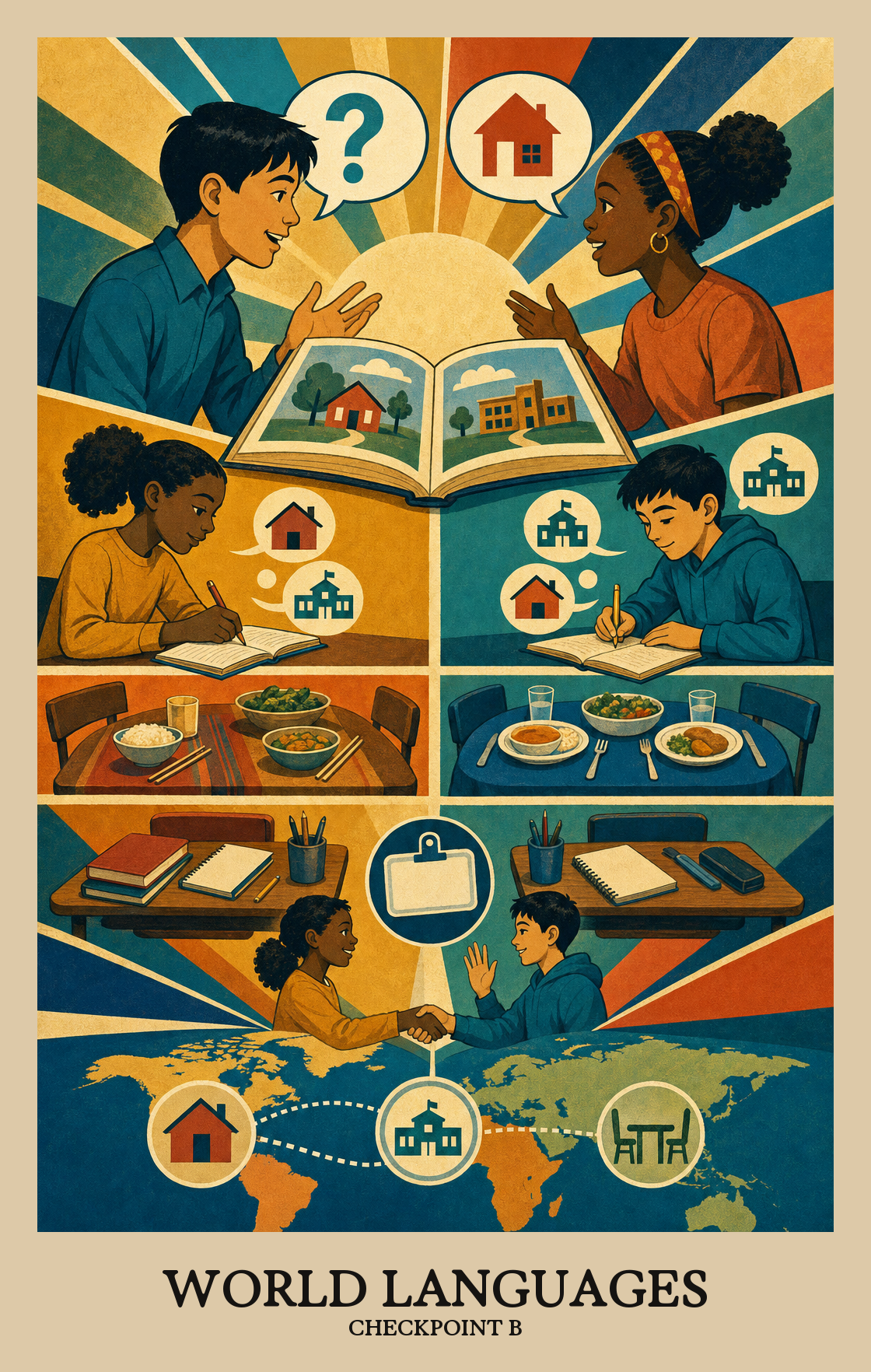
Students start the year holding longer back-and-forth conversations on familiar topics like family, school, and weekend plans. They ask follow-up questions and explain their opinions instead of giving one-word answers.
Students work with real materials like short articles, videos, songs, and ads in the new language. They pick out the main idea, important details, and the speaker's point of view.
Students look at how people in other countries celebrate, eat, shop, and spend time together, and compare it to life at home. They explain why people do things a certain way, not just what they do.
Students give short talks and write paragraphs to inform, persuade, or tell a story. They organize their ideas for a specific audience and use visuals or slides to support what they say.
Students finish the year using the language outside the classroom, through pen pals, community events, news sites, or media in the target language. They set personal goals and reflect on what they can now do.
Students listen to, read, or watch material on everyday and unfamiliar topics, then show they understand the meaning and can explain what the message is really saying.
Students hold back-and-forth conversations in the language they're learning, asking questions, sharing opinions, and working through misunderstandings to keep the exchange going.
Students prepare and deliver short presentations on familiar topics, choosing words and details to fit the audience, whether speaking to classmates, writing for a reader, or creating something visual.
| Standard | Definition | Code |
|---|---|---|
| Learners understand, interpret Checkpoint B | Students listen to, read, or watch material on everyday and unfamiliar topics, then show they understand the meaning and can explain what the message is really saying. | DC-WL.1.1.wl-checkpoint-b |
| Learners interact and negotiate meaning in spoken, signed Checkpoint B | Students hold back-and-forth conversations in the language they're learning, asking questions, sharing opinions, and working through misunderstandings to keep the exchange going. | DC-WL.1.2.wl-checkpoint-b |
| Learners present information, concepts Checkpoint B | Students prepare and deliver short presentations on familiar topics, choosing words and details to fit the audience, whether speaking to classmates, writing for a reader, or creating something visual. | DC-WL.1.3.wl-checkpoint-b |
Students look at a cultural practice (like a greeting, a meal, or a celebration) and explain in the target language why that culture does it that way. They connect the habit to the belief or value behind it.
Students use the target language to explore why a culture makes or values certain things, then connect those objects or traditions to the beliefs and ideas behind them.
| Standard | Definition | Code |
|---|---|---|
| Learners use the language to investigate, explain Checkpoint B | Students look at a cultural practice (like a greeting, a meal, or a celebration) and explain in the target language why that culture does it that way. They connect the habit to the belief or value behind it. | DC-WL.2.1.wl-checkpoint-b |
| Learners use the language to investigate, explain Checkpoint B | Students use the target language to explore why a culture makes or values certain things, then connect those objects or traditions to the beliefs and ideas behind them. | DC-WL.2.2.wl-checkpoint-b |
Students use the new language to explore ideas from other subjects, like science or history. Working across topics builds both language skills and the habit of thinking through problems carefully.
Students read, listen to, or watch content in the language they are learning, then judge whether the information and viewpoints they find are reliable or useful.
| Standard | Definition | Code |
|---|---|---|
| Learners build, reinforce Checkpoint B | Students use the new language to explore ideas from other subjects, like science or history. Working across topics builds both language skills and the habit of thinking through problems carefully. | DC-WL.3.1.wl-checkpoint-b |
| Learners access and evaluate information and diverse perspectives that are… Checkpoint B | Students read, listen to, or watch content in the language they are learning, then judge whether the information and viewpoints they find are reliable or useful. | DC-WL.3.2.wl-checkpoint-b |
Students notice how the language they're learning handles grammar, vocabulary, or sentence structure differently than their own language, then put those differences into words.
Students compare their own culture to the cultures they are studying, then explain what they notice. They practice putting those observations into words in the new language.
| Standard | Definition | Code |
|---|---|---|
| Learners use the language to investigate, explain Checkpoint B | Students notice how the language they're learning handles grammar, vocabulary, or sentence structure differently than their own language, then put those differences into words. | DC-WL.4.1.wl-checkpoint-b |
| Learners use the language to investigate, explain Checkpoint B | Students compare their own culture to the cultures they are studying, then explain what they notice. They practice putting those observations into words in the new language. | DC-WL.4.2.wl-checkpoint-b |
Students use the language they're learning to talk and work with others, both in school and in the wider world outside it.
Students set a personal goal for improving their language skills, then look back at how far they've come. The focus is on using the language in real life, whether for fun, a hobby, or getting ahead.
| Standard | Definition | Code |
|---|---|---|
| Learners use the language both within and beyond the classroom to interact and… Checkpoint B | Students use the language they're learning to talk and work with others, both in school and in the wider world outside it. | DC-WL.5.1.wl-checkpoint-b |
| Learners set goals and reflect on their progress in using languages for… Checkpoint B | Students set a personal goal for improving their language skills, then look back at how far they've come. The focus is on using the language in real life, whether for fun, a hobby, or getting ahead. | DC-WL.5.2.wl-checkpoint-b |
Students move past memorized phrases and start holding short conversations on familiar topics like school, family, food, and weekend plans. They read and listen to real material such as menus, short articles, and video clips, and they write paragraphs that string ideas together instead of single sentences.
Ask students to teach a few new words at dinner, or to narrate what they did today in the language while a parent listens. Watching a short show or song in the language together for ten minutes also counts, since hearing the language outside class makes a real difference.
No. At this stage students are expected to be understood, not flawless. Mixing up verb endings or reaching for a word is normal as long as the listener can follow the idea.
Build each unit around a topic students actually want to talk about, then layer in the grammar that topic needs. Pair every reading or listening task with a short speaking or writing task on the same topic, so input feeds output instead of sitting alone.
Past tense narration and asking questions tend to slip. Students recognize these forms when reading but stall when producing them in conversation. Short, frequent speaking warm-ups work better than one big grammar unit.
Culture should run through almost every unit, not sit in a separate week. Tie it to the topic at hand: when students learn food vocabulary, look at meal customs and why they differ from what students know at home.
Encourage students to follow a creator, athlete, or musician who posts in the language, or to label things around the house. Even ordering food in the language at a local restaurant counts as real use and builds confidence fast.
By the end of the year, students should hold a short conversation on a familiar topic without freezing, read a short article and explain the main idea, and write a paragraph about themselves or an experience. If those three things are steady, the next course will go well.