Exploring movement ideas
Students start the year trying out new ways to move and finding ideas for short dances. They draw from things they know, like a story, a song, or a memory, and turn those ideas into movement.
This is the year dance starts to feel like real choreography instead of free movement. Students take ideas from their own lives and shape them into short dances with a clear beginning, middle, and end. They practice steps until the moves look sharp, then perform for others and talk about what a dance was trying to say. By spring, students can plan a short dance, perform it cleanly, and explain why a classmate's piece worked.
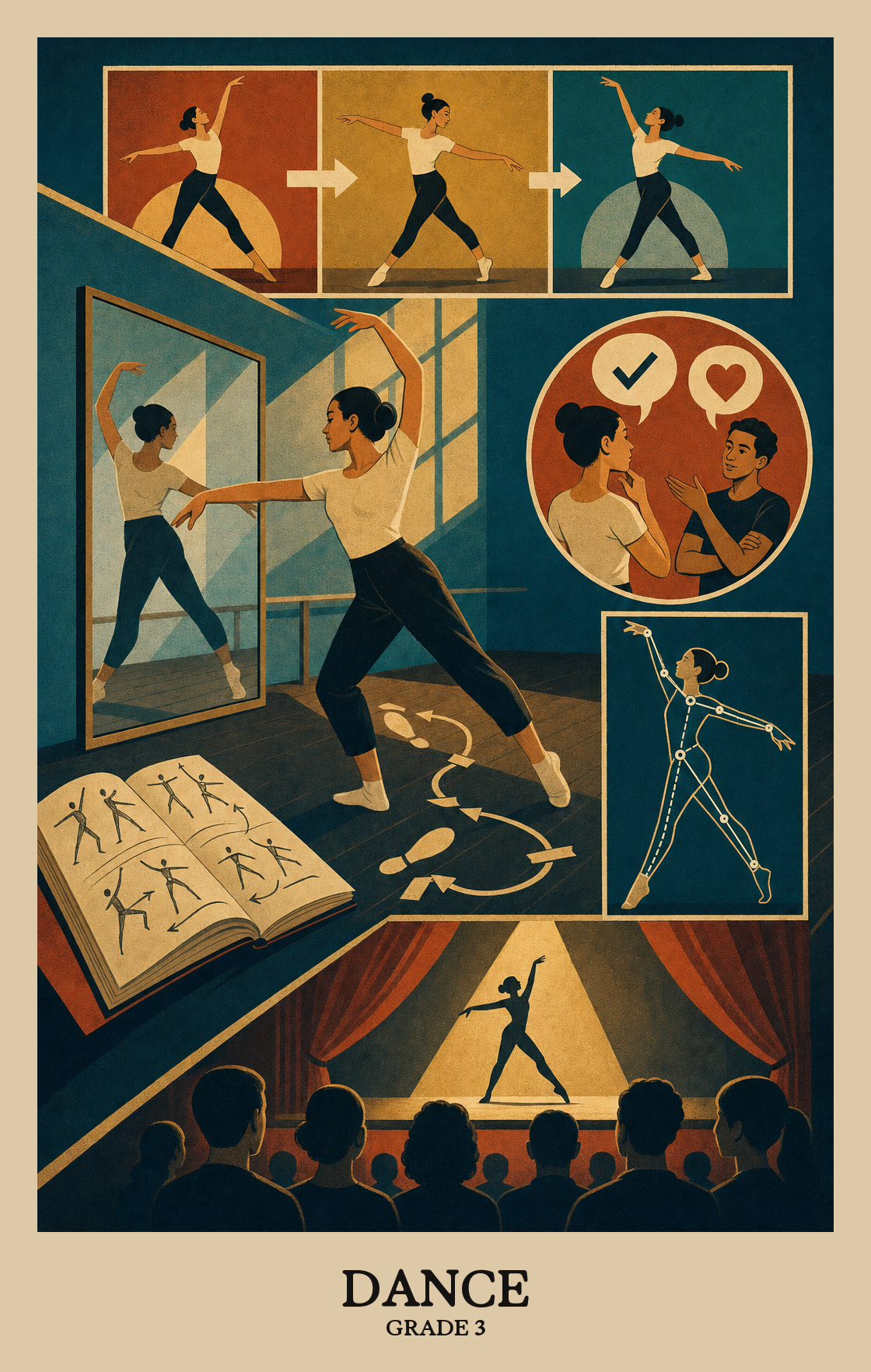
Students start the year trying out new ways to move and finding ideas for short dances. They draw from things they know, like a story, a song, or a memory, and turn those ideas into movement.
Students take their ideas and build them into short dances with a clear beginning, middle, and end. They practice the same piece more than once and make small changes to improve it.
Students learn dances from different cultures and time periods and talk about what those dances meant to the people who made them. This helps students see dance as something people everywhere have always done.
Students prepare a dance to share with classmates or family. They work on cleaner movement, clearer expression, and showing the meaning of the dance so an audience can follow it.
Students watch dances and talk about what they noticed, what the dance might mean, and what made it work. They give kind, specific feedback to classmates using simple guidelines.
Students connect what they know from their own life to the dances they make and watch. A memory, a feeling, or something learned in another class can shape how they move or what a dance means to them.
Students look at dances from different places and times to understand what people valued, celebrated, or believed. Connecting a dance to its history or culture helps students understand why it was made and what it meant.
| Standard | Definition | Code |
|---|---|---|
| Synthesize and relate knowledge and personal experiences to make art | Students connect what they know from their own life to the dances they make and watch. A memory, a feeling, or something learned in another class can shape how they move or what a dance means to them. | DA:Cn10.3 |
| Relate artistic ideas and works with societal, cultural | Students look at dances from different places and times to understand what people valued, celebrated, or believed. Connecting a dance to its history or culture helps students understand why it was made and what it meant. | DA:Cn11.3 |
Students brainstorm and sketch out ideas for a dance before they start moving. They turn a thought, feeling, or image into a plan for actual steps and sequences.
Students take a movement idea and shape it into a short dance, deciding which moves to keep, which to change, and how to put them in order.
Students look back at a dance they made, fix the parts that feel unclear or unfinished, and practice until the whole piece is ready to share.
| Standard | Definition | Code |
|---|---|---|
| Generate and conceptualize artistic ideas and work | Students brainstorm and sketch out ideas for a dance before they start moving. They turn a thought, feeling, or image into a plan for actual steps and sequences. | DA:Cr1.3 |
| Organize and develop artistic ideas and work | Students take a movement idea and shape it into a short dance, deciding which moves to keep, which to change, and how to put them in order. | DA:Cr2.3 |
| Refine and complete artistic work | Students look back at a dance they made, fix the parts that feel unclear or unfinished, and practice until the whole piece is ready to share. | DA:Cr3.3 |
Students choose which dances to perform and explain why those pieces are ready to share with an audience.
Students practice a dance piece repeatedly, fixing specific movements until the performance is clean and ready to share with an audience.
Students perform a dance for an audience with a clear purpose in mind, using movement to express a specific feeling, story, or idea.
| Standard | Definition | Code |
|---|---|---|
| Analyze, interpret, and select artistic work for presentation | Students choose which dances to perform and explain why those pieces are ready to share with an audience. | DA:Pr4.3 |
| Develop and refine artistic techniques and work for presentation | Students practice a dance piece repeatedly, fixing specific movements until the performance is clean and ready to share with an audience. | DA:Pr5.3 |
| Convey meaning through the presentation of artistic work | Students perform a dance for an audience with a clear purpose in mind, using movement to express a specific feeling, story, or idea. | DA:Pr6.3 |
Students watch a dance and describe what they notice, such as how the dancer moves fast or slow, uses big or small shapes, or changes direction. They start to explain why those choices matter.
Students explain what a dance is trying to say and why the choreographer made specific choices, like repeating a movement or changing speed.
Students practice judging dance by naming what makes a performance work well or fall short. They use a short set of questions or rules to explain why a dance succeeds.
| Standard | Definition | Code |
|---|---|---|
| Perceive and analyze artistic work | Students watch a dance and describe what they notice, such as how the dancer moves fast or slow, uses big or small shapes, or changes direction. They start to explain why those choices matter. | DA:Re7.3 |
| Interpret intent and meaning in artistic work | Students explain what a dance is trying to say and why the choreographer made specific choices, like repeating a movement or changing speed. | DA:Re8.3 |
| Apply criteria to evaluate artistic work | Students practice judging dance by naming what makes a performance work well or fall short. They use a short set of questions or rules to explain why a dance succeeds. | DA:Re9.3 |
Students make up short dances, learn steps from others, and perform for classmates. They start talking about what a dance means and why a choreographer made certain choices. Expect movement, watching, and reflecting in roughly equal parts.
No. Students are not training to be professional dancers. They are learning to use their bodies to tell a story, copy and remember steps, and talk about what they see when others dance.
Put on a song and ask students to make up a short movement that shows a feeling or a place. After a video or live performance, ask what the dance was about and which moment stood out. That kind of talk builds the same skills practiced in class.
A common path is to start with body awareness and basic movement vocabulary, move into short student-made phrases, then build toward a small performance with feedback and revision. Responding skills can run alongside the whole year using short video clips.
Refining work and giving useful feedback. Students can invent a phrase quickly but struggle to go back, change one part, and explain why the change made it better. Plan extra time for revision cycles and for modeling kind, specific feedback.
Students can create a short dance with a clear idea behind it, perform it with focus, and talk about another dance using simple criteria such as shape, energy, and meaning. They can also point to a cultural or historical context for a dance they have studied.
Not at this stage. Much of the work happens in small groups or with a partner, and students can show ideas through movement without speaking. Confidence usually grows as students get more chances to share short pieces in a low-pressure setting.
Use short checkpoints tied to a simple rubric: did the dance show a clear idea, did the student refine it after feedback, and can the student explain a choice. Video helps. Students can watch their own work and mark what they want to change next time.