Imagining characters and stories
Students warm up to theatre by inventing characters and short story ideas from their own lives. They try out voices, faces, and movements to bring a pretend person to life.
This is the year acting starts to feel like real craft instead of pretend. Students build characters on purpose, using their voice, body, and imagination to bring a story to life. They rehearse, take notes from classmates, and polish a scene before showing it. By spring, they can perform a short scene in front of the class and explain why their character moved or spoke that way.
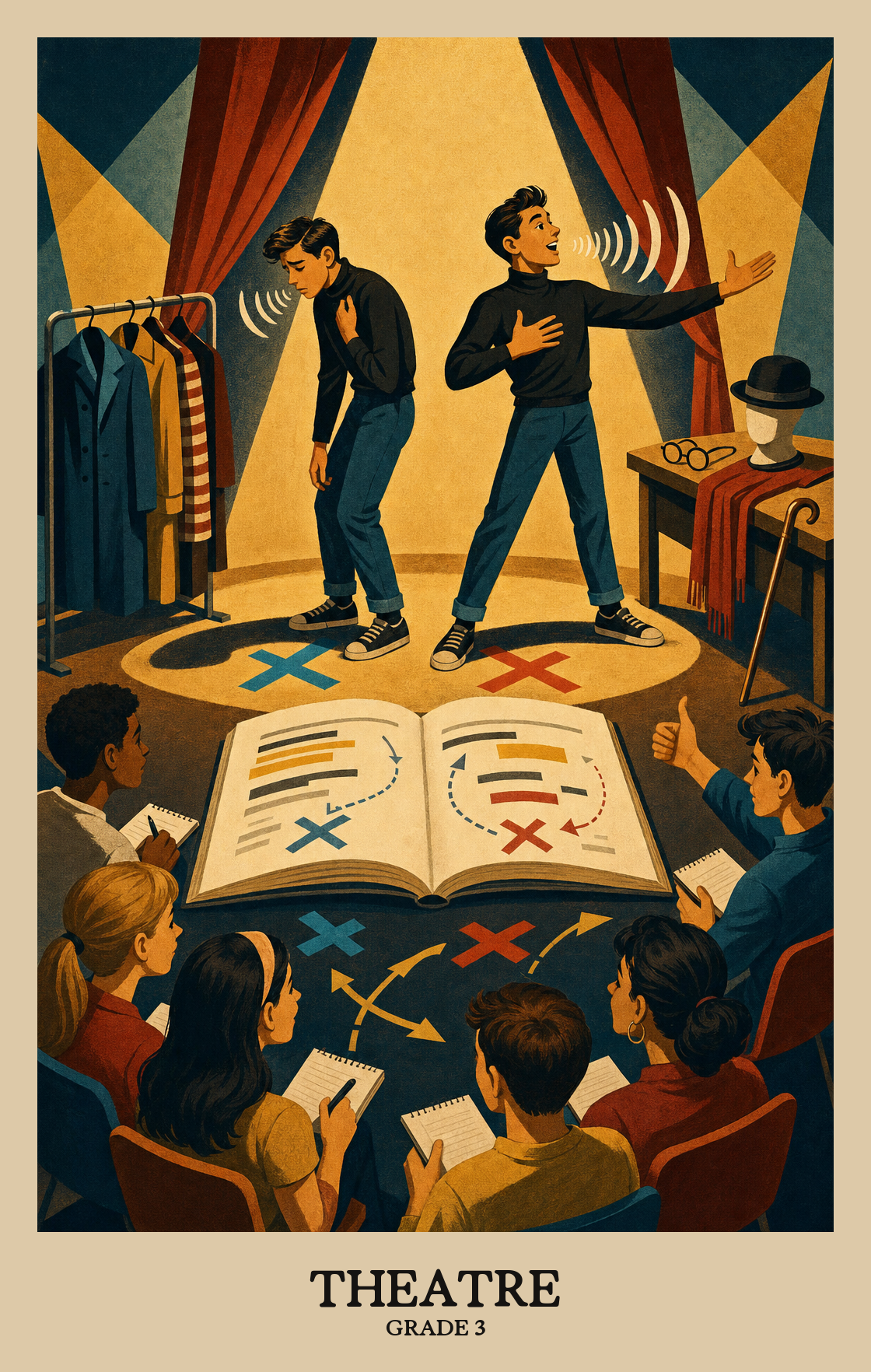
Students warm up to theatre by inventing characters and short story ideas from their own lives. They try out voices, faces, and movements to bring a pretend person to life.
Students work in small groups to shape simple scenes with a beginning, middle, and end. They decide who the characters are, where the scene happens, and what problem needs solving.
Students practice their scenes and make changes as they go. They try a line a new way, adjust where they stand, and pick props or costume pieces that fit the story.
Students share their scenes with classmates or family. They focus on speaking clearly, staying in character, and making the meaning of the story come through.
Students watch performances and talk about what worked and why. They notice acting choices, connect stories to their own lives, and learn how plays reflect different times and places.
Students connect something from their own life to a character or story in a play. That personal connection shapes the choices they make when acting, writing, or designing.
Students look at a play or performance and ask where it came from. They connect what happens on stage to the time period, culture, or community that shaped it.
| Standard | Definition | Code |
|---|---|---|
| Synthesize and relate knowledge and personal experiences to make art | Students connect something from their own life to a character or story in a play. That personal connection shapes the choices they make when acting, writing, or designing. | TH:Cn10.3 |
| Relate artistic ideas and works with societal, cultural | Students look at a play or performance and ask where it came from. They connect what happens on stage to the time period, culture, or community that shaped it. | TH:Cn11.3 |
Students brainstorm characters, scenes, or story ideas and start shaping them into something that could be performed. This is the imaginative spark that comes before rehearsal.
Students take a story idea and shape it into a short scene, deciding what characters do and say. They revise as they go until the scene makes sense to an audience.
Students look back at a scene or character they created and make specific changes to improve it before calling it done.
| Standard | Definition | Code |
|---|---|---|
| Generate and conceptualize artistic ideas and work | Students brainstorm characters, scenes, or story ideas and start shaping them into something that could be performed. This is the imaginative spark that comes before rehearsal. | TH:Cr1.3 |
| Organize and develop artistic ideas and work | Students take a story idea and shape it into a short scene, deciding what characters do and say. They revise as they go until the scene makes sense to an audience. | TH:Cr2.3 |
| Refine and complete artistic work | Students look back at a scene or character they created and make specific changes to improve it before calling it done. | TH:Cr3.3 |
Students choose a short scene or character to perform and explain why it fits the story or idea they want to show.
Students practice a scene or monologue more than once, making small fixes to voice, movement, or timing until the performance is ready to share with an audience.
Students perform a scene or character to share a clear idea or feeling with an audience. The way they speak, move, and react all work together to tell the story.
| Standard | Definition | Code |
|---|---|---|
| Analyze, interpret, and select artistic work for presentation | Students choose a short scene or character to perform and explain why it fits the story or idea they want to show. | TH:Pr4.3 |
| Develop and refine artistic techniques and work for presentation | Students practice a scene or monologue more than once, making small fixes to voice, movement, or timing until the performance is ready to share with an audience. | TH:Pr5.3 |
| Convey meaning through the presentation of artistic work | Students perform a scene or character to share a clear idea or feeling with an audience. The way they speak, move, and react all work together to tell the story. | TH:Pr6.3 |
Students look closely at a short play or performance and describe what they notice, like how an actor moves, speaks, or shows emotion. Then they explain what those choices do to the story.
Students look at a scene or performance and explain what they think the actors or characters are trying to say. They back up their ideas with details they noticed in the play.
Students use a simple checklist or set of questions to decide what works well in a scene or performance and explain why.
| Standard | Definition | Code |
|---|---|---|
| Perceive and analyze artistic work | Students look closely at a short play or performance and describe what they notice, like how an actor moves, speaks, or shows emotion. Then they explain what those choices do to the story. | TH:Re7.3 |
| Interpret intent and meaning in artistic work | Students look at a scene or performance and explain what they think the actors or characters are trying to say. They back up their ideas with details they noticed in the play. | TH:Re8.3 |
| Apply criteria to evaluate artistic work | Students use a simple checklist or set of questions to decide what works well in a scene or performance and explain why. | TH:Re9.3 |
Students make up short scenes, take on characters, and put on small performances for the class. They also watch each other perform and talk about what worked. Most of the year is about trying ideas out loud, not memorizing big scripts.
Read a picture book together and ask students to act out one character using a different voice or walk. Five minutes of pretend play counts. Asking why a character felt a certain way builds the same thinking used in class.
No. Plenty of students start the year nervous and warm up over months. Let them practice for a stuffed animal or a sibling first, and praise the effort rather than the polish.
Start with imagination and body warm-ups, move into building characters and short scenes, then spend the second half on shaping and presenting work. Save reflection and peer feedback routines for early in the year so students can use them all the way through.
Giving useful feedback to peers is the hardest part. Students tend to say a scene was good or bad without saying why. Model sentence starters that point at a specific choice, such as the voice a character used or how a scene ended.
Some short lines, yes, but most work this year is improvised or built from a simple outline. The focus is on making clear choices as a character, not on reciting a long script.
They act out moments from stories they read, retell events from social studies, or build scenes around a feeling or problem from their own lives. This is a good place to tie in books and topics already happening in class.
By spring, students should be able to build a short scene with a partner, play a character with a clear voice and body, and say one specific thing they liked about a classmate's performance. Comfort performing in front of the class is the strongest signal.