Place value and powers of ten
Students extend place value into the thousandths and see how each digit is ten times the one to its right. They use powers of ten to explain what happens when a number is multiplied or divided by 10, 100, or 1,000.
This is the year math stretches in both directions, into decimals on one side and fractions on the other. Students read and compare decimals out to the thousandths place, and they add, subtract, and round them like they already do with whole numbers. With fractions, they finally add and subtract pieces that don't share a denominator, like a half plus a third. By spring, students can multiply big numbers by hand, divide a four-digit number by a two-digit one, and find the volume of a box by stacking unit cubes inside it.
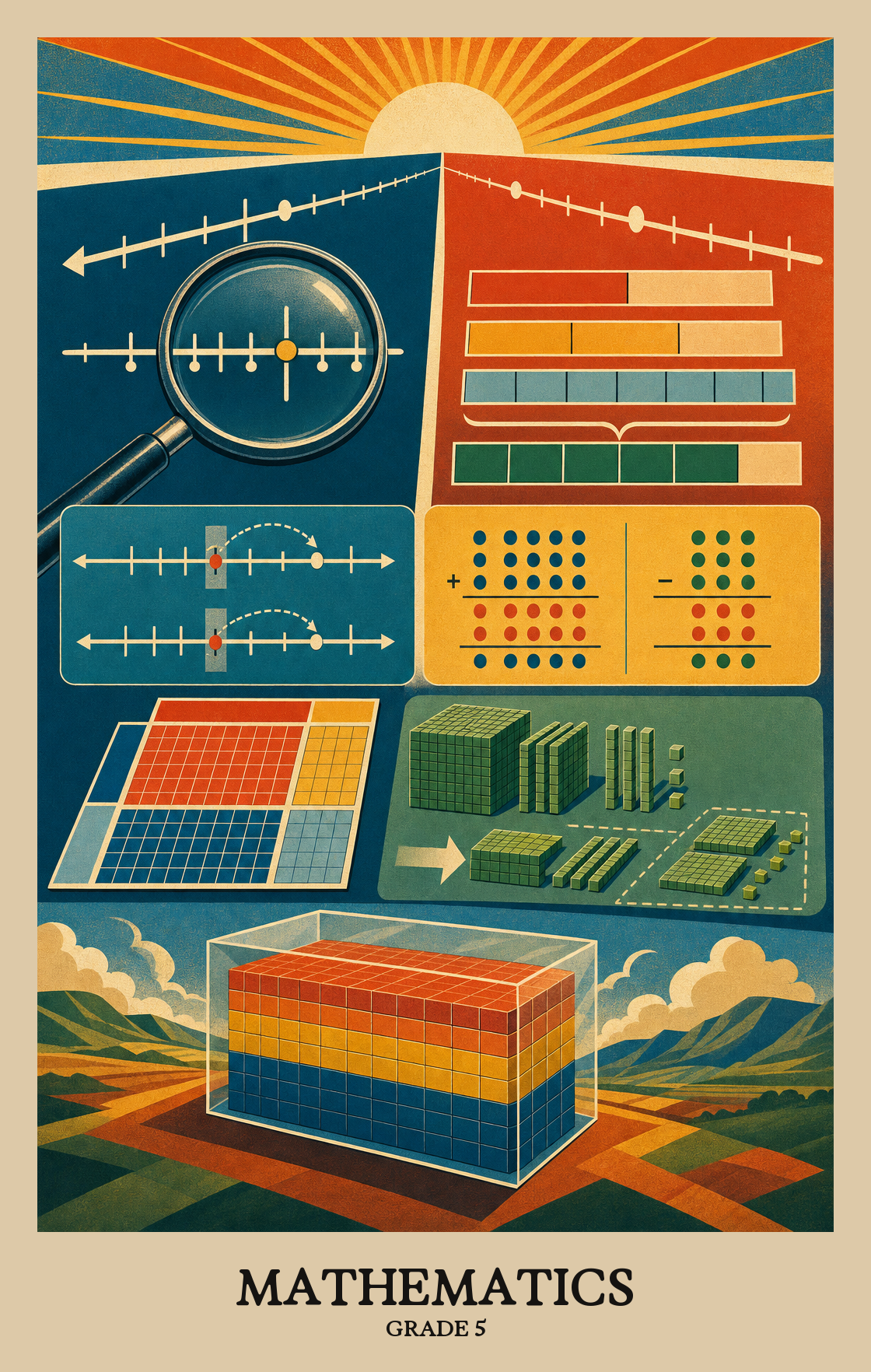
Students extend place value into the thousandths and see how each digit is ten times the one to its right. They use powers of ten to explain what happens when a number is multiplied or divided by 10, 100, or 1,000.
Students get fluent with multi-digit multiplication and long division using real problems like splitting a bill or packing boxes. Expect homework with bigger numbers and fewer steps shown.
Students work with fractions that have different bottom numbers, like 1/3 and 1/4, and learn to add and subtract them using pictures and common denominators. Mixed numbers come into play.
Students multiply fractions by whole numbers and divide whole numbers by unit fractions, such as how many quarter-cups fit in three cups. They also learn why multiplying by a fraction less than one makes a number smaller.
Students add, subtract, compare, and round decimals to the hundredths, often using money. They also convert between units like meters and centimeters or feet and inches to solve everyday problems.
Students plot points on a coordinate grid, find patterns between two rules, and measure the volume of boxes by counting cubes or multiplying length, width, and height. They also sort shapes by their properties.
Students keep working through hard math problems even when the first try doesn't work. They ask for help when stuck, learn from feedback, and keep track of what they're getting better at.
Students read a math problem carefully, figure out what it's actually asking, and keep trying even when the first approach doesn't work.
Students take a real problem, turn it into numbers or an equation to solve it, then translate the answer back into what it means in the real world.
Students build a math argument that explains why their answer makes sense, then check a classmate's reasoning and point out where it holds up or falls short.
Students take a real-world situation, like splitting a bill or planning a garden, and show it as a number sentence, diagram, or equation. They check whether their math model matches what's actually happening.
Students learn when to reach for a calculator, ruler, or graph paper and when to work it out by hand. Choosing the right tool is part of solving the problem.
Students check their work carefully, use the right labels (like inches or dollars), and say exactly what they mean when explaining a solution. Small mistakes matter, so they slow down to get details right.
Students notice patterns in how numbers and shapes are built, then use those patterns as shortcuts to solve harder problems faster.
Students notice when the same steps keep showing up in a problem and use that pattern to find a shortcut or rule. Spotting repetition is how math stops feeling like guesswork.
| Standard | Definition | Code |
|---|---|---|
| Display perseverance and patience in problem-solving | Students keep working through hard math problems even when the first try doesn't work. They ask for help when stuck, learn from feedback, and keep track of what they're getting better at. | 5.MP |
| Make sense of problems and persevere in solving them | Students read a math problem carefully, figure out what it's actually asking, and keep trying even when the first approach doesn't work. | 5.MP.1 |
| Reason abstractly and quantitatively | Students take a real problem, turn it into numbers or an equation to solve it, then translate the answer back into what it means in the real world. | 5.MP.2 |
| Construct viable arguments and critique the reasoning of others | Students build a math argument that explains why their answer makes sense, then check a classmate's reasoning and point out where it holds up or falls short. | 5.MP.3 |
| Model with mathematics | Students take a real-world situation, like splitting a bill or planning a garden, and show it as a number sentence, diagram, or equation. They check whether their math model matches what's actually happening. | 5.MP.4 |
| Use appropriate tools strategically | Students learn when to reach for a calculator, ruler, or graph paper and when to work it out by hand. Choosing the right tool is part of solving the problem. | 5.MP.5 |
| Attend to precision | Students check their work carefully, use the right labels (like inches or dollars), and say exactly what they mean when explaining a solution. Small mistakes matter, so they slow down to get details right. | 5.MP.6 |
| Look for and make use of structure | Students notice patterns in how numbers and shapes are built, then use those patterns as shortcuts to solve harder problems faster. | 5.MP.7 |
| Look for and express regularity in repeated reasoning | Students notice when the same steps keep showing up in a problem and use that pattern to find a shortcut or rule. Spotting repetition is how math stops feeling like guesswork. | 5.MP.8 |
Reading and writing numbers up to the billions, students use what they know about place value to solve real problems. That means knowing why a digit's position changes its value and using that to add, subtract, multiply, or divide with confidence.
In any number, moving one place to the left makes a digit worth 10 times more. Moving one place to the right makes it worth ten times less. Students explain why the 4 in 400 is worth ten 40s and one hundred 4s.
When students multiply or divide a number by 10, 100, or 1,000, the digits shift left or right on the place value chart. Students explain why that shift happens and write powers of 10 using exponents, like 10^2 for 100.
Students multiply and divide numbers with multiple digits to solve real problems. Think long multiplication and long division with numbers well past 100.
Students multiply numbers up to three digits by two digits, working through problems quickly and accurately. Think of it as scaling up from basic times tables to bigger, real-world calculations.
Students divide large numbers, up to four digits, by numbers as large as 25. They work through problems tied to real situations, not just drills on a page.
Fractions show parts of a whole. Students add, subtract, multiply, and divide fractions to solve problems, using drawings and diagrams to show their work.
A fraction like 3/4 means 3 divided by 4. Students solve division problems where the answer comes out as a fraction or mixed number, like splitting 7 sandwiches equally among 4 people.
Students line up two or three fractions in order from smallest to largest, even when the bottom numbers differ. They use number lines, common denominators, or benchmark fractions like one-half to figure out which fraction is bigger.
Students add and subtract fractions that have different bottom numbers, such as 1/2 and 1/3, by finding a common denominator first. They work through problems using visual models and solve with mixed numbers too.
Students multiply a fraction by a whole number, such as finding 3/4 of 12 objects, using pictures or diagrams to show the math.
Students explain why multiplying a whole number by a fraction changes the size of the answer. A fraction bigger than 1 makes the result grow, a fraction smaller than 1 shrinks it, and a fraction equal to 1 leaves it the same.
Students divide fractions by whole numbers and whole numbers by fractions, using diagrams or number lines to show what the math means. For example, splitting half a pizza among 3 people, or finding how many quarter-miles fit in 5 miles.
Students read, write, and compare decimal numbers out to the thousandths place (like 3.147). They also round decimals and add, subtract, multiply, or divide them to the hundredths place to solve real problems.
Students read and write decimal numbers like 3.142 in standard form (just the number) and expanded form (3 + 0.1 + 0.04 + 0.002). They work with decimals out to the thousandths place, three digits past the decimal point.
Students read decimal numbers out to the thousandths place and decide which is larger, smaller, or equal. They record comparisons using the symbols >, =, and <.
Students use place value to round a decimal to the nearest hundredth. For example, 3.847 rounds to 3.85 because the thousandths digit determines which way the hundredths digit goes.
Students add and subtract decimal numbers like 3.47 or 12.09 to solve problems. They use more than one method to find the answer, such as working with place value or drawing a number line.
Students write and solve math expressions that show up in real problems, like figuring out total cost or splitting a bill. They also read an expression someone else wrote and explain what it means.
Students write and solve math expressions that match a real situation, like "3 × (4 + 2)" to show three groups of six. They also read expressions others wrote and explain what the numbers and symbols mean.
| Standard | Definition | Code |
|---|---|---|
| Use place value understanding to solve real-life, mathematical problems | Reading and writing numbers up to the billions, students use what they know about place value to solve real problems. That means knowing why a digit's position changes its value and using that to add, subtract, multiply, or divide with confidence. | 5.NR.1 |
| Explain that in a multi-digit number, a digit in one place represents 10 times… | In any number, moving one place to the left makes a digit worth 10 times more. Moving one place to the right makes it worth ten times less. Students explain why the 4 in 400 is worth ten 40s and one hundred 4s. | 5.NR.1.1 |
| Explain patterns in the placement of digits when multiplied or divided by a… | When students multiply or divide a number by 10, 100, or 1,000, the digits shift left or right on the place value chart. Students explain why that shift happens and write powers of 10 using exponents, like 10^2 for 100. | 5.NR.1.2 |
| Multiply and divide multi-digit whole numbers to solve relevant, mathematical… | Students multiply and divide numbers with multiple digits to solve real problems. Think long multiplication and long division with numbers well past 100. | 5.NR.2 |
| Fluently multiply multi-digit | Students multiply numbers up to three digits by two digits, working through problems quickly and accurately. Think of it as scaling up from basic times tables to bigger, real-world calculations. | 5.NR.2.1 |
| Fluently divide multi-digit whole numbers | Students divide large numbers, up to four digits, by numbers as large as 25. They work through problems tied to real situations, not just drills on a page. | 5.NR.2.2 |
| Describe fractions and perform operations with fractions to solve relevant… | Fractions show parts of a whole. Students add, subtract, multiply, and divide fractions to solve problems, using drawings and diagrams to show their work. | 5.NR.3 |
| Explain the meaning of a fraction as division of the numerator by the… | A fraction like 3/4 means 3 divided by 4. Students solve division problems where the answer comes out as a fraction or mixed number, like splitting 7 sandwiches equally among 4 people. | 5.NR.3.1 |
| Compare and order up to three fractions with different numerators and/or… | Students line up two or three fractions in order from smallest to largest, even when the bottom numbers differ. They use number lines, common denominators, or benchmark fractions like one-half to figure out which fraction is bigger. | 5.NR.3.2 |
| Model and solve problems involving addition and subtraction of fractions and… | Students add and subtract fractions that have different bottom numbers, such as 1/2 and 1/3, by finding a common denominator first. They work through problems using visual models and solve with mixed numbers too. | 5.NR.3.3 |
| Model and solve problems involving multiplication of a fraction and a whole… | Students multiply a fraction by a whole number, such as finding 3/4 of 12 objects, using pictures or diagrams to show the math. | 5.NR.3.4 |
| Explain why multiplying a whole number by a fraction greater than one results… | Students explain why multiplying a whole number by a fraction changes the size of the answer. A fraction bigger than 1 makes the result grow, a fraction smaller than 1 shrinks it, and a fraction equal to 1 leaves it the same. | 5.NR.3.5 |
| Model and solve problems involving division of a unit fraction by a whole… | Students divide fractions by whole numbers and whole numbers by fractions, using diagrams or number lines to show what the math means. For example, splitting half a pizza among 3 people, or finding how many quarter-miles fit in 5 miles. | 5.NR.3.6 |
| Read, write, and compare decimal numbers to the thousandths place | Students read, write, and compare decimal numbers out to the thousandths place (like 3.147). They also round decimals and add, subtract, multiply, or divide them to the hundredths place to solve real problems. | 5.NR.4 |
| Read and write decimal numbers to the thousandths place using base-ten numerals… | Students read and write decimal numbers like 3.142 in standard form (just the number) and expanded form (3 + 0.1 + 0.04 + 0.002). They work with decimals out to the thousandths place, three digits past the decimal point. | 5.NR.4.1 |
| Represent, compare, and order decimal numbers to the thousandths place based on… | Students read decimal numbers out to the thousandths place and decide which is larger, smaller, or equal. They record comparisons using the symbols >, =, and <. | 5.NR.4.2 |
| Use place value understanding to round decimal numbers to the hundredths place | Students use place value to round a decimal to the nearest hundredth. For example, 3.847 rounds to 3.85 because the thousandths digit determines which way the hundredths digit goes. | 5.NR.4.3 |
| Solve problems involving addition and subtraction of decimal numbers to the… | Students add and subtract decimal numbers like 3.47 or 12.09 to solve problems. They use more than one method to find the answer, such as working with place value or drawing a number line. | 5.NR.4.4 |
| Write, interpret, and evaluate numerical expressions within authentic problems | Students write and solve math expressions that show up in real problems, like figuring out total cost or splitting a bill. They also read an expression someone else wrote and explain what it means. | 5.NR.5 |
| Write, interpret, and evaluate simple numerical expressions involving whole… | Students write and solve math expressions that match a real situation, like "3 × (4 + 2)" to show three groups of six. They also read expressions others wrote and explain what the numbers and symbols mean. | 5.NR.5.1 |
Students read, write, and compare large whole numbers, from thousands up to the millions. They understand what each digit's position means and use that knowledge to round, order, and work with big numbers.
Students add and subtract fractions that have different bottom numbers, like 1/2 and 1/3, by finding a common denominator first. It's the same skill used when splitting a pizza into equal slices before comparing pieces.
Students work with fractions like 7/4 or 11/3, where the top number is bigger than the bottom. They learn to rewrite those as mixed numbers, such as 1¾, and understand what that value means on a number line.
Students read, write, and compare decimal numbers like 0.4, 0.37, and 0.125, understanding each digit's place value down to the thousandths column.
Students count forward and backward using decimal numbers, like 0.1, 0.2, 0.3, moving past whole numbers without stopping. This builds the number sense students need before adding and subtracting decimals.
Students read and compare decimal numbers by understanding how each place value position is ten times larger or smaller than the one next to it. That pattern extends from whole numbers all the way to hundredths and beyond.
Students learn that multiplying by 10, 100, or 1,000 shifts every digit one, two, or three places to the left on a place-value chart. They practice recognizing how zeros stack up as numbers grow by powers of ten.
Students read and write numbers like 3.045 or 12.807, recognizing what each digit after the decimal point is worth, down to the thousandths place.
Students practice rounding a decimal like 3.847 to the nearest hundredth, deciding whether to round up or down based on the digit to the right of the hundredths place.
Students read, write, and compare decimal numbers out to the thousandths place, like 0.375. They understand that each place to the right of a decimal point is ten times smaller than the one before it.
Students read and write fractions larger than one whole, like 7/4 or 3/2, and connect them to mixed numbers like 1¾. They practice placing these values on a number line and comparing their sizes.
Students multiply and divide large whole numbers quickly and accurately, without stopping to figure out each step. This is the mental and pencil-and-paper speed they need before decimals and fractions get harder.
Students add and subtract fractions that have different bottom numbers, like 1/2 and 1/3, by finding a common denominator first. This builds toward working with any fraction, not just the ones that already share a bottom number.
Reading and writing decimal numbers like 0.75 or 3.04, students work with values that fall between whole numbers. They understand what each digit means, whether it sits in the tenths or hundredths column.
Students multiply large whole numbers together, like 347 times 28, using place value and what they know about how numbers work. This builds the foundation for division, fractions, and most of the math they'll see in middle school.
Students multiply a fraction by a whole number to find a total, such as 3 groups of 2/4. They practice setting up the problem and simplifying the answer into a form that makes sense.
Students divide a fraction like 1/4 by a whole number, or a whole number by a fraction like 1/3. They figure out how many pieces fit into a quantity or how a share gets split into smaller parts.
Multiplying a number by a fraction smaller than 1 makes the result smaller. Multiplying by a fraction larger than 1 makes it bigger. Students figure out whether an answer will be larger or smaller before they calculate.
Students read and solve basic math expressions like 3 × (4 + 2) or 15 - 7, with and without parentheses. They learn how grouping symbols change which part of a problem gets solved first.
Students learn that a fraction like 3/4 means 3 divided by 4. They can write any fraction as a division problem and any division problem as a fraction.
Students follow two separate rules to build two lists of numbers, then compare how the patterns grow differently from each other.
Students fill in a table with two related number sequences, then describe the rule connecting them. For example, they might notice that one column is always five times the other.
Students practice locating points on a grid by moving right along the bottom axis, then up, and marking the spot where those two numbers meet. This builds the foundation for reading graphs and maps that show data.
Students sort shapes like triangles, squares, and pentagons by their properties: how many sides they have, whether the sides are equal, and whether any angles are right angles.
Students sort shapes into groups and subgroups based on their properties. A rectangle fits inside the broader category of quadrilaterals, for example, because sorting by shared traits shows how shapes relate to one another.
Students find the volume of box-shaped figures by counting or multiplying the layers of unit cubes that fill the inside. They use the formula length times width times height to find how much space a box holds.
Students measure objects using metric units like centimeters and kilograms. This builds the foundation for science and math work that relies on meters, grams, and liters instead of inches and pounds.
Students practice switching between units in the same system, like turning 3 feet into 36 inches or 2 liters into 2,000 milliliters. The numbers change but the actual size stays the same.
Students make a number line chart that tracks measurements written as fractions, then answer questions about what the data shows. The focus is reading the chart to spot patterns or compare amounts.
Students use coins and dollars to practice adding, subtracting, and comparing decimal amounts. Working with money makes the decimal point concrete before students apply the same thinking to measurements and other numbers.
Students solve problems that involve hours, minutes, and elapsed time, such as figuring out when something ends or how long it took. They work with clocks and schedules to find missing time values.
| Standard | Definition | Code |
|---|---|---|
| Multi-digit whole numbers | Students read, write, and compare large whole numbers, from thousands up to the millions. They understand what each digit's position means and use that knowledge to round, order, and work with big numbers. | 5.LP1.1.1 |
| Fractions with unlike denominators | Students add and subtract fractions that have different bottom numbers, like 1/2 and 1/3, by finding a common denominator first. It's the same skill used when splitting a pizza into equal slices before comparing pieces. | 5.LP1.1.2 |
| Fractions greater than 1 | Students work with fractions like 7/4 or 11/3, where the top number is bigger than the bottom. They learn to rewrite those as mixed numbers, such as 1¾, and understand what that value means on a number line. | 5.LP1.1.3 |
| Decimal fractions to thousandths | Students read, write, and compare decimal numbers like 0.4, 0.37, and 0.125, understanding each digit's place value down to the thousandths column. | 5.LP1.1.4 |
| Counting decimal numbers | Students count forward and backward using decimal numbers, like 0.1, 0.2, 0.3, moving past whole numbers without stopping. This builds the number sense students need before adding and subtracting decimals. | 5.LP1.2.1 |
| Magnitude of place value extended to decimal numbers | Students read and compare decimal numbers by understanding how each place value position is ten times larger or smaller than the one next to it. That pattern extends from whole numbers all the way to hundredths and beyond. | 5.LP1.3.1 |
| Powers of 10 to 10<sup>3</sup> | Students learn that multiplying by 10, 100, or 1,000 shifts every digit one, two, or three places to the left on a place-value chart. They practice recognizing how zeros stack up as numbers grow by powers of ten. | 5.LP1.3.2 |
| Read & write decimal numbers to thousandths place | Students read and write numbers like 3.045 or 12.807, recognizing what each digit after the decimal point is worth, down to the thousandths place. | 5.LP1.3.3 |
| Round decimal numbers to hundredths place | Students practice rounding a decimal like 3.847 to the nearest hundredth, deciding whether to round up or down based on the digit to the right of the hundredths place. | 5.LP1.3.4 |
| Decimal fractions to thousandths place | Students read, write, and compare decimal numbers out to the thousandths place, like 0.375. They understand that each place to the right of a decimal point is ten times smaller than the one before it. | 5.LP1.4.1 |
| Fractions greater than 1 | Students read and write fractions larger than one whole, like 7/4 or 3/2, and connect them to mixed numbers like 1¾. They practice placing these values on a number line and comparing their sizes. | 5.LP1.4.2 |
| Fluency with multiplication and division with multi-digit whole numbers | Students multiply and divide large whole numbers quickly and accurately, without stopping to figure out each step. This is the mental and pencil-and-paper speed they need before decimals and fractions get harder. | 5.LP1.5.1 |
| Fractions with unlike denominators | Students add and subtract fractions that have different bottom numbers, like 1/2 and 1/3, by finding a common denominator first. This builds toward working with any fraction, not just the ones that already share a bottom number. | 5.LP1.6.1 |
| Decimal fractions to the hundredths place | Reading and writing decimal numbers like 0.75 or 3.04, students work with values that fall between whole numbers. They understand what each digit means, whether it sits in the tenths or hundredths column. | 5.LP1.6.2 |
| Multiply multi-digit whole numbers | Students multiply large whole numbers together, like 347 times 28, using place value and what they know about how numbers work. This builds the foundation for division, fractions, and most of the math they'll see in middle school. | 5.LP1.7.1 |
| Multiply fractions and whole numbers | Students multiply a fraction by a whole number to find a total, such as 3 groups of 2/4. They practice setting up the problem and simplifying the answer into a form that makes sense. | 5.LP1.7.2 |
| Divide unit fractions and whole numbers | Students divide a fraction like 1/4 by a whole number, or a whole number by a fraction like 1/3. They figure out how many pieces fit into a quantity or how a share gets split into smaller parts. | 5.LP1.7.3 |
| Reason about multiplying by a fraction >, < | Multiplying a number by a fraction smaller than 1 makes the result smaller. Multiplying by a fraction larger than 1 makes it bigger. Students figure out whether an answer will be larger or smaller before they calculate. | 5.LP1.7.4 |
| Simple numerical expressions involving whole numbers with or without grouping… | Students read and solve basic math expressions like 3 × (4 + 2) or 15 - 7, with and without parentheses. They learn how grouping symbols change which part of a problem gets solved first. | 5.LP1.8.1 |
| Express fractions as division problems | Students learn that a fraction like 3/4 means 3 divided by 4. They can write any fraction as a division problem and any division problem as a fraction. | 5.LP1.8.2 |
| Generate two numerical patterns using a given rule | Students follow two separate rules to build two lists of numbers, then compare how the patterns grow differently from each other. | 5.LP2.1.1 |
| Identify relationships using a table | Students fill in a table with two related number sequences, then describe the rule connecting them. For example, they might notice that one column is always five times the other. | 5.LP2.1.2 |
| Plot order pairs in first quadrant | Students practice locating points on a grid by moving right along the bottom axis, then up, and marking the spot where those two numbers meet. This builds the foundation for reading graphs and maps that show data. | 5.LP2.2.1 |
| Classify polygons based on geometric properties | Students sort shapes like triangles, squares, and pentagons by their properties: how many sides they have, whether the sides are equal, and whether any angles are right angles. | 5.LP3.1.1 |
| Relationships between categories and subcategories of shapes | Students sort shapes into groups and subgroups based on their properties. A rectangle fits inside the broader category of quadrilaterals, for example, because sorting by shared traits shows how shapes relate to one another. | 5.LP3.1.2 |
| Volume of right rectangular prisms | Students find the volume of box-shaped figures by counting or multiplying the layers of unit cubes that fill the inside. They use the formula length times width times height to find how much space a box holds. | 5.LP3.2.1 |
| Measure length and weight in metric units | Students measure objects using metric units like centimeters and kilograms. This builds the foundation for science and math work that relies on meters, grams, and liters instead of inches and pounds. | 5.LP4.1.1 |
| Convert between units of measurement | Students practice switching between units in the same system, like turning 3 feet into 36 inches or 2 liters into 2,000 milliliters. The numbers change but the actual size stays the same. | 5.LP4.1.2 |
| Create and analyze dot plots | Students make a number line chart that tracks measurements written as fractions, then answer questions about what the data shows. The focus is reading the chart to spot patterns or compare amounts. | 5.LP4.1.3 |
| Using money as a tool to solve problems involving decimals | Students use coins and dollars to practice adding, subtracting, and comparing decimal amounts. Working with money makes the decimal point concrete before students apply the same thinking to measurements and other numbers. | 5.LP4.2.1 |
| Solving problems involving time | Students solve problems that involve hours, minutes, and elapsed time, such as figuring out when something ends or how long it took. They work with clocks and schedules to find missing time values. | 5.LP4.3.1 |
Students follow a rule (like "multiply by 3") to build a number pattern, then use that pattern to answer a question. They also look at a finished pattern and figure out the rule behind it.
Students follow two different counting rules to build two number sequences at the same time, then fill in a table to spot how the pairs of numbers relate to each other.
Students plot points on a grid using two numbers, one for how far across and one for how far up, then explain what those two numbers mean in the context of a problem.
| Standard | Definition | Code |
|---|---|---|
| Solve relevant problems by creating and analyzing numerical patterns using the… | Students follow a rule (like "multiply by 3") to build a number pattern, then use that pattern to answer a question. They also look at a finished pattern and figure out the rule behind it. | 5.PAR.6 |
| Generate two numerical patterns using two given rules | Students follow two different counting rules to build two number sequences at the same time, then fill in a table to spot how the pairs of numbers relate to each other. | 5.PAR.6.1 |
| Represent problems by plotting ordered pairs and explain coordinate values of… | Students plot points on a grid using two numbers, one for how far across and one for how far up, then explain what those two numbers mean in the context of a problem. | 5.PAR.6.2 |
Students convert between inches, feet, miles, pounds, centimeters, and kilometers to solve real measurement problems. They also read charts and graphs to pull out answers and spot patterns in the data.
Students solve everyday problems using measurement units like miles, grams, pounds, cups, and hours. They practice converting between units and applying those measurements to real situations.
Students read a chart, graph, or table and figure out what it's telling them about a real situation. They come up with questions, find the answers in the data, and explain what those numbers mean.
Students convert between metric units like millimeters, centimeters, meters, and kilometers, then use those conversions to solve real-world problems that take more than one step to figure out.
Students convert measurements inside the customary system, changing feet to inches, pounds to ounces, or gallons to quarts. They work with the relationships between units to solve problems using the right-sized measurement.
| Standard | Definition | Code |
|---|---|---|
| Solve problems involving customary measurements, metric measurements | Students convert between inches, feet, miles, pounds, centimeters, and kilometers to solve real measurement problems. They also read charts and graphs to pull out answers and spot patterns in the data. | 5.MDR.7 |
| Explore realistic problems involving different units of measurement, including… | Students solve everyday problems using measurement units like miles, grams, pounds, cups, and hours. They practice converting between units and applying those measurements to real situations. | 5.MDR.7.1 |
| Ask questions and answer them based on gathered information, observations | Students read a chart, graph, or table and figure out what it's telling them about a real situation. They come up with questions, find the answers in the data, and explain what those numbers mean. | 5.MDR.7.2 |
| Convert among units within the metric system and then apply these conversions… | Students convert between metric units like millimeters, centimeters, meters, and kilometers, then use those conversions to solve real-world problems that take more than one step to figure out. | 5.MDR.7.3 |
| Convert among units within relative sizes of measurement units within the… | Students convert measurements inside the customary system, changing feet to inches, pounds to ounces, or gallons to quarts. They work with the relationships between units to solve problems using the right-sized measurement. | 5.MDR.7.4 |
Students sort and describe flat shapes by their sides and angles, then figure out how much space fits inside a box-shaped solid. The focus is on seeing what makes a shape what it is.
Polygons are closed shapes made of straight sides. Students sort and compare them by counting sides and angles, spotting which shapes share properties like equal sides or right corners.
Sorting shapes into groups follows a chain: any rule true for the big group stays true for every smaller group inside it. Students explore why every property of a quadrilateral, for example, also belongs to every rectangle and square within it.
Students fill a box-shaped solid with same-sized cubes, count how many fit without leaving gaps, and use that count to find the total volume.
Students figure out why multiplying the floor area of a box by its height gives the total volume. They apply that relationship to solve real problems involving rectangular boxes and containers.
| Standard | Definition | Code |
|---|---|---|
| Examine properties of polygons and rectangular prisms, classify polygons by… | Students sort and describe flat shapes by their sides and angles, then figure out how much space fits inside a box-shaped solid. The focus is on seeing what makes a shape what it is. | 5.GSR.8 |
| Classify, compare, and contrast polygons based on properties | Polygons are closed shapes made of straight sides. Students sort and compare them by counting sides and angles, spotting which shapes share properties like equal sides or right corners. | 5.GSR.8.1 |
| Determine, through exploration and investigation, that attributes belonging to… | Sorting shapes into groups follows a chain: any rule true for the big group stays true for every smaller group inside it. Students explore why every property of a quadrilateral, for example, also belongs to every rectangle and square within it. | 5.GSR.8.2 |
| Investigate volume of right rectangular prisms by packing them with unit cubes… | Students fill a box-shaped solid with same-sized cubes, count how many fit without leaving gaps, and use that count to find the total volume. | 5.GSR.8.3 |
| Discover and explain how the volume of a right rectangular prism can be found… | Students figure out why multiplying the floor area of a box by its height gives the total volume. They apply that relationship to solve real problems involving rectangular boxes and containers. | 5.GSR.8.4 |
Students read, write, and compare large whole numbers, from thousands up to millions. They understand the value each digit holds based on its position in the number.
Students add and subtract fractions that have different bottom numbers, like 1/2 and 1/3, by finding a common denominator first. This is the groundwork for most fraction math they'll see in middle school.
Fractions greater than 1 are numbers like 7/4 or 3 1/2, where the amount is more than one whole. Students read, write, and place these on a number line.
Students read, write, and compare decimal numbers that go past the hundredths place, down to the thousandths. Think of a price like $1.234 or a measurement on a precise ruler.
Students multiply and divide by powers of 10, up to 1,000, and explain how the digits in a number shift left or right each time they do.
Students add and subtract fractions that have different bottom numbers, like 1/2 plus 1/3. They find a common denominator first, then combine or separate the parts.
Students add and subtract decimal numbers, like $3.47 + 1.25 or $6.90 - $2.38. They work with values that go two digits past the decimal point, the same precision used on a price tag or a gas pump.
Students multiply and divide numbers in the hundreds and thousands, not just single digits. This is the math behind splitting a restaurant bill, figuring out how many days until summer, or pricing items at a school fundraiser.
Students multiply a fraction by a whole number, like figuring out how much three-quarters of 20 really is. They practice finding a part of a larger amount using multiplication.
Students divide a fraction like 1/4 by a whole number, or a whole number by a fraction like 1/3. They find how many pieces fit into a total, or how big each piece is when something gets split up.
Multiplying by a fraction smaller than 1 shrinks a number. Multiplying by a fraction larger than 1 grows it. Students learn to predict whether an answer will be bigger or smaller before they calculate.
Reading and writing decimal numbers out to the thousandths place, like 0.375. Students connect those digits to what they mean on a number line or in a measurement.
Fractions like 7/4 or 11/3 are greater than 1 whole. Students read, write, and compare these fractions, understanding that the numerator is larger than the denominator and the value sits above 1 on a number line.
Students follow two separate counting rules to build two lists of numbers, then compare what they notice across both patterns.
Students read a table of numbers and describe the rule connecting each input to its output, such as noticing that every number in one column is double the number next to it.
Students read and calculate simple math expressions with whole numbers, such as 3 × (4 + 2), and explain what the grouping symbols mean for the order of calculation.
Fractions are just division in disguise. Students learn that 3/4 means 3 divided by 4, and they can write any fraction as a division problem to show the same relationship.
Students plot points on a grid using two numbers, one for how far to move right and one for how far to move up. They practice this in the positive section of the grid, where both numbers are greater than zero.
Students sort shapes like triangles, rectangles, and pentagons by their properties: how many sides they have, whether sides are equal, and whether angles are right angles or not.
Students find how much space a box takes up by multiplying its length, width, and height. They practice with real measurements and learn why the formula works, not just how to use it.
| Standard | Definition | Code |
|---|---|---|
| Multi-digit whole numbers | Students read, write, and compare large whole numbers, from thousands up to millions. They understand the value each digit holds based on its position in the number. | 5.LP5.1.1 |
| Fractions with unlike denominators | Students add and subtract fractions that have different bottom numbers, like 1/2 and 1/3, by finding a common denominator first. This is the groundwork for most fraction math they'll see in middle school. | 5.LP5.1.2 |
| Fractions greater than 1 | Fractions greater than 1 are numbers like 7/4 or 3 1/2, where the amount is more than one whole. Students read, write, and place these on a number line. | 5.LP5.1.3 |
| Decimal numbers to thousandths | Students read, write, and compare decimal numbers that go past the hundredths place, down to the thousandths. Think of a price like $1.234 or a measurement on a precise ruler. | 5.LP5.1.4 |
| Powers of 10 to 10<sup>3</sup> | Students multiply and divide by powers of 10, up to 1,000, and explain how the digits in a number shift left or right each time they do. | 5.LP5.1.5 |
| Add & subtract fractions with unlike denominators | Students add and subtract fractions that have different bottom numbers, like 1/2 plus 1/3. They find a common denominator first, then combine or separate the parts. | 5.LP5.2.1 |
| Add and subtract decimal numbers to the hundredths place | Students add and subtract decimal numbers, like $3.47 + 1.25 or $6.90 - $2.38. They work with values that go two digits past the decimal point, the same precision used on a price tag or a gas pump. | 5.LP5.2.2 |
| Multiply & divide multi-digit whole numbers | Students multiply and divide numbers in the hundreds and thousands, not just single digits. This is the math behind splitting a restaurant bill, figuring out how many days until summer, or pricing items at a school fundraiser. | 5.LP5.2.3 |
| Multiply fractions and whole numbers | Students multiply a fraction by a whole number, like figuring out how much three-quarters of 20 really is. They practice finding a part of a larger amount using multiplication. | 5.LP5.2.4 |
| Divide unit fractions and whole numbers | Students divide a fraction like 1/4 by a whole number, or a whole number by a fraction like 1/3. They find how many pieces fit into a total, or how big each piece is when something gets split up. | 5.LP5.2.5 |
| Reason about multiplying by a fraction >, < | Multiplying by a fraction smaller than 1 shrinks a number. Multiplying by a fraction larger than 1 grows it. Students learn to predict whether an answer will be bigger or smaller before they calculate. | 5.LP5.2.6 |
| Decimal fractions to thousandths place | Reading and writing decimal numbers out to the thousandths place, like 0.375. Students connect those digits to what they mean on a number line or in a measurement. | 5.LP5.3.1 |
| Fractions greater than 1 | Fractions like 7/4 or 11/3 are greater than 1 whole. Students read, write, and compare these fractions, understanding that the numerator is larger than the denominator and the value sits above 1 on a number line. | 5.LP5.3.2 |
| Generate two numerical patterns from a given rule | Students follow two separate counting rules to build two lists of numbers, then compare what they notice across both patterns. | 5.LP6.1.1 |
| Identify relationships using a table | Students read a table of numbers and describe the rule connecting each input to its output, such as noticing that every number in one column is double the number next to it. | 5.LP6.1.2 |
| Simple numerical expressions involving whole numbers with or without grouping… | Students read and calculate simple math expressions with whole numbers, such as 3 × (4 + 2), and explain what the grouping symbols mean for the order of calculation. | 5.LP6.2.1 |
| Express fractions as division problems | Fractions are just division in disguise. Students learn that 3/4 means 3 divided by 4, and they can write any fraction as a division problem to show the same relationship. | 5.LP6.2.2 |
| Plot order pairs in first quadrant | Students plot points on a grid using two numbers, one for how far to move right and one for how far to move up. They practice this in the positive section of the grid, where both numbers are greater than zero. | 5.LP6.6.1 |
| Classify polygons based on geometric properties | Students sort shapes like triangles, rectangles, and pentagons by their properties: how many sides they have, whether sides are equal, and whether angles are right angles or not. | 5.LP8.1.1 |
| Volume of right rectangular prisms | Students find how much space a box takes up by multiplying its length, width, and height. They practice with real measurements and learn why the formula works, not just how to use it. | 5.LP8.2.1 |
End-of-grade mathematics assessment for grades 3 through 8, aligned to Georgia's state-adopted math standards.
Students should multiply and divide larger numbers without a calculator, add and subtract fractions with different bottom numbers, work with decimals out to the thousandths place, and find the volume of a box by multiplying length, width, and height.
Cook together and double or halve a recipe. Cutting a cup of flour in half, or adding one-third plus one-fourth, gives real practice with fractions that have different bottom numbers. Ask students to explain their thinking out loud.
Students should multiply up to a 3-digit number by a 2-digit number and divide up to a 4-digit number by a 2-digit number, accurately and in a reasonable time. They should also be able to explain the steps, not just get an answer.
Yes. If you split 4 cookies into half-cookie pieces, you get 8 pieces. Dividing by a number smaller than 1 gives a bigger result. Acting it out with food or paper strips helps this click.
Start by extending place value to the right of the decimal point, then move to reading, writing, and comparing decimals to the thousandths. Save adding, subtracting, and rounding decimals until students can say what each digit is worth.
Adding and subtracting fractions with different bottom numbers, long division with 2-digit divisors, and the meaning of multiplying or dividing by a fraction. Plan extra practice and small-group time for these three.
Use grocery receipts to add decimals, measuring cups to compare fractions, and a ruler or measuring tape to switch between inches and feet or centimeters and meters. Short, regular practice beats one long session on the weekend.
They can work with fractions and decimals as comfortably as whole numbers, plot points on a grid, and write a number sentence with parentheses for a word problem. If those feel shaky, build them up before the year ends.