Getting to know the classroom
Students learn what good citizens do and why classrooms need rules. They practice honesty, respect, and self-control, and start using words like yesterday, today, and tomorrow to talk about time.
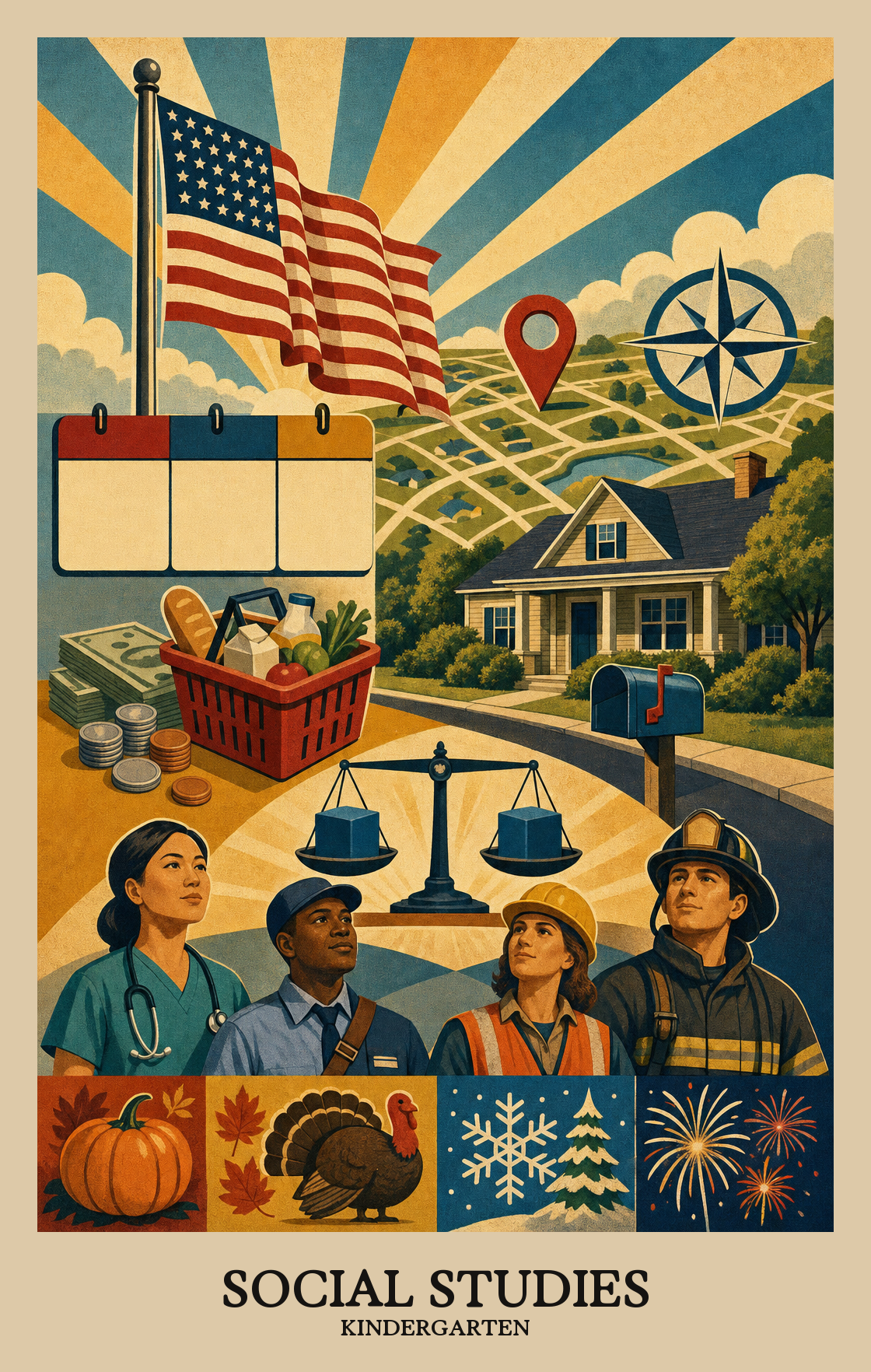
This is the year the wider world starts to make sense. Students learn the holidays, flags, and symbols that hold the country together, and they start using simple maps to find places and directions. They practice words like yesterday, today, and tomorrow, and they talk about rules, fairness, and the jobs grown-ups do for pay. By spring, students can name their address, point out the U.S. flag, and explain that people use money to buy things they need.
Students learn what good citizens do and why classrooms need rules. They practice honesty, respect, and self-control, and start using words like yesterday, today, and tomorrow to talk about time.
Students recognize the American flag, the bald eagle, the Statue of Liberty, and the White House. They learn the Pledge of Allegiance and find out which people and events the country celebrates on holidays like Thanksgiving and Independence Day.
Students see that a map is a drawing of a place from above and a globe is a model of Earth. They tell land from water, point out north, south, east, and west, and learn to say their own street address, city, state, and country.
Students talk about the customs and celebrations of different families and communities. They learn about jobs like teacher, doctor, farmer, and mail carrier, and find out that people earn money by working.
Students learn that coins and dollar bills are used to buy things. They tell the difference between goods, like apples, and services, like a haircut, and start to see why people have to make choices when they cannot have everything they want.
Students read simple maps to find information about places, like where a city sits on a coast or where a road connects two towns.
| Standard | Definition | Code |
|---|---|---|
| The student will use maps to retrieve social studies information | Students read simple maps to find information about places, like where a city sits on a coast or where a road connects two towns. | SS.1 |
Students learn the names of major U.S. holidays and who or what each one celebrates, from Martin Luther King Jr. to the workers honored on Labor Day.
Students learn to recognize American symbols like the U.S. flag, the bald eagle, and the Statue of Liberty, and connect landmarks like the White House and Lincoln Memorial to presidents and national holidays.
Students learn words like yesterday, tomorrow, before, after, and long ago so they can talk about when things happened in history and in daily life.
| Standard | Definition | Code |
|---|---|---|
| Identify the national holidays and describe the people and/or events… | Students learn the names of major U.S. holidays and who or what each one celebrates, from Martin Luther King Jr. to the workers honored on Labor Day. | SSKH1 |
| Identify the following American symbols:<ul><li>The national and state flags | Students learn to recognize American symbols like the U.S. flag, the bald eagle, and the Statue of Liberty, and connect landmarks like the White House and Lincoln Memorial to presidents and national holidays. | SSKH2 |
| Correctly use words and phrases related to chronology and time | Students learn words like yesterday, tomorrow, before, after, and long ago so they can talk about when things happened in history and in daily life. | SSKH3 |
Students learn the four cardinal directions (north, south, east, west) and practice reading a compass rose to figure out which way is which on a map.
Students learn to describe where things are using directions like northeast, northwest, southeast, and southwest. They practice finding those directions on a map or compass rose.
Students learn to find places on a map by matching a letter and a number, the way you find a seat at a stadium. They practice pointing to the square where the row and column meet.
Students look at a map and sort its markings into groups: things nature made (rivers, mountains), things people built (roads, cities), and lines governments drew (borders). Then they explain how those groups are alike and different.
Students learn to read the small scale bar printed on a map and use it to figure out how far apart two places really are.
Students learn to read a map's legend (the small box that explains what each symbol or color means) and use it to find information on different kinds of maps, like maps that show land, roads, or natural resources.
Students look at a map and talk about how rivers, mountains, or other land features shaped what happened in a place then or now.
Students look at a simple map and answer questions about it, like which town is closest or where most people live. They explain what the map is telling them in their own words.
Students learn to read the grid of lines that criss-cross a map and use those lines to pinpoint exactly where a place is on Earth.
Students look at two maps of the same place made at different times and figure out what changed. They notice patterns, like whether a neighborhood grew or a road was added.
Students look at a map alongside a chart or short reading, then explain what the two sources show together. This builds the habit of using more than one source to figure something out.
Students use digital maps and simple geography tools to spot patterns in how people live, move, and use land. They look at what has changed over time and draw basic conclusions from what they see.
| Standard | Definition | Code |
|---|---|---|
| use a compass rose to identify cardinal directions | Students learn the four cardinal directions (north, south, east, west) and practice reading a compass rose to figure out which way is which on a map. | SS.1.1 |
| use intermediate directions | Students learn to describe where things are using directions like northeast, northwest, southeast, and southwest. They practice finding those directions on a map or compass rose. | SS.1.2 |
| use a letter/number grid system to determine location | Students learn to find places on a map by matching a letter and a number, the way you find a seat at a stadium. They practice pointing to the square where the row and column meet. | SS.1.3 |
| compare and contrast the categories of natural, cultural | Students look at a map and sort its markings into groups: things nature made (rivers, mountains), things people built (roads, cities), and lines governments drew (borders). Then they explain how those groups are alike and different. | SS.1.4 |
| use graphic scales to determine distances on a map | Students learn to read the small scale bar printed on a map and use it to figure out how far apart two places really are. | SS.1.5 |
| use map key/legend to acquire information from historical, physical, political… | Students learn to read a map's legend (the small box that explains what each symbol or color means) and use it to find information on different kinds of maps, like maps that show land, roads, or natural resources. | SS.1.6 |
| use a map to explain impact of geography on historical and current events | Students look at a map and talk about how rivers, mountains, or other land features shaped what happened in a place then or now. | SS.1.7 |
| draw conclusions and make generalizations based on information from maps | Students look at a simple map and answer questions about it, like which town is closest or where most people live. They explain what the map is telling them in their own words. | SS.1.8 |
| use latitude and longitude to determine location | Students learn to read the grid of lines that criss-cross a map and use those lines to pinpoint exactly where a place is on Earth. | SS.1.9 |
| compare maps of the same place at different points in time and from different… | Students look at two maps of the same place made at different times and figure out what changed. They notice patterns, like whether a neighborhood grew or a road was added. | SS.1.10 |
| compare maps with data sets | Students look at a map alongside a chart or short reading, then explain what the two sources show together. This builds the habit of using more than one source to figure something out. | SS.1.11 |
| use geographic technology and software to determine changes, identify trends | Students use digital maps and simple geography tools to spot patterns in how people live, move, and use land. They look at what has changed over time and draw basic conclusions from what they see. | SS.1.12 |
Students learn that families across the U.S. celebrate holidays and follow customs in different ways. They practice describing those differences using examples from their own family and others.
Maps are flat drawings of a place; globes are rounded models of the whole Earth. Students learn that both show land and water from above, shrunk down to a size you can hold or hang on a wall.
Students learn their own home address, including street, city, state, and country. It's the first step in understanding where they live in the world.
| Standard | Definition | Code |
|---|---|---|
| Describe the diversity of American culture by explaining the customs and… | Students learn that families across the U.S. celebrate holidays and follow customs in different ways. They practice describing those differences using examples from their own family and others. | SSKG1 |
| Explain that a map is a drawing of a place and a globe is a model of… | Maps are flat drawings of a place; globes are rounded models of the whole Earth. Students learn that both show land and water from above, shrunk down to a size you can hold or hang on a wall. | SSKG2 |
| State the street address, city, state | Students learn their own home address, including street, city, state, and country. It's the first step in understanding where they live in the world. | SSKG3 |
Good citizenship means following rules, helping others, and treating people fairly. Students learn what it looks like to be a responsible member of a classroom and community.
Rules are agreements people make together to keep things fair and safe. Students learn who makes rules, how those rules get decided, and why following them matters.
Rules keep people safe and make sure everyone is treated fairly. Students learn to explain what would happen if a rule didn't exist.
Good citizens treat others with kindness and fairness. Students look at real examples of honesty, respect, and self-control and talk about why those actions make a community work better.
| Standard | Definition | Code |
|---|---|---|
| Demonstrate an understanding of good citizenship | Good citizenship means following rules, helping others, and treating people fairly. Students learn what it looks like to be a responsible member of a classroom and community. | SSKCG1 |
| Explain how rules are made and why | Rules are agreements people make together to keep things fair and safe. Students learn who makes rules, how those rules get decided, and why following them matters. | SSKCG1.a |
| Explain why rules should be followed | Rules keep people safe and make sure everyone is treated fairly. Students learn to explain what would happen if a rule didn't exist. | SSKCG1.b |
| Describe examples of positive character traits exhibited by good citizens such… | Good citizens treat others with kindness and fairness. Students look at real examples of honesty, respect, and self-control and talk about why those actions make a community work better. | SSKCG2 |
Students name jobs people do in their community, like a police officer, farmer, or doctor, and talk about what each job involves.
Working a job is how people earn money. Students learn that the paycheck or wages someone brings home come from the work they do, whether that's teaching, fixing cars, or stocking shelves.
Money is how people pay for things they buy or services someone does for them. Students learn why a store needs payment for food, and why a barber or doctor gets paid for their work.
Goods are things you can hold, like food or toys. Services are things people do for you, like a haircut or a doctor visit. Students learn to tell the difference between the two.
Coins and dollar bills are the money Americans use to buy things. Students learn to recognize pennies, nickels, dimes, quarters, and dollar bills as the currency used in the United States.
People can't have everything they want, so they have to choose. Students learn why picking one thing sometimes means giving up another.
| Standard | Definition | Code |
|---|---|---|
| Describe the work that people do such as | Students name jobs people do in their community, like a police officer, farmer, or doctor, and talk about what each job involves. | SSKE1 |
| Explain that people earn income by working | Working a job is how people earn money. Students learn that the paycheck or wages someone brings home come from the work they do, whether that's teaching, fixing cars, or stocking shelves. | SSKE2 |
| Explain how money is used to purchase goods and services | Money is how people pay for things they buy or services someone does for them. Students learn why a store needs payment for food, and why a barber or doctor gets paid for their work. | SSKE3 |
| Distinguish goods from services | Goods are things you can hold, like food or toys. Services are things people do for you, like a haircut or a doctor visit. Students learn to tell the difference between the two. | SSKE3.a |
| Identify that U.S. coins and dollar bills | Coins and dollar bills are the money Americans use to buy things. Students learn to recognize pennies, nickels, dimes, quarters, and dollar bills as the currency used in the United States. | SSKE3.b |
| Explain that people must make choices because they cannot have everything they… | People can't have everything they want, so they have to choose. Students learn why picking one thing sometimes means giving up another. | SSKE4 |
Federally administered sample-based assessment in reading, mathematics, science, writing, and other subjects. NAEP results inform state-by-state comparisons rather than individual student or school accountability.
Students learn about national holidays, American symbols, and the work people do in a community. They start using simple maps and globes, talk about rules and good citizenship, and learn how money is used to buy things.
Draw a map of the bedroom or backyard together and mark where things are. Point out north, south, east, and west on a walk, or use a weather app to talk about which direction a storm is coming from.
Yes. Students are expected to say their street address, city, state, and country. Practice it in the car or at bedtime until it comes out easily, the same way students learn a phone number.
Let students hold real coins and dollar bills and name them. At the store, talk about the difference between buying a thing (a banana) and paying for help (a haircut), and why a family can't buy everything in the cart.
Most plans start with self, family, and community, then move outward to symbols, holidays, and maps as the calendar gives natural hooks. Save latitude, longitude, and grid work for spring, after students are comfortable with cardinal directions and map keys.
Cardinal directions and the idea that a map shows a view from above are the stickiest. Many students also confuse goods and services, and mix up holidays that fall close together. Plan to revisit these in short bursts across the year.
Tie each holiday or symbol to a person, place, or event students can picture, and use the calendar as the spine. Pair Presidents Day with the Lincoln Memorial and Washington Monument, and pair the Pledge with the flag so the names and images stick together.
Talk about why a family rule exists before enforcing it, such as holding hands in a parking lot. Praise honesty, patience, and taking turns by name when it happens, so students hear what good citizenship sounds like in everyday life.
By spring, students should name their address, identify the United States and Georgia flags, use a compass rose, and tell time words like yesterday, today, and tomorrow. They should also explain that people work to earn money and that choices have to be made.