Numbers to 1,000 and place value
Students read, write, and compare numbers up to 1,000. They learn what the digits in a three-digit number stand for and practice counting forward and backward by ones, fives, tens, and hundreds.
This is the year math stretches from twenty to a thousand. Students think in hundreds, tens, and ones, and they add and subtract two-digit numbers using strategies that match how the numbers are built. They start measuring with rulers, telling time on a clock, and counting coins to make a price. By spring, students can split a circle or rectangle into halves, thirds, or fourths and name each equal part.
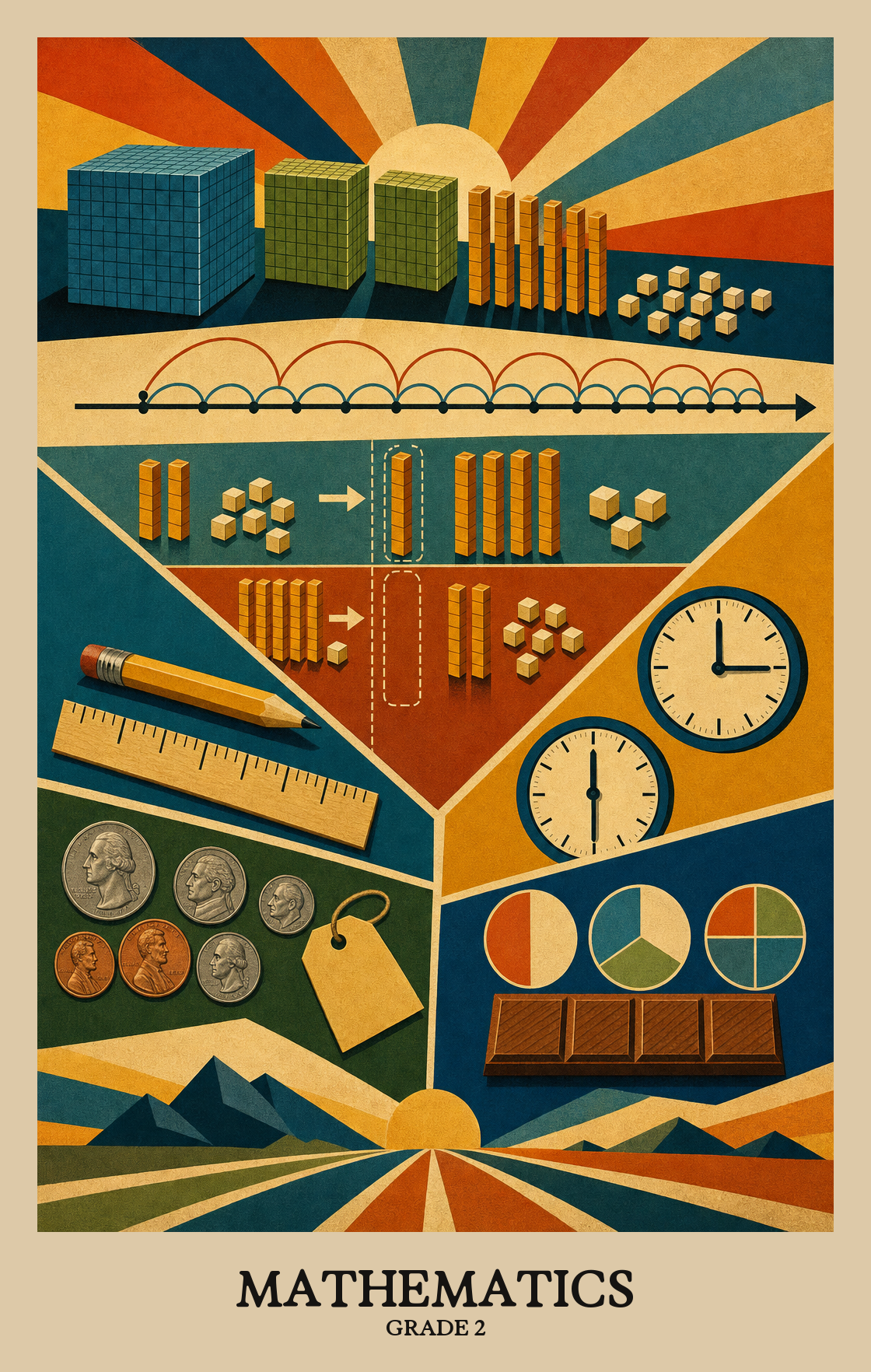
Students read, write, and compare numbers up to 1,000. They learn what the digits in a three-digit number stand for and practice counting forward and backward by ones, fives, tens, and hundreds.
Students build quick recall of addition and subtraction facts within 20, then use those facts to add and subtract larger two-digit numbers in their heads and on paper. Word problems start showing up more often.
Students measure objects with rulers in inches, feet, and yards. They tell time on analog and digital clocks to the nearest five minutes and count mixed coins and dollar bills to solve everyday money problems.
Students sort flat and solid shapes by their features and split circles and rectangles into halves, thirds, and fourths. They also work with equal groups and simple rows and columns, which sets up multiplication later.
Students add and subtract within 1,000 using place value, find numerical patterns, and answer questions using picture graphs and bar graphs. Problems pull together the year's work into longer, real-life questions.
Students keep trying when a math problem gets hard, ask for help when they're stuck, and listen to feedback. They work with others, explain their thinking, and set goals for getting better.
Students read a math problem carefully, figure out what it's asking, and keep trying even when the first approach doesn't work. They check whether their answer actually makes sense before moving on.
Students take a real problem, like sharing 12 crayons equally, and translate it into numbers to solve it. Then they check that the answer still makes sense in the real situation.
Students explain how they solved a math problem and listen to how classmates solved it differently. They practice backing up their answer with a reason and politely questioning answers that don't seem right.
Students show their thinking by drawing a picture, making a chart, or writing a number sentence to solve a real-world problem. The model helps them see whether their answer makes sense.
Students learn to pick the right tool for the job, whether that means reaching for a ruler, drawing a picture, or using counters to work through a math problem.
Students check their work carefully, use the right labels (like inches or dollars), and say what they mean clearly so their answers make sense to others.
Students notice patterns and rules in math problems, like how place value works in every two-digit addition problem, and use what they notice to solve new problems faster.
Students notice when the same steps keep showing up in a problem and use that pattern to work faster or check their answers.
| Standard | Definition | Code |
|---|---|---|
| Display perseverance and patience in problem-solving | Students keep trying when a math problem gets hard, ask for help when they're stuck, and listen to feedback. They work with others, explain their thinking, and set goals for getting better. | 2.MP |
| Make sense of problems and persevere in solving them | Students read a math problem carefully, figure out what it's asking, and keep trying even when the first approach doesn't work. They check whether their answer actually makes sense before moving on. | 2.MP.1 |
| Reason abstractly and quantitatively | Students take a real problem, like sharing 12 crayons equally, and translate it into numbers to solve it. Then they check that the answer still makes sense in the real situation. | 2.MP.2 |
| Construct viable arguments and critique the reasoning of others | Students explain how they solved a math problem and listen to how classmates solved it differently. They practice backing up their answer with a reason and politely questioning answers that don't seem right. | 2.MP.3 |
| Model with mathematics | Students show their thinking by drawing a picture, making a chart, or writing a number sentence to solve a real-world problem. The model helps them see whether their answer makes sense. | 2.MP.4 |
| Use appropriate tools strategically | Students learn to pick the right tool for the job, whether that means reaching for a ruler, drawing a picture, or using counters to work through a math problem. | 2.MP.5 |
| Attend to precision | Students check their work carefully, use the right labels (like inches or dollars), and say what they mean clearly so their answers make sense to others. | 2.MP.6 |
| Look for and make use of structure | Students notice patterns and rules in math problems, like how place value works in every two-digit addition problem, and use what they notice to solve new problems faster. | 2.MP.7 |
| Look for and express regularity in repeated reasoning | Students notice when the same steps keep showing up in a problem and use that pattern to work faster or check their answers. | 2.MP.8 |
Students read, write, and compare numbers up to 1,000 by understanding what each digit means. A 3 in the hundreds place is worth 300, not 3, and students use that idea to put numbers in order and make sense of how our number system works.
A three-digit number like 347 means 3 hundreds, 4 tens, and 7 ones. Students break apart numbers and explain what each digit is worth.
Students count up and down by ones, fives, tens, and hundreds using any starting number up to 1000. They also count up by 25s starting from zero.
Students line up whole numbers to 1,000 from smallest to largest and compare any two using the greater than, equal to, and less than symbols. The key is reading each number by its hundreds, tens, and ones.
Students use place value and number sense to add and subtract numbers up to 1,000. They work through real-life problems by breaking numbers apart and putting them back together in ways that make sense.
Adding and subtracting any two numbers up to 20 quickly and from memory, without counting on fingers. Students use mental strategies like making ten or breaking a number into parts.
Starting with a number like 345, students practice jumping up or down by 10 or by 100 to land on a new number. They focus on which digit changes and which ones stay the same.
Students add and subtract two-digit numbers by breaking them into tens and ones. For example, to solve 47 + 35, a student might add the tens first, then the ones, and combine the parts.
Students add and subtract any two numbers up to 100 quickly and accurately, using what they know about tens and ones to choose the most efficient strategy.
Students sort objects into equal groups and figure out how many there are in all. This builds the thinking behind multiplication before the times tables arrive.
Students sort a group of up to 20 objects to decide if the count is odd or even. For even numbers, they write an addition sentence showing two equal groups, like 6 = 3 + 3.
Students count objects arranged in rows and columns (like a 4-by-3 grid of eggs in a carton) by adding equal groups. Then they write that as an addition equation, like 3 + 3 + 3 + 3 = 12.
| Standard | Definition | Code |
|---|---|---|
| Using the place value structure, explore the count sequences to represent… | Students read, write, and compare numbers up to 1,000 by understanding what each digit means. A 3 in the hundreds place is worth 300, not 3, and students use that idea to put numbers in order and make sense of how our number system works. | 2.NR.1 |
| Explain the value of a three-digit number using hundreds, tens | A three-digit number like 347 means 3 hundreds, 4 tens, and 7 ones. Students break apart numbers and explain what each digit is worth. | 2.NR.1.1 |
| Count forward and backward by ones from any number within 1000 | Students count up and down by ones, fives, tens, and hundreds using any starting number up to 1000. They also count up by 25s starting from zero. | 2.NR.1.2 |
| Represent, compare, and order whole numbers to 1000 with an emphasis on place… | Students line up whole numbers to 1,000 from smallest to largest and compare any two using the greater than, equal to, and less than symbols. The key is reading each number by its hundreds, tens, and ones. | 2.NR.1.3 |
| Apply multiple part-whole strategies, properties of operations and place value… | Students use place value and number sense to add and subtract numbers up to 1,000. They work through real-life problems by breaking numbers apart and putting them back together in ways that make sense. | 2.NR.2 |
| Fluently add and subtract within 20 using a variety of mental, part-whole… | Adding and subtracting any two numbers up to 20 quickly and from memory, without counting on fingers. Students use mental strategies like making ten or breaking a number into parts. | 2.NR.2.1 |
| Find 10 more or 10 less than a given three-digit number and find 100 more or… | Starting with a number like 345, students practice jumping up or down by 10 or by 100 to land on a new number. They focus on which digit changes and which ones stay the same. | 2.NR.2.2 |
| Solve problems involving the addition and subtraction of two-digit numbers… | Students add and subtract two-digit numbers by breaking them into tens and ones. For example, to solve 47 + 35, a student might add the tens first, then the ones, and combine the parts. | 2.NR.2.3 |
| Fluently add and subtract within 100 using strategies based on place value… | Students add and subtract any two numbers up to 100 quickly and accurately, using what they know about tens and ones to choose the most efficient strategy. | 2.NR.2.4 |
| Work with equal groups to gain foundations for multiplication through… | Students sort objects into equal groups and figure out how many there are in all. This builds the thinking behind multiplication before the times tables arrive. | 2.NR.3 |
| Determine whether a group | Students sort a group of up to 20 objects to decide if the count is odd or even. For even numbers, they write an addition sentence showing two equal groups, like 6 = 3 + 3. | 2.NR.3.1 |
| Use addition to find the total number of objects arranged in rectangular arrays… | Students count objects arranged in rows and columns (like a 4-by-3 grid of eggs in a carton) by adding equal groups. Then they write that as an addition equation, like 3 + 3 + 3 + 3 = 12. | 2.NR.3.2 |
Students spot patterns that repeat, grow, or shrink, then figure out what comes next. They also build their own patterns using numbers, shapes, or objects.
Students spot a number pattern made by adding or subtracting the same amount each time, then describe how it works and build one of their own.
Students look at a number pattern that gets bigger or smaller, figure out the rule behind it, and create their own. The numbers stay within 20, and the rule always involves adding or subtracting the same amount.
| Standard | Definition | Code |
|---|---|---|
| Identify, describe, extend | Students spot patterns that repeat, grow, or shrink, then figure out what comes next. They also build their own patterns using numbers, shapes, or objects. | 2.PAR.4 |
| Identify, describe, and create a numerical pattern resulting from repeating an… | Students spot a number pattern made by adding or subtracting the same amount each time, then describe how it works and build one of their own. | 2.PAR.4.1 |
| Identify, describe, and create growing patterns and shrinking patterns… | Students look at a number pattern that gets bigger or smaller, figure out the rule behind it, and create their own. The numbers stay within 20, and the rule always involves adding or subtracting the same amount. | 2.PAR.4.2 |
Students read, write, and count whole numbers up to 1,000. They understand how the digits in a number like 347 each stand for hundreds, tens, and ones.
Students cut circles, squares, and rectangles into 2, 3, or 4 equal pieces by drawing lines. No piece is shaded; the goal is just to make the parts the same size.
Students count up and down from any number up to 1000, not just from zero. This builds the number sense they need before adding and subtracting larger numbers.
Students count forward by 2s, 5s, 10s, 25s, and 100s instead of counting one by one. This is the foundation for adding quickly and understanding coins like nickels, quarters, and dimes.
Students count collections of objects all the way up to 1,000, grouping them into hundreds, tens, and ones to keep track.
Students break a three-digit number like 347 into how many hundreds, tens, and ones it holds. This is the foundation for adding and subtracting bigger numbers later on.
Students look at two numbers up to 1,000 and decide which is greater, which is less, or whether they are equal. They use symbols like >, <, and = to show how the numbers relate.
Students add and subtract numbers up to 20 in their heads, without counting on fingers or writing it out. The goal is speed and accuracy from memory.
Students add and subtract any two numbers up to 100 quickly and reliably, using mental math tricks like counting on, making tens, or breaking numbers apart.
Students add and subtract numbers up to 1,000 using tools like number lines, hundreds charts, or place-value blocks to work out the answer.
Students arrange objects into rows and columns to see how multiplication works before they ever learn the word for it. A 3-by-4 grid of coins or tiles shows how groups combine into a total.
Students spot and continue number patterns that grow or shrink by adding or subtracting the same amount, like a sequence that goes 4, 7, 10, 13.
Students sort and compare flat shapes like squares and circles alongside solid shapes like cubes and spheres by looking at their corners, sides, and faces.
Students look at everyday objects like letters, leaves, or shapes and find the line where both halves match. It's an early step in seeing how geometry shows up in the real world.
Students measure real objects using a ruler or tape measure and record the length to the nearest whole inch or centimeter. No estimating; they line up the tool and read the number.
Students use a real ruler to measure objects in inches or centimeters. They learn why the marks matter and how to line up the ruler correctly to get an accurate length.
Students pick the right unit to measure something, choosing inches for small objects like a pencil and yards for longer distances like a hallway. The size of the object guides the choice.
Students sort information into groups and show the results in a chart or picture graph. They read the finished display to answer questions like which group has the most or how many are in each category.
Students figure out the total value of a small group of coins, mixing pennies, nickels, dimes, and quarters. They practice counting on and skip-counting to find the right amount.
Students count coins and dollar bills to find totals and make change. They work with pennies, nickels, dimes, quarters, and dollar bills together in the same problem.
Students read clocks to the nearest five minutes, saying times like 3:15 or 7:45. They practice with both digital and analog clocks.
Students learn that a.m. covers midnight to noon and p.m. covers noon to midnight. They use this to make sense of daily routines, like knowing 8:00 a.m. is breakfast time and 8:00 p.m. is close to bedtime.
Students figure out how much time has passed between two events, like when a movie started and when it ended, by reading a clock to the nearest hour or half hour.
| Standard | Definition | Code |
|---|---|---|
| Whole numbers to 1000 | Students read, write, and count whole numbers up to 1,000. They understand how the digits in a number like 347 each stand for hundreds, tens, and ones. | 2.LP1.1.1 |
| Partition shapes into halves, thirds and quarters | Students cut circles, squares, and rectangles into 2, 3, or 4 equal pieces by drawing lines. No piece is shaded; the goal is just to make the parts the same size. | 2.LP1.1.2 |
| Counting forward and backward within 1000 | Students count up and down from any number up to 1000, not just from zero. This builds the number sense they need before adding and subtracting larger numbers. | 2.LP1.2.1 |
| Skip counting by 2s, 5s, 10s, 25s | Students count forward by 2s, 5s, 10s, 25s, and 100s instead of counting one by one. This is the foundation for adding quickly and understanding coins like nickels, quarters, and dimes. | 2.LP1.2.2 |
| Counting objects to 1000 | Students count collections of objects all the way up to 1,000, grouping them into hundreds, tens, and ones to keep track. | 2.LP1.2.3 |
| Hundreds, tens and ones in 3-digit numbers | Students break a three-digit number like 347 into how many hundreds, tens, and ones it holds. This is the foundation for adding and subtracting bigger numbers later on. | 2.LP1.3.1 |
| Comparing numbers to 1,000 | Students look at two numbers up to 1,000 and decide which is greater, which is less, or whether they are equal. They use symbols like >, <, and = to show how the numbers relate. | 2.LP1.4.1 |
| Fluency using mental math up to 20 | Students add and subtract numbers up to 20 in their heads, without counting on fingers or writing it out. The goal is speed and accuracy from memory. | 2.LP1.5.1 |
| Fluency with strategies within 100 | Students add and subtract any two numbers up to 100 quickly and reliably, using mental math tricks like counting on, making tens, or breaking numbers apart. | 2.LP1.5.2 |
| Within 1,000 (using tools and strategies) | Students add and subtract numbers up to 1,000 using tools like number lines, hundreds charts, or place-value blocks to work out the answer. | 2.LP1.6.1 |
| Building arrays | Students arrange objects into rows and columns to see how multiplication works before they ever learn the word for it. A 3-by-4 grid of coins or tiles shows how groups combine into a total. | 2.LP1.7.1 |
| Numerical patterns involving addition and subtraction | Students spot and continue number patterns that grow or shrink by adding or subtracting the same amount, like a sequence that goes 4, 7, 10, 13. | 2.LP2.1.1 |
| Describe, compare and sort 2-D and 3-D shapes given a set of attributes | Students sort and compare flat shapes like squares and circles alongside solid shapes like cubes and spheres by looking at their corners, sides, and faces. | 2.LP3.1.1 |
| Identify lines of symmetry in everyday objects | Students look at everyday objects like letters, leaves, or shapes and find the line where both halves match. It's an early step in seeing how geometry shows up in the real world. | 2.LP3.1.2 |
| Measure length to nearest whole unit | Students measure real objects using a ruler or tape measure and record the length to the nearest whole inch or centimeter. No estimating; they line up the tool and read the number. | 2.LP4.1.1 |
| Use tools such as constructed rulers and standard rulers | Students use a real ruler to measure objects in inches or centimeters. They learn why the marks matter and how to line up the ruler correctly to get an accurate length. | 2.LP4.1.2 |
| Choose units (in, ft, yd) appropriately | Students pick the right unit to measure something, choosing inches for small objects like a pencil and yards for longer distances like a hallway. The size of the object guides the choice. | 2.LP4.1.3 |
| Display and interpret categorical data | Students sort information into groups and show the results in a chart or picture graph. They read the finished display to answer questions like which group has the most or how many are in each category. | 2.LP4.1.4 |
| Combination of coins | Students figure out the total value of a small group of coins, mixing pennies, nickels, dimes, and quarters. They practice counting on and skip-counting to find the right amount. | 2.LP4.2.1 |
| Problems involving dollars and all coins | Students count coins and dollar bills to find totals and make change. They work with pennies, nickels, dimes, quarters, and dollar bills together in the same problem. | 2.LP4.2.2 |
| Time to the nearest five minutes | Students read clocks to the nearest five minutes, saying times like 3:15 or 7:45. They practice with both digital and analog clocks. | 2.LP4.3.1 |
| Distinguish between a.m | Students learn that a.m. covers midnight to noon and p.m. covers noon to midnight. They use this to make sense of daily routines, like knowing 8:00 a.m. is breakfast time and 8:00 p.m. is close to bedtime. | 2.LP4.3.2 |
| Elapsed time to hour or half hour | Students figure out how much time has passed between two events, like when a movie started and when it ended, by reading a clock to the nearest hour or half hour. | 2.LP4.3.3 |
Students measure real objects using inches, feet, and yards, then read graphs and charts to answer questions about what the data shows.
Students build their own measuring tools by repeating a small unit end to end, then check their tool against a real ruler to see how the marks line up.
Students estimate how long something is, then measure it with a ruler or tape measure to the nearest whole inch, foot, or yard.
Students measure two objects and find the difference in length. For example, they might figure out that a pencil is 3 inches longer than a crayon.
Students look at a bar graph or picture chart, ask a question about what it shows, and use the data to find the answer. The information comes from real-life topics like weather, favorite foods, or how many students are in each group.
Students add and subtract measurements on a number line, such as finding the total length of two objects in inches or how much shorter one object is than another.
Students read clocks to find the time and count coins and bills to solve everyday problems, like figuring out how long until recess or whether they have enough money to buy lunch.
Students read both analog and digital clocks to the nearest five minutes, then figure out how much time has passed between two events, rounding to the nearest hour or half hour.
Students add up a handful of coins, figure out which coins combine to hit a target amount under a dollar, and work through simple problems using quarters, dimes, nickels, and pennies with the right $ and ¢ symbols.
| Standard | Definition | Code |
|---|---|---|
| Estimate and measure the lengths of objects and distance to solve problems… | Students measure real objects using inches, feet, and yards, then read graphs and charts to answer questions about what the data shows. | 2.MDR.5 |
| Construct simple measuring instruments using unit models | Students build their own measuring tools by repeating a small unit end to end, then check their tool against a real ruler to see how the marks line up. | 2.MDR.5.1 |
| Estimate and measure the length of an object or distance to the nearest whole… | Students estimate how long something is, then measure it with a ruler or tape measure to the nearest whole inch, foot, or yard. | 2.MDR.5.2 |
| Measure to determine how much longer one object is than another and express the… | Students measure two objects and find the difference in length. For example, they might figure out that a pencil is 3 inches longer than a crayon. | 2.MDR.5.3 |
| Ask questions and answer them based on gathered information, observations | Students look at a bar graph or picture chart, ask a question about what it shows, and use the data to find the answer. The information comes from real-life topics like weather, favorite foods, or how many students are in each group. | 2.MDR.5.4 |
| Represent whole-number sums and differences within a standard unit of… | Students add and subtract measurements on a number line, such as finding the total length of two objects in inches or how much shorter one object is than another. | 2.MDR.5.5 |
| Solve real-life problems involving time and money | Students read clocks to find the time and count coins and bills to solve everyday problems, like figuring out how long until recess or whether they have enough money to buy lunch. | 2.MDR.6 |
| Tell and write time from analog and digital clocks to the nearest five minutes | Students read both analog and digital clocks to the nearest five minutes, then figure out how much time has passed between two events, rounding to the nearest hour or half hour. | 2.MDR.6.1 |
| Find the value of a group of coins and determine combinations of coins that… | Students add up a handful of coins, figure out which coins combine to hit a target amount under a dollar, and work through simple problems using quarters, dimes, nickels, and pennies with the right $ and ¢ symbols. | 2.MDR.6.2 |
Students draw shapes, split them into equal parts, and look for those shapes in everyday objects like windows, tiles, and buildings.
Students sort and compare flat and solid shapes by describing what makes each one different, such as how many sides a shape has or whether its edges are straight or curved.
Students look at real objects, like a leaf or a window, and find the line where one side mirrors the other. That folding line is called a line of symmetry.
Students cut circles and rectangles into two, three, or four equal pieces, then name each piece using words like "half," "third," or "quarter."
Two equal pieces of the same shape don't have to look alike. A square cut into two rectangles and a square cut into two triangles can both be split fairly, even though the pieces look different.
| Standard | Definition | Code |
|---|---|---|
| Draw and partition shapes and other objects with specific attributes | Students draw shapes, split them into equal parts, and look for those shapes in everyday objects like windows, tiles, and buildings. | 2.GSR.7 |
| Describe, compare and sort 2-D shapes including polygons, triangles… | Students sort and compare flat and solid shapes by describing what makes each one different, such as how many sides a shape has or whether its edges are straight or curved. | 2.GSR.7.1 |
| Identify at least one line of symmetry in everyday objects to describe each… | Students look at real objects, like a leaf or a window, and find the line where one side mirrors the other. That folding line is called a line of symmetry. | 2.GSR.7.2 |
| Partition circles and rectangles into two, three | Students cut circles and rectangles into two, three, or four equal pieces, then name each piece using words like "half," "third," or "quarter." | 2.GSR.7.3 |
| Recognize that equal shares of identical wholes may be different shapes within… | Two equal pieces of the same shape don't have to look alike. A square cut into two rectangles and a square cut into two triangles can both be split fairly, even though the pieces look different. | 2.GSR.7.4 |
End-of-grade mathematics assessment for grades 3 through 8, aligned to Georgia's state-adopted math standards.
Students should read, write, and compare numbers up to 1000, add and subtract within 100 quickly, and solve word problems with two-digit numbers. They should also tell time to the nearest five minutes, count coins, measure with a ruler, and name basic shapes and their parts.
Practice during real moments. Count coins from a pocket, read the clock at dinner, measure a snack with a ruler, or ask what number is ten more than the house number. Five minutes a day of real-life math does more than a worksheet.
Not yet. By the end of the year, students should add and subtract within 20 in their heads. Fingers are a normal step. Try quick games like flashing a number and asking for the partner that makes 10, or rolling two dice and adding the total.
Start by extending counting and place value from 100 to 1000, then build adding and subtracting within 100 using place value strategies. Save bigger numbers and harder word problems for later. Money, time, and measurement give natural practice with place value once the base is solid.
Subtracting two-digit numbers across a ten trips up most students, and so does telling time to the nearest five minutes. Counting mixed coins is another sticky spot. Plan short review blocks in spring rather than waiting for a unit test to show the gap.
Cutting a circle or rectangle into halves, thirds, and fourths sets up real fraction work in third grade. When a student says a pizza is cut into fourths and each piece is the same size, that is the foundation. Folding paper at home is great practice.
Students should solve problems like 47 + 28 or 63 - 19 in under a minute using strategies, not by counting on fingers one by one. They might break numbers apart, use a known fact, or count up. Speed matters less than choosing a strategy that works.
Look for students who can add and subtract within 100 with confidence, explain place value in a three-digit number, partition shapes into equal parts, and solve a two-step word problem about money or measurement. Those skills carry directly into multiplication and fractions next year.
Ask the student to read the problem aloud and explain what it is asking. Pull out coins, beans, or paper squares to act it out. If frustration builds after ten minutes, stop and write a quick note to the teacher. Struggling for an hour does not help.