Counting and numbers to 120
Students count, read, and write numbers up to 120. They count forward and backward from any starting number and use groups of 5s and 10s to count big piles without losing track.
This is the year numbers grow past ten and start working in groups. Students count, read, and compare numbers up to 120, and they see that a number like 47 means four groups of ten and seven ones. They add and subtract within 20 using strategies like counting on and making ten, and they sort coins and measure objects with everyday units. By spring, students can solve a simple word problem within 20 and explain their thinking with drawings or an equation.
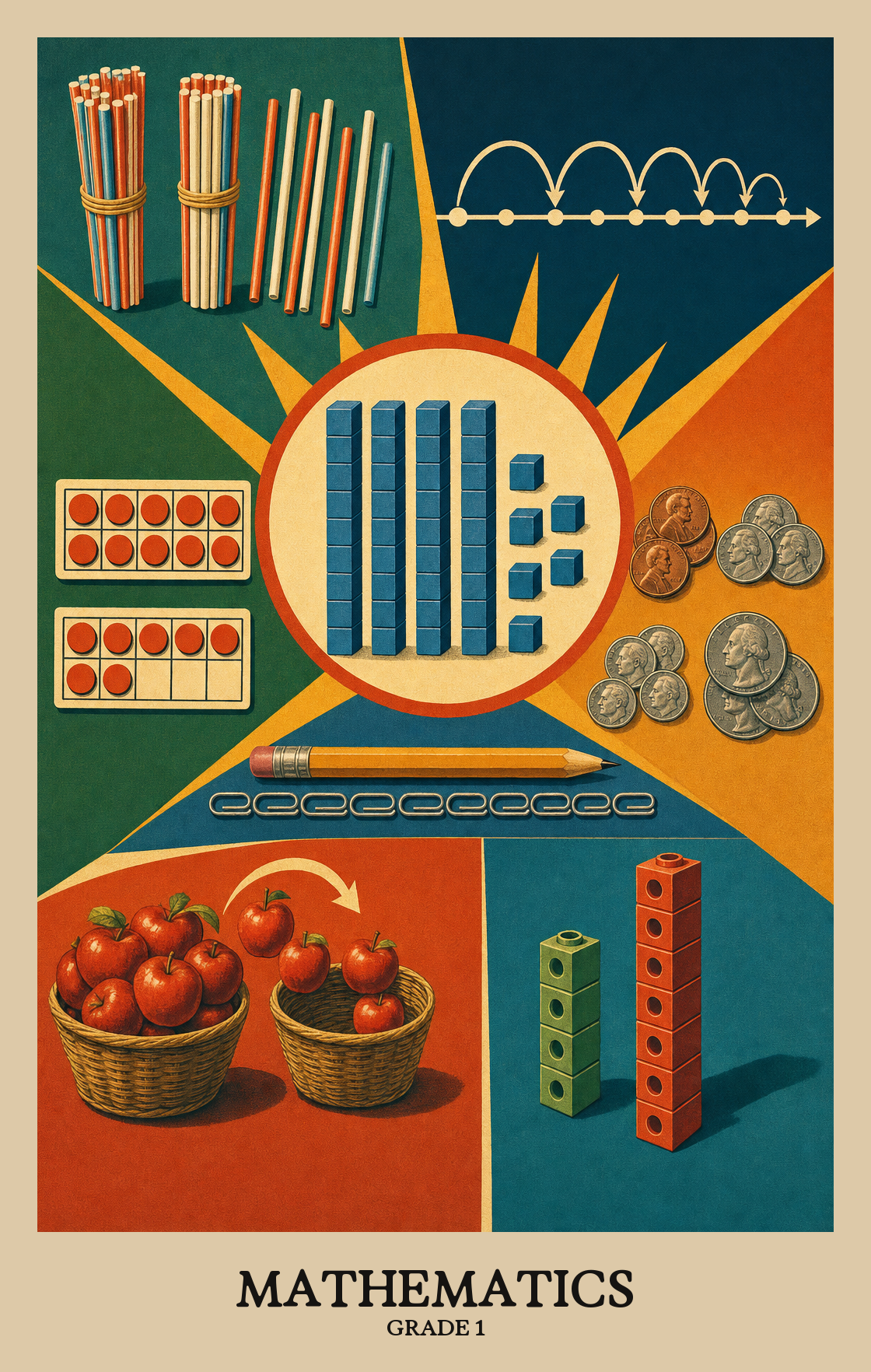
Students count, read, and write numbers up to 120. They count forward and backward from any starting number and use groups of 5s and 10s to count big piles without losing track.
Students learn that a number like 47 means 4 tens and 7 ones. They use this to compare two numbers and decide which is bigger, using tens and ones to explain why.
Students add and subtract in word problems and become fluent within 10. They learn strategies like counting on, making a ten, and using addition to help with subtraction.
Students add within 100, including a two-digit number plus a one-digit number or a multiple of ten. They also find, extend, and describe patterns in numbers and pictures.
Students name flat and solid shapes, put them together to make new ones, and measure length using objects like paper clips. They also identify pennies, nickels, and dimes and find the total value.
Students collect data and show it with tally marks and bar graphs. They split a whole into two equal parts called halves and decide if an event is impossible, possible, or certain.
Students look at a set of data, spot a pattern in it, and then come up with a question that could be answered by collecting more data. A teacher helps guide the process.
Students gather information to answer a simple question, then show what they found using drawings, tally marks, or a bar graph.
Some things can never happen, some might happen, and some will always happen. Students sort everyday events into those three groups, like deciding whether it could ever snow in July or whether the sun will set tonight.
| Standard | Definition | Code |
|---|---|---|
| Notice and describe patterns in data-rich situations and create statistical… | Students look at a set of data, spot a pattern in it, and then come up with a question that could be answered by collecting more data. A teacher helps guide the process. | 1.1.1.1 |
| Collect and use data to consider and decide what data will answer a question… | Students gather information to answer a simple question, then show what they found using drawings, tally marks, or a bar graph. | 1.1.1.2 |
| Describe outcomes of events as impossible, possible or certain. (MP1, MP6) ☼ | Some things can never happen, some might happen, and some will always happen. Students sort everyday events into those three groups, like deciding whether it could ever snow in July or whether the sun will set tonight. | 1.1.2.1 |
Students line up three objects from shortest to longest, then figure out which of two objects is longer by comparing each one to a third object, like a piece of string or a pencil.
Students pick a small object, like a paper clip or a crayon, and use it as a measuring tool. They line up copies of it end to end along something longer to find out how many fit.
Students identify pennies, nickels, and dimes, then add up a small group of those coins to find the total amount, up to one dollar.
Students look at shapes like triangles, squares, and boxes and describe what they notice: how many sides, whether edges are straight or curved, and whether the shape is flat or solid.
Students put simple shapes together to build a new, larger shape, then take that larger shape apart to name the pieces inside it.
Students name the shapes they see in everyday objects, like a door being a rectangle or a clock being a circle, and say where those objects are using "left" and "right."
A triangle is still a triangle even when it's tilted or flipped. Students recognize shapes like squares and circles no matter which way they're turned.
| Standard | Definition | Code |
|---|---|---|
| Order three objects by length | Students line up three objects from shortest to longest, then figure out which of two objects is longer by comparing each one to a third object, like a piece of string or a pencil. | 1.2.3.1 |
| Measure the length of an object in terms of nonstandard units | Students pick a small object, like a paper clip or a crayon, and use it as a measuring tool. They line up copies of it end to end along something longer to find out how many fit. | 1.2.3.2 |
| Identify pennies, nickels and dimes | Students identify pennies, nickels, and dimes, then add up a small group of those coins to find the total amount, up to one dollar. | 1.2.3.3 |
| Describe attributes of two- and three-dimensional objects, such as triangles… | Students look at shapes like triangles, squares, and boxes and describe what they notice: how many sides, whether edges are straight or curved, and whether the shape is flat or solid. | 1.2.4.1 |
| Compose two-dimensional shapes | Students put simple shapes together to build a new, larger shape, then take that larger shape apart to name the pieces inside it. | 1.2.4.2 |
| Describe objects in the environment using names of shapes and describe the… | Students name the shapes they see in everyday objects, like a door being a rectangle or a clock being a circle, and say where those objects are using "left" and "right." | 1.2.4.3 |
| Identify shapes regardless of their orientations | A triangle is still a triangle even when it's tilted or flipped. Students recognize shapes like squares and circles no matter which way they're turned. | 1.2.4.4 |
Students count a pile of objects by grouping them into fives or tens instead of counting one by one. It's the same skill used when counting coins or tallying a score.
Students read, write, and compare numbers up to 120 using tools like number lines, tally marks, and base-ten blocks. They also learn that numbers like 30 or 70 are made of groups of tens.
Students count forward and backward starting from any number up to 120, with or without objects in hand. This builds the mental number line they use for adding and subtracting later.
Numbers like 43 mean 4 groups of ten and 3 leftover ones. Students use pictures and objects to see how any number up to 120 is built from tens and ones.
Students look at a group of objects and make a close guess at how many there are by thinking in fives or tens. They do not need to count every single one.
Students solve simple addition and subtraction word problems using numbers up to 20. They figure out missing numbers whether the unknown is the starting amount, the change, or the answer.
Students add numbers up to 100, like 47 + 6 or 47 + 30, using blocks or drawings. They learn that when ones pile up past 9, those extra ones group together to make a new ten.
Students break a number like 7 into two smaller numbers in different ways, such as 3 and 4 or 5 and 2, then draw a picture or write an equation to show each split.
Students add and subtract numbers up to 20, building enough practice with numbers up to 10 to work quickly and accurately. They use shortcuts like counting forward, splitting numbers apart, or swapping addition for subtraction to find answers.
Students use the fact that 10 makes a new ten to add across round numbers, like jumping from 28 to 38 by adding 10. This builds the mental math shortcut for adding through 100.
Students split a group of objects into 2 equal shares and call each share "one half." For example, 6 apples shared between 2 friends means each friend gets one half, or 3 apples.
Students look at two numbers like 34 and 52 and decide which is bigger by checking the tens place first, then the ones place if needed.
Students look at a math sentence like 3 + 4 = 5 + 2 and decide if both sides actually equal the same number. The equal sign means "the same as," not just "write the answer here."
Students find the missing number that makes an addition or subtraction equation balance. For example, if 3 + ? = 7, they figure out what goes in the blank.
Students make simple patterns using objects, pictures, or numbers, then figure out the rule behind them. They practice spotting what comes next in patterns that repeat, grow, or shrink.
Students count by 2s, 5s, and 10s instead of counting every number one by one. They practice jumping ahead in a sequence, like landing on 5, 10, 15, 20, all the way up to 120.
Students look at a pattern that grows (like a row of shapes that gets one bigger each time) and say out loud what changes and what stays the same from step to step.
| Standard | Definition | Code |
|---|---|---|
| Count collections of objects up to 120 using groups of 5s or 10s. (MP1, MP5) $… | Students count a pile of objects by grouping them into fives or tens instead of counting one by one. It's the same skill used when counting coins or tallying a score. | 1.3.5.1 |
| Read, write, compare, order and represent whole numbers from 0 to 120… | Students read, write, and compare numbers up to 120 using tools like number lines, tally marks, and base-ten blocks. They also learn that numbers like 30 or 70 are made of groups of tens. | 1.3.5.2 |
| Count, with or without objects, forward and backward from any given number up… | Students count forward and backward starting from any number up to 120, with or without objects in hand. This builds the mental number line they use for adding and subtracting later. | 1.3.5.3 |
| Using models, pictures or numbers to recognize and describe the place value of… | Numbers like 43 mean 4 groups of ten and 3 leftover ones. Students use pictures and objects to see how any number up to 120 is built from tens and ones. | 1.3.5.4 |
| Estimate amounts up to 120 using benchmarks of 5s and 10s. (MP1, MP2) $ ☼ | Students look at a group of objects and make a close guess at how many there are by thinking in fives or tens. They do not need to count every single one. | 1.3.5.5 |
| Solve contextual situations, up to and including 20, using addition and… | Students solve simple addition and subtraction word problems using numbers up to 20. They figure out missing numbers whether the unknown is the starting amount, the change, or the answer. | 1.3.5.6 |
| Add within 100, including adding a two-digit number with a one-digit number… | Students add numbers up to 100, like 47 + 6 or 47 + 30, using blocks or drawings. They learn that when ones pile up past 9, those extra ones group together to make a new ten. | 1.3.5.7 |
| Decompose numbers less than or equal to 10 into pairs, in more than one way… | Students break a number like 7 into two smaller numbers in different ways, such as 3 and 4 or 5 and 2, then draw a picture or write an equation to show each split. | 1.3.5.8 |
| Add and subtract within 20, demonstrating fluency for addition and subtraction… | Students add and subtract numbers up to 20, building enough practice with numbers up to 10 to work quickly and accurately. They use shortcuts like counting forward, splitting numbers apart, or swapping addition for subtraction to find answers. | 1.3.5.9 |
| Use combinations of 10 to add to the next decade through 100. (MP7) $ | Students use the fact that 10 makes a new ten to add across round numbers, like jumping from 28 to 38 by adding 10. This builds the mental math shortcut for adding through 100. | 1.3.5.11 |
| Represent and solve contextual equal sharing situations where a whole number… | Students split a group of objects into 2 equal shares and call each share "one half." For example, 6 apples shared between 2 friends means each friend gets one half, or 3 apples. | 1.3.5.12 |
| Compare two two-digit numbers based on the meaning of the tens and ones… | Students look at two numbers like 34 and 52 and decide which is bigger by checking the tens place first, then the ones place if needed. | 1.3.6.1 |
| Determine if equations involving addition and subtraction are true or false… | Students look at a math sentence like 3 + 4 = 5 + 2 and decide if both sides actually equal the same number. The equal sign means "the same as," not just "write the answer here." | 1.3.6.2 |
| Determine the unknown whole number in an addition or subtraction equation… | Students find the missing number that makes an addition or subtraction equation balance. For example, if 3 + ? = 7, they figure out what goes in the blank. | 1.3.6.3 |
| Create simple patterns using objects, pictures, numbers and rules. Identify… | Students make simple patterns using objects, pictures, or numbers, then figure out the rule behind them. They practice spotting what comes next in patterns that repeat, grow, or shrink. | 1.3.7.1 |
| Recognize patterns in counting | Students count by 2s, 5s, and 10s instead of counting every number one by one. They practice jumping ahead in a sequence, like landing on 5, 10, 15, 20, all the way up to 120. | 1.3.7.2 |
| Describe what is changing and what is staying the same in a visual growing… | Students look at a pattern that grows (like a row of shapes that gets one bigger each time) and say out loud what changes and what stays the same from step to step. | 1.3.7.3 |
Standards-based mathematics assessment for grades 3 through 8 and grade 11, aligned to Minnesota Academic Standards.
Alternate standards-based assessment for eligible students with the most significant cognitive disabilities, administered in the same subjects and grades as the MCA program.
Students should count, read, and write numbers up to 120, and add and subtract within 20 with quick recall up to 10. They should also identify pennies, nickels, and dimes, name common shapes, and measure how long something is using paper clips or cubes.
Count steps to the car, count coins from a jar, or ask how many more forks are needed to set the table. Short, real questions like these build the same skills students use in class. Keep it light and frequent rather than long.
Yes, the teen numbers trip up most students because the words do not match the digits the way twenty-one or thirty-one do. Practice counting forward and backward starting from numbers like 13 or 27, not always from 1. A number line on the fridge helps.
Start with counting collections in groups of 5s and 10s, then move to building numbers with ten frames or bundles of sticks. Once students see that 34 means 3 tens and 4 ones, comparing two-digit numbers and adding within 100 becomes much easier. Save regrouping for later in the year.
Subtraction within 20, the teen numbers, and word problems where the unknown is at the start of the equation. Plan to revisit these in short bursts across the year rather than as one unit. Mixed review every week beats a single push.
Read the problem together, then ask what is happening before asking for an answer. Acting it out with coins, blocks, or snacks makes the math visible. The goal is for students to explain their thinking, not just say a number.
Students should answer sums and differences within 10 in a few seconds, using strategies like making ten or counting on rather than starting from one each time. It does not have to be flash-card speed. Confident and accurate is the bar.
They can count to 120, compare two-digit numbers, add and subtract within 20, and solve simple story problems with the unknown in any spot. They can also name basic shapes, measure with nonstandard units, and identify coins. Gaps in any of these are worth flagging before summer.