Letters, sounds, and print
Students learn to name every uppercase and lowercase letter and match each one to its sound. They also figure out how books work, like reading left to right and turning pages in order.
This is the year letters and sounds turn into real reading. Students learn the names of every uppercase and lowercase letter, match each letter to its sound, and start sounding out short words like cat and pen. They listen to stories and answer questions about characters and what happened. By spring, students can read simple decodable books, print most letters, and draw or write a sentence sharing their own opinion about a topic.
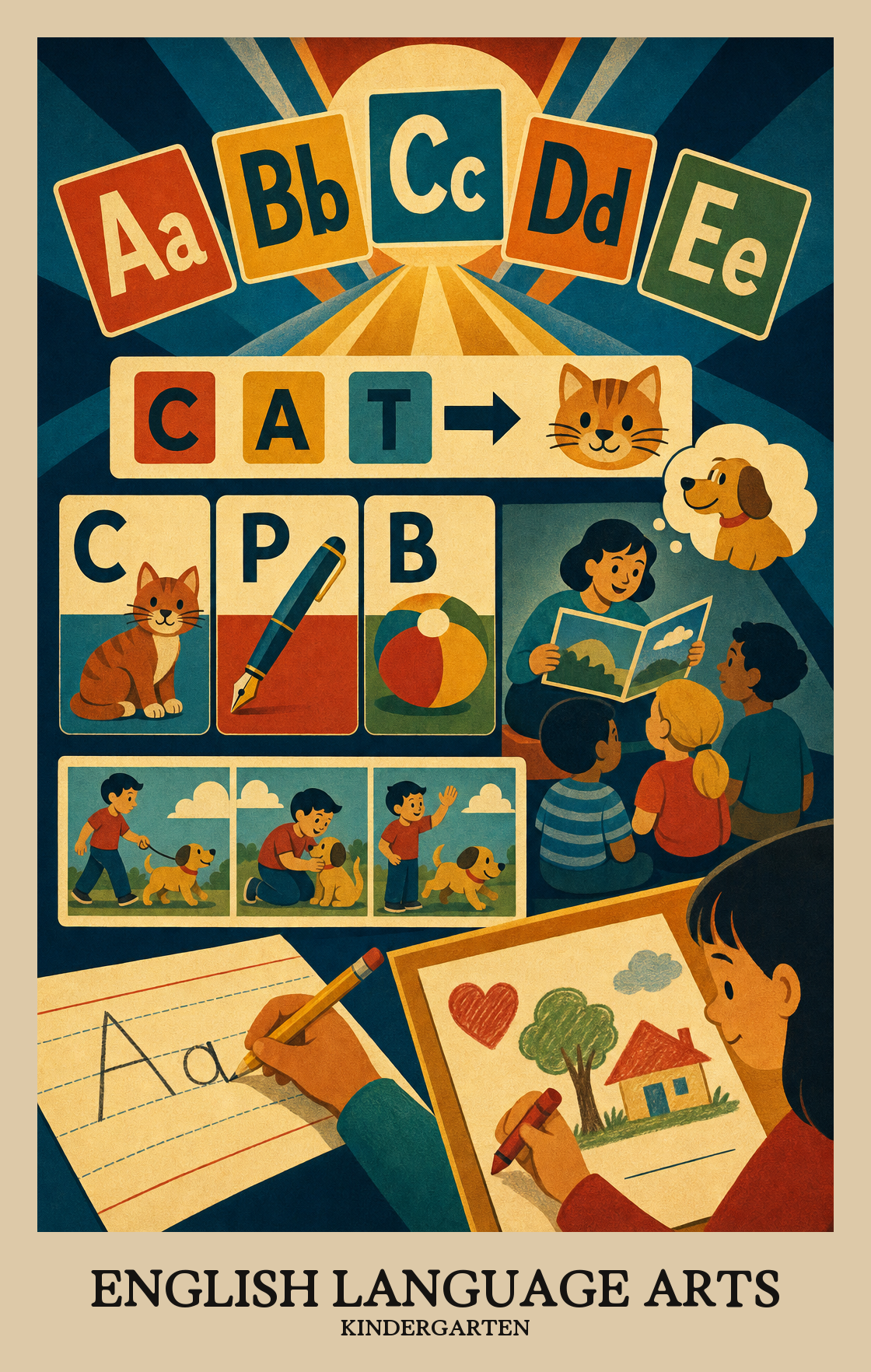
Students learn to name every uppercase and lowercase letter and match each one to its sound. They also figure out how books work, like reading left to right and turning pages in order.
Students play with the sounds inside spoken words. They pick out rhymes, clap syllables, and stretch short words into their separate sounds before blending them back together.
Students start sounding out short words like cat and sun and recognize a small set of common words on sight. With a teacher nearby, they read simple books made from sounds they already know.
Students listen to stories and informational books read aloud, then answer questions about who is in them, where they happen, and what the book is mostly about. They also notice the difference between a made-up story and a true one.
Students share ideas using a mix of pictures, dictated sentences, and their own writing. They practice printing letters, leaving spaces between words, and telling a short story with a beginning, middle, and end.
Students take turns in class conversations, speak loud enough to be heard, and ask questions when something is unclear. They practice listening to classmates and adding on to what someone else said.
Reading starts with hearing how words sound and knowing how letters match those sounds. Students practice breaking words apart and blending them back together so they can read words on the page.
Reading starts with knowing how a book works. Students learn that print moves left to right, that spaces separate words, and that letters on the page match the sounds they say aloud.
Reading starts at the top left of the page and moves right, then down, one line at a time. Students learn that print has a direction, and every page follows the same pattern.
Students name every letter of the alphabet, both the big (uppercase) and small (lowercase) versions, when they see them on paper.
Reading a sentence, students learn that the white gaps between words on a page are what separate one word from the next. Spaces are what make a string of letters readable.
Spoken words are made of smaller parts. Students learn to hear syllables in words, break words into their separate sounds, and put those sounds back together.
Students listen to words and recognize when they rhyme, then make their own rhyming pairs. They also notice when words share the same starting sound, like "big," "ball," and "bug."
Students clap out syllables in longer words and practice pulling them apart or swapping pieces, like turning "cupcake" into "cup" or "snowball" into "snowman."
Students practice hearing and changing individual sounds in short words, like swapping the first sound in "map" to make "cap." This builds the ear-to-letter connection reading depends on.
Sounding out written words by matching letters to their sounds. Students use what they know about letters and letter patterns to read unfamiliar words on the page.
Students sound out short three-letter words like "cat," "hot," and "cup" by matching each letter to its sound. With enough practice, they read those words quickly without stopping to puzzle them out.
Students read common short words like "the," "said," and "you" quickly and without sounding them out, both on a page and when shown the word on its own.
Students read short books made up of words they have already learned in phonics lessons. A teacher or adult is nearby to help when they get stuck.
Students pick up books on their own and read through them, including stories and nonfiction. Over the year they read texts from different kinds of people and communities, not just familiar ones.
Students follow along in a book and fix their own mistakes while reading, using clues in the words and pictures to figure out what they don't understand yet.
With a little help from a teacher, students pick books that connect to who they are and what they care about.
Students read stories and nonfiction books about Dakota and Anishinaabe people, chosen by themselves or their teacher. The texts include both historical accounts and stories from today.
Students pick books or stories that show the lives and experiences of Dakota and Anishinaabe people, past and present. A teacher helps them choose and understand what they read.
Reading carefully to understand what a story or article is really about. Students find the big idea the author wants readers to take away, whether the text is a made-up story or a piece about real life.
Students listen to a story or book, then answer simple questions about what happened, who was in it, and why. A teacher helps by asking guiding questions along the way.
Students pick out what a book or passage is mostly about, usually with a teacher's help.
Students name who is in a story and where it takes place. A teacher or grown-up helps by asking questions and pointing to clues in the pictures and words.
Students find two facts in a nonfiction book and explain how they connect. A teacher or adult helps by asking guiding questions.
Students learn to recognize how a story or book is put together, whether it has characters and a plot, or facts and headings, and use that structure to understand what they're reading. Wait, I used an em dash. Let me fix that. Students learn to notice how a story or book is organized. Recognizing that structure (characters and a plot, or facts and headings) helps them understand and think about what they read.
Students learn which part of a book is the front, which is the back, and where to find the title. With digital text, they practice tapping or scrolling to move through the pages.
Students learn to tell the difference between a storybook (made-up characters and events) and an informational book (real facts about the world). This works whether a teacher reads aloud or students read on their own.
Students look at the pictures in a book and explain how they help tell the story or give information in the words.
Reading a story means asking why the author wrote it this way. Students learn to notice whether a story is real or made up, when it was written, and whose voice is telling it, including Native perspectives like those of the Dakota and Anishinaabe peoples.
Authors write the words in a book. Illustrators draw the pictures. Students learn what each person's job is and how both help tell the story.
This skill starts in first grade. Kindergarteners are not assessed on this one yet.
Students learn that books come in different forms. A storybook tells a made-up tale, a poem plays with words and rhythm, and an informational book shares real facts about the world.
Students listen to a nonfiction text and decide whether the author's point makes sense. They look at the reasons given and say whether those reasons actually back up what the author is saying.
This skill starts in third grade. Kindergarten reading focuses on stories, basic questions, and learning how print works.
Students notice how word choices shape the feel and meaning of a story or book. A scary word and a funny word can send a reading in completely different directions.
Students listen for patterns in read-aloud poems and songs: words that start with the same sound, lines that repeat, and a beat they can clap along to.
Students hear a nonfiction book read aloud and ask about words they don't know. They also answer questions about those words when a teacher asks.
Students look at books, pictures, and other sources to find information. They start to notice whether a source actually answers their question.
Kindergartners are just beginning to explore books and stories. This standard formally starts in first grade.
| Standard | Definition | Code |
|---|---|---|
| Demonstrate knowledge of oral language, phonological and phonemic awareness… | Reading starts with hearing how words sound and knowing how letters match those sounds. Students practice breaking words apart and blending them back together so they can read words on the page. | R1.0.1 |
| Demonstrate understanding of the basic features of print | Reading starts with knowing how a book works. Students learn that print moves left to right, that spaces separate words, and that letters on the page match the sounds they say aloud. | R1.0.1.1.0 |
| Follow words from left to right, top to bottom and page by page | Reading starts at the top left of the page and moves right, then down, one line at a time. Students learn that print has a direction, and every page follows the same pattern. | R1.0.1.1.0.a |
| Recognize and name all uppercase and lowercase letters of the alphabet | Students name every letter of the alphabet, both the big (uppercase) and small (lowercase) versions, when they see them on paper. | R1.0.1.1.0.b |
| Understand that words are separated by spaces in print | Reading a sentence, students learn that the white gaps between words on a page are what separate one word from the next. Spaces are what make a string of letters readable. | R1.0.1.1.0.c |
| Demonstrate understanding of spoken words, syllables and sounds | Spoken words are made of smaller parts. Students learn to hear syllables in words, break words into their separate sounds, and put those sounds back together. | RI.0.1.1.1 |
| Identify and orally produce rhyming words, onset-rime and alliteration | Students listen to words and recognize when they rhyme, then make their own rhyming pairs. They also notice when words share the same starting sound, like "big," "ball," and "bug." | RI.0.1.1.1.a |
| Identify, count, pronounce, blend, segment and manipulate | Students clap out syllables in longer words and practice pulling them apart or swapping pieces, like turning "cupcake" into "cup" or "snowball" into "snowman." | RI.0.1.1.1.b |
| Isolate, pronounce and manipulate sounds in three-phoneme civic words | Students practice hearing and changing individual sounds in short words, like swapping the first sound in "map" to make "cap." This builds the ear-to-letter connection reading depends on. | RI.0.1.1.1.c |
| Know and apply grade-level phonics and word analysis skills in decoding words | Sounding out written words by matching letters to their sounds. Students use what they know about letters and letter patterns to read unfamiliar words on the page. | RI.0.1.1.2 |
| Decode words using one-to-one letter sound correspondences in three-phoneme CVC… | Students sound out short three-letter words like "cat," "hot," and "cup" by matching each letter to its sound. With enough practice, they read those words quickly without stopping to puzzle them out. | RI.0.1.1.2.a |
| Read high-frequency words, in and out of context, demonstrating both accuracy… | Students read common short words like "the," "said," and "you" quickly and without sounding them out, both on a page and when shown the word on its own. | RI.0.1.1.2.b |
| Read decodable texts accurately, with guidance and support | Students read short books made up of words they have already learned in phonics lessons. A teacher or adult is nearby to help when they get stuck. | RI.0.1.1.3 |
| Read and comprehend independently A) both self-selected and teacher-directed… | Students pick up books on their own and read through them, including stories and nonfiction. Over the year they read texts from different kinds of people and communities, not just familiar ones. | R2.0.1 |
| With guidance and support, read and monitor understanding of grade-level text… | Students follow along in a book and fix their own mistakes while reading, using clues in the words and pictures to figure out what they don't understand yet. | R2.0.1.2.1 |
| Choose and read texts that explore personal identity and interests, with… | With a little help from a teacher, students pick books that connect to who they are and what they care about. | R2.0.1.2.2 |
| Read and comprehend independently both self-selected and teacher-directed… | Students read stories and nonfiction books about Dakota and Anishinaabe people, chosen by themselves or their teacher. The texts include both historical accounts and stories from today. | R3.0.1 |
| Choose and read texts that represent perspectives and identities of historical… | Students pick books or stories that show the lives and experiences of Dakota and Anishinaabe people, past and present. A teacher helps them choose and understand what they read. | R3.0.1.3.1 |
| Read critically to comprehend, interpret and analyze themes and central ideas… | Reading carefully to understand what a story or article is really about. Students find the big idea the author wants readers to take away, whether the text is a made-up story or a piece about real life. | R4.0.1 |
| Ask and answer questions about key details in a text, with prompting and… | Students listen to a story or book, then answer simple questions about what happened, who was in it, and why. A teacher helps by asking guiding questions along the way. | R4.0.1.4.1 |
| Identify the topic of a text, with prompting and support | Students pick out what a book or passage is mostly about, usually with a teacher's help. | R4.0.1.4.2 |
| Identify characters and setting, in a literary text, with prompting and support | Students name who is in a story and where it takes place. A teacher or grown-up helps by asking questions and pointing to clues in the pictures and words. | R4.0.1.4.3 |
| Describe the connection between two pieces of information, events, people or… | Students find two facts in a nonfiction book and explain how they connect. A teacher or adult helps by asking guiding questions. | R4.0.1.4.4 |
| Apply knowledge of text structure to understand and evaluate a wide variety of… | Students learn to recognize how a story or book is put together, whether it has characters and a plot, or facts and headings, and use that structure to understand what they're reading. Wait, I used an em dash. Let me fix that. Students learn to notice how a story or book is organized. Recognizing that structure (characters and a plot, or facts and headings) helps them understand and think about what they read. | R5.0.1 |
| Recognize orientation | Students learn which part of a book is the front, which is the back, and where to find the title. With digital text, they practice tapping or scrolling to move through the pages. | R5.0.1.5.1 |
| Recognize the difference between literary and informational text, through… | Students learn to tell the difference between a storybook (made-up characters and events) and an informational book (real facts about the world). This works whether a teacher reads aloud or students read on their own. | R5.0.1.5.2 |
| Recognize the connection between illustrations and text | Students look at the pictures in a book and explain how they help tell the story or give information in the words. | R5.0.1.5.3 |
| Analyze influences on content, meaning and style of text including fact and… | Reading a story means asking why the author wrote it this way. Students learn to notice whether a story is real or made up, when it was written, and whose voice is telling it, including Native perspectives like those of the Dakota and Anishinaabe peoples. | R6.0.1 |
| Define the role of an author and illustrator in telling the story | Authors write the words in a book. Illustrators draw the pictures. Students learn what each person's job is and how both help tell the story. | R6.0.1.6.1 |
| Benchmark starts in grade 1 | This skill starts in first grade. Kindergarteners are not assessed on this one yet. | R6.0.1.6.2 |
| Recognize common types of text | Students learn that books come in different forms. A storybook tells a made-up tale, a poem plays with words and rhythm, and an informational book shares real facts about the world. | R6.0.1.6.3 |
| Evaluate arguments and specific claims from complex informational texts | Students listen to a nonfiction text and decide whether the author's point makes sense. They look at the reasons given and say whether those reasons actually back up what the author is saying. | R7.0.1 |
| Benchmarks begin in grade 3 | This skill starts in third grade. Kindergarten reading focuses on stories, basic questions, and learning how print works. | R7.0.1.7.1 |
| Examine the impact of vocabulary, including words and phrases, on content… | Students notice how word choices shape the feel and meaning of a story or book. A scary word and a funny word can send a reading in completely different directions. | R8.0.1 |
| Recognize rhythm, alliteration and repeated lines in a story, poem or song read… | Students listen for patterns in read-aloud poems and songs: words that start with the same sound, lines that repeat, and a beat they can clap along to. | R8.0.1.8.1 |
| Ask and answer questions about unfamiliar vocabulary in informational text read… | Students hear a nonfiction book read aloud and ask about words they don't know. They also answer questions about those words when a teacher asks. | R8.0.1.8.2 |
| Access and gather information from a variety of sources, representing diverse… | Students look at books, pictures, and other sources to find information. They start to notice whether a source actually answers their question. | R9.0.1 |
| Benchmarks begin in grade 1 | Kindergartners are just beginning to explore books and stories. This standard formally starts in first grade. | R9.0.1.9.1 |
Writing in kindergarten means putting spoken words onto paper. Students practice spelling sounds they hear, forming letters correctly, and using basic rules like spaces between words and capital letters to start a sentence.
Students practice writing both the capital and small version of many letters of the alphabet.
Words on a page are made of letters in a specific order, with spaces between each word. Students learn that sentences are built by arranging those words in order, not at random.
Students match each letter to the sound it makes. When they see the letter B, they know it says "buh", that kind of connection is what early reading and spelling are built on.
Students write regularly across different subjects, sharing their own thoughts and experiences in their own words. The goal is building the habit of putting ideas on paper.
Kindergartners practice writing regularly, using drawings, spoken words, or written letters to share their ideas. A teacher or adult helps them along the way.
Students share what they think, feel, or notice by talking out loud or drawing a picture that shows their own point of view.
Students practice writing in steps: first they plan what to say, then they write it out, then they fix and improve it before sharing it with others.
Students plan and draft a piece of writing with a teacher or group, then look back at it to make it clearer or stronger. At this age, that can mean drawing a picture, saying words aloud, or writing letters and words.
Students write sentences that try to convince someone of something, giving a reason that supports their point. The writing is aimed at a specific reader, not just a general audience.
Students share what they think or believe about something, then back it up with a reason. A teacher helps them say it out loud, draw it, or write it down.
Students write to explain something real, like how an animal lives or how something works. They choose words and details that help the reader understand, not just the writer.
Students pick a topic and say or draw one fact about it. This is the beginning of writing to inform.
Students share what they noticed or felt about a story, by talking about it or drawing a picture. A teacher or adult helps guide the conversation.
Students write their own stories and poems, adding specific details to bring their ideas to life. The goal is learning to choose words that make writing feel vivid and real.
Students tell a story from their own life or about a made-up character, sharing it by talking, drawing, or writing sentences on paper.
Students put a story in order: what happens first, what happens next, and how it ends. With help from a teacher, they learn that stories move in a sequence that makes sense to a reader.
Students ask a question they're curious about, then find answers and turn what they learn into a drawing, story, or simple presentation to share with others.
Students ask questions to help the class explore a topic together, then use what they find to write or create something as a group.
Students find facts or details from a book or website, use them in their writing, and name where the information came from. They also learn that copying someone else's words without credit is not allowed.
This skill starts in first grade. Kindergarten students focus on other writing foundations first.
| Standard | Definition | Code |
|---|---|---|
| Demonstrate knowledge of oral language, orthography, grammar and mechanics to… | Writing in kindergarten means putting spoken words onto paper. Students practice spelling sounds they hear, forming letters correctly, and using basic rules like spaces between words and capital letters to start a sentence. | W1.0.2 |
| Print many uppercase and lowercase letters | Students practice writing both the capital and small version of many letters of the alphabet. | W1.0.2.1.0 |
| Recognize that words are represented in written language by specific sequences… | Words on a page are made of letters in a specific order, with spaces between each word. Students learn that sentences are built by arranging those words in order, not at random. | W1.0.2.1.1 |
| Demonstrate one-to-one letter-sound correspondence | Students match each letter to the sound it makes. When they see the letter B, they know it says "buh", that kind of connection is what early reading and spelling are built on. | W1.0.2.1.2 |
| Write routinely for various purposes and disciplines, representing one's own… | Students write regularly across different subjects, sharing their own thoughts and experiences in their own words. The goal is building the habit of putting ideas on paper. | W2.0.2 |
| Write routinely (may include a combination of drawing, dictating and writing)… | Kindergartners practice writing regularly, using drawings, spoken words, or written letters to share their ideas. A teacher or adult helps them along the way. | W2.0.2.2.1 |
| Share personal perspective, identity and voice, verbally or visually | Students share what they think, feel, or notice by talking out loud or drawing a picture that shows their own point of view. | W2.0.2.2.2 |
| Develop and strengthen writing by using a writing process including planning… | Students practice writing in steps: first they plan what to say, then they write it out, then they fix and improve it before sharing it with others. | W3.0.2 |
| Plan and draft writing | Students plan and draft a piece of writing with a teacher or group, then look back at it to make it clearer or stronger. At this age, that can mean drawing a picture, saying words aloud, or writing letters and words. | W3.0.2.3.1 |
| Write arguments to support claims and to persuade in an analysis of topics or… | Students write sentences that try to convince someone of something, giving a reason that supports their point. The writing is aimed at a specific reader, not just a general audience. | W4.0.2 |
| State a personal opinion for the purpose of sharing, verbally, visually or in… | Students share what they think or believe about something, then back it up with a reason. A teacher helps them say it out loud, draw it, or write it down. | W4.0.2.4.1 |
| Write informative or explanatory texts to examine and convey complex ideas and… | Students write to explain something real, like how an animal lives or how something works. They choose words and details that help the reader understand, not just the writer. | W5.0.2 |
| Make a statement about a topic and offer one or two details about the topic… | Students pick a topic and say or draw one fact about it. This is the beginning of writing to inform. | W5.0.2.5.1 |
| Verbally or visually respond to a story, with support and guidance | Students share what they noticed or felt about a story, by talking about it or drawing a picture. A teacher or adult helps guide the conversation. | W5.0.2.5.2 |
| Write narratives, poetry and other creative texts with details and effective… | Students write their own stories and poems, adding specific details to bring their ideas to life. The goal is learning to choose words that make writing feel vivid and real. | W6.0.2 |
| Tell a story about a personal experience or that of a character, verbally… | Students tell a story from their own life or about a made-up character, sharing it by talking, drawing, or writing sentences on paper. | W6.0.2.6.1 |
| Correctly order beginning, middle and end of a story, with support and guidance | Students put a story in order: what happens first, what happens next, and how it ends. With help from a teacher, they learn that stories move in a sequence that makes sense to a reader. | W6.0.2.6.2 |
| Engage in inquiry-based learning and research processes to create texts and… | Students ask a question they're curious about, then find answers and turn what they learn into a drawing, story, or simple presentation to share with others. | W7.0.2 |
| Ask questions to participate in shared research and writing projects | Students ask questions to help the class explore a topic together, then use what they find to write or create something as a group. | W7.0.2.7.1 |
| Support writing with evidence from sources, correctly citing those sources | Students find facts or details from a book or website, use them in their writing, and name where the information came from. They also learn that copying someone else's words without credit is not allowed. | W8.0.2 |
| Benchmarks begin in grade 1 | This skill starts in first grade. Kindergarten students focus on other writing foundations first. | W8.0.2.8.1 |
Students take turns talking and listening in group conversations, sharing their own stories and ideas while making room for what classmates think and experience too.
Students share their own stories and listen to others, including stories from Dakota and Anishinaabe people. Talking together helps students learn from voices and experiences different from their own.
Students practice the simple rules that make a conversation work, like taking turns, listening while others talk, and treating every voice with respect.
Students take turns talking and listening in a group conversation, keeping the discussion going with more than one back-and-forth exchange.
Students listen to a story or set of directions and follow along in order, tracking what happens first, next, and last.
Students listen to a story, poem, or song and ask questions about what they heard. When something is confusing, they say so and ask for help understanding it.
Students practice choosing their words carefully and speaking in full, clear sentences. They learn to adjust how they talk depending on who is listening, like a teacher versus a friend.
Students practice saying their thoughts out loud so other people can hear and understand them.
Students learn to choose the right words and format for the moment, whether they're sharing a story out loud, writing a sentence, or looking at a picture. The goal is to think about who's listening or reading before they speak or create.
With help from a teacher, students share what they know by drawing, talking, or making something simple like a picture or short recording.
Students make a simple digital or multimedia project, like a drawing with recorded voice or a slideshow, to share a story or idea. A teacher helps them think about who will see it and what it means to put something online.
| Standard | Definition | Code |
|---|---|---|
| Exchange ideas in discussion and collaboration, as listener, speaker and… | Students take turns talking and listening in group conversations, sharing their own stories and ideas while making room for what classmates think and experience too. | LSVEI1.03 |
| Exchange ideas in storytelling, discussion and collaboration, with intentional… | Students share their own stories and listen to others, including stories from Dakota and Anishinaabe people. Talking together helps students learn from voices and experiences different from their own. | LSVEI1.0.3.1.1 |
| Help create and follow agreed-upon norms for a discussion | Students practice the simple rules that make a conversation work, like taking turns, listening while others talk, and treating every voice with respect. | LSVEI1.0.3.1.1.a |
| Participate as a speaker and listener | Students take turns talking and listening in a group conversation, keeping the discussion going with more than one back-and-forth exchange. | LSVEI1.0.3.1.1.b |
| Follow sequence of a story or discussion or steps in a process | Students listen to a story or set of directions and follow along in order, tracking what happens first, next, and last. | LSVEI1.0.3.1.1.c |
| Confirm understanding of a text read aloud or information presented orally or… | Students listen to a story, poem, or song and ask questions about what they heard. When something is confusing, they say so and ask for help understanding it. | LSVEI1.0.3.1.2 |
| Communicate with others, applying knowledge of vocabulary, language, structure… | Students practice choosing their words carefully and speaking in full, clear sentences. They learn to adjust how they talk depending on who is listening, like a teacher versus a friend. | LSVEI2.03 |
| Speak audibly and express thoughts, feelings and ideas clearly | Students practice saying their thoughts out loud so other people can hear and understand them. | LSVEI2.0.3.2.1 |
| Thoughtfully and safely access, analyze | Students learn to choose the right words and format for the moment, whether they're sharing a story out loud, writing a sentence, or looking at a picture. The goal is to think about who's listening or reading before they speak or create. | LSVEI3.03 |
| Create written, oral and digital content that communicates knowledge and ideas… | With help from a teacher, students share what they know by drawing, talking, or making something simple like a picture or short recording. | LSVEI3.0.3.3.1 |
| With prompting and support, create an individual or shared multimedia work for… | Students make a simple digital or multimedia project, like a drawing with recorded voice or a slideshow, to share a story or idea. A teacher helps them think about who will see it and what it means to put something online. | LSVEI3.0.3.3.2 |
Standards-based reading assessment for grades 3 through 8 and grade 10, aligned to Minnesota Academic Standards.
Alternate standards-based assessment for eligible students with the most significant cognitive disabilities, administered in the same subjects and grades as the MCA program.
Students should know all the letter names and the sounds each letter makes. They should sound out short words like cat, sit, and mop, and read a handful of common words like the, is, and and on sight. Short, simple books should feel doable with help.
Read a picture book out loud and run a finger under the words as you go. Then pick three words on the page and ask what sounds they hear at the start and end. Rhyming games in the car count too.
Reversed letters are normal at this age. Keep practicing by writing names, labels for drawings, and short notes to family. Focus on the sounds in the word, not perfect handwriting.
Start with letter names and sounds, then move to blending and segmenting sounds in short words like sun and map. Add common sight words in small batches once students can hear and stretch sounds. Decodable books come in as soon as a few letter sounds are solid.
Hearing and pulling apart the separate sounds in a word is the skill that holds students back most. Lowercase letter names, especially b, d, p, and q, also need steady review. Build five minutes of sound work into the daily routine.
Writing at this age is a mix of drawing, labels, and short sentences. Students should be able to share an opinion, tell a story with a beginning and end, or give a fact about a topic, using pictures and a few written words. Spelling will be by sound.
Yes, a small set of common words like the, was, you, and said should be recognized on sight by spring. Write five on index cards and flip through them while making dinner. Stop once it stops being fun.
By spring, students should read short decodable books with help, retell the basic story, and answer simple questions about characters and what happened. They should also write a sentence or two about a picture using sounds they hear. Fluency comes later.
Many students leave this grade sounding out words slowly, and that is fine. What matters is steady progress with letter sounds and hearing the parts of words. Talk to the teacher if letter sounds still feel stuck by spring.