How government works
Students start the year looking at how the United States is set up. They learn how local, state, federal, and Tribal governments make decisions, and what rights and duties citizens have inside that system.
This is the year social studies asks students to think like citizens, not just memorize facts. Students dig into how the U.S. government works, why people disagree about laws and rights, and how Tribal Nations operate as their own governments. They also weigh trade-offs in everyday money choices and read history from more than one point of view. By spring, they can take a current issue in the news, trace its roots, and back up an opinion with real evidence.
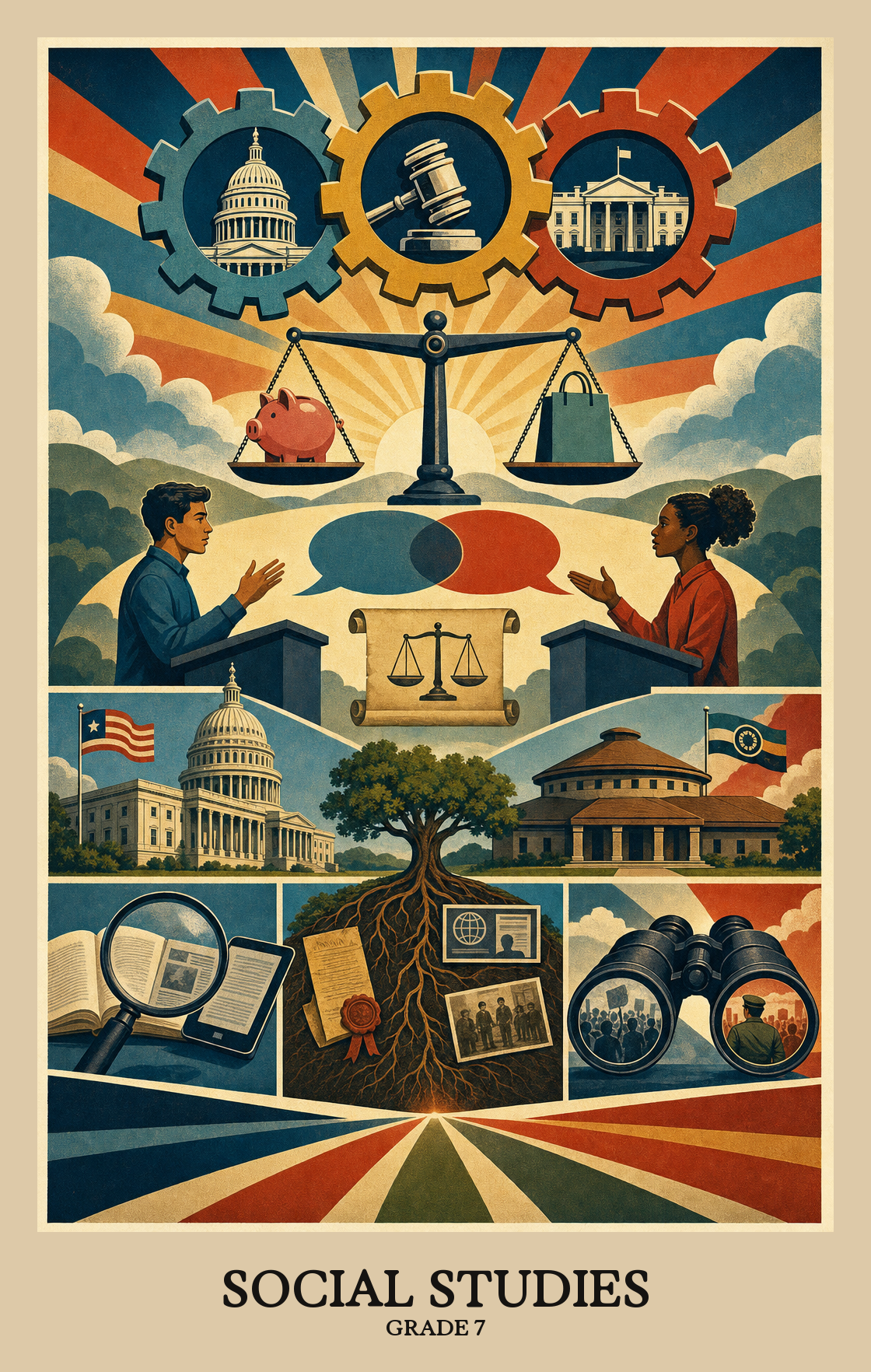
Students start the year looking at how the United States is set up. They learn how local, state, federal, and Tribal governments make decisions, and what rights and duties citizens have inside that system.
Students dig into how laws and policies actually get made, and how regular people push for change. They look at real examples of communities organizing to fix a problem they cared about.
Students study how people and countries make economic choices when there isn't enough to go around. They look at personal money goals, how prices and incentives work, and why nations trade with each other.
Students use maps and mapping tools to ask questions about where people live, work, and move. They look at how culture and power shape a place, including the places they know in Minnesota.
Students work like historians. They read letters, photos, and other primary sources, notice whose stories are missing, and build arguments about the past using evidence from more than one source.
Students close the year connecting the past to the present. They study how communities have pushed back against unfair treatment, and trace the roots of an issue they see in their own community.
Civic reasoning means thinking through real public issues and deciding how to act on them. Students practice the habits of an engaged citizen: weighing evidence, forming a position, and taking part in decisions that affect a community.
Students explain the core values behind democracy, such as equality, rights, and majority rule, then look at where those values clash inside the U.S. government. Real tensions, like balancing individual freedoms against the common good, are part of the analysis.
Students explain what rights citizens have in a democracy and weigh them against the duties that come with those rights, like voting, serving on a jury, or following laws.
Students learn how laws get made and changed at every level of government, from city hall to Congress to Tribal Nations. They also look at whether those rules are working the way they should.
Students study how laws and community rules get made, and who influences them. That includes looking at how everyday people, local groups, and government offices each push policy in different directions.
Students examine how Tribal Nations hold their own governing authority while also maintaining a distinct legal relationship with the federal government. They look at what that means for how tribal communities make laws and decisions.
| Standard | Definition | Code |
|---|---|---|
| Civic Skills: Apply civic reasoning and demonstrate civic skills for the… | Civic reasoning means thinking through real public issues and deciding how to act on them. Students practice the habits of an engaged citizen: weighing evidence, forming a position, and taking part in decisions that affect a community. | 7.1.1.1 |
| Democratic Values and Principles: Explain democratic values and principles that… | Students explain the core values behind democracy, such as equality, rights, and majority rule, then look at where those values clash inside the U.S. government. Real tensions, like balancing individual freedoms against the common good, are part of the analysis. | 7.1.2.1 |
| Rights and Responsibilities | Students explain what rights citizens have in a democracy and weigh them against the duties that come with those rights, like voting, serving on a jury, or following laws. | 7.1.3.1 |
| Governmental Institutions and Political Processes: Explain and evaluate… | Students learn how laws get made and changed at every level of government, from city hall to Congress to Tribal Nations. They also look at whether those rules are working the way they should. | 7.1.4.1 |
| Public Policy: Analyze how public policy is shaped by governmental and… | Students study how laws and community rules get made, and who influences them. That includes looking at how everyday people, local groups, and government offices each push policy in different directions. | 7.1.5.1 |
| Tribal Nations: Evaluate the unique political status, trust relationships and… | Students examine how Tribal Nations hold their own governing authority while also maintaining a distinct legal relationship with the federal government. They look at what that means for how tribal communities make laws and decisions. | 7.1.6.1 |
Students pick a real economic question, use data and economic models to build an argument, and propose a solution. Then they think through how that solution would affect different groups of people.
Scarcity means there isn't enough of something to go around, so people and governments have to choose who gets what. Every choice has a trade-off: picking one thing means giving up another, and those decisions shape who benefits and who doesn't.
Students set short- and long-term money goals and map out steps to reach them. They also look at real-world conditions, like job markets or family history, that can make building wealth harder or easier.
Students look at how different economies decide who gets goods and services, and why. They examine what motivates buyers, sellers, and governments to make the choices they do, then weigh what actually happens as a result.
Students learn why countries buy and sell goods across borders, and what those deals actually cost. They weigh who benefits from global trade, who gets left out, and what happens to local communities and the environment when goods move around the world.
| Standard | Definition | Code |
|---|---|---|
| Economic Inquiry: Use economic models and reasoning and data analysis to… | Students pick a real economic question, use data and economic models to build an argument, and propose a solution. Then they think through how that solution would affect different groups of people. | 7.2.7.1 |
| Fundamental Economic Concepts: Analyze how scarcity and artificial shortages… | Scarcity means there isn't enough of something to go around, so people and governments have to choose who gets what. Every choice has a trade-off: picking one thing means giving up another, and those decisions shape who benefits and who doesn't. | 7.2.8.1 |
| Personal Finance: Apply economic concepts and models to develop individual… | Students set short- and long-term money goals and map out steps to reach them. They also look at real-world conditions, like job markets or family history, that can make building wealth harder or easier. | 7.2.9.1 |
| Microeconomics: Explain and evaluate how resources are used and how goods and… | Students look at how different economies decide who gets goods and services, and why. They examine what motivates buyers, sellers, and governments to make the choices they do, then weigh what actually happens as a result. | 7.2.10.1 |
| Global and International | Students learn why countries buy and sell goods across borders, and what those deals actually cost. They weigh who benefits from global trade, who gets left out, and what happens to local communities and the environment when goods move around the world. | 7.2.12.1 |
Students use maps, satellite images, and digital tools to ask geographic questions and find patterns about places and people in the world.
Students use maps, satellite images, and digital tools to figure out why things happen where they do. They ask geographic questions and use real data to answer them.
Students describe a place or region and explain how governments, rulers, or powerful groups have shaped what it looks like and how it functions.
Students study how people, goods, and ideas move between communities, countries, and regions. They look at what connects local neighborhoods to global systems, whether through trade, migration, or shared politics.
Students look at a familiar place, like a neighborhood or river, and examine how people from different cultural backgrounds see it differently. The same spot can hold different meanings, histories, and importance depending on who is describing it.
| Standard | Definition | Code |
|---|---|---|
| Geospatial Skills and Inquiry | Students use maps, satellite images, and digital tools to ask geographic questions and find patterns about places and people in the world. | 7.3.13.1 |
| Geospatial Skills and Inquiry | Students use maps, satellite images, and digital tools to figure out why things happen where they do. They ask geographic questions and use real data to answer them. | 7.3.13.2 |
| Places and Regions: Describe places and regions, explaining how they are… | Students describe a place or region and explain how governments, rulers, or powerful groups have shaped what it looks like and how it functions. | 7.3.14.1 |
| Human Systems: Analyze patterns of movement and interconnectedness within… | Students study how people, goods, and ideas move between communities, countries, and regions. They look at what connects local neighborhoods to global systems, whether through trade, migration, or shared politics. | 7.3.15.1 |
| Culture: Investigate how sense of place is impacted by different cultural… | Students look at a familiar place, like a neighborhood or river, and examine how people from different cultural backgrounds see it differently. The same spot can hold different meanings, histories, and importance depending on who is describing it. | 7.3.17.1 |
Students learn to question who wrote the history they're reading and whose story might be missing. They look at what stayed the same over time and what changed, then weigh different accounts of the same events.
Students learn to ask questions about historical events from multiple angles, including the perspectives often left out of textbooks. They look for what changed over time, what stayed the same, and whose story is being told.
Students practice asking questions about historical events to uncover whose stories get told and whose get left out. They look at what changed over time and what stayed the same, then compare the main version of history with the versions that often get overlooked.
Students look at the same historical event from more than one angle, including voices that history books often leave out. They ask questions about why things changed, what stayed the same, and whose story is being told.
Reading history means understanding that two people can witness the same event and describe it very differently. Students learn to spot whose viewpoint a source reflects and why that person saw things the way they did.
Reading the same historical event through different eyes can lead to very different stories. Students learn to spot those differences and explain why a person's background, beliefs, or experiences shape what they notice and what they leave out.
Students read original documents and later accounts of the same event, then ask whose voices are missing. They also consider why each source was written, who it was written for, and what the author believed.
Students read original documents and later accounts of historical events, then ask whose voices are missing and why the source was written. They consider who the author was trying to reach and what that person believed.
Students read firsthand accounts and later summaries of events, then ask whose voices are missing. They look at when a source was made, who it was written for, and what the author was trying to prove.
Students pull facts and details from several historical sources, then build a clear argument or story that explains why events happened the way they did.
Students pull facts and details from several historical sources, then build an argument or story that explains what happened and why. The reasoning has to hold up across all the sources, not just one.
Students pull together details from several different historical sources and use them to build one clear argument or story about what happened and why.
Students pick a problem in the world today, then trace it back through history to find where it started. They finish by sketching a plan to address it.
Students trace a current real-world problem back to its historical roots, then build a plan to address it. They practice the same skills historians use: finding sources, weighing evidence, and drawing connections across time.
| Standard | Definition | Code |
|---|---|---|
| Context, Change, and Continuity: Ask historical questions about context… | Students learn to question who wrote the history they're reading and whose story might be missing. They look at what stayed the same over time and what changed, then weigh different accounts of the same events. | 7.4.18.1 |
| Context, Change, and Continuity: Ask historical questions about context… | Students learn to ask questions about historical events from multiple angles, including the perspectives often left out of textbooks. They look for what changed over time, what stayed the same, and whose story is being told. | 7.4.18.2 |
| Context, Change, and Continuity: Ask historical questions about context… | Students practice asking questions about historical events to uncover whose stories get told and whose get left out. They look at what changed over time and what stayed the same, then compare the main version of history with the versions that often get overlooked. | 7.4.18.3 |
| Context, Change, and Continuity: Ask historical questions about context… | Students look at the same historical event from more than one angle, including voices that history books often leave out. They ask questions about why things changed, what stayed the same, and whose story is being told. | 7.4.18.4 |
| Historical Perspectives | Reading history means understanding that two people can witness the same event and describe it very differently. Students learn to spot whose viewpoint a source reflects and why that person saw things the way they did. | 7.4.19.1 |
| Historical Perspectives | Reading the same historical event through different eyes can lead to very different stories. Students learn to spot those differences and explain why a person's background, beliefs, or experiences shape what they notice and what they leave out. | 7.4.19.2 |
| Historical Sources and Evidence: Investigate a variety of historical sources… | Students read original documents and later accounts of the same event, then ask whose voices are missing. They also consider why each source was written, who it was written for, and what the author believed. | 7.4.20.1 |
| Historical Sources and Evidence: Investigate a variety of historical sources… | Students read original documents and later accounts of historical events, then ask whose voices are missing and why the source was written. They consider who the author was trying to reach and what that person believed. | 7.4.20.2 |
| Historical Sources and Evidence: Investigate a variety of historical sources… | Students read firsthand accounts and later summaries of events, then ask whose voices are missing. They look at when a source was made, who it was written for, and what the author was trying to prove. | 7.4.20.3 |
| Causation and Argumentation: Integrate evidence from multiple… | Students pull facts and details from several historical sources, then build a clear argument or story that explains why events happened the way they did. | 7.4.21.1 |
| Causation and Argumentation: Integrate evidence from multiple… | Students pull facts and details from several historical sources, then build an argument or story that explains what happened and why. The reasoning has to hold up across all the sources, not just one. | 7.4.21.2 |
| Causation and Argumentation: Integrate evidence from multiple… | Students pull together details from several different historical sources and use them to build one clear argument or story about what happened and why. | 7.4.21.3 |
| Connecting Past and Present | Students pick a problem in the world today, then trace it back through history to find where it started. They finish by sketching a plan to address it. | 7.4.22.1 |
| Connecting Past and Present | Students trace a current real-world problem back to its historical roots, then build a plan to address it. They practice the same skills historians use: finding sources, weighing evidence, and drawing connections across time. | 7.4.22.2 |
Students examine how the words people use and the rules societies make shape what it means to belong to a racial, religious, or ethnic group. Then they connect those ideas to their own identities and to communities in Minnesota whose histories have often been left out of the mainstream story.
Students learn how people and communities have pushed back against unfair systems to win lasting rights and freedoms. They study real strategies that worked, then think about how to act alongside others today.
Students learn how people and communities have pushed back against unfair systems, from local neighborhoods to global movements. They look at which strategies created lasting change, then work with others to take real action for equal rights and dignity.
Students learn research methods rooted in ethnic and Indigenous communities to trace how past injustices shaped systems that still exist today. The goal is to use those lessons to understand what change has looked like and what it might take now.
Students learn to use sources and research methods from ethnic and Indigenous studies to trace how today's systems of inequality took shape. The goal is to draw lessons from that history and apply them to addressing injustice now.
| Standard | Definition | Code |
|---|---|---|
| Identity: Analyze the ways power and language construct the social identities… | Students examine how the words people use and the rules societies make shape what it means to belong to a racial, religious, or ethnic group. Then they connect those ideas to their own identities and to communities in Minnesota whose histories have often been left out of the mainstream story. | 7.5.23.1 |
| Resistance: Describe how individuals and communities have fought for freedom… | Students learn how people and communities have pushed back against unfair systems to win lasting rights and freedoms. They study real strategies that worked, then think about how to act alongside others today. | 7.5.24.1 |
| Resistance: Describe how individuals and communities have fought for freedom… | Students learn how people and communities have pushed back against unfair systems, from local neighborhoods to global movements. They look at which strategies created lasting change, then work with others to take real action for equal rights and dignity. | 7.5.24.2 |
| Ways of Knowing and Methodologies: Use ethnic and Indigenous studies methods… | Students learn research methods rooted in ethnic and Indigenous communities to trace how past injustices shaped systems that still exist today. The goal is to use those lessons to understand what change has looked like and what it might take now. | 7.5.25.1 |
| Ways of Knowing and Methodologies: Use ethnic and Indigenous studies methods… | Students learn to use sources and research methods from ethnic and Indigenous studies to trace how today's systems of inequality took shape. The goal is to draw lessons from that history and apply them to addressing injustice now. | 7.5.25.2 |
Federally administered sample-based assessment in reading, mathematics, science, writing, and other subjects. NAEP results inform state-by-state comparisons rather than individual student or school accountability.
Students study how government works, how money and trade shape choices, how places and people connect, and how to read history from more than one point of view. A lot of the work is reading a source, asking who wrote it and why, and building an argument with evidence.
Talk about the news at dinner and ask who is affected and who decides. When a topic comes up, pull up a map, a short article, or a primary source and ask what the writer wants the reader to believe. Ten minutes of real conversation beats a worksheet.
Tie it to something they care about: a sport, a song, a local place, a family story. Then ask where that thing came from and who shaped it. History gets interesting when students see that someone made a choice and it could have gone another way.
Students can take two or three sources, weigh them against each other, and write a short argument that uses evidence from each. They can also explain how a current issue connects to something older, and name a few ways people have pushed for change.
Pick a few anchor questions about power, place, and change, then pull civics, economics, geography, history, and ethnic studies into each one. Sequencing by theme keeps the strands talking to each other instead of sitting in separate units that students never connect.
Sourcing and corroboration. Students can summarize a document, but they struggle to ask who wrote it, who is missing from it, and whether another source agrees. Build short, repeated practice with two sources side by side from the first week.
Ask three questions before they write: What is your claim, what evidence backs it up, and what would someone who disagrees say? If they can answer all three out loud, the writing gets much easier. Keep paragraphs short and tied to evidence.
Most events look different depending on who is telling the story. Students practice noticing whose voice is in a source and whose is missing, because that is how careful readers and informed voters think. It is a skill that pays off well past this class.
Watch for three signs: they can read a primary source and question it, they can connect a past event to a present issue, and they can write a short evidence-based argument without being walked through it. If those are solid, the next grade builds cleanly on them.