Letters, sounds, and book basics
Students learn the names and sounds of every letter, upper and lower case. They start to see that books are read left to right and that the words on the page match the words being said out loud.
This is the year letters and sounds start clicking into reading. Students learn every letter, match each one to the sound it makes, and blend those sounds to read short, simple words like cat and sun. They listen to stories and answer questions about who is in them and what happens. By spring, they can read a few easy words on their own and draw or write a sentence that starts with a capital letter and ends with a period.
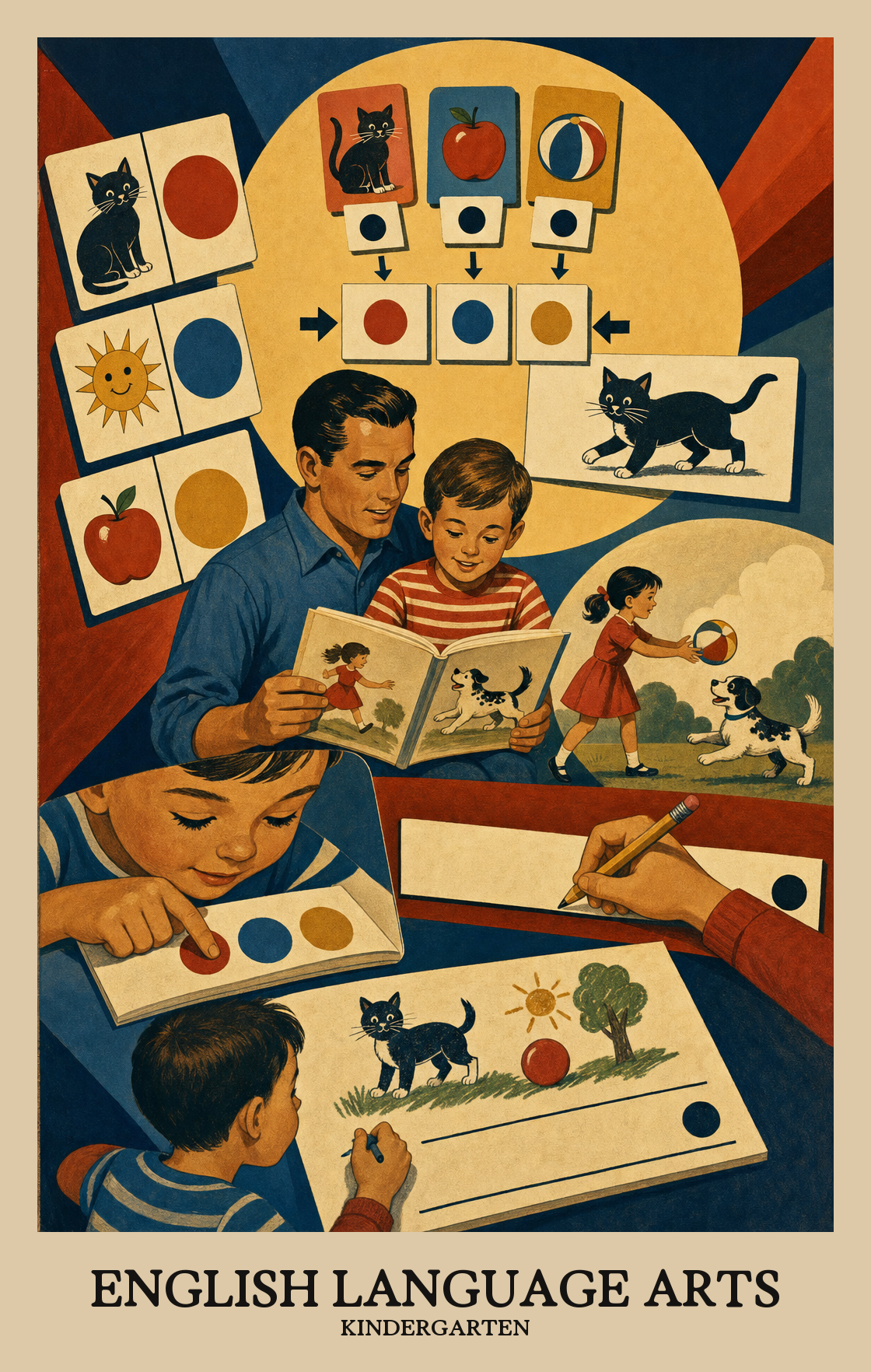
Students learn the names and sounds of every letter, upper and lower case. They start to see that books are read left to right and that the words on the page match the words being said out loud.
Students play with the sounds inside spoken words. They make rhymes, spot the first and last sound in a word like cat, and pull a short word apart sound by sound.
Students blend letter sounds together to read simple words like sat and pin. They start to recognize common words on sight, such as the and is, and read short, easy books on their own.
During read-alouds, students answer questions about what happened, name the characters and setting, and retell the main events. With nonfiction, they say what the book was about and share a few facts they remember.
Students draw and write to tell a story, share an opinion, or explain something they know. They print letters, use a capital at the start of a sentence, and end with a punctuation mark.
A teacher reads a story or book out loud, and students show they understood it by answering questions or talking about what happened.
A teacher reads a story or book out loud, and students ask and answer questions about what they heard. This builds the habit of thinking carefully about what a story or book is saying.
Reading new words is the focus here. With a teacher's help, students learn what unfamiliar words mean and start building the word knowledge they'll use in every subject.
Students use words they picked up from conversations, books read aloud, and stories to talk and write about what they've read.
Students build the habit of sitting quietly with a book on their own, without stopping after just a page or two.
Reading a story, poem, or simple play out loud, then talking through what it means and what might happen next. Students practice figuring out things the author hints at but never says directly.
Reading a story together, students name where and when it happens, who is in it, and what the main things that occur are.
Nonfiction books use tools like titles, photos, and captions to help readers understand the topic. Students learn to use those features to figure out what a book is about and what the author is trying to say.
Students listen to or look at a nonfiction book and point out what the whole book is about, then find words or pictures that give more detail about that topic.
Nonfiction books are built with titles, headings, and captions to help readers find information. Students learn to use those parts to figure out what a book is saying, even when the answer is not spelled out directly.
Students pick out what a nonfiction book is mostly about and remember the important details that support it. Think of it as finding the big idea and the facts that back it up.
| Standard | Definition | Code |
|---|---|---|
| With assistance, develop and demonstrate comprehension-reading skills in… | A teacher reads a story or book out loud, and students show they understood it by answering questions or talking about what happened. | K.R.1.A |
| Asking and responding to questions about texts read aloud | A teacher reads a story or book out loud, and students ask and answer questions about what they heard. This builds the habit of thinking carefully about what a story or book is saying. | K.R.1.A.b |
| With assistance, develop an understanding of vocabulary | Reading new words is the focus here. With a teacher's help, students learn what unfamiliar words mean and start building the word knowledge they'll use in every subject. | K.R.1.B |
| Using words and phrases acquired through conversations, reading and being read… | Students use words they picked up from conversations, books read aloud, and stories to talk and write about what they've read. | K.R.1.B.e |
| Read independently for sustained periods of time | Students build the habit of sitting quietly with a book on their own, without stopping after just a page or two. | K.R.1.D |
| With assistance, read, infer and draw conclusions using fiction texts including… | Reading a story, poem, or simple play out loud, then talking through what it means and what might happen next. Students practice figuring out things the author hints at but never says directly. | K.R.2.A |
| Identify elements of a story, including setting, characters | Reading a story together, students name where and when it happens, who is in it, and what the main things that occur are. | K.R.2.A.a |
| With assistance, read, infer and draw conclusions using text features… | Nonfiction books use tools like titles, photos, and captions to help readers understand the topic. Students learn to use those features to figure out what a book is about and what the author is trying to say. | K.R.3.A |
| Identify the topic and details in an expository text heard and/or… | Students listen to or look at a nonfiction book and point out what the whole book is about, then find words or pictures that give more detail about that topic. | K.R.3.A.a |
| With assistance, read, infer and draw conclusions using text structures in… | Nonfiction books are built with titles, headings, and captions to help readers find information. Students learn to use those parts to figure out what a book is saying, even when the answer is not spelled out directly. | K.R.3.C |
| Name the main topic and recall key details of the text | Students pick out what a nonfiction book is mostly about and remember the important details that support it. Think of it as finding the big idea and the facts that back it up. | K.R.3.C.c |
Knowing that print is read left to right and top to bottom. Students learn that words on a page have spaces between them and that letters form words with meaning.
Students name each letter of the alphabet in both its capital and small form. This is one of the first steps toward reading words on a page.
Reading a book means starting at the top left of the page and moving right across each line, then dropping down to the next line. Students practice this direction every time they follow along in a story.
Students point to each word on the page while saying it aloud, matching every spoken word to a printed one. This is how they learn that the words they say and the words on the page line up.
Students listen for individual sounds in spoken words, like noticing that "cat" has three sounds: /k/, /a/, /t/. This is the ear-training behind learning to read.
Students listen to a spoken word and pick out the individual sounds inside it. For example, "cat" has three sounds: /k/, /a/, and /t/.
Students hear a word out loud and say a word that rhymes with it. This is an early step in learning how sounds in words work.
Students listen to two words and decide if they rhyme. For example, "cat" and "hat" rhyme, but "cat" and "dog" do not.
Students hear a word split into its starting sound and ending chunk, then push them together to say the whole word. For example, a teacher says "/c/... at" and students blend it into "cat."
Students hear separate sounds spoken aloud and blend them into a single word. For example, they hear /k/ /a/ /t/ and say "cat."
Students listen to a word and pick out the first sound, the middle sound, and the last sound. Say "cat" and students can tell you it starts with /k/, has /a/ in the middle, and ends with /t/.
Students break a spoken word into its individual sounds. For example, "cat" becomes three sounds: /k/, /a/, /t/.
Students learn to match letters to the sounds they make. That skill is what lets them start sounding out real words.
Students match letters to the sounds they make, focusing on short vowel sounds like the "a" in "cat" and common consonant sounds. They write those letters when they hear the sounds in words.
Students read common short words by sight, like "the," "is," and "are," without sounding them out. Recognizing these words on the spot helps students read sentences smoothly from the start.
Students hear each sound in a short word, then blend those sounds together to read the word as a whole. This is one of the first steps toward reading simple books on their own.
Changing one letter in a word makes a brand-new word. Students practice spotting those changes and use what they know about letter sounds to write simple words and short messages.
| Standard | Definition | Code |
|---|---|---|
| Develop print awareness in the reading process | Knowing that print is read left to right and top to bottom. Students learn that words on a page have spaces between them and that letters form words with meaning. | K.RF.1.A |
| Identifying all upper- and lower-case letters | Students name each letter of the alphabet in both its capital and small form. This is one of the first steps toward reading words on a page. | K.RF.1.A.a |
| Demonstrating that books are read left to right, top to bottom | Reading a book means starting at the top left of the page and moving right across each line, then dropping down to the next line. Students practice this direction every time they follow along in a story. | K.RF.1.A.c |
| Demonstrating one-to-one correspondence between spoken words and written words | Students point to each word on the page while saying it aloud, matching every spoken word to a printed one. This is how they learn that the words they say and the words on the page line up. | K.RF.1.A.f |
| Develop phonemic awareness in the reading process | Students listen for individual sounds in spoken words, like noticing that "cat" has three sounds: /k/, /a/, /t/. This is the ear-training behind learning to read. | K.RF.2.A |
| Identifying sounds in spoken words | Students listen to a spoken word and pick out the individual sounds inside it. For example, "cat" has three sounds: /k/, /a/, and /t/. | K.RF.2.A.a |
| Produce rhymes in response to spoken words | Students hear a word out loud and say a word that rhymes with it. This is an early step in learning how sounds in words work. | K.RF.2.A.b |
| Distinguishing orally presented rhyming pairs of words from nonrhyming pairs | Students listen to two words and decide if they rhyme. For example, "cat" and "hat" rhyme, but "cat" and "dog" do not. | K.RF.2.A.c |
| Blending spoken onsets and rimes to form simple words | Students hear a word split into its starting sound and ending chunk, then push them together to say the whole word. For example, a teacher says "/c/... at" and students blend it into "cat." | K.RF.2.A.e |
| Blending spoken phonemes to form one-syllable words | Students hear separate sounds spoken aloud and blend them into a single word. For example, they hear /k/ /a/ /t/ and say "cat." | K.RF.2.A.f |
| Isolating the initial, medial | Students listen to a word and pick out the first sound, the middle sound, and the last sound. Say "cat" and students can tell you it starts with /k/, has /a/ in the middle, and ends with /t/. | K.RF.2.A.g |
| Segmenting spoken words into two or three phonemes | Students break a spoken word into its individual sounds. For example, "cat" becomes three sounds: /k/, /a/, /t/. | K.RF.2.A.h |
| Develop phonics in the reading process | Students learn to match letters to the sounds they make. That skill is what lets them start sounding out real words. | K.RF.3.A |
| Producing and writing letter | Students match letters to the sounds they make, focusing on short vowel sounds like the "a" in "cat" and common consonant sounds. They write those letters when they hear the sounds in words. | K.RF.3.A.a |
| Reading high-frequency words | Students read common short words by sight, like "the," "is," and "are," without sounding them out. Recognizing these words on the spot helps students read sentences smoothly from the start. | K.RF.3.A.b |
| Blending letter sounds to decode simple words | Students hear each sound in a short word, then blend those sounds together to read the word as a whole. This is one of the first steps toward reading simple books on their own. | K.RF.3.A.c |
| Recognizing that new words can be created when letters are changed, added, or… | Changing one letter in a word makes a brand-new word. Students practice spotting those changes and use what they know about letter sounds to write simple words and short messages. | K.RF.3.A.d |
Students share what they think or prefer about a topic by drawing a picture or writing words to explain their choice. A teacher or adult helps them get their ideas onto the page.
Students draw a picture or write words to share what they know about a topic. A teacher or adult helps them get their ideas onto the page.
Students draw pictures or write simple words to tell a short story or poem. A teacher or adult helps them get started.
| Standard | Definition | Code |
|---|---|---|
| With assistance, draw/write opinion texts | Students share what they think or prefer about a topic by drawing a picture or writing words to explain their choice. A teacher or adult helps them get their ideas onto the page. | K.W.2.A |
| With assistance, draw/write informative/explanatory texts | Students draw a picture or write words to share what they know about a topic. A teacher or adult helps them get their ideas onto the page. | K.W.2.B |
| With assistance, draw/write fiction or non-fiction narratives and poems | Students draw pictures or write simple words to tell a short story or poem. A teacher or adult helps them get started. | K.W.2.C |
Students learn to write sentences that follow the basic rules of English grammar, like using capital letters, spacing between words, and matching words the way a fluent speaker would.
Students practice writing full sentences together as a class, not just single words or phrases. A complete sentence has a subject and a verb, like "The dog runs."
Students learn to start sentences with a capital letter, end them with the right punctuation mark, and spell out simple words when they write.
Students practice writing every letter of the alphabet in both its big form (A, B, C) and its small form (a, b, c).
Students learn that every sentence needs a punctuation mark at the end, like a period, a question mark, or an exclamation point, to show where the sentence stops.
Students learn to start every sentence with a capital letter. It is one of the first rules of written English.
| Standard | Definition | Code |
|---|---|---|
| In written text, apply standard English grammar | Students learn to write sentences that follow the basic rules of English grammar, like using capital letters, spacing between words, and matching words the way a fluent speaker would. | K.L.1.A |
| Demonstrate the use of complete sentences in shared language activities | Students practice writing full sentences together as a class, not just single words or phrases. A complete sentence has a subject and a verb, like "The dog runs." | K.L.1.A.d |
| In written text, apply punctuation, capitalization and spelling | Students learn to start sentences with a capital letter, end them with the right punctuation mark, and spell out simple words when they write. | K.L.1.B |
| Print in upper and lowercase letters | Students practice writing every letter of the alphabet in both its big form (A, B, C) and its small form (a, b, c). | K.L.1.B.a |
| Recognize that a sentence ends with punctuation marks | Students learn that every sentence needs a punctuation mark at the end, like a period, a question mark, or an exclamation point, to show where the sentence stops. | K.L.1.B.b |
| Capitalize first word in a sentence | Students learn to start every sentence with a capital letter. It is one of the first rules of written English. | K.L.1.B.d |
Students practice speaking in front of others with clear words and a steady voice, whether alone or with a small group.
After a teacher reads a story aloud, students retell what happened in their own words and ask questions about anything they didn't understand.
| Standard | Definition | Code |
|---|---|---|
| Speak clearly using conventions of language when presenting individually or… | Students practice speaking in front of others with clear words and a steady voice, whether alone or with a small group. | K.SL.3.A |
| Confirming comprehension by retelling information and asking appropriate… | After a teacher reads a story aloud, students retell what happened in their own words and ask questions about anything they didn't understand. | K.SL.3.A.c |
Missouri Assessment Program grade-level English language arts assessment for grades 3 through 8.
Alternate assessment for eligible students with significant cognitive disabilities, covering the state-tested grade-level and end-of-course subjects.
Students should know every letter and the sound it makes, blend simple sounds into short words like cat or sit, and read a small set of common words by sight. They should also retell a story they heard and name the characters and setting.
Read aloud for ten minutes a day and stop to ask who the story is about, where it happens, and what just happened. Run a finger under the words so students see that print moves left to right and that each spoken word matches one written word.
Yes. Saying the alphabet is a song. Reading words means hearing the separate sounds in a word and blending them back together. Practice by stretching short words out loud, like sss-aaa-t for sat, and then saying it fast.
Phonemic awareness is hearing and playing with the separate sounds inside spoken words, with no letters involved. It is the strongest predictor of later reading, so spend daily time on rhyming, first sounds, last sounds, and blending sounds into words.
Start with drawing plus labels, then move to a label that is a real word, then a sentence under the picture. By spring, students should be writing a short opinion, a fact piece, and a small story, using sound spelling and a capital and period.
No. Students should spell words the way they hear them, using the letter for each sound. Sound spelling like KAT for cat shows that a student is listening for sounds and matching them to letters, which is exactly the goal right now.
Hearing the middle sound in a short word, blending three sounds into one word, and remembering common words like the, is, and was. Short daily practice in small groups works better than long whole-class lessons.
A ready student can read simple short-vowel words on their own, read about twenty common words by sight, and retell a story with the characters, setting, and main events. They can also write a sentence that starts with a capital and ends with a period.
Talk and read about things students cannot see in the room, such as oceans, deserts, hospitals, or insects. Use the real word for things instead of a baby word, and use a new word again later that day so it sticks.