Reading closely for evidence
Students learn to back up what they say about a story or article with specific lines from the text. They start pulling quotes that prove their point instead of guessing or summarizing.
This is the year reading shifts from finding the main idea to questioning how the author built it. Students back up their thinking with specific lines from the text and weigh whether an author's argument actually holds up. In writing, they research a real question, pull from several sources, and shape a focused piece for a clear audience. By spring, students can write an essay that takes a position, cites evidence from more than one source, and answers the other side.
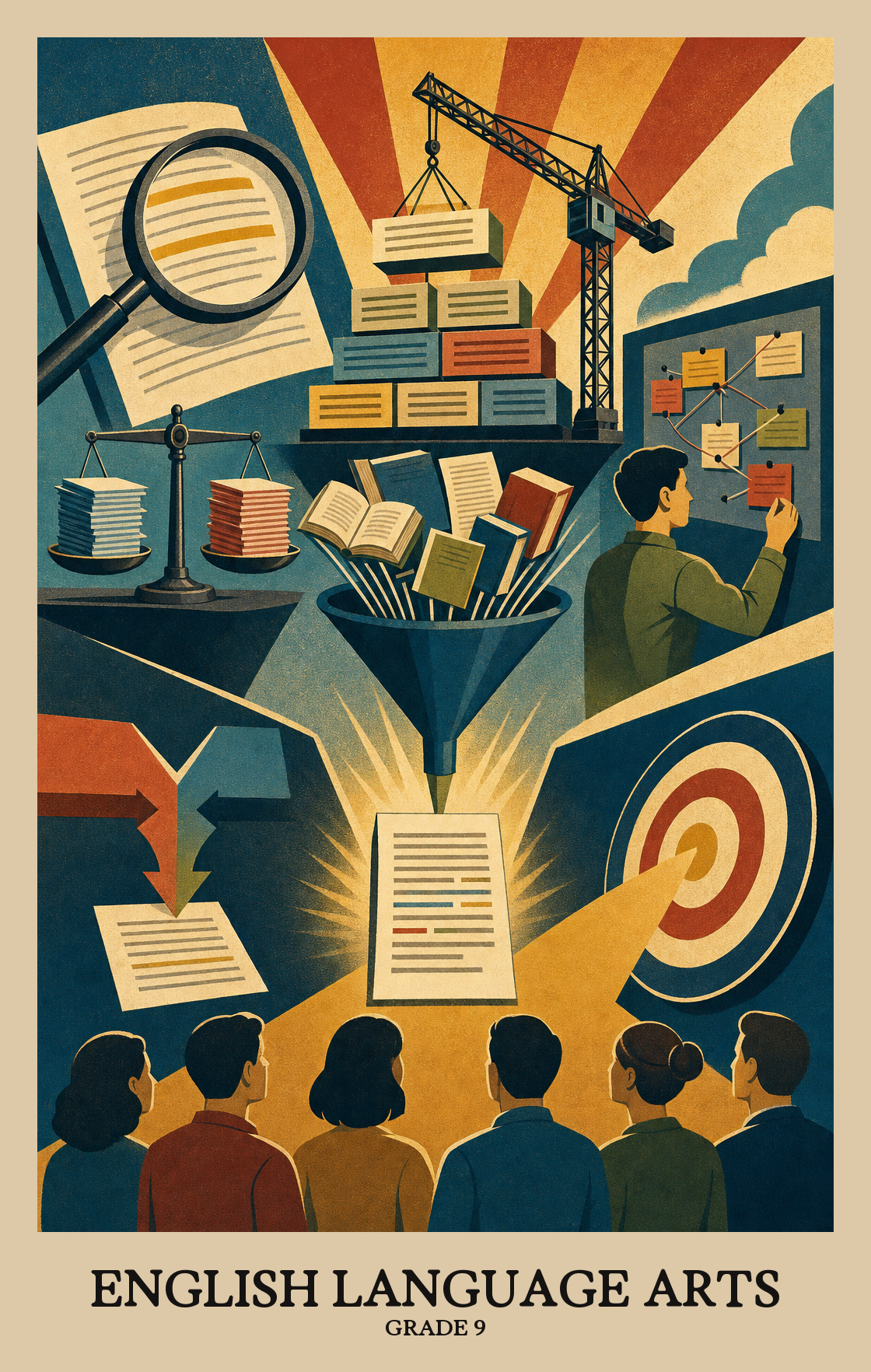
Students learn to back up what they say about a story or article with specific lines from the text. They start pulling quotes that prove their point instead of guessing or summarizing.
Students move from five-paragraph templates to longer, more focused writing. They learn to introduce a topic clearly, stay on it, and close in a way that connects back to the opening.
Students follow how characters change across a novel or play and how big ideas like loyalty, power, or identity build over time. They connect those ideas to their own lives.
Students study why a writer picked one word over another and how sentence length shapes mood. They notice tone in poems, speeches, and articles, and explain the effect on the reader.
Students research a real question using multiple sources, judge which ones are trustworthy, and weave evidence into their own writing. They learn to spot weak reasoning in someone else's argument.
Students learn to disagree without shutting down the conversation. They summarize what a classmate or speaker actually said, weigh the reasoning, and decide what they still need to find out.
Reading grade-level texts closely enough to understand what they say and what they mean. Students move past the surface of a story or article to figure out the ideas underneath.
Students read a story or article, then back up their ideas with specific lines from the text. They go beyond what the page says out loud, using details to support a conclusion the author left for readers to figure out.
Students read a nonfiction passage and back up every claim with specific lines from the text, whether the text states something outright or leaves students to figure it out.
Students figure out what unfamiliar or figurative words mean by using context clues, word parts, or a dictionary. This includes picking up on the emotional weight a word carries, not just its dictionary definition.
Students figure out what unfamiliar words mean in a nonfiction passage by reading the surrounding sentences, breaking apart the word's parts, or looking the word up.
Students find two or more themes in a story or novel, trace how each one builds from beginning to end, and connect those ideas to real life.
Students find two or more central ideas in a text, trace how each one builds from start to finish, and connect what the author is saying to real life.
Students read like writers, studying how an author chose to organize a piece, build an argument, or shape a scene. The goal is to understand not just what a text says, but why the author made those specific choices.
Students examine how a narrator's or character's perspective shapes what we see in a story: which details get highlighted, how the setting feels, and where the plot goes.
Rhetoric is how a writer chooses words, evidence, and emotional appeals to make a case. Students look at those choices in a nonfiction text and explain how each one pushes the author's argument forward.
Students examine how an author's word choices and sentence structure build up over a passage to shape its mood and meaning. Small decisions about language add up, and students track how that effect grows.
Students study how an author's word choices and sentence structures build up over a passage to shape the overall mood and message. Small decisions in language add up to a larger effect on how a reader feels and thinks.
Students trace how a main character changes from the first page to the last, then explain how those changes push the story's events forward and shape its deeper meaning.
Students read a nonfiction argument and judge whether the author's reasoning holds up: Is the evidence real and relevant? Are there gaps, false claims, or logical errors? Students name what works and what doesn't.
Students read two or more texts on the same topic and piece together what they have in common, where they disagree, and what the combination reveals that no single text could on its own.
Students read two or more informational texts on the same topic and judge how well each one develops its ideas. They consider which text makes a stronger case and why.
| Standard | Definition | Code |
|---|---|---|
| Approach texts as a reader by comprehending and interpreting grade appropriate… | Reading grade-level texts closely enough to understand what they say and what they mean. Students move past the surface of a story or article to figure out the ideas underneath. | 9-10.R.1 |
| Draw conclusions, infer | Students read a story or article, then back up their ideas with specific lines from the text. They go beyond what the page says out loud, using details to support a conclusion the author left for readers to figure out. | 9-10.RL.1.A |
| Draw conclusions, infer | Students read a nonfiction passage and back up every claim with specific lines from the text, whether the text states something outright or leaves students to figure it out. | 9-10.RI.1.A |
| Determine the meaning of words and phrases as they are used in the text… | Students figure out what unfamiliar or figurative words mean by using context clues, word parts, or a dictionary. This includes picking up on the emotional weight a word carries, not just its dictionary definition. | 9-10.RL.1.B |
| Determine the meaning of words and phrases as they are used in the text… | Students figure out what unfamiliar words mean in a nonfiction passage by reading the surrounding sentences, breaking apart the word's parts, or looking the word up. | 9-10.RI.1.B |
| Using appropriate text, determine two or more themes/central ideas in a text… | Students find two or more themes in a story or novel, trace how each one builds from beginning to end, and connect those ideas to real life. | 9-10.RL.1.D |
| Using appropriate text, determine two or more themes/central ideas in a text… | Students find two or more central ideas in a text, trace how each one builds from start to finish, and connect what the author is saying to real life. | 9-10.RI.1.D |
| Approach texts as a writer by analyzing craft and structure | Students read like writers, studying how an author chose to organize a piece, build an argument, or shape a scene. The goal is to understand not just what a text says, but why the author made those specific choices. | 9-10.R.2 |
| Analyze how point of view is reflected in the characters, setting | Students examine how a narrator's or character's perspective shapes what we see in a story: which details get highlighted, how the setting feels, and where the plot goes. | 9-10.RL.2.B |
| Analyze how an author uses rhetoric to advance point of view or purpose in an… | Rhetoric is how a writer chooses words, evidence, and emotional appeals to make a case. Students look at those choices in a nonfiction text and explain how each one pushes the author's argument forward. | 9-10.RI.2.B |
| Analyze the cumulative impact of specific word choices and syntax on meaning… | Students examine how an author's word choices and sentence structure build up over a passage to shape its mood and meaning. Small decisions about language add up, and students track how that effect grows. | 9-10.RL.2.C |
| Analyze the cumulative impact of specific word choices and syntax on meaning… | Students study how an author's word choices and sentence structures build up over a passage to shape the overall mood and message. Small decisions in language add up to a larger effect on how a reader feels and thinks. | 9-10.RI.2.C |
| Analyze how complex characters develop over the course of a text to advance the… | Students trace how a main character changes from the first page to the last, then explain how those changes push the story's events forward and shape its deeper meaning. | 9-10.RL.2.D |
| Evaluate an author's argument, assessing whether the reasoning is valid and the… | Students read a nonfiction argument and judge whether the author's reasoning holds up: Is the evidence real and relevant? Are there gaps, false claims, or logical errors? Students name what works and what doesn't. | 9-10.RI.2.D |
| Approach texts as a researcher by synthesizing/comparing/ contrasting ideas… | Students read two or more texts on the same topic and piece together what they have in common, where they disagree, and what the combination reveals that no single text could on its own. | 9-10.RI.3 |
| Evaluate how effectively two or more texts develop similar ideas/topics in an… | Students read two or more informational texts on the same topic and judge how well each one develops its ideas. They consider which text makes a stronger case and why. | 9-10.RI.3.B |
Before writing, students gather real evidence on their topic, the way a reporter would. The goal is to let the facts and sources drive the argument, not just opinion.
Students pick a question worth investigating, then search for real answers. If the topic is too broad or too narrow, they adjust the focus before writing.
Students search for trustworthy sources, judge whether each one actually answers their research question, and weave the most useful details into their writing without copying.
Students write with the choices a real author makes: deciding what to include, how to order it, and what tone fits the work. The goal is a finished piece that sounds like a person thought it through, not a checklist someone filled out.
Students plan, draft, and revise a piece of writing that fits its purpose and audience, drawing on storytelling, explanatory, and persuasive techniques they already know how to use.
Students step back from their own draft and read it the way a stranger would, checking whether the story or argument actually makes sense to someone who wasn't there when it was written.
Students open with a clear introduction, stay focused through the middle, and close with an ending that fits what they wrote. Every choice about what to include and how to order it keeps the audience in mind.
Students choose words and sentence structures on purpose, picking language that sharpens exactly what they mean rather than just getting the idea across.
Students write sentences that follow standard grammar rules, use correct punctuation, and spell words accurately. The goal is writing that a reader can follow without stumbling.
Students practice moving smoothly between ideas in an essay or story by choosing transition words and phrases that show how one point connects to the next, or that signal when time moves forward or backward.
| Standard | Definition | Code |
|---|---|---|
| Approach the writing task as a researcher | Before writing, students gather real evidence on their topic, the way a reporter would. The goal is to let the facts and sources drive the argument, not just opinion. | 9-10.W.1 |
| Conduct research to answer a question or solve a problem | Students pick a question worth investigating, then search for real answers. If the topic is too broad or too narrow, they adjust the focus before writing. | 9-10.W.1.A.a |
| Gather relevant information from multiple authoritative print and digital… | Students search for trustworthy sources, judge whether each one actually answers their research question, and weave the most useful details into their writing without copying. | 9-10.W.1.A.b |
| Approach the writing task as a writer | Students write with the choices a real author makes: deciding what to include, how to order it, and what tone fits the work. The goal is a finished piece that sounds like a person thought it through, not a checklist someone filled out. | 9-10.W.2 |
| Follow a writing process to produce clear and coherent writing in which the… | Students plan, draft, and revise a piece of writing that fits its purpose and audience, drawing on storytelling, explanatory, and persuasive techniques they already know how to use. | 9-10.W.2.A |
| Approach the writing task as a reader | Students step back from their own draft and read it the way a stranger would, checking whether the story or argument actually makes sense to someone who wasn't there when it was written. | 9-10.W.3 |
| Organization and content | Students open with a clear introduction, stay focused through the middle, and close with an ending that fits what they wrote. Every choice about what to include and how to order it keeps the audience in mind. | 9-10.W.3.A.a |
| Word choice, syntax, and style | Students choose words and sentence structures on purpose, picking language that sharpens exactly what they mean rather than just getting the idea across. | 9-10.W.3.A.b |
| Conventions of standard English and usage | Students write sentences that follow standard grammar rules, use correct punctuation, and spell words accurately. The goal is writing that a reader can follow without stumbling. | 9-10.W.3.A.c |
| Use a variety of appropriate transitions to clarify relationships, connect… | Students practice moving smoothly between ideas in an essay or story by choosing transition words and phrases that show how one point connects to the next, or that signal when time moves forward or backward. | 9-10.W.3.A.d |
Students hold a discussion with peers, building on each other's ideas with evidence from the text. They ask questions, respond thoughtfully, and help the group reach a stronger understanding together.
Students listen to a speaker, then break down the argument: what point the speaker is making, why they believe it, and whether the evidence actually holds up.
During class discussions, students listen to different viewpoints and sum up where the group agrees and disagrees. When two ideas conflict, they work to find common ground and name any questions that still need an answer.
| Standard | Definition | Code |
|---|---|---|
| Collaborate | Students hold a discussion with peers, building on each other's ideas with evidence from the text. They ask questions, respond thoughtfully, and help the group reach a stronger understanding together. | 9-10.SL.1 |
| Delineate a speaker’s argument and claims, evaluating the speaker’s point of… | Students listen to a speaker, then break down the argument: what point the speaker is making, why they believe it, and whether the evidence actually holds up. | 9-10.SL.1.B |
| Respond thoughtfully to diverse perspectives including those presented in… | During class discussions, students listen to different viewpoints and sum up where the group agrees and disagrees. When two ideas conflict, they work to find common ground and name any questions that still need an answer. | 9-10.SL.1.C |
Alternate assessment for eligible students with significant cognitive disabilities, covering the state-tested grade-level and end-of-course subjects.
Ninth graders read longer stories, articles, and essays and learn to back up what they say with specific lines from the text. They write organized essays, do short research projects, and take part in real discussions where they have to listen and respond, not just talk.
Ask what they are reading and push them to point at the exact line that proves their opinion. A five-minute conversation about a character's choice or an author's argument does more than rereading the chapter. Articles, podcasts, and films all count as good practice.
Expect essays with a clear focus, a real introduction and conclusion, and paragraphs that connect with smooth transitions. Word choice should feel intentional, not random. Spelling, grammar, and punctuation should be mostly clean without an adult fixing it first.
Start with evidence and inference using shorter texts before moving to longer works. Layer in craft questions about word choice, point of view, and structure once students can defend a basic claim. Save the full research project and synthesis writing for later in the year.
Try pairing the assigned book with an article, song, or movie on the same theme. Talking about both at dinner gives students something to compare and an easier way in. The goal is to keep them thinking, not to love every text.
Citing evidence well, not just dropping a quote, tends to be the biggest gap coming in. Analyzing how word choice and syntax shape tone also takes repeated practice. Plan to revisit both across several units rather than treating them as one-and-done lessons.
Students should be able to ask a question, find a few trustworthy sources, and weave the information into their own writing without copying. Expect one or two short research projects over the year rather than a single huge paper.
A ready student can read a challenging article, summarize the argument, and say whether the evidence actually holds up. In writing, expect organized essays with specific quotes and clean grammar. In discussion, expect listening and responding, not just waiting to talk.
Ask students to delineate a speaker's claim and evidence before reacting to it. Routines like text-based seminars, structured debates, and short response protocols build the habit of summarizing points of agreement and disagreement before pushing back.