Ratios and proportional thinking
Students start the year working with rates, percentages, and proportions. They figure out when two amounts grow together at a steady rate and use that to solve problems like tips, discounts, and recipes.
This is the year math leans hard on proportions and negative numbers. Students figure out when two amounts grow at the same rate, then use that idea to solve problems with percentages, tips, discounts, and scale drawings. They also add, subtract, multiply, and divide with negatives and fractions, and start solving two-step equations like 3x + 5 = 20. By spring, they can find the area of a circle, set up a proportion to solve a real problem, and tell whether an answer makes sense.
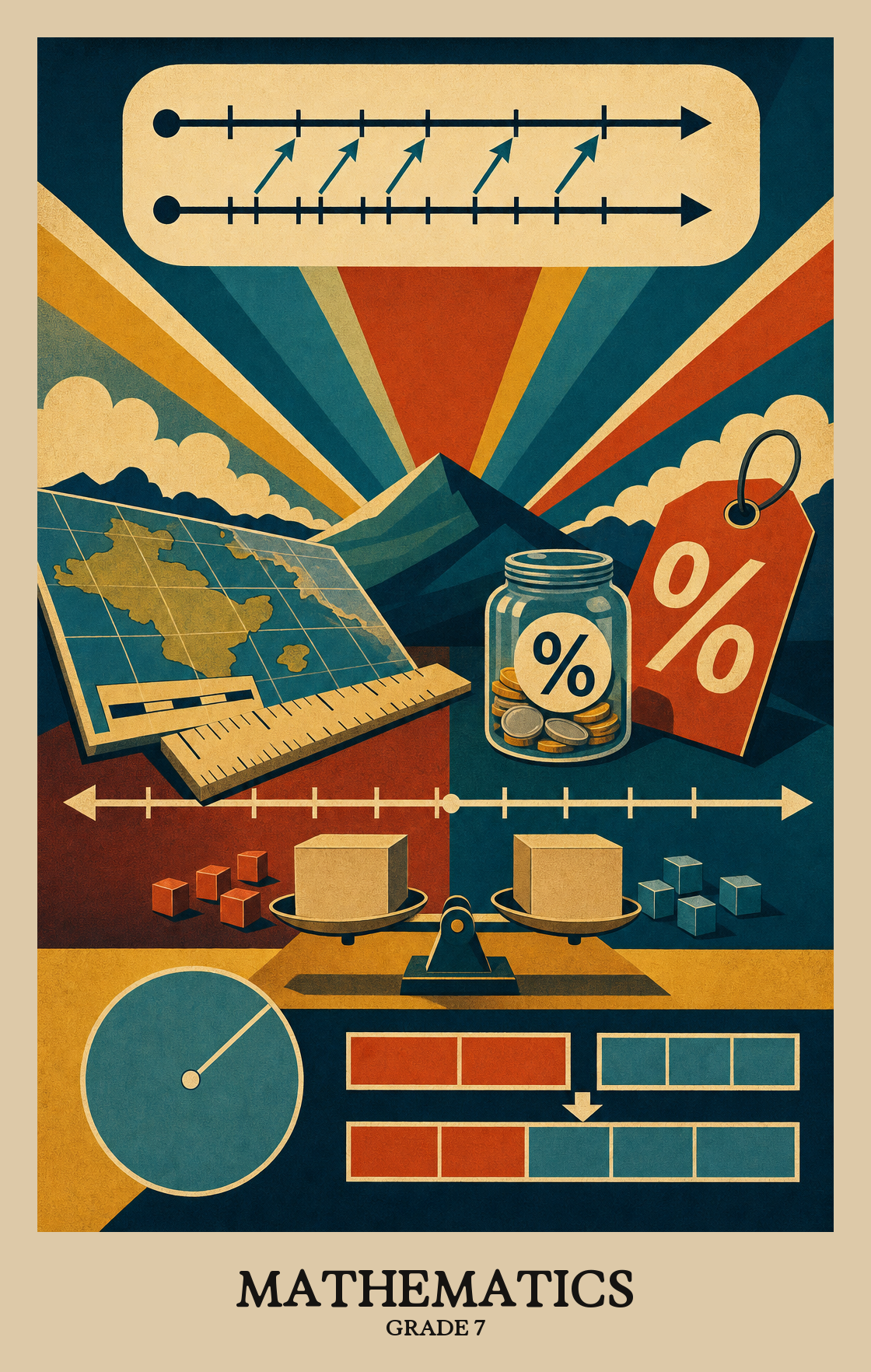
Students start the year working with rates, percentages, and proportions. They figure out when two amounts grow together at a steady rate and use that to solve problems like tips, discounts, and recipes.
Students add, subtract, multiply, and divide with negative numbers, fractions, and decimals. They learn to read these numbers in real settings like temperature drops, debts, and elevation.
Students rewrite algebra expressions in simpler forms and solve two-step equations and inequalities. They also check whether an answer makes sense before circling it.
Students work with scale drawings and find the area, surface area, and volume of shapes like triangles, prisms, and cylinders. Circles get their own focus, including circumference, area, and pi.
Students wrap up the year by comparing data sets and asking whether a sample really represents the larger group. They also assign probabilities to events and read them as numbers between 0 and 1.
Proportional relationships show up everywhere: recipes, maps, sale prices, speed. Students learn to spot them, set up ratios, and use those ratios to solve real problems with numbers that scale together.
Two quantities are proportional when they grow (or shrink) at the same steady rate. Students look at a table or graph and decide whether the relationship between two values stays constant throughout.
Reading a graph of a proportional relationship, students explain what a specific point means in real terms. If a point shows (3, 12), they can say what the 3 and the 12 represent in the actual situation, like 3 hours and 12 miles.
Real-world math problems involving percentages, rates, and ratios. Students figure out things like sale prices, unit costs, and how long a trip takes at a given speed.
| Standard | Definition | Code |
|---|---|---|
| Analyze proportional relationships and use them to solve problems | Proportional relationships show up everywhere: recipes, maps, sale prices, speed. Students learn to spot them, set up ratios, and use those ratios to solve real problems with numbers that scale together. | 7.RP.A |
| Determine when two quantities are in a proportional relationship | Two quantities are proportional when they grow (or shrink) at the same steady rate. Students look at a table or graph and decide whether the relationship between two values stays constant throughout. | 7.RP.A.2a |
| Explain what a point | Reading a graph of a proportional relationship, students explain what a specific point means in real terms. If a point shows (3, 12), they can say what the 3 and the 12 represent in the actual situation, like 3 hours and 12 miles. | 7.RP.A.2c |
| Solve problems involving ratios, rates, percentages and proportional… | Real-world math problems involving percentages, rates, and ratios. Students figure out things like sale prices, unit costs, and how long a trip takes at a given speed. | 7.RP.A.3 |
Adding, subtracting, multiplying, and dividing with negative numbers, fractions, and decimals. Students extend the number rules they learned in earlier grades to work with any rational number on the number line.
Adding a number and its opposite always equals zero. Students learn to recognize these pairs, like 5 and -5, and explain why they cancel each other out.
Students explain what an answer means after adding or subtracting fractions, decimals, or negative numbers. For example, they can say whether a sum shows a gain or a loss, and how far it lands from zero on a number line.
Flipping a fraction and multiplying it by the original always gives 1. Students learn why dividing by a number works the same as multiplying by its flipped version.
Students connect multiplication and division of fractions, decimals, and negative numbers to real situations, like splitting a debt or scaling a recipe. The math tells a story, and students explain what the answer actually means.
Students practice adding, subtracting, multiplying, and dividing with fractions, decimals, and negative numbers to solve real-world problems.
| Standard | Definition | Code |
|---|---|---|
| Apply and extend previous understandings of operations to add… | Adding, subtracting, multiplying, and dividing with negative numbers, fractions, and decimals. Students extend the number rules they learned in earlier grades to work with any rational number on the number line. | 7.NS.A |
| Describe situations and show that a number and its opposite have a sum of 0 | Adding a number and its opposite always equals zero. Students learn to recognize these pairs, like 5 and -5, and explain why they cancel each other out. | 7.NS.A.1c |
| Interpret sums and differences of rational numbers | Students explain what an answer means after adding or subtracting fractions, decimals, or negative numbers. For example, they can say whether a sum shows a gain or a loss, and how far it lands from zero on a number line. | 7.NS.A.1f |
| Determine that a number and its reciprocal have a product of 1 | Flipping a fraction and multiplying it by the original always gives 1. Students learn why dividing by a number works the same as multiplying by its flipped version. | 7.NS.A.2b |
| Interpret products and quotients of rational numbers by describing real-world… | Students connect multiplication and division of fractions, decimals, and negative numbers to real situations, like splitting a debt or scaling a recipe. The math tells a story, and students explain what the answer actually means. | 7.NS.A.2f |
| Solve problems involving the four arithmetic operations with rational numbers | Students practice adding, subtracting, multiplying, and dividing with fractions, decimals, and negative numbers to solve real-world problems. | 7.NS.A.3 |
Students rewrite math expressions into simpler or different forms using rules like the distributive property and combining like terms. Two expressions that look different can mean the same thing.
Students rewrite expressions like 3(x + ½) by distributing, combining like terms, or pulling out a common factor. The numbers involved can be fractions or decimals, not just whole numbers.
Students rewrite expressions in a different but equal form to make a problem easier to read or solve. The goal is to see the same math written a new way so the numbers and relationships are clearer.
Students use numbers and letters to write expressions, set up equations, and solve real problems. This is where abstract algebra starts doing practical work: finding unknown values, checking solutions, and building the habits that carry into higher math. Wait, that's too long and has an em dash issue. Let me redo. Students write and solve equations and expressions to find unknown values in real problems. They move between words, numbers, and algebraic notation to set up and check their work.
Students check whether an answer makes sense by estimating or doing quick mental math before accepting a result. This habit catches errors that a calculator or written work can miss.
Two-step equations ask students to find a missing number using two math operations, like multiplying and then adding. Students solve equations such as 3x + 5 = 20 and explain what the answer means in the real situation the problem describes.
Students write and solve inequalities with a variable, like 3x + 5 < 20, then show all the solutions on a number line. The numbers involved can be fractions or decimals, not just whole numbers.
| Standard | Definition | Code |
|---|---|---|
| Use properties of operations to generate equivalent expressions | Students rewrite math expressions into simpler or different forms using rules like the distributive property and combining like terms. Two expressions that look different can mean the same thing. | 7.EEI.A |
| Apply properties of operations to simplify and to factor linear algebraic… | Students rewrite expressions like 3(x + ½) by distributing, combining like terms, or pulling out a common factor. The numbers involved can be fractions or decimals, not just whole numbers. | 7.EEI.A.1 |
| Understand how to use equivalent expressions to clarify quantities in a problem | Students rewrite expressions in a different but equal form to make a problem easier to read or solve. The goal is to see the same math written a new way so the numbers and relationships are clearer. | 7.EEI.A.2 |
| Solve problems using numerical and algebraic expressions and equations | Students use numbers and letters to write expressions, set up equations, and solve real problems. This is where abstract algebra starts doing practical work: finding unknown values, checking solutions, and building the habits that carry into higher math. Wait, that's too long and has an em dash issue. Let me redo. Students write and solve equations and expressions to find unknown values in real problems. They move between words, numbers, and algebraic notation to set up and check their work. | 7.EEI.B |
| Assess the reasonableness of answers using mental computation and… | Students check whether an answer makes sense by estimating or doing quick mental math before accepting a result. This habit catches errors that a calculator or written work can miss. | 7.EEI.B.3b |
| Write and/or solve two-step equations of the form px + q = r and p | Two-step equations ask students to find a missing number using two math operations, like multiplying and then adding. Students solve equations such as 3x + 5 = 20 and explain what the answer means in the real situation the problem describes. | 7.EEI.B.4b |
| Write, solve and/or graph inequalities of the form px + q > r or px + q < r… | Students write and solve inequalities with a variable, like 3x + 5 < 20, then show all the solutions on a number line. The numbers involved can be fractions or decimals, not just whole numbers. | 7.EEI.B.4c |
Students draw and label geometric figures, like triangles and quadrilaterals, then explain how those shapes relate to each other in size, angle, or position.
A scale drawing shrinks or stretches a real object so it fits on paper. Students figure out the actual size of rooms, buildings, or shapes from that drawing, then redraw it at a new scale.
Students learn how the distance across a circle, the distance from center to edge, and the area inside it all connect through the number pi. Change the radius and every other measurement changes in a predictable way.
Students practice using two formulas for circles: one finds the distance around the edge, the other finds the space inside. They apply both to solve real problems involving circular shapes.
Students use what they already know about angles, area, and volume to solve harder problems, like finding the space inside irregular shapes or figuring out how much a 3-D object holds.
Students find the area of shapes like triangles, parallelograms, and irregular polygons by breaking them into simpler pieces. They use what they know about rectangles and triangles to calculate the total space inside each shape.
Students find the amount of space inside 3D shapes like boxes, pyramids, and cylinders, and calculate the total area of their outer surfaces. Both skills use formulas students apply step by step.
| Standard | Definition | Code |
|---|---|---|
| Draw and describe geometric figures and describe the relationships between them | Students draw and label geometric figures, like triangles and quadrilaterals, then explain how those shapes relate to each other in size, angle, or position. | 7.GM.A |
| Solve problems involving scale drawings of real objects and geometric figures… | A scale drawing shrinks or stretches a real object so it fits on paper. Students figure out the actual size of rooms, buildings, or shapes from that drawing, then redraw it at a new scale. | 7.GM.A.1 |
| Analyze the relationships among the circumference, the radius, the diameter… | Students learn how the distance across a circle, the distance from center to edge, and the area inside it all connect through the number pi. Change the radius and every other measurement changes in a predictable way. | 7.GM.A.4a |
| Know and apply the formulas for circumference and area of circles to solve… | Students practice using two formulas for circles: one finds the distance around the edge, the other finds the space inside. They apply both to solve real problems involving circular shapes. | 7.GM.A.4b |
| Apply and extend previous understanding of angle measure, area and volume | Students use what they already know about angles, area, and volume to solve harder problems, like finding the space inside irregular shapes or figuring out how much a 3-D object holds. | 7.GM.B |
| Find the area of triangles, quadrilaterals and other polygons composed of… | Students find the area of shapes like triangles, parallelograms, and irregular polygons by breaking them into simpler pieces. They use what they know about rectangles and triangles to calculate the total space inside each shape. | 7.GM.B.6a |
| Find the volume and surface area of prisms, pyramids and cylinders | Students find the amount of space inside 3D shapes like boxes, pyramids, and cylinders, and calculate the total area of their outer surfaces. Both skills use formulas students apply step by step. | 7.GM.B.6b |
Students learn to survey a small, randomly chosen group and use those results to make reasonable predictions about a much larger group, like estimating how many kids in a whole school prefer a certain lunch.
A sample only tells you something true about a larger group if it reflects that group fairly. Students learn why a survey of just one neighborhood, for example, can't speak for a whole city.
Students compare two groups using real data, like survey results or measurements, and draw conclusions about how the groups differ or overlap.
Students compare two sets of data by looking at the mean, median, or spread to draw conclusions about which group is higher, more consistent, or more spread out.
Students learn to predict how likely an event is to happen, build simple models to test those predictions, and compare what the model says to what actually occurs.
Students figure out how likely a single event is to happen, such as rolling a specific number on a die or picking a certain card from a deck. They express that chance as a fraction, decimal, or percent.
Probability is a number from 0 to 1 that shows how likely something is to happen. A probability of 0 means it can't happen; a probability of 1 means it will. Numbers in between show how good the chances are.
| Standard | Definition | Code |
|---|---|---|
| Use random sampling to draw inferences about a population | Students learn to survey a small, randomly chosen group and use those results to make reasonable predictions about a much larger group, like estimating how many kids in a whole school prefer a certain lunch. | 7.DSP.A |
| Understand that generalizations from a sample are valid only if the sample… | A sample only tells you something true about a larger group if it reflects that group fairly. Students learn why a survey of just one neighborhood, for example, can't speak for a whole city. | 7.DSP.A.1b |
| Draw informal comparative inferences about two populations | Students compare two groups using real data, like survey results or measurements, and draw conclusions about how the groups differ or overlap. | 7.DSP.B |
| Analyze different data distributions using statistical measures | Students compare two sets of data by looking at the mean, median, or spread to draw conclusions about which group is higher, more consistent, or more spread out. | 7.DSP.B.3 |
| Develop, use and evaluate probability models | Students learn to predict how likely an event is to happen, build simple models to test those predictions, and compare what the model says to what actually occurs. | 7.DSP.C |
| Determine probabilities of simple events | Students figure out how likely a single event is to happen, such as rolling a specific number on a die or picking a certain card from a deck. They express that chance as a fraction, decimal, or percent. | 7.DSP.C.5a |
| Understand that the probability of a chance event is a number between 0 and 1… | Probability is a number from 0 to 1 that shows how likely something is to happen. A probability of 0 means it can't happen; a probability of 1 means it will. Numbers in between show how good the chances are. | 7.DSP.C.5b |
Missouri Assessment Program grade-level mathematics assessment for grades 3 through 8.
Alternate assessment for eligible students with significant cognitive disabilities, covering the state-tested grade-level and end-of-course subjects.
Students work with ratios, percents, and proportions. They add, subtract, multiply, and divide with negative numbers and fractions. They also solve two-step equations, find the area and circumference of circles, and start using probability and samples to draw conclusions from data.
Cooking, shopping, and tipping are the easiest places to practice. Ask students to scale a recipe up or down, figure out a 20 percent tip, or compare unit prices at the store. Five minutes of this a few times a week builds real fluency.
Use a thermometer, a bank balance, or steps forward and backward on a number line. Ask questions like, the temperature was -4 and rose 7 degrees, where is it now? Talking through the meaning matters more than memorising rules about signs.
Most teachers start with rational number operations so signed numbers are solid before equations begin. Ratios and proportions come next and feed directly into percent problems and scale drawings. Save circles, volume, and probability for the back half once algebraic reasoning is steady.
Subtracting negative numbers, dividing fractions, and setting up proportions from a word problem are the common sticking points. Students also struggle to interpret what a solution means in context. Build in short spiral reviews every couple of weeks rather than one big unit review.
Students should solve equations like 3x + 8 = 23 or 2(x - 5) = 14 without a calculator and check that the answer makes sense in the story. They should also write a simple inequality from a situation and graph the solution on a number line.
They can move between fractions, decimals, and percents without freezing. They can solve a two-step equation and explain what the answer means. They can find the area of a circle and read a graph well enough to compare two sets of data.
Yes, students should know that circumference is pi times the diameter and area is pi times the radius squared. A quick way to practice is measuring round objects at home, like a plate or a can, and estimating the distance around before checking with a string.
Calculators are fine for messy numbers and real-world problems, but students still need to estimate first. Ask, is the answer closer to 10 or 100, before they type anything. That habit catches most mistakes and builds number sense that lasts.