Reading closely for evidence
Students learn to back up what they say about a book or article with specific lines from the page. They start drawing conclusions the author hints at instead of only what is stated outright.
This is the year reading and writing start asking students to back up what they think. Students point to lines in a story or article to explain what they figured out, and they track how a character changes or how an author builds an argument. In their own writing, they pull from several sources, sort credible ones from shaky ones, and give credit. By spring, students can write a paragraph that states a clear claim and supports it with evidence from what they read.
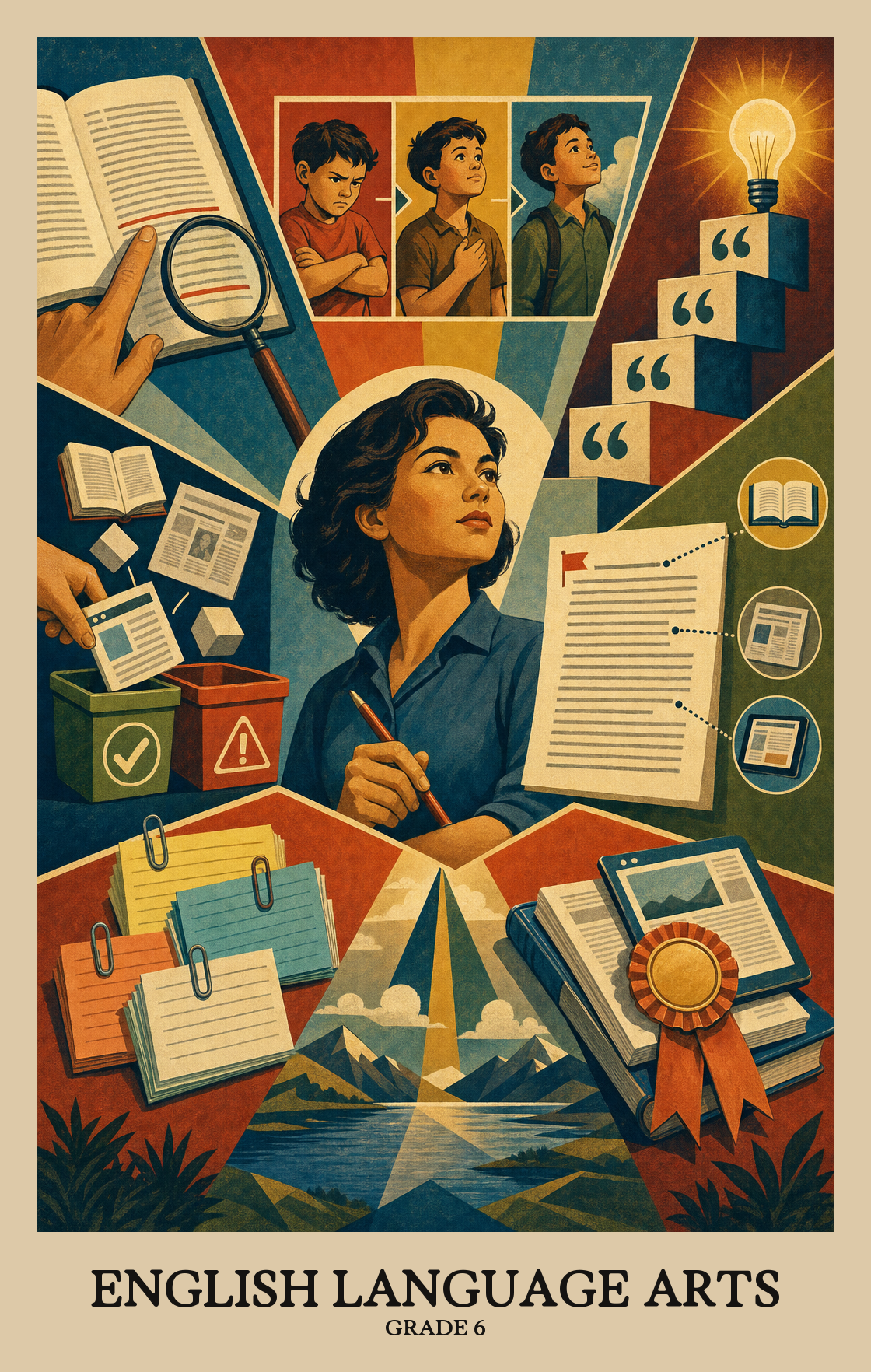
Students learn to back up what they say about a book or article with specific lines from the page. They start drawing conclusions the author hints at instead of only what is stated outright.
Students look at why an author picked certain words and how a narrator's view shapes a story. They notice figurative language and how repeated words or sounds change how a passage feels.
Students track how a story unfolds and how characters change by the end. In nonfiction, they spot the author's argument and decide which claims are backed by real reasons.
Students answer a research question by pulling from several books and websites. They check whether a source is trustworthy and learn to quote or reword ideas without copying.
Students write in three modes: stories with real characters and scenes, explanatory pieces packed with facts, and arguments that defend a clear claim. They focus on a strong opening, smooth transitions, and a clean ending.
Students join class discussions by building on what others say and asking follow-up questions. They learn to restate a speaker's main points in their own words to show they were really listening.
Reading is the foundation of this grade's work. Students read stories and nonfiction closely enough to understand what the text says and what it means beneath the surface.
Students read closely to find what the text says directly and to figure out what it implies. Then they back up both kinds of thinking with specific lines or passages from the text.
Students read a nonfiction passage and back up every conclusion with a direct quote or detail from the text, not just a feeling or a guess.
Students figure out what unfamiliar words mean by using clues in the surrounding sentences, word parts like prefixes and suffixes, or a dictionary. This includes words used in a figurative way, like "she had a heavy heart."
Students figure out what unfamiliar or figurative words mean by using clues in the surrounding sentences, word parts like prefixes and suffixes, or a dictionary.
Students read a story or article and figure out the main message or central idea, then point to specific lines or passages that show how that idea builds across the text.
Students figure out the main message or big idea of a passage, then point to specific lines or details that show how that idea builds from start to finish.
Reading closely to study how authors make choices, like word selection and how a piece is organized, so students can use those same moves in their own writing.
Students identify who is telling the story and trace how the author builds that narrator's perspective through word choices, details, and what the narrator notices or ignores.
Students read a nonfiction article or essay and explain how the author's choices, like word choice or what details get included, reveal what the author believes or wants the reader to think.
Students examine why an author chose specific words, repeated certain phrases, or used comparisons and images to shape how a passage feels and what it means.
Students look at specific words an author chose and ask why. They figure out how those words, repeated phrases, or sound patterns shape the feeling or meaning of a passage.
Students trace how a story's plot builds episode by episode and watch how characters shift or grow by the time the conflict is resolved.
Students find the main argument an author is making, then sort out which claims the author backs up with facts or reasons and which ones the author just states without proof.
Reading more than one source on the same topic, students pull ideas together across texts to find what each source adds, contradicts, or confirms.
Students read two accounts of the same event and spot where the authors agree, where they differ, and why those differences might matter.
| Standard | Definition | Code |
|---|---|---|
| Approach texts as a reader by comprehending and interpreting grade appropriate… | Reading is the foundation of this grade's work. Students read stories and nonfiction closely enough to understand what the text says and what it means beneath the surface. | 6.R.1 |
| draw conclusion, infer and analyze by citing textual evidence to support… | Students read closely to find what the text says directly and to figure out what it implies. Then they back up both kinds of thinking with specific lines or passages from the text. | 6.RL.1.A |
| draw conclusion, infer and analyze by citing textual evidence to support… | Students read a nonfiction passage and back up every conclusion with a direct quote or detail from the text, not just a feeling or a guess. | 6.RI.1.A |
| determine meaning of words and phrases as they are used in the text, including… | Students figure out what unfamiliar words mean by using clues in the surrounding sentences, word parts like prefixes and suffixes, or a dictionary. This includes words used in a figurative way, like "she had a heavy heart." | 6.RI.1.B |
| determine meaning of words and phrases as they are used in the text, including… | Students figure out what unfamiliar or figurative words mean by using clues in the surrounding sentences, word parts like prefixes and suffixes, or a dictionary. | 6.RL.1.B |
| determine the theme(s)/central idea of a text and cite evidence of its… | Students read a story or article and figure out the main message or central idea, then point to specific lines or passages that show how that idea builds across the text. | 6.RL.1.D |
| determine the theme(s)/central idea of a text and cite evidence of its… | Students figure out the main message or big idea of a passage, then point to specific lines or details that show how that idea builds from start to finish. | 6.RI.1.D |
| Approach texts as a writer by analyzing craft and structure in… | Reading closely to study how authors make choices, like word selection and how a piece is organized, so students can use those same moves in their own writing. | 6.R.2 |
| explain how an author develops the point of view of the narrator or speaker in… | Students identify who is telling the story and trace how the author builds that narrator's perspective through word choices, details, and what the narrator notices or ignores. | 6.RL.2.B |
| explain how an author’s point of view or purpose is conveyed in… | Students read a nonfiction article or essay and explain how the author's choices, like word choice or what details get included, reveal what the author believes or wants the reader to think. | 6.RI.2.B |
| analyze how word choice, including figurative language and/or the repetition of… | Students examine why an author chose specific words, repeated certain phrases, or used comparisons and images to shape how a passage feels and what it means. | 6.RL.2.C |
| analyze how word choice, including figurative language and/or the repetition of… | Students look at specific words an author chose and ask why. They figure out how those words, repeated phrases, or sound patterns shape the feeling or meaning of a passage. | 6.RI.2.C |
| describe how a particular text’s plot unfolds in a series of episodes as well… | Students trace how a story's plot builds episode by episode and watch how characters shift or grow by the time the conflict is resolved. | 6.RL.2.D |
| identify an author’s argument in a text and distinguish claims that are… | Students find the main argument an author is making, then sort out which claims the author backs up with facts or reasons and which ones the author just states without proof. | 6.RI.2.D |
| Approach texts as a researcher by synthesizing/comparing/ contrasting ideas… | Reading more than one source on the same topic, students pull ideas together across texts to find what each source adds, contradicts, or confirms. | 6.RI.3 |
| compare and contrast one author’s presentation of events with that of another | Students read two accounts of the same event and spot where the authors agree, where they differ, and why those differences might matter. | 6.RI.3.B |
Before writing an argument or essay, students gather information, read sources carefully, and use what they find to shape their thinking. The writing grows out of research, not just opinion.
Students pick a question, search several sources for answers, and weave the information together into their own writing. The goal is to pull from more than one place and make the ideas fit together clearly.
Students find facts and details from more than one source, mixing books, articles, and websites to build a fuller picture of their topic.
Students learn to judge whether a source is trustworthy before using it in writing. That means checking who wrote it, why, and whether the facts hold up against other reliable sources.
Students learn to use an author's exact words or restate ideas in their own words, with credit given to the source. They practice the basics of citing where information came from.
Students make real choices about how to open, organize, and end a piece, the way a working writer would, not just to satisfy an assignment.
Students write stories or poems about real or imagined events, building scenes with named characters and details that move the story forward in a clear order.
Students write to explain a topic clearly, using facts, examples, and real details that actually support the point. The goal is to inform a reader who knows nothing about the subject yet.
Students write a short argument, state a clear position, and back it up with reasons and evidence drawn from what they have read or researched.
When writing a story or argument, students think about what a reader actually needs to follow along, filling in details and context that make sense to someone who wasn't there.
Students open with a clear topic, stay on it through the whole piece, and close with an ending that grows out of what they wrote. The writing holds together from the first sentence to the last.
Students pick words that say exactly what they mean and keep the same tone throughout a piece of writing. Every sentence is complete, so the writing sounds polished and consistent from start to finish.
Students write with correct spelling, punctuation, and grammar. Think complete sentences, commas in the right places, and words spelled the way a published book would have them.
Students practice using transition words and phrases to link ideas, show how one thought leads to the next, and signal when time has shifted in a piece of writing.
| Standard | Definition | Code |
|---|---|---|
| Approach the writing task as a researcher | Before writing an argument or essay, students gather information, read sources carefully, and use what they find to shape their thinking. The writing grows out of research, not just opinion. | 6.W.1.A |
| conduct research to answer a question drawing on several sources; integrate… | Students pick a question, search several sources for answers, and weave the information together into their own writing. The goal is to pull from more than one place and make the ideas fit together clearly. | 6.W.1.A.a |
| gather relevant information from multiple print and digital resources | Students find facts and details from more than one source, mixing books, articles, and websites to build a fuller picture of their topic. | 6.W.1.A.b |
| assess the credibility of sources | Students learn to judge whether a source is trustworthy before using it in writing. That means checking who wrote it, why, and whether the facts hold up against other reliable sources. | 6.W.1.A.c |
| quote or paraphrase while avoiding plagiarism | Students learn to use an author's exact words or restate ideas in their own words, with credit given to the source. They practice the basics of citing where information came from. | 6.W.1.A.d |
| Approach the writing task as a writer | Students make real choices about how to open, organize, and end a piece, the way a working writer would, not just to satisfy an assignment. | 6.W.2.A |
| Narrative writing, including poems about real or imagined experiences with… | Students write stories or poems about real or imagined events, building scenes with named characters and details that move the story forward in a clear order. | 6.W.2.A.a |
| Expository (informative/explanatory) writing to examine a topic with relevant… | Students write to explain a topic clearly, using facts, examples, and real details that actually support the point. The goal is to inform a reader who knows nothing about the subject yet. | 6.W.2.A.b |
| Argumentative writing introducing and supporting a claim with clear reasons and… | Students write a short argument, state a clear position, and back it up with reasons and evidence drawn from what they have read or researched. | 6.W.2.A.c |
| Approach the writing task as a reader | When writing a story or argument, students think about what a reader actually needs to follow along, filling in details and context that make sense to someone who wasn't there. | 6.W.3.A |
| introduce the topic, maintain a clear focus throughout the text, provide a… | Students open with a clear topic, stay on it through the whole piece, and close with an ending that grows out of what they wrote. The writing holds together from the first sentence to the last. | 6.W.3.A.a |
| choose precise language and establish and maintain an appropriate and… | Students pick words that say exactly what they mean and keep the same tone throughout a piece of writing. Every sentence is complete, so the writing sounds polished and consistent from start to finish. | 6.W.3.A.b |
| demonstrate a command of the conventions of standard English grammar and usage… | Students write with correct spelling, punctuation, and grammar. Think complete sentences, commas in the right places, and words spelled the way a published book would have them. | 6.W.3.A.c |
| use transitions to clarify relationships, connect ideas and claims | Students practice using transition words and phrases to link ideas, show how one thought leads to the next, and signal when time has shifted in a piece of writing. | 6.W.3.A.d |
Students practice talking through ideas with a group, listening carefully, and building on what others say. The goal is real back-and-forth discussion, not just taking turns to speak.
Students listen to a speaker's argument, then ask or answer questions that go beyond yes or no. Their comments add something real to the conversation, not just agreement.
Students listen to a speaker or media presentation, then restate the key ideas in their own words to show they understood different viewpoints.
| Standard | Definition | Code |
|---|---|---|
| Collaborate | Students practice talking through ideas with a group, listening carefully, and building on what others say. The goal is real back-and-forth discussion, not just taking turns to speak. | 6.SL.1 |
| delineate a speaker’s argument and claims in order to pose and respond to… | Students listen to a speaker's argument, then ask or answer questions that go beyond yes or no. Their comments add something real to the conversation, not just agreement. | 6.SL.1.B |
| Review the key ideas expressed by a speaker including those presented in… | Students listen to a speaker or media presentation, then restate the key ideas in their own words to show they understood different viewpoints. | 6.SL.1.C |
Missouri Assessment Program grade-level English language arts assessment for grades 3 through 8.
Alternate assessment for eligible students with significant cognitive disabilities, covering the state-tested grade-level and end-of-course subjects.
Students read longer stories and articles and write longer pieces about them. They learn to back up what they say with proof from the text. They also practice sharing ideas in class discussions and listening closely to what others say.
After reading a chapter or article together, ask what the author is really trying to say and where in the text they found that idea. Pointing to a specific sentence or paragraph as proof is the habit students need this year.
Students should write a clear story, a short report on a topic, and a piece that argues a point with reasons. Each piece should have a beginning that sets up the topic, a middle that stays focused, and an ending that wraps things up.
Many teachers anchor each quarter to one writing type (narrative, informative, argument, research) and pull reading and discussion work from the same texts. That way evidence work in reading feeds directly into the writing students owe at the end of the unit.
Citing evidence well is the big one. Students often summarize instead of quoting or paraphrasing a specific line. Figurative language and tracking an author's point of view also tend to need a second and third pass during the year.
Students pull information from several sources, check whether a source is trustworthy, and credit where the ideas came from. At home, a quick conversation about why one website looks more reliable than another goes a long way.
By June, students should read a new article or story on their own and explain the main idea with proof from the text. They should also write a few paragraphs that stay on topic, use full sentences, and credit any sources they used.
Plan for it deliberately. Students are expected to respond to a speaker's argument, ask follow-up questions, and paraphrase what others said. Short structured discussions two or three times a week build the habits faster than occasional whole-class debates.