Thinking and working like scientists
Students start the year practicing how scientists work. They ask testable questions, plan fair experiments, measure with rulers and scales, and record results in tables and graphs they can explain to others.
This is the year science starts to feel like physics. Students stop just describing the world and start tracking how energy moves through it, from a battery to a bulb, from a guitar string to your ear, from a rolling ball to the wall it hits. They run real experiments with a question, a variable they change, and data they graph. By spring, students can explain how a simple circuit works and why a heavier cart is harder to stop.
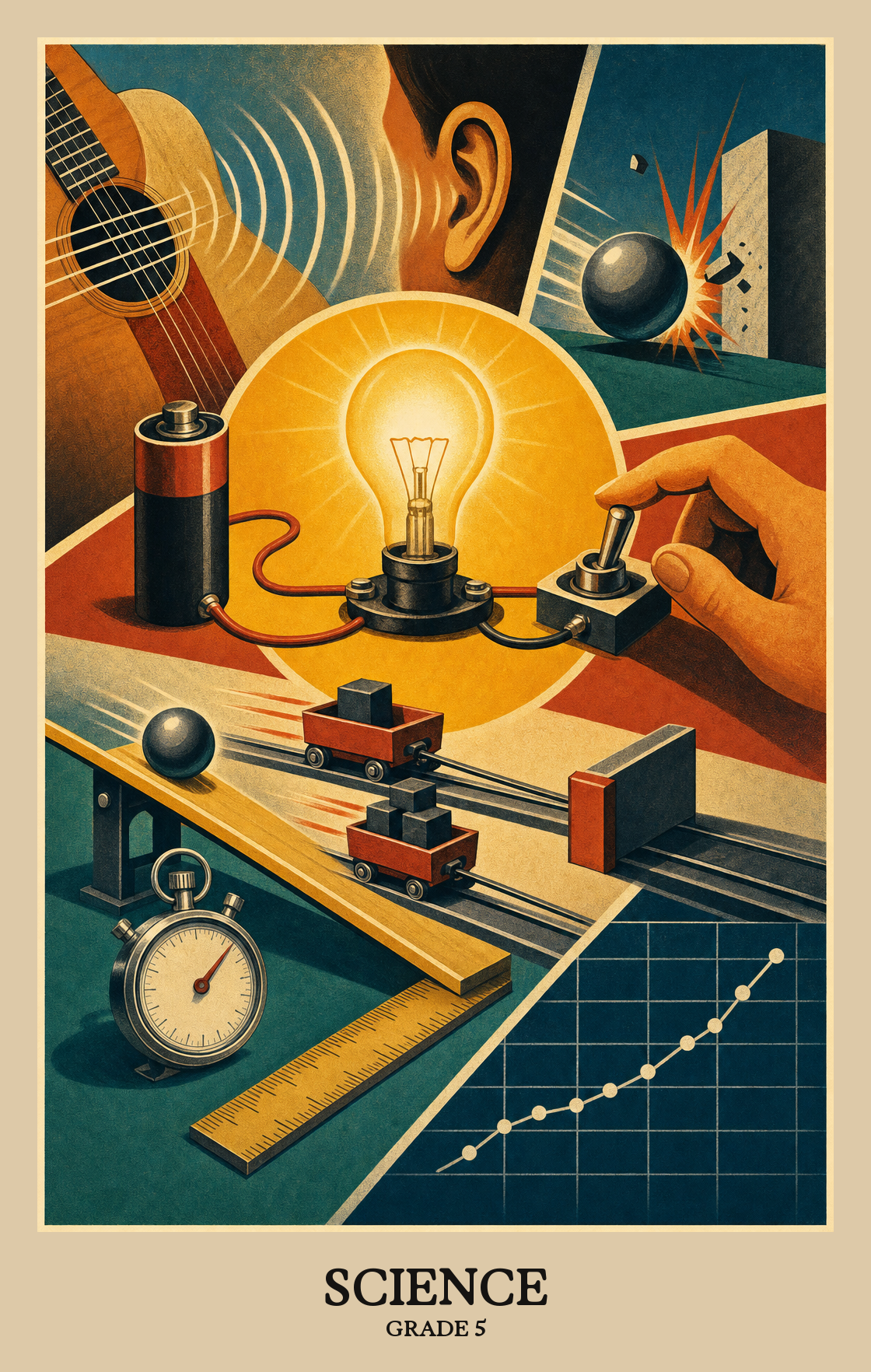
Students start the year practicing how scientists work. They ask testable questions, plan fair experiments, measure with rulers and scales, and record results in tables and graphs they can explain to others.
Students explore what energy is and how it moves things. They look at how pushes, pulls, speed, and friction change motion, and what happens when objects bump into each other.
Students build simple circuits and learn why some materials carry electricity and others do not. They also study how sound travels through different materials and how light bends, reflects, and warms things up.
Students learn that everything is made of tiny atoms. They mix substances to see what changes and what stays the same, and watch how heating or cooling turns matter into a solid, liquid, or gas.
Students see how the Earth slowly reshapes itself. They study moving plates, the rock cycle, and how wind and water wear land down over time. Fossils show what the planet used to look like.
Students wrap up the year by looking at where energy comes from. They compare renewable and nonrenewable sources, talk about ways families and communities save energy, and see how new technology helps.
Students learn to think and work like scientists. They ask questions, plan investigations, collect data, and use evidence to explain what they found.
Students ask questions about things they observe and define a problem clearly before trying to solve it. This is where scientific investigation and engineering design begin.
Students form a question they can actually test with an experiment, then predict what will happen based on a pattern they've already noticed.
Students write a hypothesis as an if-then prediction: if one thing changes, then something else will happen as a result. The hypothesis explains a cause, not just a guess.
Students practice spotting a real problem and describing it clearly enough that someone could design a solution, whether that solution is a new tool, a step-by-step process, or an entire system.
Students plan a test or experiment, decide what to measure, and record what happens. The goal is to answer a specific question with real evidence, not a guess.
Students work with classmates to plan a hands-on investigation, then run it together and record what they find.
Students learn to separate the one thing they change in an experiment from the things they measure and the things they keep the same throughout.
Students decide what to measure or record before running an experiment. They match the data they plan to collect directly to the question they are trying to answer.
Students measure length, mass, and liquid volume using metric units, choosing the right tool for each job: a ruler for distance, a scale for mass, a graduated cylinder for liquids.
Students pick tools and materials to build something that solves a real problem, like designing a barrier to block wind or a structure to hold weight. The focus is on making a working device, not just drawing a plan.
Students look at collected data, spot patterns, and decide what the results actually mean. This skill runs through every experiment and investigation in fifth-grade science.
Students organize numbers from experiments into tables and graphs, then look for patterns to explain what the data shows.
Students sort and arrange collected data to spot patterns, like noticing that temperature rises every time a certain variable changes. Finding the pattern is the point, not just recording the numbers.
Students look at data collected by other groups doing the same investigation, then explain where the results match and where they differ.
Students look at test results and measurements to figure out whether a design works, then decide what to change to make it better.
Students write conclusions from their investigation results, then look for weak spots in their own reasoning or a classmate's. The goal is a conclusion backed by evidence, not just a guess.
Students back up a scientific claim by pointing to data from an experiment, a graph, or a model. The goal is to show why the evidence fits the claim, not just state that it does.
Students explain how a scientific idea, like how heat moves or how forces work, shaped the design of a solution to a real problem.
Students think up more than one way to solve a problem, then compare their ideas to see which solution best fits the requirements and limits they were given.
Students build or draw models to show how something in nature works, then use those models to answer questions or make predictions.
Students build a model, like a diagram or a comparison to something familiar, to explain how a scientific idea or invention works.
Models help explain ideas, but every model leaves something out or gets something wrong. Students learn to spot where a model stops being accurate or useful.
Students read science texts, diagrams, and data to find reliable information, then decide what's worth keeping and share what they learned in writing, a diagram, or a discussion.
Students read science articles, diagrams, or videos at their grade level and pull out accurate information to use in their work.
Students share findings, design ideas, or solutions with classmates and teachers using words, drawings, charts, or models. The goal is to explain their thinking clearly enough that someone else can understand and respond to it.
| Standard | Definition | Code |
|---|---|---|
| The student will demonstrate an understanding of scientific and engineering… | Students learn to think and work like scientists. They ask questions, plan investigations, collect data, and use evidence to explain what they found. | 5.1 |
| asking questions and defining problems | Students ask questions about things they observe and define a problem clearly before trying to solve it. This is where scientific investigation and engineering design begin. | 5.1.a |
| ask testable questions based on observations and predict reasonable outcomes… | Students form a question they can actually test with an experiment, then predict what will happen based on a pattern they've already noticed. | 5.1.a.i |
| develop hypotheses as cause-and-effect relationship | Students write a hypothesis as an if-then prediction: if one thing changes, then something else will happen as a result. The hypothesis explains a cause, not just a guess. | 5.1.a.ii |
| define design problems that can be solved through the development of an object… | Students practice spotting a real problem and describing it clearly enough that someone could design a solution, whether that solution is a new tool, a step-by-step process, or an entire system. | 5.1.a.iii |
| planning and carrying out investigations | Students plan a test or experiment, decide what to measure, and record what happens. The goal is to answer a specific question with real evidence, not a guess. | 5.1.b |
| collaboratively plan and conduct investigations to produce data | Students work with classmates to plan a hands-on investigation, then run it together and record what they find. | 5.1.b.i |
| identify independent variable, dependent variables | Students learn to separate the one thing they change in an experiment from the things they measure and the things they keep the same throughout. | 5.1.b.ii |
| determine data that should be collected to answer a testable question | Students decide what to measure or record before running an experiment. They match the data they plan to collect directly to the question they are trying to answer. | 5.1.b.iii |
| take¬ metric measurements using appropriate tools | Students measure length, mass, and liquid volume using metric units, choosing the right tool for each job: a ruler for distance, a scale for mass, a graduated cylinder for liquids. | 5.1.b.iv |
| use tools and/or materials to design and/or build a device that solves a… | Students pick tools and materials to build something that solves a real problem, like designing a barrier to block wind or a structure to hold weight. The focus is on making a working device, not just drawing a plan. | 5.1.b.v |
| interpreting, analyzing | Students look at collected data, spot patterns, and decide what the results actually mean. This skill runs through every experiment and investigation in fifth-grade science. | 5.1.c |
| represent and analyze data using tables and graphs | Students organize numbers from experiments into tables and graphs, then look for patterns to explain what the data shows. | 5.1.c.i |
| organize simple data sets to reveal patterns that suggest relationships | Students sort and arrange collected data to spot patterns, like noticing that temperature rises every time a certain variable changes. Finding the pattern is the point, not just recording the numbers. | 5.1.c.ii |
| compare and contrast data collected by different groups and discuss… | Students look at data collected by other groups doing the same investigation, then explain where the results match and where they differ. | 5.1.c.iii |
| use data to evaluate and refine design solutions | Students look at test results and measurements to figure out whether a design works, then decide what to change to make it better. | 5.1.c.iv |
| constructing and critiquing conclusions and explanations | Students write conclusions from their investigation results, then look for weak spots in their own reasoning or a classmate's. The goal is a conclusion backed by evidence, not just a guess. | 5.1.d |
| construct and/or support arguments with evidence, data, and/or a model | Students back up a scientific claim by pointing to data from an experiment, a graph, or a model. The goal is to show why the evidence fits the claim, not just state that it does. | 5.1.d.i |
| describe how scientific ideas apply to design solutions | Students explain how a scientific idea, like how heat moves or how forces work, shaped the design of a solution to a real problem. | 5.1.d.ii |
| generate and compare multiple solutions to problems based on how well they meet… | Students think up more than one way to solve a problem, then compare their ideas to see which solution best fits the requirements and limits they were given. | 5.1.d.iii |
| developing and using models | Students build or draw models to show how something in nature works, then use those models to answer questions or make predictions. | 5.1.e |
| develop models using an analogy, example | Students build a model, like a diagram or a comparison to something familiar, to explain how a scientific idea or invention works. | 5.1.e.i |
| identify limitations of models | Models help explain ideas, but every model leaves something out or gets something wrong. Students learn to spot where a model stops being accurate or useful. | 5.1.e.ii |
| obtaining, evaluating | Students read science texts, diagrams, and data to find reliable information, then decide what's worth keeping and share what they learned in writing, a diagram, or a discussion. | 5.1.f |
| read and comprehend reading-level-appropriate texts and/or other reliable media | Students read science articles, diagrams, or videos at their grade level and pull out accurate information to use in their work. | 5.1.f.i |
| communicate scientific information, design ideas, and/or solutions with others | Students share findings, design ideas, or solutions with classmates and teachers using words, drawings, charts, or models. The goal is to explain their thinking clearly enough that someone else can understand and respond to it. | 5.1.f.ii |
Energy shows up in many forms: light, heat, sound, and motion. Students explore how energy moves from one object to another and how it can change from one form into another.
Energy is what makes things move, heat up, light up, or change. Students learn that without energy, nothing happens.
Energy comes in many forms: light, heat, sound, and motion are all types. Students learn to recognize that electricity, chemical reactions, and even a stretched rubber band all store or carry energy in different ways.
Energy can change from one form to another. A battery turns stored chemical energy into electricity, and a light bulb turns that electricity into light and heat.
When energy changes form (heat, light, sound, motion), the total amount stays the same. Nothing is created or destroyed, just moved or changed.
Moving objects carry energy, and the harder you push or pull something, the more energy it has. Students explore how force and speed affect the energy of a moving object.
Kinetic energy is the energy an object has because it's moving. Students learn that a rolling ball, a falling rock, or a sliding book all carry kinetic energy, and that faster or heavier objects carry more of it.
Students describe how fast something is moving and which way it is heading. Together, those two pieces of information tell the full story of an object's motion.
When a push or pull acts on an object, how fast it changes speed or direction depends on how hard the force is and how heavy the object is. A heavier object needs a bigger push to move the same way a lighter one does.
When two objects crash into each other, they push on each other and swap energy. That push can slow one object down, speed it up, or change its direction.
Friction is the force that slows things down when surfaces rub together. Students learn why a ball rolling across grass stops faster than one rolling across pavement.
Electricity travels from a power source through wires to lights, appliances, and devices students use every day. This standard covers how electric circuits work and why some materials carry current while others do not.
Conductors let electricity pass through them easily. Insulators block it. Students learn which materials (like metal and rubber) fall into each group and why that matters for building safe circuits.
A closed circuit is a complete loop that electricity can travel around without a break. Students learn why a light turns on when a switch is flipped and why it goes dark when the loop is interrupted.
Rubbing certain materials together, like a balloon on hair, builds up a static charge. That invisible charge can make objects attract or repel each other without touching.
Electricity flowing through a device can turn into light, movement, or heat. A light bulb, a fan, and a toaster each show one of those changes.
A wire carrying electricity acts like a magnet. Students learn that electric current produces a magnetic field around the wire, which is the basic idea behind motors, speakers, and doorbells.
Sound is made when something vibrates, and it travels as waves through air, water, and solid objects. Students learn how volume and pitch change depending on how fast or how hard an object vibrates.
Sound starts when something vibrates. Students learn that the back-and-forth movement of an object or material creates the waves our ears detect as sound.
Sound moves energy from one place to another. When something vibrates, like a drum or a guitar string, that movement travels outward as sound waves carrying energy through the air.
Sound travels faster through some materials than others. Students compare how well sound moves through solids, liquids, and air to understand why you can hear a train through the tracks before you hear it through the air.
Sound waves carry energy that can be put to work. Students explore how vibrating objects produce sound, and how that energy travels in ways we use every day, from medical imaging to communication technology.
Light travels in straight lines, bends when it passes through water or glass, and splits into colors when conditions are right. Students investigate how light reflects off surfaces and how the eye detects it.
Visible light is a form of energy that travels in waves, the way ripples spread across water. Students learn that light waves move up and down as they travel forward, which is what makes them different from sound waves.
Light comes in many colors, each with a slightly different wavelength. The rainbow of colors we can see, from red to violet, is the visible spectrum.
Light bends or bounces differently depending on what it hits. Students learn how glass, water, and other materials change the direction light travels.
Sunlight and other forms of radiant energy can be converted into heat, movement, or electricity. Students learn how solar panels, solar ovens, and similar devices capture light and put it to work.
| Standard | Definition | Code |
|---|---|---|
| The student will investigate and understand that energy can take many forms | Energy shows up in many forms: light, heat, sound, and motion. Students explore how energy moves from one object to another and how it can change from one form into another. | 5.2 |
| energy is the ability to do work or to cause change | Energy is what makes things move, heat up, light up, or change. Students learn that without energy, nothing happens. | 5.2.a |
| there are many different forms of energy | Energy comes in many forms: light, heat, sound, and motion are all types. Students learn to recognize that electricity, chemical reactions, and even a stretched rubber band all store or carry energy in different ways. | 5.2.b |
| energy can be transformed | Energy can change from one form to another. A battery turns stored chemical energy into electricity, and a light bulb turns that electricity into light and heat. | 5.2.c |
| energy is conserved | When energy changes form (heat, light, sound, motion), the total amount stays the same. Nothing is created or destroyed, just moved or changed. | 5.2.d |
| The student will investigate and understand that there is a relationship… | Moving objects carry energy, and the harder you push or pull something, the more energy it has. Students explore how force and speed affect the energy of a moving object. | 5.3 |
| moving objects have kinetic energy | Kinetic energy is the energy an object has because it's moving. Students learn that a rolling ball, a falling rock, or a sliding book all carry kinetic energy, and that faster or heavier objects carry more of it. | 5.3.a |
| motion is described by an object's direction and speed | Students describe how fast something is moving and which way it is heading. Together, those two pieces of information tell the full story of an object's motion. | 5.3.b |
| changes in motion are related to net force and mass | When a push or pull acts on an object, how fast it changes speed or direction depends on how hard the force is and how heavy the object is. A heavier object needs a bigger push to move the same way a lighter one does. | 5.3.c |
| when objects collide, the contact forces transfer energy and can change… | When two objects crash into each other, they push on each other and swap energy. That push can slow one object down, speed it up, or change its direction. | 5.3.d |
| friction is a force that opposes motion | Friction is the force that slows things down when surfaces rub together. Students learn why a ball rolling across grass stops faster than one rolling across pavement. | 5.3.e |
| The student will investigate and understand that electricity is transmitted and… | Electricity travels from a power source through wires to lights, appliances, and devices students use every day. This standard covers how electric circuits work and why some materials carry current while others do not. | 5.4 |
| electricity flows easily through conductors but not insulators | Conductors let electricity pass through them easily. Insulators block it. Students learn which materials (like metal and rubber) fall into each group and why that matters for building safe circuits. | 5.4.a |
| electricity flows through closed circuits | A closed circuit is a complete loop that electricity can travel around without a break. Students learn why a light turns on when a switch is flipped and why it goes dark when the loop is interrupted. | 5.4.b |
| static electricity can be generated by rubbing certain materials together | Rubbing certain materials together, like a balloon on hair, builds up a static charge. That invisible charge can make objects attract or repel each other without touching. | 5.4.c |
| electrical energy can be transformed into radiant, mechanical | Electricity flowing through a device can turn into light, movement, or heat. A light bulb, a fan, and a toaster each show one of those changes. | 5.4.d |
| a current flowing through a wire creates a magnetic field | A wire carrying electricity acts like a magnet. Students learn that electric current produces a magnetic field around the wire, which is the basic idea behind motors, speakers, and doorbells. | 5.4.e |
| The student will investigate and understand that sound can be produced and… | Sound is made when something vibrates, and it travels as waves through air, water, and solid objects. Students learn how volume and pitch change depending on how fast or how hard an object vibrates. | 5.5 |
| sound is produced when an object or substance vibrates | Sound starts when something vibrates. Students learn that the back-and-forth movement of an object or material creates the waves our ears detect as sound. | 5.5.a |
| sound is the transfer of energy | Sound moves energy from one place to another. When something vibrates, like a drum or a guitar string, that movement travels outward as sound waves carrying energy through the air. | 5.5.b |
| different media transmit sound differently | Sound travels faster through some materials than others. Students compare how well sound moves through solids, liquids, and air to understand why you can hear a train through the tracks before you hear it through the air. | 5.5.c |
| sound waves have many uses and applications | Sound waves carry energy that can be put to work. Students explore how vibrating objects produce sound, and how that energy travels in ways we use every day, from medical imaging to communication technology. | 5.5.d |
| The student will investigate and understand that visible light has certain… | Light travels in straight lines, bends when it passes through water or glass, and splits into colors when conditions are right. Students investigate how light reflects off surfaces and how the eye detects it. | 5.6 |
| visible light is radiant energy that moves in transverse waves | Visible light is a form of energy that travels in waves, the way ripples spread across water. Students learn that light waves move up and down as they travel forward, which is what makes them different from sound waves. | 5.6.a |
| the visible spectrum includes light with different wavelengths | Light comes in many colors, each with a slightly different wavelength. The rainbow of colors we can see, from red to violet, is the visible spectrum. | 5.6.b |
| matter influences the path of light | Light bends or bounces differently depending on what it hits. Students learn how glass, water, and other materials change the direction light travels. | 5.6.c |
| radiant energy can be transformed into thermal, mechanical | Sunlight and other forms of radiant energy can be converted into heat, movement, or electricity. Students learn how solar panels, solar ovens, and similar devices capture light and put it to work. | 5.6.d |
Matter is anything that takes up space and has mass, like water, air, or a rock. Students investigate how different materials look, feel, and behave, and what happens when those materials interact or change.
Atoms are the tiny building blocks that make up everything around us. Students learn that all matter, from a rock to a drop of water, is made of these particles too small to see.
Mixing two substances together, like salt and sand, does not change what each one looks and feels like. Each substance keeps its own color, texture, and other physical properties after mixing.
Heating or cooling a substance can change its phase, turning water to steam or ice. Students learn how adding or removing energy causes matter to shift between solid, liquid, and gas.
| Standard | Definition | Code |
|---|---|---|
| The student will investigate and understand that matter has properties and… | Matter is anything that takes up space and has mass, like water, air, or a rock. Students investigate how different materials look, feel, and behave, and what happens when those materials interact or change. | 5.7 |
| matter is composed of atoms | Atoms are the tiny building blocks that make up everything around us. Students learn that all matter, from a rock to a drop of water, is made of these particles too small to see. | 5.7.a |
| substances can be mixed together without changes in their physical properties | Mixing two substances together, like salt and sand, does not change what each one looks and feels like. Each substance keeps its own color, texture, and other physical properties after mixing. | 5.7.b |
| energy has an effect on the phases of matter | Heating or cooling a substance can change its phase, turning water to steam or ice. Students learn how adding or removing energy causes matter to shift between solid, liquid, and gas. | 5.7.c |
Earth's surface is always changing, through forces like volcanic eruptions, earthquakes, erosion, and slow shifts in rock layers. Students investigate how those changes happen, how fast or slow they occur, and what evidence they leave behind.
Heat deep inside Earth pushes and pulls the rock and melted material below the surface, slowly moving it around over millions of years.
Students learn that Earth's outer layer is broken into giant pieces that slowly shift and grind against each other, causing mountains to form, earthquakes to shake, and ocean floors to spread.
Rocks change form over millions of years through heat, pressure, and erosion. Students learn how igneous, sedimentary, and metamorphic rock each form from the others in a slow, ongoing cycle.
Weathering, erosion, and deposition slowly reshape the land around us. Students learn how wind, water, and ice break rock apart, carry pieces away, and drop them somewhere new.
Fossils and rock layers act as clues about how Earth looked millions of years ago. Students study these patterns to understand how landforms, climates, and living things have changed over time.
| Standard | Definition | Code |
|---|---|---|
| The student will investigate and understand that Earth constantly changes | Earth's surface is always changing, through forces like volcanic eruptions, earthquakes, erosion, and slow shifts in rock layers. Students investigate how those changes happen, how fast or slow they occur, and what evidence they leave behind. | 5.8 |
| Earth's internal energy causes movement of material within the Earth | Heat deep inside Earth pushes and pulls the rock and melted material below the surface, slowly moving it around over millions of years. | 5.8.a |
| plate tectonics describe movement of the crust | Students learn that Earth's outer layer is broken into giant pieces that slowly shift and grind against each other, causing mountains to form, earthquakes to shake, and ocean floors to spread. | 5.8.b |
| the rock cycle models the transformation of rocks | Rocks change form over millions of years through heat, pressure, and erosion. Students learn how igneous, sedimentary, and metamorphic rock each form from the others in a slow, ongoing cycle. | 5.8.c |
| processes such as weathering, erosion | Weathering, erosion, and deposition slowly reshape the land around us. Students learn how wind, water, and ice break rock apart, carry pieces away, and drop them somewhere new. | 5.8.d |
| fossils and geologic patterns provide evidence of Earth's change | Fossils and rock layers act as clues about how Earth looked millions of years ago. Students study these patterns to understand how landforms, climates, and living things have changed over time. | 5.8.e |
Conserving energy means using less of it so it lasts longer. Students explore why resources like coal, oil, and natural gas are limited, and what habits or technologies help slow how fast we use them up.
Renewable energy sources like sunlight and wind naturally replenish, so they don't run out. Non-renewable sources like coal and oil took millions of years to form and will eventually be used up.
Students learn specific ways people can cut down on waste and save energy at home and in their communities, like reusing materials or reducing how much power they use.
Students learn how new tools and machines make it easier to move electricity from one place to another or convert it into light, heat, or motion. Better technology means less energy wasted along the way.
| Standard | Definition | Code |
|---|---|---|
| The student will investigate and understand that the conservation of energy… | Conserving energy means using less of it so it lasts longer. Students explore why resources like coal, oil, and natural gas are limited, and what habits or technologies help slow how fast we use them up. | 5.9 |
| some sources of energy are considered renewable and others are not | Renewable energy sources like sunlight and wind naturally replenish, so they don't run out. Non-renewable sources like coal and oil took millions of years to form and will eventually be used up. | 5.9.a |
| individuals and communities have means of conserving both energy and matter | Students learn specific ways people can cut down on waste and save energy at home and in their communities, like reusing materials or reducing how much power they use. | 5.9.b |
| advances in technology improve the ability to transfer and transform energy | Students learn how new tools and machines make it easier to move electricity from one place to another or convert it into light, heat, or motion. Better technology means less energy wasted along the way. | 5.9.c |
Standards of Learning science assessment in grades 5 and 8.
Alternate assessment program for eligible students with significant cognitive disabilities, covering state-tested grades and subjects.
Fifth grade science focuses on energy in its many forms: motion, electricity, sound, light, and heat. Students also study matter and atoms, how Earth changes through plate movement and erosion, and how people use and conserve energy resources.
Talk about energy and motion during everyday moments. Notice how a flashlight turns battery power into light, how a rubber band stores energy, or how brakes use friction to stop a bike. Asking students to explain what they see builds the habits used in class.
Students plan and run experiments where they change one thing and measure what happens. They identify the variable they change, the one they measure, and what they keep the same. This is the backbone of fifth grade science, so practice with simple home experiments helps.
A common path is to start with the practices and measurement, then move into force, motion, and energy units that build on each other: motion, electricity, sound, light. Matter fits well alongside energy. Save Earth systems and resources for the second half so students can apply energy ideas to the rock cycle and conservation.
Net force and mass, energy transformations, and the difference between conductors and insulators tend to trip students up. Plate tectonics and the rock cycle also need repeated exposure. Plan to revisit these through quick warm-ups and short labs across the year, not just in one unit.
Give students small building challenges at home with a clear problem and limits, such as building a paper bridge that holds ten coins. Ask what worked, what failed, and what they would change. That cycle of testing and improving is exactly what students do in class.
Students take measurements in metric units, record data in tables, and make bar and line graphs. Comfort with decimals, averages, and reading a ruler in centimeters and millimeters makes labs go smoother. A few minutes of measuring objects at home pays off.
By spring, students should be able to plan a simple experiment, take careful measurements, and explain results using evidence. They should also describe energy changes in familiar examples, like a lamp or a moving ball, and talk about how Earth's surface changes over time.
Students can design a fair test, collect and graph data, and back up a claim with evidence from that data. They can describe energy transformations across forms, explain circuits and motion in their own words, and connect Earth processes to evidence such as fossils and rock layers.