Letters, sounds, and book basics
Students learn the names and sounds of every letter. They figure out how a book works, which way print goes on a page, and how to spot the first word in a sentence.
This is the year letters start clicking into words. Students learn the sounds each letter makes, then blend them to read short words like cat and ship. They listen to stories and nonfiction read aloud every day, then talk about the characters, the main idea, and new words they heard. By spring, students can print their first and last names, sound out simple words, and tell a story back in order with a beginning, middle, and end.
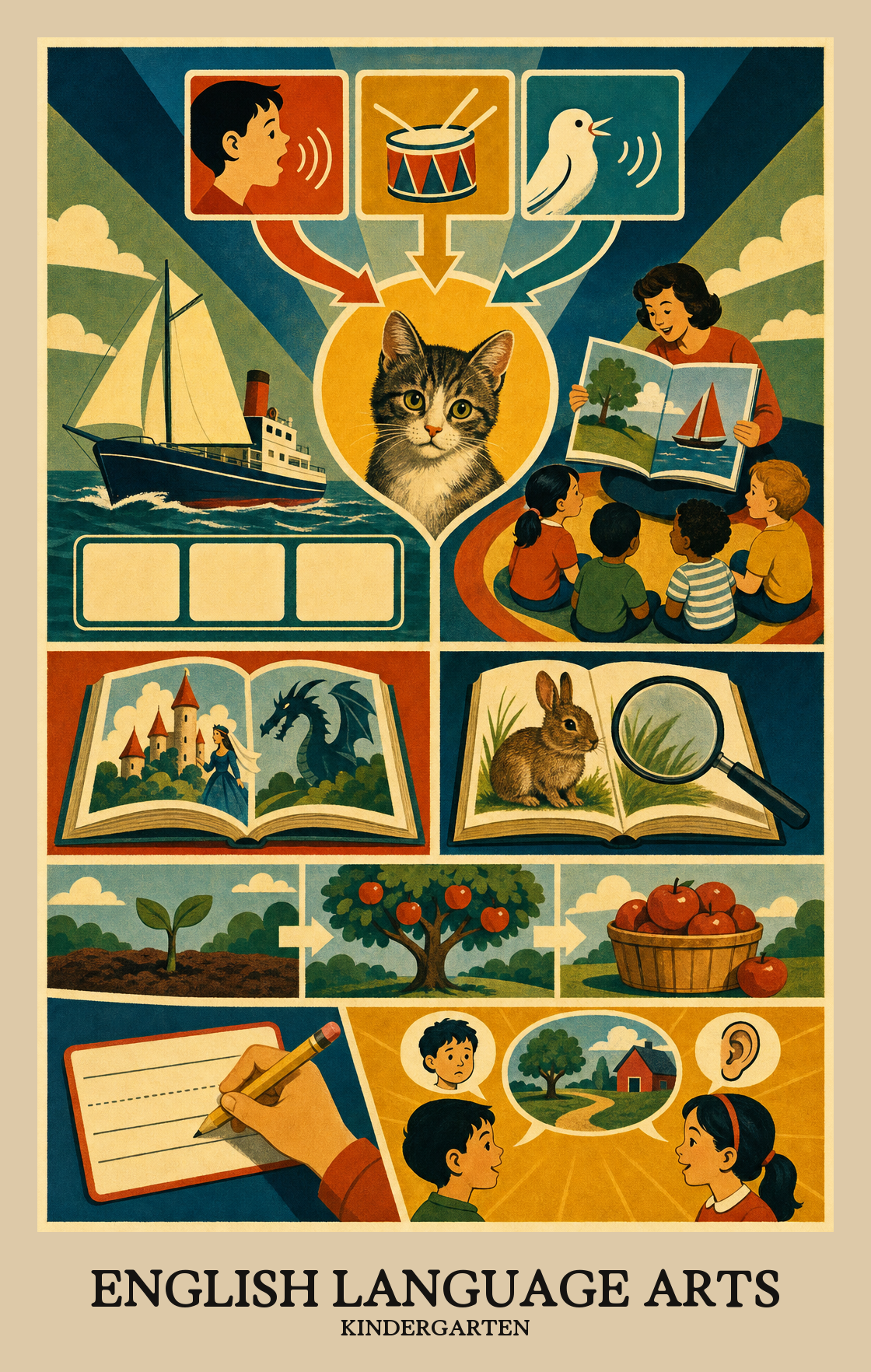
Students learn the names and sounds of every letter. They figure out how a book works, which way print goes on a page, and how to spot the first word in a sentence.
Students pull words apart by sound and put them back together. They practice the first, middle, and last sounds in short words, which is the groundwork for reading and spelling.
Students start sounding out short words like cat, ship, and pen. They write their first and last name, leave spaces between words, and spell simple words by stretching out the sounds.
During read-alouds, students follow the characters and events in a story and pick out the main idea of a fact book. They answer questions, retell what happened, and use new words in conversation.
Students use drawing, talking, and writing to tell a story or describe something they know. They speak in full sentences, take turns in group talks, and share what they found out about a topic.
Reading goes left to right, top to bottom, and each group of letters with spaces around it is one word. Students learn how a page of print is set up before they start sounding out words.
Reading in English starts at the top left, moves right across each line, then jumps back to the left to begin the next line. Students practice tracking this path with their eyes or a finger as they read a page.
A sentence is a group of words, a word is a single unit, and a letter is one of the A-to-Z symbols that builds words. Students learn to tell the difference between all three on a printed page.
Printed words on a page match the words we say out loud. Students learn that each word has a space on both sides of it, so readers can tell where one word ends and the next begins.
Students point to the author's name and explain that the author wrote the words, then point to the illustrator's name and explain that the illustrator drew the pictures.
Students point to the front cover, back cover, and title of a book. It's one of the first steps in learning how a book works.
A sentence starts with a capital letter and ends with a period, question mark, or exclamation point. Students learn to spot those features so they can tell where a sentence begins and ends.
Students listen for the individual sounds inside spoken words, then say those sounds aloud. This builds the ear-training that makes learning to read and spell much easier.
Students listen to a spoken sentence and clap or count each word in it. They also break a word like "pencil" into its syllable beats: pen-cil.
Students break a word into its starting sound and the rest of it, then snap those two pieces back together. For example, they hear /c/ and /at/, blend them into "cat," or split "cat" back apart.
Students listen to a short word and pick out its first sound, middle sound, and last sound. For example, in "cat" they identify the /k/, the /a/, and the /t/ separately.
Students break short words into individual sounds and then blend those sounds back into words. This includes words with two-part consonant sounds like "sh," "ch," "th," and "wh."
Reading letters and matching them to their sounds. Students use those sound-letter connections to read simple words and begin spelling them.
Students name each letter of the alphabet in both its capital and lowercase form, like knowing that "A" and "a" are the same letter.
Students match letters to the sounds they make, like knowing that the letter "b" makes the sound at the start of "ball." This is the foundation of sounding out words.
Students learn that vowels like A, E, I, O, and U each make two sounds: a short sound like the "e" in "pet" and a long sound like the "e" in "he." They practice hearing and reading the difference.
Every word spoken out loud has at least one vowel sound in it. Students learn to hear that vowel in short words like "cat," "in," and "go."
Students learn that two consonants together can make one new sound, like the "sh" in "ship" or the "ch" in "chin." They practice spotting those pairs in words they read and spell.
Students sound out short words by matching letters to their sounds, then blending those sounds together. Words like "up," "at," "hop," and "sit" follow this pattern.
Students read and spell short-vowel words, including ones that start or end with two-letter sounds like "ch," "sh," or "th."
Students read common words like "the," "is," and "said" quickly and correctly, without sounding them out each time. Recognizing these words on sight helps reading feel smoother and faster.
| Standard | Definition | Code |
|---|---|---|
| Print Concepts: The student will apply knowledge of how print is organized… | Reading goes left to right, top to bottom, and each group of letters with spaces around it is one word. Students learn how a page of print is set up before they start sounding out words. | K.FFR.1 |
| Follow words from left to right and from top to bottom on a printed page… | Reading in English starts at the top left, moves right across each line, then jumps back to the left to begin the next line. Students practice tracking this path with their eyes or a finger as they read a page. | K.FFR.1.A |
| Demonstrate knowledge of a sentence, word | A sentence is a group of words, a word is a single unit, and a letter is one of the A-to-Z symbols that builds words. Students learn to tell the difference between all three on a printed page. | K.FFR.1.B |
| Demonstrate knowledge that spoken words are represented in print and separated… | Printed words on a page match the words we say out loud. Students learn that each word has a space on both sides of it, so readers can tell where one word ends and the next begins. | K.FFR.1.C |
| Identify the author and illustrator of a text and define the role of each | Students point to the author's name and explain that the author wrote the words, then point to the illustrator's name and explain that the illustrator drew the pictures. | K.FFR.1.D |
| Identify the front cover, back cover and title of a text | Students point to the front cover, back cover, and title of a book. It's one of the first steps in learning how a book works. | K.FFR.1.E |
| Recognize the distinguishing features of a sentence | A sentence starts with a capital letter and ends with a period, question mark, or exclamation point. Students learn to spot those features so they can tell where a sentence begins and ends. | K.FFR.1.F |
| Phonological and Phonemic Awareness | Students listen for the individual sounds inside spoken words, then say those sounds aloud. This builds the ear-training that makes learning to read and spell much easier. | K.FFR.2 |
| Demonstrate ability to segment spoken words in sentences and syllables in words | Students listen to a spoken sentence and clap or count each word in it. They also break a word like "pencil" into its syllable beats: pen-cil. | K.FFR.2.A |
| Blend and segment one syllable words by onset and rime | Students break a word into its starting sound and the rest of it, then snap those two pieces back together. For example, they hear /c/ and /at/, blend them into "cat," or split "cat" back apart. | K.FFR.2.B |
| Isolate the initial, medial | Students listen to a short word and pick out its first sound, middle sound, and last sound. For example, in "cat" they identify the /k/, the /a/, and the /t/ separately. | K.FFR.2.C |
| Demonstrate ability to segment and blend one syllable words with two, three | Students break short words into individual sounds and then blend those sounds back into words. This includes words with two-part consonant sounds like "sh," "ch," "th," and "wh." | K.FFR.2.D |
| Phonics and Word Analysis | Reading letters and matching them to their sounds. Students use those sound-letter connections to read simple words and begin spelling them. | K.FFR.3 |
| Identify capital and lowercase letters of the alphabet | Students name each letter of the alphabet in both its capital and lowercase form, like knowing that "A" and "a" are the same letter. | K.FFR.3.A |
| Identify common letter-sound correspondences | Students match letters to the sounds they make, like knowing that the letter "b" makes the sound at the start of "ball." This is the foundation of sounding out words. | K.FFR.3.B |
| Discriminate between long and short sounds with common spellings for the five… | Students learn that vowels like A, E, I, O, and U each make two sounds: a short sound like the "e" in "pet" and a long sound like the "e" in "he." They practice hearing and reading the difference. | K.FFR.3.C |
| Demonstrate knowledge that every word has a vowel sound | Every word spoken out loud has at least one vowel sound in it. Students learn to hear that vowel in short words like "cat," "in," and "go." | K.FFR.3.D |
| Identify the letter-sound correspondences for consonant digraphs | Students learn that two consonants together can make one new sound, like the "sh" in "ship" or the "ch" in "chin." They practice spotting those pairs in words they read and spell. | K.FFR.3.E |
| Demonstrate knowledge of letter-sound correspondences to blend CV, CVC, VC words | Students sound out short words by matching letters to their sounds, then blending those sounds together. Words like "up," "at," "hop," and "sit" follow this pattern. | K.FFR.3.F |
| Decode (read) and encode | Students read and spell short-vowel words, including ones that start or end with two-letter sounds like "ch," "sh," or "th." | K.FFR.3.G |
| Use letter-sound correspondences to read grade-level high frequency words… | Students read common words like "the," "is," and "said" quickly and correctly, without sounding them out each time. Recognizing these words on sight helps reading feel smoother and faster. | K.FFR.3.H |
Reading books and listening to stories helps students learn new words and ideas. Students practice reading simple sentences on their own and talk about what they heard to show they understood it.
Students sound out letters to read simple sentences, then read them again to build speed and confidence. Practice with short, controlled texts helps words start to click faster.
This standard is introduced in second grade, so no Kindergarten work is expected here yet.
Students listen to a story or book read aloud, then point to specific parts that back up what they think. They practice pulling more than one detail from the text to explain their answer.
Students listen to several books or passages on the same topic, then use what they learned to understand new books on that topic. Reading the same subject again and again builds vocabulary and helps new ideas stick.
This standard isn't taught in Kindergarten. It's introduced in Grade 3.
| Standard | Definition | Code |
|---|---|---|
| The student will build knowledge and comprehension skills from reading… | Reading books and listening to stories helps students learn new words and ideas. Students practice reading simple sentences on their own and talk about what they heard to show they understood it. | K.DSR.1 |
| Use knowledge of letter-sound correspondences to read and reread controlled… | Students sound out letters to read simple sentences, then read them again to build speed and confidence. Practice with short, controlled texts helps words start to click faster. | K.DSR.1.A |
| (Text Complexity, 2-12) - Introduced in Grade Two | This standard is introduced in second grade, so no Kindergarten work is expected here yet. | K.DSR.1.B |
| With prompting and support, when responding to text through discussions and/or… | Students listen to a story or book read aloud, then point to specific parts that back up what they think. They practice pulling more than one detail from the text to explain their answer. | K.DSR.1.C |
| Regularly engage in listening to a series of conceptually related texts… | Students listen to several books or passages on the same topic, then use what they learned to understand new books on that topic. Reading the same subject again and again builds vocabulary and helps new ideas stick. | K.DSR.1.D |
| (Reading Strategies, 3-12) - Introduced in Grade Three | This standard isn't taught in Kindergarten. It's introduced in Grade 3. | K.DSR.1.E |
Students build a bank of new words by listening to stories and lessons read aloud. Each word they learn helps them understand more of what they hear and read.
Reading starts with knowing what words mean. Students learn to recognize new words, figure out unfamiliar ones using context or word parts, and build the vocabulary they need to understand what they read and hear.
Students talk about what words mean using books, conversations, and everyday experiences as clues. The goal is building a habit of wondering what words mean and asking about them.
Students ask about words they don't recognize while reading or listening. This builds the habit of stopping to check meaning instead of skipping past what they don't know.
Students learn and use words from science, math, and other subjects, not just reading class. A word like "solid" or "count" shows up everywhere, and students practice using it in the right place.
Students learn what a dictionary is for and when to look something up. They practice using picture dictionaries and simple digital tools to find the meaning of a word they don't know.
Students build new vocabulary by listening to stories and books read aloud. The more complex and varied those books are, the more words students pick up.
Students practice using new words out loud, in conversations and class discussions, not just recognizing them on a page.
| Standard | Definition | Code |
|---|---|---|
| The student will systematically build vocabulary and word knowledge based… | Students build a bank of new words by listening to stories and lessons read aloud. Each word they learn helps them understand more of what they hear and read. | K.RV |
| Vocabulary Development and Word Analysis | Reading starts with knowing what words mean. Students learn to recognize new words, figure out unfamiliar ones using context or word parts, and build the vocabulary they need to understand what they read and hear. | K.RV.1 |
| Discuss meanings of words from a variety of texts and experiences | Students talk about what words mean using books, conversations, and everyday experiences as clues. The goal is building a habit of wondering what words mean and asking about them. | K.RV.1.A |
| Ask questions about words not understood | Students ask about words they don't recognize while reading or listening. This builds the habit of stopping to check meaning instead of skipping past what they don't know. | K.RV.1.B |
| Use vocabulary from across content areas | Students learn and use words from science, math, and other subjects, not just reading class. A word like "solid" or "count" shows up everywhere, and students practice using it in the right place. | K.RV.1.C |
| Identify the purpose of simple reference materials | Students learn what a dictionary is for and when to look something up. They practice using picture dictionaries and simple digital tools to find the meaning of a word they don't know. | K.RV.1.D |
| Increase and develop breadth of vocabulary knowledge by listening to… | Students build new vocabulary by listening to stories and books read aloud. The more complex and varied those books are, the more words students pick up. | K.RV.1.E |
| Use newly learned words and phrases in discussions and speaking activities | Students practice using new words out loud, in conversations and class discussions, not just recognizing them on a page. | K.RV.1.F |
Students listen to stories like fairy tales, fables, and realistic fiction, then answer questions and talk about what happened using details from the text.
Students listen to a story and answer questions about what happened and why. They point to details in the text or pictures to back up their answers.
Before reading, students talk about what they already know. Then, as the story unfolds, they connect it to their own experiences or things they have learned before.
Students listen to a story and name who is in it, where it takes place, and what happens. A teacher helps them find those answers.
Students listen to a familiar story and retell it out loud in order: what happened first, what happened next, and how it ended. A teacher or adult helps them along.
Students listen to a story and guess what a character might do next, using clues from the words or pictures. Teachers help them think it through.
Reading closely means noticing how an author chooses words and builds a story. Students look at why a book sounds the way it does and how those choices shape what they feel as they read.
Students look at the characters, settings, and events in a story to understand how the pieces fit together. They talk or write about what they noticed.
Students look at the pictures in a book and talk about what moment in the story each one shows. A teacher or adult helps them make the connection between what they see and what happened in the words.
Students look at two familiar stories side by side and talk about how the characters, what happens, or where the story takes place are the same or different. A teacher helps them find the comparisons.
When a teacher reads a story aloud, students learn to notice when something confuses them and ask a question or ask to hear that part again.
| Standard | Definition | Code |
|---|---|---|
| The student will use textual evidence to demonstrate comprehension and… | Students listen to stories like fairy tales, fables, and realistic fiction, then answer questions and talk about what happened using details from the text. | K.RL |
| Key Ideas and Plot Details | Students listen to a story and answer questions about what happened and why. They point to details in the text or pictures to back up their answers. | K.RL.1 |
| With prompting and support, activate prior | Before reading, students talk about what they already know. Then, as the story unfolds, they connect it to their own experiences or things they have learned before. | K.RL.1.A |
| With prompting and support, demonstrate knowledge of story structure by… | Students listen to a story and name who is in it, where it takes place, and what happens. A teacher helps them find those answers. | K.RL.1.B |
| With prompting and support, orally re-tell a familiar story in sequential order | Students listen to a familiar story and retell it out loud in order: what happened first, what happened next, and how it ended. A teacher or adult helps them along. | K.RL.1.C |
| With prompting and support, generate predictions about story characters and… | Students listen to a story and guess what a character might do next, using clues from the words or pictures. Teachers help them think it through. | K.RL.1.D |
| Craft and Style | Reading closely means noticing how an author chooses words and builds a story. Students look at why a book sounds the way it does and how those choices shape what they feel as they read. | K.RL.2 |
| Integration of Concepts | Students look at the characters, settings, and events in a story to understand how the pieces fit together. They talk or write about what they noticed. | K.RL.3 |
| With prompting and support, describe the relationship between illustrations and… | Students look at the pictures in a book and talk about what moment in the story each one shows. A teacher or adult helps them make the connection between what they see and what happened in the words. | K.RL.3.A |
| With prompting and support, compare and contrast characters, plot events | Students look at two familiar stories side by side and talk about how the characters, what happens, or where the story takes place are the same or different. A teacher helps them find the comparisons. | K.RL.3.B |
| With prompting and support, monitor listening comprehension | When a teacher reads a story aloud, students learn to notice when something confuses them and ask a question or ask to hear that part again. | K.RL.3.C |
Students listen to true books and short passages read aloud, then answer questions and talk about what they heard. The focus is on remembering facts and details from the text, not making things up.
Students answer simple questions about a book or article by pointing to or talking about the part of the text that shows the answer.
Readers ask and answer simple questions about a book or article, like who is in it, what happens, or why something occurs. A teacher may help by pointing to pictures or rereading a sentence aloud.
Students pick out what a short book or article is mostly about, then point to the details that tell more about that idea. A teacher may help by asking questions and pointing to pictures.
Reading informational text means noticing how an author chooses words and organizes ideas to explain something. Students learn to recognize why a writer made those choices and what effect they have on the reader.
A table of contents, headings, bold words, and pictures all help readers find and understand information faster. Students learn what each one does and why authors use them.
Students learn how two pieces of information in a book connect, like why something happens or how one idea leads to another. The focus is on finding the relationship between people, events, or ideas.
Students look at two books or passages about the same topic and spot what is alike and what is different between them. A teacher helps them notice the details.
Students look at a book about real topics and explain how two things in it go together, like how rain connects to puddles. A teacher helps them find the connection and put it into words.
| Standard | Definition | Code |
|---|---|---|
| The student will use textual evidence to demonstrate comprehension and… | Students listen to true books and short passages read aloud, then answer questions and talk about what they heard. The focus is on remembering facts and details from the text, not making things up. | K.RI |
| Key Ideas and Confirming Details | Students answer simple questions about a book or article by pointing to or talking about the part of the text that shows the answer. | K.RI.1 |
| With prompting and support, ask and answer literal | Readers ask and answer simple questions about a book or article, like who is in it, what happens, or why something occurs. A teacher may help by pointing to pictures or rereading a sentence aloud. | K.RI.1.A |
| With prompting and support, identify the main topic and key details of a text | Students pick out what a short book or article is mostly about, then point to the details that tell more about that idea. A teacher may help by asking questions and pointing to pictures. | K.RI.1.B |
| Craft and Style | Reading informational text means noticing how an author chooses words and organizes ideas to explain something. Students learn to recognize why a writer made those choices and what effect they have on the reader. | K.RI.2 |
| With prompting and support, identify the purpose of common text features | A table of contents, headings, bold words, and pictures all help readers find and understand information faster. Students learn what each one does and why authors use them. | K.RI.2.A |
| Integration of Concepts | Students learn how two pieces of information in a book connect, like why something happens or how one idea leads to another. The focus is on finding the relationship between people, events, or ideas. | K.RI.3 |
| With prompting and support, identify basic similarities in and differences… | Students look at two books or passages about the same topic and spot what is alike and what is different between them. A teacher helps them notice the details. | K.RI.3.A |
| With prompting and support, describe the connection between two individuals… | Students look at a book about real topics and explain how two things in it go together, like how rain connects to puddles. A teacher helps them find the connection and put it into words. | K.RI.3.B |
Students practice printing letters and words by hand, forming each letter clearly enough to read.
Students practice forming letters by hand, learning to hold a pencil and place letters correctly on the page.
Students practice holding a pencil the right way so they can form letters clearly and with control.
Students write every capital and lowercase letter of the alphabet on their own, without help or a model to copy.
Students practice writing words and sentences starting at the top-left of the page, moving right, then dropping to the next line. This is the basic direction every reader expects on the page.
Students write their first and last names by hand, starting each one with a capital letter. This is usually one of the first things kids practice writing in school.
Students leave a finger-width gap between each word when writing a phrase or sentence. That spacing makes handwriting readable.
Students spell simple words by matching letters to the sounds they hear, often starting with just beginning and ending sounds before filling in the middle.
Students spell short, simple words by sounding them out letter by letter, including words that start or end with two-letter sounds like "ch," "sh," and "th."
Students sound out unfamiliar words and write them the way they think the letters should go. The goal is to connect sounds to letters, not to spell perfectly.
Students match the sounds they hear in common words to the letters that make those sounds, then write the word correctly. This is early spelling practice with short, everyday words like "the," "is," and "can."
| Standard | Definition | Code |
|---|---|---|
| The student will print legibly in manuscript | Students practice printing letters and words by hand, forming each letter clearly enough to read. | K.FFW |
| Handwriting | Students practice forming letters by hand, learning to hold a pencil and place letters correctly on the page. | K.FFW.1 |
| Use functional pencil grasp for letter formation | Students practice holding a pencil the right way so they can form letters clearly and with control. | K.FFW.1.A |
| Accurately and automatically print capital and lowercase letters of the… | Students write every capital and lowercase letter of the alphabet on their own, without help or a model to copy. | K.FFW.1.B |
| Write left to right and top to bottom | Students practice writing words and sentences starting at the top-left of the page, moving right, then dropping to the next line. This is the basic direction every reader expects on the page. | K.FFW.1.C |
| Accurately print first and last names, beginning each with a capital letter | Students write their first and last names by hand, starting each one with a capital letter. This is usually one of the first things kids practice writing in school. | K.FFW.1.D |
| Apply spaces between written words in phrase or sentence level writing | Students leave a finger-width gap between each word when writing a phrase or sentence. That spacing makes handwriting readable. | K.FFW.1.E |
| Spelling | Students spell simple words by matching letters to the sounds they hear, often starting with just beginning and ending sounds before filling in the middle. | K.FFW.2 |
| Encode (spell) one syllable words with short vowels and one syllable words… | Students spell short, simple words by sounding them out letter by letter, including words that start or end with two-letter sounds like "ch," "sh," and "th." | K.FFW.2.A |
| Encode (spell) unknown words using logical invented spelling | Students sound out unfamiliar words and write them the way they think the letters should go. The goal is to connect sounds to letters, not to spell perfectly. | K.FFW.2.B |
| With prompting and support, use phoneme/grapheme | Students match the sounds they hear in common words to the letters that make those sounds, then write the word correctly. This is early spelling practice with short, everyday words like "the," "is," and "can." | K.FFW.2.C |
Students practice writing in different ways, like drawing and labeling a picture, finishing a sentence, or telling a short story. All writing ties back to something they are reading or learning about in class.
Students pick a topic they have an opinion about and write or dictate a sentence telling what they think. At this grade, that might mean drawing a picture and telling a teacher why they like or dislike something.
Students draw pictures and write or dictate words to tell a short story in order, with a clear beginning, middle, and end.
Students pick a topic and describe it using pictures, spoken words, or writing. They share at least one detail that tells more about the topic.
Students listen to a story or book read aloud, then respond to it through pictures, spoken words, or writing. It's an early step in learning to share thoughts about what they've heard.
Students write or draw to share information about a topic, giving it a beginning, a middle, and an end.
Drawing pictures and talking with classmates helps students figure out what they want to say before they start writing. At this stage, students plan their ideas with help from a teacher or a friend.
Before writing, students decide who will read their work and why. A letter goes to a person, a story entertains, and an "all about" book teaches someone something new.
Students write or say simple sentences about one topic, making sure each sentence has a person or thing doing something.
Students practice the basic rules of written English: capitalizing the first word in a sentence, adding punctuation at the end, and spelling common words correctly.
| Standard | Definition | Code |
|---|---|---|
| The student will write in a variety of forms, linked to kindergarten content… | Students practice writing in different ways, like drawing and labeling a picture, finishing a sentence, or telling a short story. All writing ties back to something they are reading or learning about in class. | K.W |
| Modes and Purposes for Writing | Students pick a topic they have an opinion about and write or dictate a sentence telling what they think. At this grade, that might mean drawing a picture and telling a teacher why they like or dislike something. | K.W.1 |
| Use a combination of drawing, dictating | Students draw pictures and write or dictate words to tell a short story in order, with a clear beginning, middle, and end. | K.W.1.A |
| Use a combination of drawing, dictating | Students pick a topic and describe it using pictures, spoken words, or writing. They share at least one detail that tells more about the topic. | K.W.1.B |
| Use a combination of drawing, dictating | Students listen to a story or book read aloud, then respond to it through pictures, spoken words, or writing. It's an early step in learning to share thoughts about what they've heard. | K.W.1.C |
| Organization and Composition | Students write or draw to share information about a topic, giving it a beginning, a middle, and an end. | K.W.2 |
| With guidance and support, use prewriting activities, including drawing and… | Drawing pictures and talking with classmates helps students figure out what they want to say before they start writing. At this stage, students plan their ideas with help from a teacher or a friend. | K.W.2.A |
| Identifying the audience and purpose of the writing | Before writing, students decide who will read their work and why. A letter goes to a person, a story entertains, and an "all about" book teaches someone something new. | K.W.2.A.i |
| Composing or dictating simple sentences that include a subject | Students write or say simple sentences about one topic, making sure each sentence has a person or thing doing something. | K.W.2.A.ii |
| Usage and Mechanics | Students practice the basic rules of written English: capitalizing the first word in a sentence, adding punctuation at the end, and spelling common words correctly. | K.W.3 |
Students learn when to use careful, correct English and when everyday casual speech is fine. They practice matching the way they talk or write to the situation.
Students learn to put words together into simple spoken and written sentences, using correct names for the parts of speech their teacher introduces.
Students practice building complete sentences out loud, often with the whole class, and learn to stretch a short sentence into a longer, more detailed one.
Nouns are the naming words in a sentence. Students practice spotting and using words that name a person (like a teacher), a place (like a park), or a thing (like a chair).
Pronouns are shortcut words that replace someone's name. Students practice swapping names for words like "he," "she," and "they" so sentences don't repeat the same name over and over.
Students pick words that describe an object: how many, how big, how old, what shape, what color, or where it is. "Three small red blocks" is the kind of phrase they practice building.
Action words like "jump," "sit," and "clap" tell us exactly what is happening in a sentence. Students practice spotting and using those verbs to make their meaning clear.
Students learn how to use capital letters, punctuation, and proper spacing when writing sentences. These are the basic rules that make writing readable.
Students practice starting every sentence with a capital letter and writing the word I as a capital. A teacher or adult helps them notice and fix mistakes.
Sentences that ask something end with a question mark; sentences that tell something end with a period. Students practice spotting the difference and putting the right mark at the end.
Students sound out words and write the letters they hear, even when they are not sure of the correct spelling. The goal is to get ideas on paper, not to spell every word perfectly yet.
| Standard | Definition | Code |
|---|---|---|
| The student will use the conventions of Standard English when speaking and… | Students learn when to use careful, correct English and when everyday casual speech is fine. They practice matching the way they talk or write to the situation. | K.LU |
| Grammar | Students learn to put words together into simple spoken and written sentences, using correct names for the parts of speech their teacher introduces. | K.LU.1 |
| Produce and expand complete sentences in shared language activities | Students practice building complete sentences out loud, often with the whole class, and learn to stretch a short sentence into a longer, more detailed one. | K.LU.1.A |
| Use nouns to identify and name people, places | Nouns are the naming words in a sentence. Students practice spotting and using words that name a person (like a teacher), a place (like a park), or a thing (like a chair). | K.LU.1.B |
| Use pronouns to identify individuals and groups | Pronouns are shortcut words that replace someone's name. Students practice swapping names for words like "he," "she," and "they" so sentences don't repeat the same name over and over. | K.LU.1.C |
| Use adjectives to describe specific objects | Students pick words that describe an object: how many, how big, how old, what shape, what color, or where it is. "Three small red blocks" is the kind of phrase they practice building. | K.LU.1.D |
| Use verbs to locate specific actions | Action words like "jump," "sit," and "clap" tell us exactly what is happening in a sentence. Students practice spotting and using those verbs to make their meaning clear. | K.LU.1.E |
| Mechanics | Students learn how to use capital letters, punctuation, and proper spacing when writing sentences. These are the basic rules that make writing readable. | K.LU.2 |
| With guidance and support, begin each sentence with a capital letter and… | Students practice starting every sentence with a capital letter and writing the word I as a capital. A teacher or adult helps them notice and fix mistakes. | K.LU.2.A |
| With guidance and support, identify statements and questions and use ending… | Sentences that ask something end with a question mark; sentences that tell something end with a period. Students practice spotting the difference and putting the right mark at the end. | K.LU.2.B |
| Phonetically spell words containing unknown letter-sound correspondences | Students sound out words and write the letters they hear, even when they are not sure of the correct spelling. The goal is to get ideas on paper, not to spell every word perfectly yet. | K.LU.2.C |
Talking and listening skills practiced here. Students share ideas out loud, take turns speaking, and work with classmates to make sense of stories, lessons, and new information together.
Students listen carefully and take turns talking with others. They share ideas, ask questions, and respond to what classmates say.
Talking and listening in a group or with a partner, students share ideas about a story or topic the class is exploring together.
Students take turns in group conversations, wait to speak, and stay on the topic being discussed. This is the foundation of how students learn to talk and listen together in school.
Students listen to a classmate's idea and add to it politely, then share their own thoughts in words others can follow.
Students ask questions out loud when they need help, want to know more, or don't understand something. "Why?" and "How does that work?" are the kinds of questions this standard is about.
Students practice saying what they think or need out loud using a full sentence, not just a word or two. "I want the red crayon" instead of just "red crayon."
Students share ideas out loud with the class, using words and pictures to help others follow along.
Students talk about something that happened to them, using full sentences instead of single words or short phrases.
Students practice speaking at a pace others can follow, with a voice loud enough to hear and natural rises and falls in tone. The goal is for listeners to understand every word without straining.
Students join in group reading, singing, and reciting simple poems and stories aloud. Hearing and repeating patterns and rhymes helps build early language skills.
Students retell stories and events in order, using words like "first," "next," and "last." They might act it out, use pictures, or recite a rhyme to show what happened from beginning to end.
Students combine pictures, words, and gestures to share ideas and tell stories. They learn that meaning can come from drawing, speaking, or moving, not just from written words.
Students look at pictures, videos, and signs to figure out what message someone is trying to send. They practice asking who made it and why.
| Standard | Definition | Code |
|---|---|---|
| The student will develop effective oral communication and collaboration skills… | Talking and listening skills practiced here. Students share ideas out loud, take turns speaking, and work with classmates to make sense of stories, lessons, and new information together. | K.C |
| Communication, Listening | Students listen carefully and take turns talking with others. They share ideas, ask questions, and respond to what classmates say. | K.C.1 |
| Participate in a range of collaborative discussions | Talking and listening in a group or with a partner, students share ideas about a story or topic the class is exploring together. | K.C.1.A |
| Listening actively and following agreed-upon rules for participating in… | Students take turns in group conversations, wait to speak, and stay on the topic being discussed. This is the foundation of how students learn to talk and listen together in school. | K.C.1.A.i |
| Respectfully building on others’ ideas and expressing their own clearly | Students listen to a classmate's idea and add to it politely, then share their own thoughts in words others can follow. | K.C.1.A.ii |
| Asking questions to seek help, get information | Students ask questions out loud when they need help, want to know more, or don't understand something. "Why?" and "How does that work?" are the kinds of questions this standard is about. | K.C.1.A.iii |
| Expressing ideas and needs in complete sentences | Students practice saying what they think or need out loud using a full sentence, not just a word or two. "I want the red crayon" instead of just "red crayon." | K.C.1.A.iv |
| Speaking and Presentation of Ideas | Students share ideas out loud with the class, using words and pictures to help others follow along. | K.C.2 |
| Describe personal experiences using complete sentences | Students talk about something that happened to them, using full sentences instead of single words or short phrases. | K.C.2.A |
| Speak audibly with appropriate pacing, prosody | Students practice speaking at a pace others can follow, with a voice loud enough to hear and natural rises and falls in tone. The goal is for listeners to understand every word without straining. | K.C.2.B |
| Participate in a variety of oral language activities, including choral speaking… | Students join in group reading, singing, and reciting simple poems and stories aloud. Hearing and repeating patterns and rhymes helps build early language skills. | K.C.2.C |
| Retell, create, and dictate stories, rhymes, poems | Students retell stories and events in order, using words like "first," "next," and "last." They might act it out, use pictures, or recite a rhyme to show what happened from beginning to end. | K.C.2.D |
| Integrating Multimodal Literacies | Students combine pictures, words, and gestures to share ideas and tell stories. They learn that meaning can come from drawing, speaking, or moving, not just from written words. | K.C.3 |
| Examining Media Messages | Students look at pictures, videos, and signs to figure out what message someone is trying to send. They practice asking who made it and why. | K.C.4 |
Students listen to several books or passages on the same topic to build up what they know about it. Over time, those details add up into real knowledge they can talk or write about.
Students find answers to simple questions by looking at books, pictures, or other sources, then share what they learned.
Students pick something they're curious about and come up with a question to learn more. A teacher helps them figure out where to start.
Students find information about a topic using pictures, books, or people around them. A teacher or adult helps guide the search.
Students pick a topic, gather a few facts about it, and then draw a picture, write words, or tell a sentence out loud to share what they found.
After gathering facts through a class research project, students talk about what they found with a group. A teacher or adult helps them share their notes or drawings out loud.
| Standard | Definition | Code |
|---|---|---|
| The student will conduct research and listen to a series of conceptually… | Students listen to several books or passages on the same topic to build up what they know about it. Over time, those details add up into real knowledge they can talk or write about. | K.R |
| Evaluation and Synthesis of Information | Students find answers to simple questions by looking at books, pictures, or other sources, then share what they learned. | K.R.1 |
| With prompting and support, generate a topic of interest and question to… | Students pick something they're curious about and come up with a question to learn more. A teacher helps them figure out where to start. | K.R.1.A |
| With prompting and support, find information on the topic from pictures, texts… | Students find information about a topic using pictures, books, or people around them. A teacher or adult helps guide the search. | K.R.1.B |
| With prompting and support, use drawing, writing | Students pick a topic, gather a few facts about it, and then draw a picture, write words, or tell a sentence out loud to share what they found. | K.R.1.C |
| With prompting and support, in small or large group settings, informally share… | After gathering facts through a class research project, students talk about what they found with a group. A teacher or adult helps them share their notes or drawings out loud. | K.R.1.D |
Standards of Learning reading assessment for grades 3 through 8.
Shorter computer-adaptive reading growth assessments for grades 3 through 8, administered during the school year in addition to spring SOL tests.
Alternate assessment program for eligible students with significant cognitive disabilities, covering state-tested grades and subjects.
Students learn the letters and sounds, then blend those sounds into short words like cat, ship, and pen. They listen to lots of stories and books read aloud, talk about them, and start writing short sentences using letters they know.
Play short sound games in the car or at dinner. Say a word like sun and ask what sound it starts with, or say three sounds like m-a-p and let your child blend them into a word. Five minutes a day adds up fast.
Not yet. Reversing b and d and spelling kat for cat is normal at this age. Gently show the correct letter or spelling, then move on. What matters most is that students keep trying to write and read.
Read one picture book aloud most nights. Run a finger under the words sometimes so students see that print moves left to right. Ask one or two simple questions afterward, such as who was in the story and what happened first.
Start with letter names and single sounds, then move to short vowel words like cat and pen, then add digraphs like sh, ch, th, and wh. Keep decodable reading and spelling on the same sounds students just learned so the two reinforce each other.
By June, most students can read short words with short vowels and common digraphs, read a set of high-frequency words on sight, and write a simple sentence that starts with a capital letter and ends with a period. They can also retell a story in order.
Middle vowel sounds in three-sound words, blending all the sounds smoothly instead of sound by sound, and putting spaces between words when writing. Short daily practice with the same handful of words usually does more than long weekly lessons.
Listen for steady sounding out of short words, recognition of common words like the and is without sounding them out, and the ability to retell a story with a beginning, middle, and end. Writing a short sentence others can read is another strong sign.
Expect a mix. Students should spell short words with known sounds correctly, like cat or ship, and use their best guess for harder words, like jrf for giraffe. Invented spelling is a sign they are using what they know about sounds.