Counting, skip counting, and patterns
Students count forward and backward by 2s, 5s, 10s, 25s, and 100s up to 1,000. They spot patterns in the numbers and start sorting groups into even and odd.
This is the year numbers stretch past 100 and start working in hundreds, tens, and ones. Students read and write numbers up to 999, add and subtract within 100, and learn their facts up to 20 by heart. They also start splitting shapes into halves, fourths, and thirds, count coins up to two dollars, and tell time to the nearest five minutes. By spring, they can solve a word problem with two steps and explain how they got the answer.
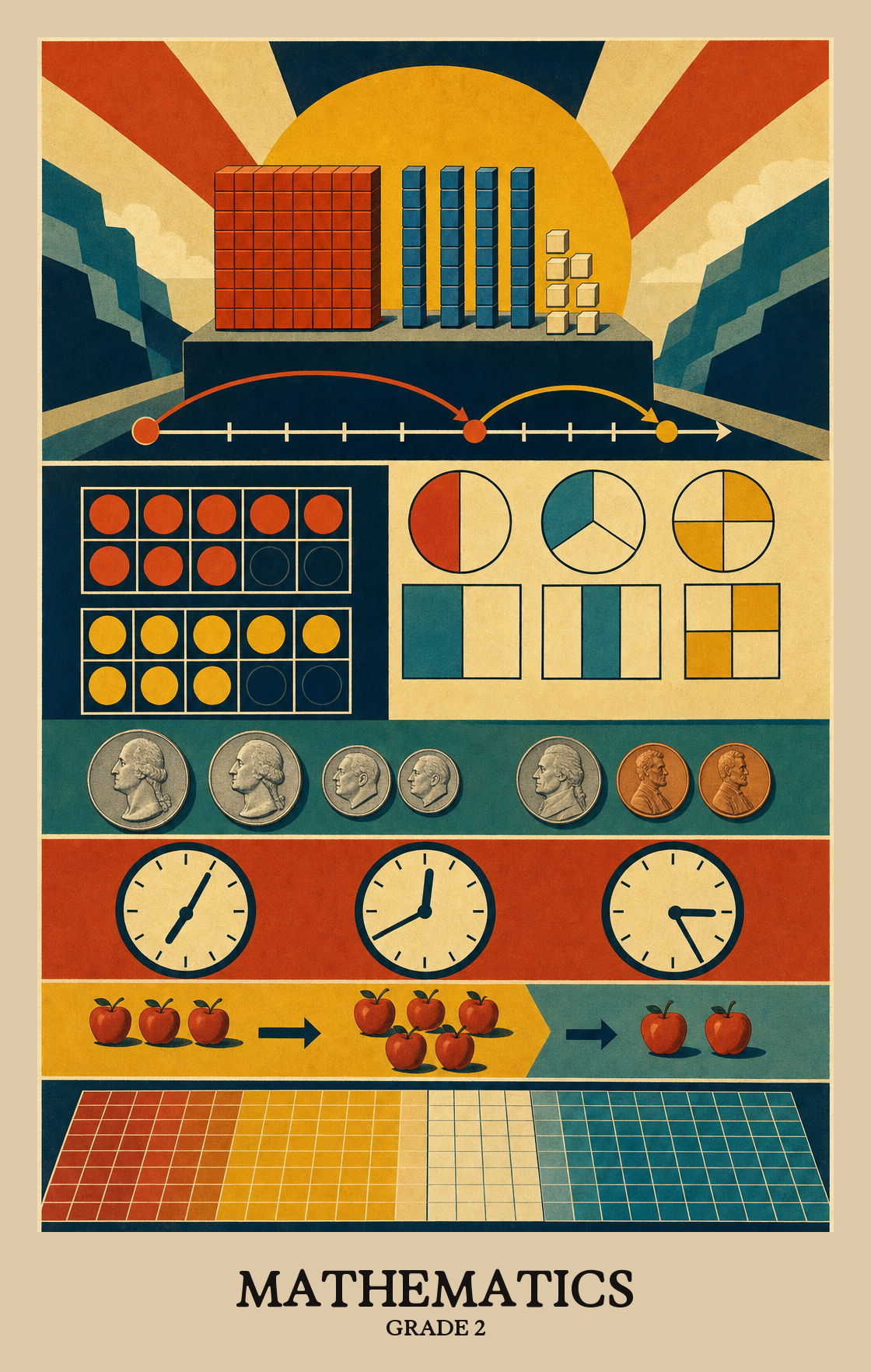
Students count forward and backward by 2s, 5s, 10s, 25s, and 100s up to 1,000. They spot patterns in the numbers and start sorting groups into even and odd.
Students learn that a digit's spot in a number changes its value. They read, write, compare, and order three-digit numbers using base 10 blocks and number lines.
Students memorize their addition and subtraction facts to 20 and use them to solve word problems with larger numbers. They also estimate answers before solving.
Students split shapes into halves, fourths, eighths, thirds, and sixths, and compare the pieces. They also count mixed coins and bills up to two dollars.
Students measure length, weight, and liquid volume with rulers, scales, and measuring cups. They tell time to the nearest five minutes and describe flat shapes and solid shapes like cubes and spheres.
Students ask a question, collect answers, and show what they found on a bar graph or picture graph. They also build and extend patterns using shapes and numbers.
Students count, group, and describe amounts up to 200, using strategies like skip-counting by 5s or 10s to get there faster. The focus is on building number sense, not just reciting a sequence.
Students count by 2s starting from different even numbers, using tools like a number line or hundreds chart to show the pattern as they go.
Students count forward by 5s, 10s, and 25s (like nickels and dimes) starting from different numbers, then show those patterns on a number line or hundreds chart.
Skip counting means jumping forward by the same number each time, like counting by 5s or 10s instead of one by one. Students practice these patterns and use them to figure out what number comes next in a sequence.
Counting by 100s, students practice jumping from 0 to 100 to 200 and beyond, reaching at least 1,000. They use tools like number lines or charts to see and show the pattern those big jumps make.
Students count backward by 10s starting from any number up to 200, using tools like a number line or hundreds chart to track the pattern as the numbers decrease.
Starting at any number up to 200, students count backward by tens (200, 190, 180...) and explain why each number comes next.
Students pick the most sensible number from a short list of choices when a real-life question involves a large quantity. They rule out answers that are obviously too small or too big.
Students show that even numbers can be split into two equal groups. For example, 12 becomes two groups of 6, or the addition sentence 6 + 6 = 12.
Students sort objects into two equal groups to show why odd numbers always leave one extra. For example, 7 becomes three and three, with one left over, or 3 + 3 + 1.
Students sort a pile of up to 50 objects into two equal groups to decide if a number is even or odd, then explain how they know.
Reading, writing, and comparing numbers up to 999 by understanding that each place in a number means tens or hundreds of the one before it. Students use that pattern to say which number is bigger or smaller.
Students look at a picture or group of blocks arranged in hundreds, tens, and ones, then write the number those blocks show, such as writing 347 when they see three flats, four rods, and seven cubes.
Students read and write numbers like 347 in three ways: as the numerals (347), as words (three hundred forty-seven), and broken apart by place value (300 + 40 + 7). Blocks or pictures help show what each digit actually means.
Reading a three-digit number, students name the place of each digit (ones, tens, hundreds) and say what it's worth. In 352, the 5 sits in the tens place and stands for 50.
Students use blocks or drawings to show that 10 ones make a ten, and 10 tens make a hundred. The goal is understanding why our number system groups by tens, not just memorizing the rule.
Students break a number like 156 into hundreds, tens, and ones in more than one way, then put those parts back together. A number can be split up differently and still be the same amount.
Students place a number on a number line by deciding which marked tick mark it belongs on or between. The number line might count by 1s, 2s, 5s, 10s, or 25s.
Students look at two numbers up to 999 and decide which is greater, which is smaller, or whether they match. They use the symbols >, <, and = and explain how they know.
Students put up to three numbers (each no bigger than 999) in order from smallest to biggest or biggest to smallest, whether the numbers are shown as pictures, blocks, or written digits.
Students cut shapes or objects into equal pieces and figure out how to show halves, thirds, fourths, sixths, and eighths. They explain why their parts are equal.
Students divide shapes or objects into equal parts and name each part as a fraction. A pizza cut into 4 equal slices means each slice is one-fourth of the whole.
Students explore why cutting a pizza into 8 slices gives you smaller pieces than cutting it into 4. The more equal parts you split something into, the smaller each part gets.
Given one piece of a whole, students figure out how many pieces of that same size it takes to complete the whole shape or amount.
Students count equal-sized fraction pieces in order, like counting slices of a pizza cut into fourths: one-fourth, two-fourths, three-fourths, four-fourths, and beyond. The counting keeps going past one whole shape into a second.
Students look at a shape or object split into equal parts and write the fraction that names one or more of those parts, like 1/4 for one piece of something cut into four equal pieces.
Students split shapes like circles and squares into equal parts, such as halves or fourths, using drawings or physical pieces. The focus is on making sure every part is the same size.
Students split a line, strip, or number line into equal parts to show fractions like halves, thirds, and fourths. The focus is on length, not shape, so students learn that equal parts must be the same size from end to end.
Students split a group of objects (like chips or cubes) into equal shares and name each share as a half, a third, a fourth, a sixth, or an eighth.
Students compare simple fractions like one-half and one-fourth by looking at shaded shapes or marked lengths, then decide which piece is bigger, smaller, or the same size using the symbols >, <, and =.
Students count coins and bills to make amounts up to $2.00, then solve simple word problems about buying and making change. They work with pennies, nickels, dimes, quarters, and dollar bills.
Students learn what a quarter looks like, what 25 cents means, and how to make that same amount using different combinations of pennies, nickels, and dimes.
Students count a mix of coins and dollar bills to find the total amount, up to $2.00. They skip-count by ones, fives, tens, and twenty-fives to add it all up.
Students pick a combination of coins and bills that adds up to a given amount, like 75 cents or $1.50. The total has to be $2.00 or less.
Students count a mix of coins and dollar bills, then write the total using a dollar sign, cent sign, and decimal point. Amounts stay at $2.00 or less.
| Standard | Definition | Code |
|---|---|---|
| The student will utilize flexible counting strategies to determine and describe… | Students count, group, and describe amounts up to 200, using strategies like skip-counting by 5s or 10s to get there faster. The focus is on building number sense, not just reciting a sequence. | 2.NS.1 |
| Represent forward counting patterns when counting by groups of 2 up to at least… | Students count by 2s starting from different even numbers, using tools like a number line or hundreds chart to show the pattern as they go. | 2.NS.1.a |
| Represent forward counting patterns created when counting by groups of 5s, 10s | Students count forward by 5s, 10s, and 25s (like nickels and dimes) starting from different numbers, then show those patterns on a number line or hundreds chart. | 2.NS.1.b |
| Describe and use patterns in skip counting by multiples of 2 | Skip counting means jumping forward by the same number each time, like counting by 5s or 10s instead of one by one. Students practice these patterns and use them to figure out what number comes next in a sequence. | 2.NS.1.c |
| Represent forward counting patterns when counting by groups of 100 up to at… | Counting by 100s, students practice jumping from 0 to 100 to 200 and beyond, reaching at least 1,000. They use tools like number lines or charts to see and show the pattern those big jumps make. | 2.NS.1.d |
| Represent backward counting patterns when counting by groups of 10 from 200 or… | Students count backward by 10s starting from any number up to 200, using tools like a number line or hundreds chart to track the pattern as the numbers decrease. | 2.NS.1.e |
| Describe and use patterns in skip counting backwards by 10s | Starting at any number up to 200, students count backward by tens (200, 190, 180...) and explain why each number comes next. | 2.NS.1.f |
| Choose a reasonable estimate up to 1,000 when given a contextual problem | Students pick the most sensible number from a short list of choices when a real-life question involves a large quantity. They rule out answers that are obviously too small or too big. | 2.NS.1.g |
| Represent even numbers | Students show that even numbers can be split into two equal groups. For example, 12 becomes two groups of 6, or the addition sentence 6 + 6 = 12. | 2.NS.1.h |
| Represent odd numbers | Students sort objects into two equal groups to show why odd numbers always leave one extra. For example, 7 becomes three and three, with one left over, or 3 + 3 + 1. | 2.NS.1.i |
| Determine whether a number | Students sort a pile of up to 50 objects into two equal groups to decide if a number is even or odd, then explain how they know. | 2.NS.1.j |
| The student will demonstrate an understanding of the ten-to-one relationships… | Reading, writing, and comparing numbers up to 999 by understanding that each place in a number means tens or hundreds of the one before it. Students use that pattern to say which number is bigger or smaller. | 2.NS.2 |
| Write the three-digit whole number represented by a given model | Students look at a picture or group of blocks arranged in hundreds, tens, and ones, then write the number those blocks show, such as writing 347 when they see three flats, four rods, and seven cubes. | 2.NS.2.a |
| Read, write, and represent three-digit numbers in standard form, expanded form | Students read and write numbers like 347 in three ways: as the numerals (347), as words (three hundred forty-seven), and broken apart by place value (300 + 40 + 7). Blocks or pictures help show what each digit actually means. | 2.NS.2.b |
| Apply patterns within the base 10 system to determine and communicate, orally… | Reading a three-digit number, students name the place of each digit (ones, tens, hundreds) and say what it's worth. In 352, the 5 sits in the tens place and stands for 50. | 2.NS.2.c |
| Investigate and explain the ten-to-one relationships among ones, tens | Students use blocks or drawings to show that 10 ones make a ten, and 10 tens make a hundred. The goal is understanding why our number system groups by tens, not just memorizing the rule. | 2.NS.2.d |
| Compose and decompose whole numbers up to 200 by making connections between a… | Students break a number like 156 into hundreds, tens, and ones in more than one way, then put those parts back together. A number can be split up differently and still be the same amount. | 2.NS.2.e |
| Plot and justify the position of a given number up to 100 on a number line with… | Students place a number on a number line by deciding which marked tick mark it belongs on or between. The number line might count by 1s, 2s, 5s, 10s, or 25s. | 2.NS.2.f |
| Compare two whole numbers, each 999 or less, represented concretely, pictorially | Students look at two numbers up to 999 and decide which is greater, which is smaller, or whether they match. They use the symbols >, <, and = and explain how they know. | 2.NS.2.g |
| Order up to three whole numbers, each 999 or less, represented concretely… | Students put up to three numbers (each no bigger than 999) in order from smallest to biggest or biggest to smallest, whether the numbers are shown as pictures, blocks, or written digits. | 2.NS.2.h |
| The student will use mathematical reasoning and justification to solve… | Students cut shapes or objects into equal pieces and figure out how to show halves, thirds, fourths, sixths, and eighths. They explain why their parts are equal. | 2.NS.3 |
| Model and describe fractions as representing equal-size parts of a whole | Students divide shapes or objects into equal parts and name each part as a fraction. A pizza cut into 4 equal slices means each slice is one-fourth of the whole. | 2.NS.3.a |
| Describe the relationship between the number of fractional parts needed to make… | Students explore why cutting a pizza into 8 slices gives you smaller pieces than cutting it into 4. The more equal parts you split something into, the smaller each part gets. | 2.NS.3.b |
| Compose the whole for a given fractional part and its value | Given one piece of a whole, students figure out how many pieces of that same size it takes to complete the whole shape or amount. | 2.NS.3.c |
| Using same-size fraction pieces, from a region/area model, count by unit… | Students count equal-sized fraction pieces in order, like counting slices of a pizza cut into fourths: one-fourth, two-fourths, three-fourths, four-fourths, and beyond. The counting keeps going past one whole shape into a second. | 2.NS.3.d |
| Given a context, represent, name | Students look at a shape or object split into equal parts and write the fraction that names one or more of those parts, like 1/4 for one piece of something cut into four equal pieces. | 2.NS.3.e |
| region/area models (e.g., pie pieces, pattern blocks, geoboards) | Students split shapes like circles and squares into equal parts, such as halves or fourths, using drawings or physical pieces. The focus is on making sure every part is the same size. | 2.NS.3.e.i |
| length models (e.g., paper fraction strips, fraction bars, rods, number lines) | Students split a line, strip, or number line into equal parts to show fractions like halves, thirds, and fourths. The focus is on length, not shape, so students learn that equal parts must be the same size from end to end. | 2.NS.3.e.ii |
| set models (e.g., chips, counters, cubes) | Students split a group of objects (like chips or cubes) into equal shares and name each share as a half, a third, a fourth, a sixth, or an eighth. | 2.NS.3.e.iii |
| Compare unit fractions for halves, fourths, eighths, thirds | Students compare simple fractions like one-half and one-fourth by looking at shaded shapes or marked lengths, then decide which piece is bigger, smaller, or the same size using the symbols >, <, and =. | 2.NS.3.f |
| The student will solve problems that involve counting and representing money… | Students count coins and bills to make amounts up to $2.00, then solve simple word problems about buying and making change. They work with pennies, nickels, dimes, quarters, and dollar bills. | 2.NS.4 |
| Identify a quarter and its value and determine multiple ways to represent the… | Students learn what a quarter looks like, what 25 cents means, and how to make that same amount using different combinations of pennies, nickels, and dimes. | 2.NS.4.a |
| Count by ones, fives, tens | Students count a mix of coins and dollar bills to find the total amount, up to $2.00. They skip-count by ones, fives, tens, and twenty-fives to add it all up. | 2.NS.4.b |
| Construct a set of coins and/or bills to total a given amount of money whose… | Students pick a combination of coins and bills that adds up to a given amount, like 75 cents or $1.50. The total has to be $2.00 or less. | 2.NS.4.c |
| Represent the value of a collection of coins and one-dollar bills | Students count a mix of coins and dollar bills, then write the total using a dollar sign, cent sign, and decimal point. Amounts stay at $2.00 or less. | 2.NS.4.d |
Students practice adding and subtracting numbers up to 100 until the answers come automatically. They also solve word problems and show how they got their answer.
Students practice making quick ballpark guesses before adding or subtracting two numbers up to 100. They round to the nearest ten or look for numbers that work well together to check whether their final answer makes sense.
Students use strategies like place value or drawing a picture to add or subtract two numbers up to 100. They might break apart a number by tens and ones, or use what they know about addition to check a subtraction problem.
Students read a short story problem and figure out whether to add or subtract to find the answer. Numbers stay at 100 or below, and students explain how they know their answer makes sense.
Students practice adding and subtracting numbers up to 20 using mental shortcuts, like knowing that 6+7 is just one more than 6+6, or that adding 9 is nearly the same as adding 10.
Students know their addition and subtraction facts up to 20 from memory, no counting on fingers required. Think 7 + 8 or 15 - 6, answered instantly.
Students learn that flipping the order of two numbers in an addition problem gives the same answer, and that adding zero to any number leaves it unchanged. These patterns help students add faster and with more confidence.
Students figure out the missing number in an addition or subtraction equation, like 3 + ? = 5 or 5 - ? = 3. They use objects or drawings to show how they got the answer.
Given one addition or subtraction fact, students write the other three related facts in the same family. If they know 3 + 4 = 7, they can also write 4 + 3 = 7, 7 - 4 = 3, and 7 - 3 = 4.
Students learn that the "not equal" sign (≠) means two amounts are different, not the same. They practice explaining why, using numbers or objects to back up their thinking.
Students show whether two math expressions have the same value or different values, using the equals sign or a not-equal sign. For example, they check whether 9 + 24 gives the same total as 10 + 23.
| Standard | Definition | Code |
|---|---|---|
| The student will recall with automaticity addition and subtraction facts within… | Students practice adding and subtracting numbers up to 100 until the answers come automatically. They also solve word problems and show how they got their answer. | 2.CE.1 |
| Apply strategies (e.g., rounding to the nearest 10, compatible numbers, other… | Students practice making quick ballpark guesses before adding or subtracting two numbers up to 100. They round to the nearest ten or look for numbers that work well together to check whether their final answer makes sense. | 2.CE.1.a |
| Apply strategies (e.g., the use of concrete and pictorial models, place value… | Students use strategies like place value or drawing a picture to add or subtract two numbers up to 100. They might break apart a number by tens and ones, or use what they know about addition to check a subtraction problem. | 2.CE.1.b |
| Represent, solve, and justify solutions to single-step and multistep contextual… | Students read a short story problem and figure out whether to add or subtract to find the answer. Numbers stay at 100 or below, and students explain how they know their answer makes sense. | 2.CE.1.c |
| Demonstrate fluency with addition and subtraction within 20 by applying… | Students practice adding and subtracting numbers up to 20 using mental shortcuts, like knowing that 6+7 is just one more than 6+6, or that adding 9 is nearly the same as adding 10. | 2.CE.1.d |
| Recall with automaticity addition and subtraction facts within 20 | Students know their addition and subtraction facts up to 20 from memory, no counting on fingers required. Think 7 + 8 or 15 - 6, answered instantly. | 2.CE.1.e |
| Use patterns, models | Students learn that flipping the order of two numbers in an addition problem gives the same answer, and that adding zero to any number leaves it unchanged. These patterns help students add faster and with more confidence. | 2.CE.1.f |
| Determine the missing number in an equation | Students figure out the missing number in an addition or subtraction equation, like 3 + ? = 5 or 5 - ? = 3. They use objects or drawings to show how they got the answer. | 2.CE.1.g |
| Use inverse relationships to write all related facts connected to a given… | Given one addition or subtraction fact, students write the other three related facts in the same family. If they know 3 + 4 = 7, they can also write 4 + 3 = 7, 7 - 4 = 3, and 7 - 3 = 4. | 2.CE.1.h |
| Describe the not equal symbol | Students learn that the "not equal" sign (≠) means two amounts are different, not the same. They practice explaining why, using numbers or objects to back up their thinking. | 2.CE.1.i |
| Represent and justify the relationship between values and expressions as equal… | Students show whether two math expressions have the same value or different values, using the equals sign or a not-equal sign. For example, they check whether 9 + 24 gives the same total as 10 + 23. | 2.CE.1.j |
Students measure real objects by length, weight, and liquid volume using rulers, scales, and measuring cups. They estimate before measuring and compare results using whole units like inches, pounds, and cups.
Measurement tools each have a job. Students learn what a ruler, a scale, and a measuring cup are for and practice using each one correctly to measure length, weight, or liquid.
Students learn that a ruler is the right tool for measuring how long something is, not for weighing it or checking how much liquid it holds.
Scales are tools for measuring how heavy something is. Students learn to recognize different kinds, like a kitchen scale or a balance scale, and understand that each one measures weight.
Students learn that measuring cups come in different sizes and that each one is a tool for finding how much liquid something holds.
Students estimate and measure lengths, weights, and liquid volumes using inches, feet, pounds, and cups, then check whether their estimate was close to the actual measurement.
Students measure how long an object is to the nearest inch using a ruler. They line up the ruler correctly and read the number where the object ends.
Students weigh real objects on a scale and record the result to the nearest whole pound.
Students measure how much liquid a container holds by pouring it into a measuring cup and reading the amount to the nearest cup.
Students read analog and digital clocks and tell time to the nearest five minutes. They connect the position of clock hands to the matching digital display.
Students learn that an hour holds 60 minutes and a day holds 24 hours. These two facts are the building blocks for reading any clock or planning any schedule.
Students decide which unit of time fits a real activity best, such as whether brushing teeth takes minutes, not hours. Then they explain why that unit makes sense.
Students read and write times like 3:15 or 7:45 on both a clock face with hands and a digital display, rounding to the nearest five-minute mark.
Students match a digital time like 6:20 to the same time on a clock face with hands. Both show the same moment, just written two different ways.
Students find the line where a shape folds into two matching halves, then use that idea to explain why both sides are equal in size and shape. Works with circles, triangles, squares, and rectangles.
Students fold, draw, or trace a shape to find the line where both halves match exactly. That matching line is called a line of symmetry.
Students fold, draw, or build shapes where one side mirrors the other exactly. A square, triangle, or rectangle with a line of symmetry looks the same on both halves.
Students fold a shape along its line of symmetry and see that both halves match exactly, same shape and same size.
Students sort flat shapes and 3-D objects by comparing what makes them alike and different. A square and a cube, for example, share corners and straight edges, but one is flat and the other has depth.
Students trace the flat sides of a box or cube onto paper to see which shapes make up that solid. It connects 3-D objects to the flat shapes hidden on their surfaces.
Students look at real boxes and flat cutout patterns that fold into boxes, then describe how cubes and rectangular prisms are alike and different by counting their flat faces, edges, and corners.
Students look at a 3-D shape, like a cube or a box, and describe what they notice: how many corners it has, how many edges, and what the flat faces look like.
Students sort flat shapes and 3D solids by counting their faces, edges, and corners. A square has four flat sides, while a cube has six flat faces but otherwise looks like its flat cousin.
| Standard | Definition | Code |
|---|---|---|
| The student will reason mathematically using standard units | Students measure real objects by length, weight, and liquid volume using rulers, scales, and measuring cups. They estimate before measuring and compare results using whole units like inches, pounds, and cups. | 2.MG.1 |
| Explain the purpose of various measurement tools and how to use them… | Measurement tools each have a job. Students learn what a ruler, a scale, and a measuring cup are for and practice using each one correctly to measure length, weight, or liquid. | 2.MG.1.a |
| identifying a ruler as an instrument to measure length | Students learn that a ruler is the right tool for measuring how long something is, not for weighing it or checking how much liquid it holds. | 2.MG.1.a.i |
| identifying different types of scales as instruments to measure weight | Scales are tools for measuring how heavy something is. Students learn to recognize different kinds, like a kitchen scale or a balance scale, and understand that each one measures weight. | 2.MG.1.a.ii |
| identifying different types of measuring cups as instruments to measure liquid… | Students learn that measuring cups come in different sizes and that each one is a tool for finding how much liquid something holds. | 2.MG.1.a.iii |
| Use U.S. Customary units to estimate, measure | Students estimate and measure lengths, weights, and liquid volumes using inches, feet, pounds, and cups, then check whether their estimate was close to the actual measurement. | 2.MG.1.b |
| the length of an object to the nearest inch, using a ruler | Students measure how long an object is to the nearest inch using a ruler. They line up the ruler correctly and read the number where the object ends. | 2.MG.1.b.i |
| the weight of an object to the nearest pound, using a scale | Students weigh real objects on a scale and record the result to the nearest whole pound. | 2.MG.1.b.ii |
| the liquid volume of a container to the nearest cup, using a measuring cup | Students measure how much liquid a container holds by pouring it into a measuring cup and reading the amount to the nearest cup. | 2.MG.1.b.iii |
| The student will demonstrate an understanding of the concept of time to the… | Students read analog and digital clocks and tell time to the nearest five minutes. They connect the position of clock hands to the matching digital display. | 2.MG.2 |
| Identify the number of minutes in an hour | Students learn that an hour holds 60 minutes and a day holds 24 hours. These two facts are the building blocks for reading any clock or planning any schedule. | 2.MG.2.a |
| Determine the unit of time | Students decide which unit of time fits a real activity best, such as whether brushing teeth takes minutes, not hours. Then they explain why that unit makes sense. | 2.MG.2.b |
| Show, tell, and write time to the nearest five minutes, using analog and… | Students read and write times like 3:15 or 7:45 on both a clock face with hands and a digital display, rounding to the nearest five-minute mark. | 2.MG.2.c |
| Match a written time | Students match a digital time like 6:20 to the same time on a clock face with hands. Both show the same moment, just written two different ways. | 2.MG.2.d |
| The student will identify, describe | Students find the line where a shape folds into two matching halves, then use that idea to explain why both sides are equal in size and shape. Works with circles, triangles, squares, and rectangles. | 2.MG.3 |
| Explore a figure using a variety of tools | Students fold, draw, or trace a shape to find the line where both halves match exactly. That matching line is called a line of symmetry. | 2.MG.3.a |
| Create figures with at least one line of symmetry using various concrete and… | Students fold, draw, or build shapes where one side mirrors the other exactly. A square, triangle, or rectangle with a line of symmetry looks the same on both halves. | 2.MG.3.b |
| Describe the two resulting figures formed by a line of symmetry as being… | Students fold a shape along its line of symmetry and see that both halves match exactly, same shape and same size. | 2.MG.3.c |
| The student will describe, name, compare | Students sort flat shapes and 3-D objects by comparing what makes them alike and different. A square and a cube, for example, share corners and straight edges, but one is flat and the other has depth. | 2.MG.4 |
| Trace faces of solid figures | Students trace the flat sides of a box or cube onto paper to see which shapes make up that solid. It connects 3-D objects to the flat shapes hidden on their surfaces. | 2.MG.4.a |
| Compare and contrast models and nets | Students look at real boxes and flat cutout patterns that fold into boxes, then describe how cubes and rectangular prisms are alike and different by counting their flat faces, edges, and corners. | 2.MG.4.b |
| Given a concrete or pictorial model, name and describe the solid figure | Students look at a 3-D shape, like a cube or a box, and describe what they notice: how many corners it has, how many edges, and what the flat faces look like. | 2.MG.4.c |
| Compare and contrast plane and solid figures | Students sort flat shapes and 3D solids by counting their faces, edges, and corners. A square has four flat sides, while a cube has six flat faces but otherwise looks like its flat cousin. | 2.MG.4.d |
Students gather information to answer a real question, then sort it into a picture graph or bar graph and explain what the numbers show.
Students come up with questions worth investigating, like "What is your favorite lunch?" then collect answers from classmates. They work with no more than 25 responses spread across six categories.
Students pick a question they want answered, then figure out what information they need to collect. They gather that data by voting, making lists, or using tally marks.
Students sort a set of information into a pictograph where each picture stands for 1 or 2 items, then create a key so readers know what each picture means.
Students sort collected information into categories and draw a bar graph with a title and labeled sides, using scales that count by 1s or 2s, with up to six groups and no more than 25 total items.
Students read a pictograph or bar graph and explain what the data shows, such as which category had the most or least and how the numbers compare.
Students read a picture chart or bar graph and answer questions about it, like which group has the most or how many more apples were picked than oranges. Charts use simple scales so each picture stands for 1, 2, 5, or 10 items.
Students look at a finished pictograph or bar graph and answer questions about what the data shows, then use what they see to predict what might happen next.
| Standard | Definition | Code |
|---|---|---|
| The student will apply the data cycle | Students gather information to answer a real question, then sort it into a picture graph or bar graph and explain what the numbers show. | 2.PS.1 |
| Pose questions, given a predetermined context, that require the collection of… | Students come up with questions worth investigating, like "What is your favorite lunch?" then collect answers from classmates. They work with no more than 25 responses spread across six categories. | 2.PS.1.a |
| Determine the data needed to answer a posed question and collect the data using… | Students pick a question they want answered, then figure out what information they need to collect. They gather that data by voting, making lists, or using tally marks. | 2.PS.1.b |
| Organize and represent a data set using a pictograph where each symbol… | Students sort a set of information into a pictograph where each picture stands for 1 or 2 items, then create a key so readers know what each picture means. | 2.PS.1.c |
| Organize and represent a data set using a bar graph with a title and labeled… | Students sort collected information into categories and draw a bar graph with a title and labeled sides, using scales that count by 1s or 2s, with up to six groups and no more than 25 total items. | 2.PS.1.d |
| Analyze data represented in pictographs and bar graphs and communicate results | Students read a pictograph or bar graph and explain what the data shows, such as which category had the most or least and how the numbers compare. | 2.PS.1.e |
| ask and answer questions about the data represented in pictographs and bar… | Students read a picture chart or bar graph and answer questions about it, like which group has the most or how many more apples were picked than oranges. Charts use simple scales so each picture stands for 1, 2, 5, or 10 items. | 2.PS.1.e.i |
| draw conclusions about the data and make predictions based on the data | Students look at a finished pictograph or bar graph and answer questions about what the data shows, then use what they see to predict what might happen next. | 2.PS.1.e.ii |
Students look at a number pattern, figure out the rule, and continue it. They also build their own patterns using addition, objects, or pictures.
Students look at a sequence of shapes, numbers, or objects and figure out the rule that makes it repeat or grow. They describe what comes next and explain the pattern they see.
Students look at a repeating or growing pattern, figure out the rule behind it, and use that rule to keep the pattern going. They work with objects, pictures, and numbers.
Students make their own repeating or growing pattern using objects, drawings, or numbers. For example, they might arrange blocks in a repeating color order or write numbers that keep increasing by the same amount.
Students take a pattern shown one way, such as with shapes or pictures, and redraw it using numbers or objects instead. Then they explain how the two versions match.
| Standard | Definition | Code |
|---|---|---|
| The student will describe, extend, create | Students look at a number pattern, figure out the rule, and continue it. They also build their own patterns using addition, objects, or pictures. | 2.PFA.1 |
| Identify and describe repeating and increasing patterns | Students look at a sequence of shapes, numbers, or objects and figure out the rule that makes it repeat or grow. They describe what comes next and explain the pattern they see. | 2.PFA.1.a |
| Analyze a repeating or increasing pattern and generalize the change to extend… | Students look at a repeating or growing pattern, figure out the rule behind it, and use that rule to keep the pattern going. They work with objects, pictures, and numbers. | 2.PFA.1.b |
| Create a repeating or increasing pattern using various representations | Students make their own repeating or growing pattern using objects, drawings, or numbers. For example, they might arrange blocks in a repeating color order or write numbers that keep increasing by the same amount. | 2.PFA.1.c |
| Transfer a given repeating or increasing pattern from one form to another | Students take a pattern shown one way, such as with shapes or pictures, and redraw it using numbers or objects instead. Then they explain how the two versions match. | 2.PFA.1.d |
Standards of Learning mathematics assessment for grades 3 through 8.
Shorter computer-adaptive mathematics growth assessments for grades 3 through 8, administered during the school year in addition to spring SOL tests.
Alternate assessment program for eligible students with significant cognitive disabilities, covering state-tested grades and subjects.
Students should add and subtract within 100, know their facts to 20 by memory, count and compare numbers up to 999, tell time to the nearest five minutes, count coins up to two dollars, and work with simple fractions like halves, thirds, and fourths.
Spend five minutes a day on quick fact practice. Use flash cards, dice games, or simple questions during car rides. The goal is for students to answer addition and subtraction problems up to 20 without counting on their fingers.
Counting on fingers is fine early in the year, but by spring students should be recalling most facts within 20 quickly. If a student still relies on fingers for facts like 6 plus 7, practice strategies like doubles and making ten at home.
Start with two-digit numbers and the ten-to-one relationship using base ten blocks. Move to three-digit numbers, expanded form, and comparing numbers up to 999. Save the trickier work, like showing 156 as 15 tens and 6 ones, for after students are solid on the standard breakdown.
Regrouping in two-digit subtraction, telling time to five minutes on an analog clock, and counting mixed coins tend to need the most practice. Build in short review sessions throughout the year rather than teaching each topic once and moving on.
Hand a student a pile of coins and ask them to make 75 cents in three different ways. For time, point at a clock during the day and ask what time it will be in 15 minutes. Real situations stick better than worksheets.
Students learn that a fraction is an equal-size piece of a whole, and they work with halves, thirds, fourths, sixths, and eighths. Cutting sandwiches, pizza, or paper strips into equal parts at home gives students a concrete picture before symbols come in.
By spring, students should add and subtract two-digit numbers with regrouping, recall facts within 20 quickly, read and compare three-digit numbers, and solve word problems that take more than one step. Gaps in any of these are worth closing before summer.