Thinking like a scientist
Students start the year practicing how scientists work. They ask testable questions, plan safe experiments, collect data, and decide what the numbers actually show.
This is the year science zooms out to whole ecosystems and the rules that connect living things. Students study how plants and animals adapt to their surroundings, how populations grow and crash, and how energy moves from sunlight through food chains. They also run real investigations, graph their results, and weigh evidence from different sources. By spring, students can explain how human choices shape habitats and back that explanation with data.
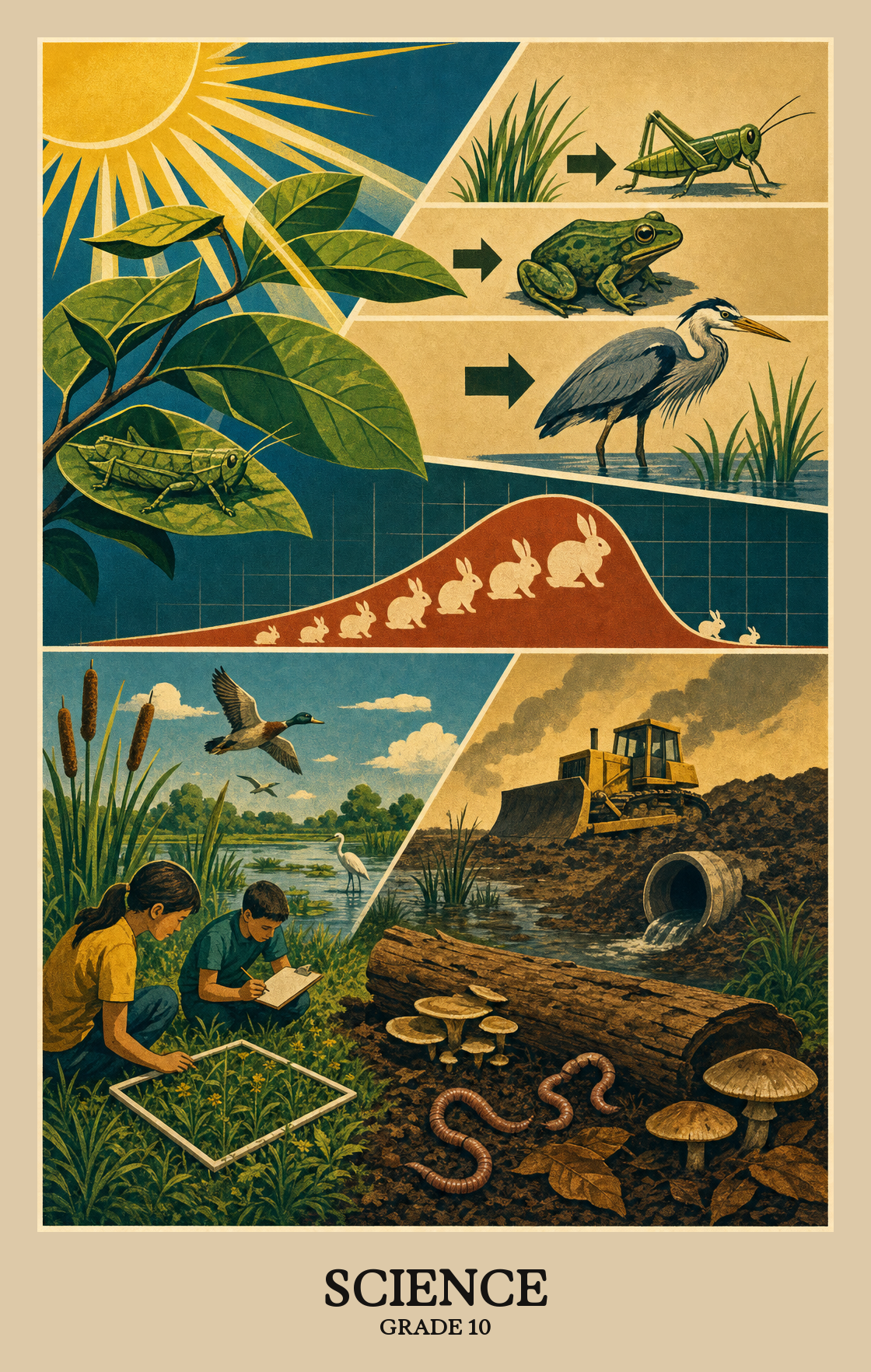
Students start the year practicing how scientists work. They ask testable questions, plan safe experiments, collect data, and decide what the numbers actually show.
Students look at why different living things grow, behave, and reproduce the way they do. They compare animals that have many young at once with animals that have a few and care for them longer.
Students study how plants and animals are built to survive where they live. They look at body size, food, temperature, and other traits that help an organism fit its environment.
Students move from single organisms to groups. They explore what makes a population grow or shrink, how species compete or help each other, and why some species hold a community together.
Students trace how energy moves through food chains and how dead material recycles back into the soil. They connect biodiversity to whether an ecosystem stays steady over time.
Students close the year by looking at how people change ecosystems. They examine pollution, climate change, habitat loss, and farming, and weigh ideas for using resources without using them up.
Reading graphs, setting up experiments, and recording results are the foundation of this standard. Students learn to think and work like scientists: asking questions, collecting data, and drawing conclusions from evidence.
Genes carry instructions from parent to child, explaining why traits like eye color or height run in families. Students study how those instructions get copied, shuffled, and passed down through reproduction.
Life History Theory explains why organisms invest energy differently in growing, surviving, and reproducing. Students use it to predict patterns like how long an animal lives, how many offspring it has, and when it reaches maturity.
Individual organisms are the starting point for all of ecology. Every population, community, and ecosystem builds up from single living things and how each one survives, reproduces, and interacts with its surroundings.
Plants have developed ways to survive in very different places, from deserts to rainforests. Students examine specific traits, like thick leaves or deep roots, that help plants live, grow, and reproduce where they do.
Animals develop physical traits and behaviors over generations that help them survive in their environment. Students study how those adaptations, from a polar bear's fur to a cactus spine, connect to the conditions where each animal lives.
Students study why some populations are large, spread out, or growing fast, and why others are not. They use charts and models to predict how a population will change over time based on factors like food supply, space, and birth rates.
Students study how competition, mate choice, and survival pressures within a single species shape which traits get passed on over time. The focus is on how those pressures slowly change what a population looks like across generations.
Students examine how living things in a community depend on and affect one another, from predator-prey relationships to competition for food and space.
Food energy moves from plants to animals to decomposers in a chain. Students trace how energy is gained, transferred, and lost at each step in a real ecosystem like a forest or ocean.
Dead leaves, fallen trees, and other organic matter break down and return nutrients to the soil. Students study how that decomposition keeps an ecosystem running.
Students examine how human activities, like farming, construction, or pollution, change the balance of an ecosystem. They look at what happens to plants, animals, and soil when people alter the land or water around them.
Living things (biotic) and non-living conditions (abiotic) like temperature, water, and soil shape where species can survive. Students study how those factors work together to explain why certain plants and animals live where they do.
Students look at how farming, cities, and industry change ecosystems, then research what ecology tells us about fixing those problems. The focus covers issues close to home and around the world.
| Standard | Definition | Code |
|---|---|---|
| The student will demonstrate an understanding of scientific skills and… | Reading graphs, setting up experiments, and recording results are the foundation of this standard. Students learn to think and work like scientists: asking questions, collecting data, and drawing conclusions from evidence. | EC.1 |
| The student will investigate and understand that there are common mechanisms… | Genes carry instructions from parent to child, explaining why traits like eye color or height run in families. Students study how those instructions get copied, shuffled, and passed down through reproduction. | BIO. |
| The student will investigate and understand that Life History Theory allows for… | Life History Theory explains why organisms invest energy differently in growing, surviving, and reproducing. Students use it to predict patterns like how long an animal lives, how many offspring it has, and when it reaches maturity. | EC.2 |
| The student will understand that the individual is the basic unit of ecology | Individual organisms are the starting point for all of ecology. Every population, community, and ecosystem builds up from single living things and how each one survives, reproduces, and interacts with its surroundings. | EC.3 |
| The student will investigate and understand that plants have evolved a variety… | Plants have developed ways to survive in very different places, from deserts to rainforests. Students examine specific traits, like thick leaves or deep roots, that help plants live, grow, and reproduce where they do. | EC.4 |
| The student will investigate and understand that animals have evolved a variety… | Animals develop physical traits and behaviors over generations that help them survive in their environment. Students study how those adaptations, from a polar bear's fur to a cactus spine, connect to the conditions where each animal lives. | EC.5 |
| The student will investigate and understand that different factors influence… | Students study why some populations are large, spread out, or growing fast, and why others are not. They use charts and models to predict how a population will change over time based on factors like food supply, space, and birth rates. | EC.6 |
| The student will investigate and understand that intraspecific interactions and… | Students study how competition, mate choice, and survival pressures within a single species shape which traits get passed on over time. The focus is on how those pressures slowly change what a population looks like across generations. | EC.7 |
| The student will explore and analyze community structures and interactions | Students examine how living things in a community depend on and affect one another, from predator-prey relationships to competition for food and space. | EC.8 |
| The student will understand the energy flow through an ecosystem | Food energy moves from plants to animals to decomposers in a chain. Students trace how energy is gained, transferred, and lost at each step in a real ecosystem like a forest or ocean. | EC.9 |
| The student will investigate and understand that dead organic matter is crucial… | Dead leaves, fallen trees, and other organic matter break down and return nutrients to the soil. Students study how that decomposition keeps an ecosystem running. | EC.10 |
| The student will investigate and understand the effect of human influence on an… | Students examine how human activities, like farming, construction, or pollution, change the balance of an ecosystem. They look at what happens to plants, animals, and soil when people alter the land or water around them. | EC.11 |
| The student will analyze how biotic and abiotic factors interact to affect the… | Living things (biotic) and non-living conditions (abiotic) like temperature, water, and soil shape where species can survive. Students study how those factors work together to explain why certain plants and animals live where they do. | EC.12 |
| Students will assess the impact of human activities on the natural world | Students look at how farming, cities, and industry change ecosystems, then research what ecology tells us about fixing those problems. The focus covers issues close to home and around the world. | EC.13 |
Students practice turning curiosity into a clear, testable question or a problem worth solving before any experiment begins.
Students ask questions based on what they notice while watching an experiment, studying a model, or getting a surprising result. The question drives the next step in their investigation.
Students figure out which science questions are actually testable with the equipment and space they have, then identify what they will change and what they will measure to find a relationship.
Students write a prediction that says: if I change one thing in an experiment, here is what I expect to happen to the thing being measured.
Students design a test, decide what to measure, and collect data to answer a science question. The focus is on thinking through the plan before picking up any equipment.
Students plan and run their own science investigations, sometimes alone and sometimes with a group. They choose what to observe or test, then carry out the work themselves.
Students plan and run experiments while thinking about how their choices could affect other people, living things, and the environment. Safety and ethics are part of the plan, not an afterthought.
Students decide how many items or people to test and how to collect data so the results are reliable, not just lucky.
Students choose the right tools for a science investigation, whether that's a ruler, a thermometer, or a spreadsheet, and use them to collect and record data they can actually analyze.
Students read graphs, tables, and measurements from an experiment, then decide what the numbers actually mean and whether the conclusion holds up.
Students set up data tables that track what they changed, what they measured, and how results averaged out across multiple trials.
Reading a scatterplot or line graph, spotting patterns in the data, and thinking carefully about what the numbers can and cannot tell you.
Students use math to make sense of science data. That means calculating averages, reading graphs, and applying formulas to answer real questions about how the natural world works.
Students use data from experiments or observations to build or improve a model, back up an explanation, or test whether a solution actually works.
Students look at collected data, use graphs or models to spot patterns, and draw a conclusion they can back up with evidence from the data itself.
Students look at data from an investigation, draw a conclusion that fits the evidence, and explain why. They also examine other conclusions and point out where the reasoning or evidence falls short.
Students explain how changing one thing in an experiment (like temperature or time) affects the results, using numbers or descriptions to back up what they found.
Students build an explanation for something they observed or tested, then revise it when new evidence from research, models, or peer feedback points to a better answer.
Students use science concepts and evidence to explain why something happens or to show how a design could solve a problem.
Students look at two competing scientific arguments or solutions and decide which one holds up better when checked against current evidence and accepted science.
Students read data from an experiment or source and build a case for what it shows. They also learn to push back on someone else's conclusion when the evidence doesn't support it.
A hypothesis is an early, testable guess about why something happens. A theory is a well-tested explanation backed by years of evidence. Students learn why scientists treat these two words very differently.
Students build diagrams, physical replicas, or computer simulations to represent a scientific idea and then use those models to make predictions or explain how something works.
Students look at a scientific model, like a diagram of the water cycle or a 3-D atom, and decide what it explains well and where it falls short. No model shows everything, and students practice saying exactly what it gets right and what it leaves out.
Students build or refine a diagram, chart, or physical model to show how two things are connected or to predict what will happen next. The model changes when new evidence calls for it.
Students build or work with models (like diagrams, simulations, or physical replicas) to collect data, explain how something works, or predict what will happen next.
Students gather information from sources like articles, data tables, and lab results, then judge whether it's reliable and share their findings clearly in writing or discussion.
Students read across sources in different formats (articles, charts, videos, data tables) to figure out which information holds up and how the pieces fit together to answer a scientific question.
Students find information about a scientific topic from several reliable sources, then weigh the evidence each source offers to decide how trustworthy it is.
Students practice sharing what they found in science, using more than one format, such as a written explanation, a graph, or a diagram, so the information is clear no matter how someone reads it.
| Standard | Definition | Code |
|---|---|---|
| asking questions and defining problems | Students practice turning curiosity into a clear, testable question or a problem worth solving before any experiment begins. | EC.1.a |
| ask questions that arise from careful observation of phenomena and/or organisms… | Students ask questions based on what they notice while watching an experiment, studying a model, or getting a surprising result. The question drives the next step in their investigation. | EC.1.a.i |
| determine which questions can be investigated within the scope of the school… | Students figure out which science questions are actually testable with the equipment and space they have, then identify what they will change and what they will measure to find a relationship. | EC.1.a.ii |
| make hypotheses that specify what happens to a dependent variable when an… | Students write a prediction that says: if I change one thing in an experiment, here is what I expect to happen to the thing being measured. | EC.1.a.iii |
| planning and carrying out investigations | Students design a test, decide what to measure, and collect data to answer a science question. The focus is on thinking through the plan before picking up any equipment. | EC.1.b |
| individually and collaboratively plan and conduct observational and… | Students plan and run their own science investigations, sometimes alone and sometimes with a group. They choose what to observe or test, then carry out the work themselves. | EC.1.b.i |
| plan and conduct investigations or test design solutions in a safe and ethical… | Students plan and run experiments while thinking about how their choices could affect other people, living things, and the environment. Safety and ethics are part of the plan, not an afterthought. | EC.1.b.ii |
| determine appropriate sample size and techniques | Students decide how many items or people to test and how to collect data so the results are reliable, not just lucky. | EC.1.b.iii |
| select and use appropriate tools and technology to collect, record, analyze | Students choose the right tools for a science investigation, whether that's a ruler, a thermometer, or a spreadsheet, and use them to collect and record data they can actually analyze. | EC.1.b.iv |
| interpreting, analyzing | Students read graphs, tables, and measurements from an experiment, then decide what the numbers actually mean and whether the conclusion holds up. | EC.1.c |
| construct and interpret data tables showing independent and dependent… | Students set up data tables that track what they changed, what they measured, and how results averaged out across multiple trials. | EC.1.c.i |
| construct, analyze, and interpret graphical displays of data, including… | Reading a scatterplot or line graph, spotting patterns in the data, and thinking carefully about what the numbers can and cannot tell you. | EC.1.c.ii |
| apply mathematical concepts and processes to scientific questions | Students use math to make sense of science data. That means calculating averages, reading graphs, and applying formulas to answer real questions about how the natural world works. | EC.1.c.iii |
| use data in building and revising models, supporting explanation for phenomena | Students use data from experiments or observations to build or improve a model, back up an explanation, or test whether a solution actually works. | EC.1.c.iv |
| analyze data using tools, technologies, and/or models to make valid and… | Students look at collected data, use graphs or models to spot patterns, and draw a conclusion they can back up with evidence from the data itself. | EC.1.c.v |
| constructing and critiquing conclusions and explanations | Students look at data from an investigation, draw a conclusion that fits the evidence, and explain why. They also examine other conclusions and point out where the reasoning or evidence falls short. | EC.1.d |
| make quantitative and/or qualitative claims regarding the relationship between… | Students explain how changing one thing in an experiment (like temperature or time) affects the results, using numbers or descriptions to back up what they found. | EC.1.d.i |
| construct and revise explanations based on valid and reliable evidence obtained… | Students build an explanation for something they observed or tested, then revise it when new evidence from research, models, or peer feedback points to a better answer. | EC.i.d.ii |
| apply scientific ideas, principles, and/or evidence to provide an explanation… | Students use science concepts and evidence to explain why something happens or to show how a design could solve a problem. | EC.1.d.iii |
| compare and evaluate competing arguments or design solutions in light of… | Students look at two competing scientific arguments or solutions and decide which one holds up better when checked against current evidence and accepted science. | EC.1.d.iv |
| construct arguments or counter arguments based on data and evidence | Students read data from an experiment or source and build a case for what it shows. They also learn to push back on someone else's conclusion when the evidence doesn't support it. | EC.1.d.v |
| differentiate between a scientific hypothesis and theory | A hypothesis is an early, testable guess about why something happens. A theory is a well-tested explanation backed by years of evidence. Students learn why scientists treat these two words very differently. | EC.1.d.vi |
| developing and using models | Students build diagrams, physical replicas, or computer simulations to represent a scientific idea and then use those models to make predictions or explain how something works. | EC.1.e |
| evaluate the merits and limitations of models | Students look at a scientific model, like a diagram of the water cycle or a 3-D atom, and decide what it explains well and where it falls short. No model shows everything, and students practice saying exactly what it gets right and what it leaves out. | EC.1.e.i |
| develop, revise, and/or use models based on evidence to illustrate or predict… | Students build or refine a diagram, chart, or physical model to show how two things are connected or to predict what will happen next. The model changes when new evidence calls for it. | EC.1.e.ii |
| develop and/or use models to generate data to support explanations, predict… | Students build or work with models (like diagrams, simulations, or physical replicas) to collect data, explain how something works, or predict what will happen next. | EC.1.e.iii |
| obtaining, evaluating | Students gather information from sources like articles, data tables, and lab results, then judge whether it's reliable and share their findings clearly in writing or discussion. | EC.1.f |
| compare, integrate, and evaluate sources of information presented in different… | Students read across sources in different formats (articles, charts, videos, data tables) to figure out which information holds up and how the pieces fit together to answer a scientific question. | EC.1.f.i |
| gather, read, and evaluate scientific and/or technical information from… | Students find information about a scientific topic from several reliable sources, then weigh the evidence each source offers to decide how trustworthy it is. | EC.1.f.ii |
| communicate scientific and/or technical information about phenomena in multiple… | Students practice sharing what they found in science, using more than one format, such as a written explanation, a graph, or a diagram, so the information is clear no matter how someone reads it. | EC.1.f.iii |
Life History Theory is a framework scientists use to predict how an organism grows, survives, and reproduces over its lifetime. Students explain how factors like body size, lifespan, and reproduction timing shape the choices an organism makes to survive.
Life history covers the key facts about how an organism grows and reproduces: how long it lives, when it starts reproducing, how many offspring it produces, and how much care those offspring receive.
Students compare how different organisms grow and develop over their lifetimes, looking at why a frog, a dog, and a human each follow a different path from birth to adulthood.
K-selection and r-selection describe two survival strategies in nature. K-selected species (like elephants) have few offspring and invest heavily in each one. R-selected species (like mice) have many offspring quickly and invest little in each.
Students look at clues about an organism's environment and resources, then predict how it will grow, develop, and reproduce over its lifetime.
Students study how animals move in response to their environment. Taxis means moving directly toward or away from something (like a moth flying toward light); kinesis means moving faster or more randomly when conditions are uncomfortable, without a set direction.
| Standard | Definition | Code |
|---|---|---|
| Explain how the Life History Theory predicts an organism's potential… | Life History Theory is a framework scientists use to predict how an organism grows, survives, and reproduces over its lifetime. Students explain how factors like body size, lifespan, and reproduction timing shape the choices an organism makes to survive. | EC.2.a |
| Describe the characteristics that make up an organism's life history | Life history covers the key facts about how an organism grows and reproduces: how long it lives, when it starts reproducing, how many offspring it produces, and how much care those offspring receive. | EC.2.b |
| Investigate differences in development among different groups of organisms | Students compare how different organisms grow and develop over their lifetimes, looking at why a frog, a dog, and a human each follow a different path from birth to adulthood. | EC.2.c |
| Compare and contrast K-selection and R-selection | K-selection and r-selection describe two survival strategies in nature. K-selected species (like elephants) have few offspring and invest heavily in each one. R-selected species (like mice) have many offspring quickly and invest little in each. | EC.2.d |
| Predict how an organism would grow, develop | Students look at clues about an organism's environment and resources, then predict how it will grow, develop, and reproduce over its lifetime. | EC.2.e |
| Investigate differences in animal behavior | Students study how animals move in response to their environment. Taxis means moving directly toward or away from something (like a moth flying toward light); kinesis means moving faster or more randomly when conditions are uncomfortable, without a set direction. | EC.2.f |
Scientists group living things by comparing DNA, body structures, and chemical processes. Students learn how these comparisons reveal which organisms are closely related and where each one fits in the tree of life.
Students learn to sort living things into groups based on how they get energy: making their own food from sunlight, eating other organisms, or breaking down dead matter.
Taxonomy, the system scientists use to classify living things, gets updated as new discoveries are made. Students learn that naming and grouping organisms is not fixed but changes when research reveals something new about how life is related.
| Standard | Definition | Code |
|---|---|---|
| classification is based on molecular phylogenetics, structural | Scientists group living things by comparing DNA, body structures, and chemical processes. Students learn how these comparisons reveal which organisms are closely related and where each one fits in the tree of life. | EC.3.a |
| organisms can be classified based on how they use energy | Students learn to sort living things into groups based on how they get energy: making their own food from sunlight, eating other organisms, or breaking down dead matter. | EC.3.b |
| systemics, the science of grouping and categorizing organisms, is adaptable to… | Taxonomy, the system scientists use to classify living things, gets updated as new discoveries are made. Students learn that naming and grouping organisms is not fixed but changes when research reveals something new about how life is related. | EC.3.c |
Students learn what plants need to run photosynthesis: the right amounts of carbon dioxide, water, and light. Too little of any one ingredient and the plant slows down or stops making food.
Plants have built-in ways to handle extreme heat or cold. Students explore how those temperature adaptations, from waxy coatings to dormancy, help plants survive in deserts, tundras, and everywhere in between.
Plants need nutrients like nitrogen and phosphorus to grow. Students explore how plants adapted to low-nutrient soils, such as carnivorous plants that digest insects or plants with roots that pull nutrients from fungi.
Plants have developed physical and chemical defenses against animals that eat them. Thorns, tough bark, and bitter or toxic compounds are all ways plants protect themselves from being eaten.
Natural selection is the process where plants best suited to their environment survive long enough to reproduce, gradually passing those useful traits to the next generation.
Plants have developed ways to survive conditions like drought, extreme cold, or poor soil. Students study how features like thick leaves, deep roots, or seasonal dormancy help specific plants live and reproduce in their environment.
Plants interact with other living things around them, and those relationships shape how they survive. Students examine how competition, pollination, and seed dispersal connect plants to animals, fungi, and other plants in the same environment.
| Standard | Definition | Code |
|---|---|---|
| quantities of reactants for photosynthesis | Students learn what plants need to run photosynthesis: the right amounts of carbon dioxide, water, and light. Too little of any one ingredient and the plant slows down or stops making food. | EC.4.a |
| temperature | Plants have built-in ways to handle extreme heat or cold. Students explore how those temperature adaptations, from waxy coatings to dormancy, help plants survive in deserts, tundras, and everywhere in between. | EC.4.b |
| nutrient availability | Plants need nutrients like nitrogen and phosphorus to grow. Students explore how plants adapted to low-nutrient soils, such as carnivorous plants that digest insects or plants with roots that pull nutrients from fungi. | EC.4.c |
| predators | Plants have developed physical and chemical defenses against animals that eat them. Thorns, tough bark, and bitter or toxic compounds are all ways plants protect themselves from being eaten. | EC.4.d |
| natural selection | Natural selection is the process where plants best suited to their environment survive long enough to reproduce, gradually passing those useful traits to the next generation. | EC.4.e |
| adaptations | Plants have developed ways to survive conditions like drought, extreme cold, or poor soil. Students study how features like thick leaves, deep roots, or seasonal dormancy help specific plants live and reproduce in their environment. | EC.4.f |
| environmental relationships | Plants interact with other living things around them, and those relationships shape how they survive. Students examine how competition, pollination, and seed dispersal connect plants to animals, fungi, and other plants in the same environment. | EC.4.g |
Body size is an adaptation that helps animals survive in their environment. Larger animals often retain heat more easily, while smaller ones may need less food or can hide from predators.
Animals have developed wildly different ways to find, catch, and break down food. Students examine how teeth, beaks, digestive organs, and feeding behaviors match the environment an animal lives in.
Students learn how different animals take in oxygen, from gills pulling it out of water to lungs breathing it from air. The method matches where the animal lives.
Students learn how animals regulate their internal body temperature and manage water loss in different climates. A desert lizard and an arctic fox face opposite problems, and this standard explains how each body solves them.
Students learn how animals adjust to changes in light and temperature, such as migrating when days grow shorter or going dormant in the cold.
| Standard | Definition | Code |
|---|---|---|
| body size | Body size is an adaptation that helps animals survive in their environment. Larger animals often retain heat more easily, while smaller ones may need less food or can hide from predators. | EC.5.a |
| acquiring and digesting food | Animals have developed wildly different ways to find, catch, and break down food. Students examine how teeth, beaks, digestive organs, and feeding behaviors match the environment an animal lives in. | EC.5.b |
| oxygen absorption | Students learn how different animals take in oxygen, from gills pulling it out of water to lungs breathing it from air. The method matches where the animal lives. | EC.5.c |
| maintaining temperature and water balance | Students learn how animals regulate their internal body temperature and manage water loss in different climates. A desert lizard and an arctic fox face opposite problems, and this standard explains how each body solves them. | EC.5.d |
| variations to light and temperature | Students learn how animals adjust to changes in light and temperature, such as migrating when days grow shorter or going dormant in the cold. | EC.5.e |
Population distribution describes where individuals live within an area. Population abundance describes how many individuals are there. Students learn to tell those two ideas apart and use both to describe real populations.
Students learn how members of the same species compete with each other for food, space, and mates, and how that competition slows population growth when a habitat gets crowded.
Students learn why populations stop growing. They examine how food, space, and other limiting resources set a ceiling on how many individuals an environment can support before the population levels off or declines.
Students learn that populations can double in size at a steady rate, the way compound interest grows in a bank account. They practice reading growth curves to predict how large a population will get over time.
Students practice reading population growth models, like graphs or charts, and use them to predict whether a population will grow, shrink, or level off over time.
Students examine why the fast rise in human population puts pressure on land, water, and air. More people means more demand for food, energy, and space, which strains the natural systems that support life on Earth.
| Standard | Definition | Code |
|---|---|---|
| basic structure of ecological populations includes population distribution and… | Population distribution describes where individuals live within an area. Population abundance describes how many individuals are there. Students learn to tell those two ideas apart and use both to describe real populations. | EC.6.a |
| factors that regulate population growth include intraspecific competition in… | Students learn how members of the same species compete with each other for food, space, and mates, and how that competition slows population growth when a habitat gets crowded. | EC.6.b |
| limits to population growth include limiting factors, population density | Students learn why populations stop growing. They examine how food, space, and other limiting resources set a ceiling on how many individuals an environment can support before the population levels off or declines. | EC.6.c |
| population growth can be described as geometric or exponential | Students learn that populations can double in size at a steady rate, the way compound interest grows in a bank account. They practice reading growth curves to predict how large a population will get over time. | EC.6.d |
| models are used to predict population growth | Students practice reading population growth models, like graphs or charts, and use them to predict whether a population will grow, shrink, or level off over time. | EC.6.e |
| the impact of rapid growth of human population is a source of environmental… | Students examine why the fast rise in human population puts pressure on land, water, and air. More people means more demand for food, energy, and space, which strains the natural systems that support life on Earth. | EC.6.f |
Animals and plants compete with others of their own kind for food, space, and mates. They also compete with different species for the same resources.
Symbiosis is when two different species live in close contact and affect each other's survival. Students learn to tell apart relationships where both species benefit, only one benefits, or one is harmed.
| Standard | Definition | Code |
|---|---|---|
| there is intraspecific and interspecific competition | Animals and plants compete with others of their own kind for food, space, and mates. They also compete with different species for the same resources. | EC.7.a |
| organisms have symbiotic relationships | Symbiosis is when two different species live in close contact and affect each other's survival. Students learn to tell apart relationships where both species benefit, only one benefits, or one is harmed. | EC.7.b |
Species interactions shape how organisms evolve. Students examine how predators, parasites, and competitors push other species to develop new traits over time, and how relationships like mutualism show both sides adapting together.
Ecological niches describe the role each species plays in a habitat. Students examine how species sharing the same space avoid direct competition by using different resources, like food sources or nesting spots, at different times or in different ways.
Students learn how certain species hold an ecosystem together, from keystone animals whose removal sends ripples through the food web to endangered species whose loss reshapes the whole community.
A mix of different species helps an ecosystem stay stable. Students examine why communities with more variety tend to recover better when conditions change.
| Standard | Definition | Code |
|---|---|---|
| species interactions | Species interactions shape how organisms evolve. Students examine how predators, parasites, and competitors push other species to develop new traits over time, and how relationships like mutualism show both sides adapting together. | EC.8.a |
| ecological niches and resource partitioning impact interactions | Ecological niches describe the role each species plays in a habitat. Students examine how species sharing the same space avoid direct competition by using different resources, like food sources or nesting spots, at different times or in different ways. | EC.8.b |
| dominant, keystone, foundation | Students learn how certain species hold an ecosystem together, from keystone animals whose removal sends ripples through the food web to endangered species whose loss reshapes the whole community. | EC.8.c |
| species diversity relates to the stability of ecosystems and communities | A mix of different species helps an ecosystem stay stable. Students examine why communities with more variety tend to recover better when conditions change. | EC.8.d |
Food chains, webs, and pyramids are diagrams that show how energy moves from plants to animals to decomposers. Students use these models to trace what eats what and see how much energy is lost at each step.
Plants and algae capture sunlight and turn it into food, fueling every other living thing in the ecosystem. That first step, called primary productivity, sets the ceiling on how much energy is available for all other organisms.
Most energy is lost as heat at each step of a food chain. Students learn why ecosystems can only support a limited number of large predators compared to the plants and smaller animals below them.
Energy moves through a food chain, but most of it is lost as heat at each step. That is why ecosystems need a constant supply of energy from the sun to keep going.
Ecosystems with more species, plants, and animals tend to stay balanced when something disrupts them. Students learn why a forest with dozens of species recovers better from drought or disease than one with only a few.
| Standard | Definition | Code |
|---|---|---|
| food chains, webs, and pyramids model energy flow in ecosystems | Food chains, webs, and pyramids are diagrams that show how energy moves from plants to animals to decomposers. Students use these models to trace what eats what and see how much energy is lost at each step. | EC.9.a |
| primary productivity is important in ecosystems | Plants and algae capture sunlight and turn it into food, fueling every other living thing in the ecosystem. That first step, called primary productivity, sets the ceiling on how much energy is available for all other organisms. | EC.9.b |
| efficiency of energy use is important | Most energy is lost as heat at each step of a food chain. Students learn why ecosystems can only support a limited number of large predators compared to the plants and smaller animals below them. | EC.9.c |
| thermodynamic principles apply in an ecological system | Energy moves through a food chain, but most of it is lost as heat at each step. That is why ecosystems need a constant supply of energy from the sun to keep going. | EC.9.d |
| the stability of an ecosystem is related to the biodiversity | Ecosystems with more species, plants, and animals tend to stay balanced when something disrupts them. Students learn why a forest with dozens of species recovers better from drought or disease than one with only a few. | EC.9.e |
Climate shapes which decomposers live in an ecosystem. Cold, dry, or wet conditions determine whether bacteria, fungi, or insects do most of the work breaking down dead plants and animals.
Decomposers like bacteria and fungi break down dead plants and animals at different speeds depending on the organism and the climate. A fallen log rots faster in a warm, wet forest than in a cold, dry one.
| Standard | Definition | Code |
|---|---|---|
| climate impacts the type of decomposers in an ecosystem | Climate shapes which decomposers live in an ecosystem. Cold, dry, or wet conditions determine whether bacteria, fungi, or insects do most of the work breaking down dead plants and animals. | EC.10.a |
| rate of decomposition varies by organism and climate | Decomposers like bacteria and fungi break down dead plants and animals at different speeds depending on the organism and the climate. A fallen log rots faster in a warm, wet forest than in a cold, dry one. | EC.10.b |
Students examine how human activities speed up, slow down, or redirect natural processes like land recovery after a disturbance or the spread of desert conditions into once-fertile soil.
| Standard | Definition | Code |
|---|---|---|
| Humans influence the pattern of natural changes such as primary/secondary… | Students examine how human activities speed up, slow down, or redirect natural processes like land recovery after a disturbance or the spread of desert conditions into once-fertile soil. | EC.11.a |
Students identify the living things (plants, animals, microbes) and non-living conditions (temperature, rainfall, soil type) that make each major habitat on Earth distinct, from tropical rainforests to deep ocean zones.
Climate patterns like temperature and rainfall shape which plants and animals can survive in a given region. Students examine why certain species live where they do and how global climate limits or expands where life takes hold.
Species richness is how many different kinds of organisms live in one place. Students explore why some ecosystems hold more species than others and why that variety matters for keeping the whole system stable.
Natural selection shapes how well a living thing fits its habitat. Students examine how traits that help an organism survive in a specific place become more common over generations.
| Standard | Definition | Code |
|---|---|---|
| the biotic and abiotic components that define various biomes and aquatic life… | Students identify the living things (plants, animals, microbes) and non-living conditions (temperature, rainfall, soil type) that make each major habitat on Earth distinct, from tropical rainforests to deep ocean zones. | EC.12.a |
| global climate patterns and biogeography impact diversity | Climate patterns like temperature and rainfall shape which plants and animals can survive in a given region. Students examine why certain species live where they do and how global climate limits or expands where life takes hold. | EC.12.b |
| different factors lead to the species richness of an ecosystem and the… | Species richness is how many different kinds of organisms live in one place. Students explore why some ecosystems hold more species than others and why that variety matters for keeping the whole system stable. | EC.12.c |
| natural selection has a role in organismal adaptations that are specific to… | Natural selection shapes how well a living thing fits its habitat. Students examine how traits that help an organism survive in a specific place become more common over generations. | EC.12.d |
Students learn what causes air and water pollution, tracing it back to direct sources like car exhaust and factory smoke, then to indirect sources formed when those pollutants react in the environment.
Students examine which everyday resources, like trees, fish, soil, and fuel, are being used faster than nature can replace them, and which practices allow those resources to last.
Students study how Earth's climate shifts naturally over time and how human activities like burning fossil fuels speed up that change. They look at evidence for both causes and consider what the difference means for ecosystems and communities.
Students learn how breaking up or shrinking wild habitats reduces the number of species that can survive there. They use that same idea to evaluate how parks and nature preserves should be shaped and connected to protect as many species as possible.
Students examine how farming practices, from ancient times to today, change soil, water, and wildlife. They look at what those changes mean for feeding a growing global population.
| Standard | Definition | Code |
|---|---|---|
| major primary and secondary pollutants | Students learn what causes air and water pollution, tracing it back to direct sources like car exhaust and factory smoke, then to indirect sources formed when those pollutants react in the environment. | EC.13.a |
| sustainable and unsustainable use of resources, including soil, timber, fish… | Students examine which everyday resources, like trees, fish, soil, and fuel, are being used faster than nature can replace them, and which practices allow those resources to last. | EC.13.b |
| natural and anthropogenic climate change | Students study how Earth's climate shifts naturally over time and how human activities like burning fossil fuels speed up that change. They look at evidence for both causes and consider what the difference means for ecosystems and communities. | EC.13.c |
| habitat fragmentation and habitat loss on biodiversity in relation to island… | Students learn how breaking up or shrinking wild habitats reduces the number of species that can survive there. They use that same idea to evaluate how parks and nature preserves should be shaped and connected to protect as many species as possible. | EC.13.d |
| the ecological impact of agriculture | Students examine how farming practices, from ancient times to today, change soil, water, and wildlife. They look at what those changes mean for feeding a growing global population. | EC.13.e |
High school end-of-course science assessments, including Biology, Chemistry, and Earth Science.
This is an ecology course. Students look at how living things interact with each other and their surroundings, from single organisms up to whole ecosystems. They also study how humans affect the natural world and what can be done about it.
Spend time outside and talk about what you notice. Point out a bird at a feeder, ants on a sidewalk, or weeds taking over a garden bed, and ask what each one needs to live. A short nature walk or a documentary about a national park counts.
There are a lot of terms, but the course is really about cause and effect. Students should be able to explain why a population grows or crashes, not just define the word carrying capacity. Ask them to explain a term using a real animal or place.
A common arc moves from small to large: individuals and life history, then populations, then communities, then ecosystems and energy flow, then human impact. Lab and field skills run alongside every unit, not as a separate front-loaded chapter.
Energy flow through trophic levels, the difference between exponential and logistic growth, and the distinction between a hypothesis and a theory tend to slip. Plan a short revisit of each later in the year, tied to a new context like a local pond or forest.
Students need repeated practice planning an investigation, picking a sample size, collecting data, and graphing it. Aim for a mix of short indoor labs and at least one outdoor study, such as a schoolyard plot survey or a stream sample.
Ask questions instead of giving answers. What is the variable being changed? How many trials? What would make the data more trustworthy? Helping students sharpen the question is more useful than helping them write the report.
By spring, students should be able to read a graph, judge whether a claim is supported by the data, and explain a real ecological event using concepts from the year. If they can defend a position about a local environmental issue with evidence, they are ready.