Counting and writing numbers
Students learn to count out loud to 100 and write the numbers 0 to 20. They practice counting groups of objects and saying how many there are in total.
This is the year numbers start to feel real. Students count to 100, write the numbers 0 to 20, and learn that the last number they say is how many there are. They start adding and subtracting small groups with fingers, drawings, and objects, and they notice shapes everywhere. By spring, they can count out 15 crackers, tell which pile has more, and name a circle, square, or triangle on sight.
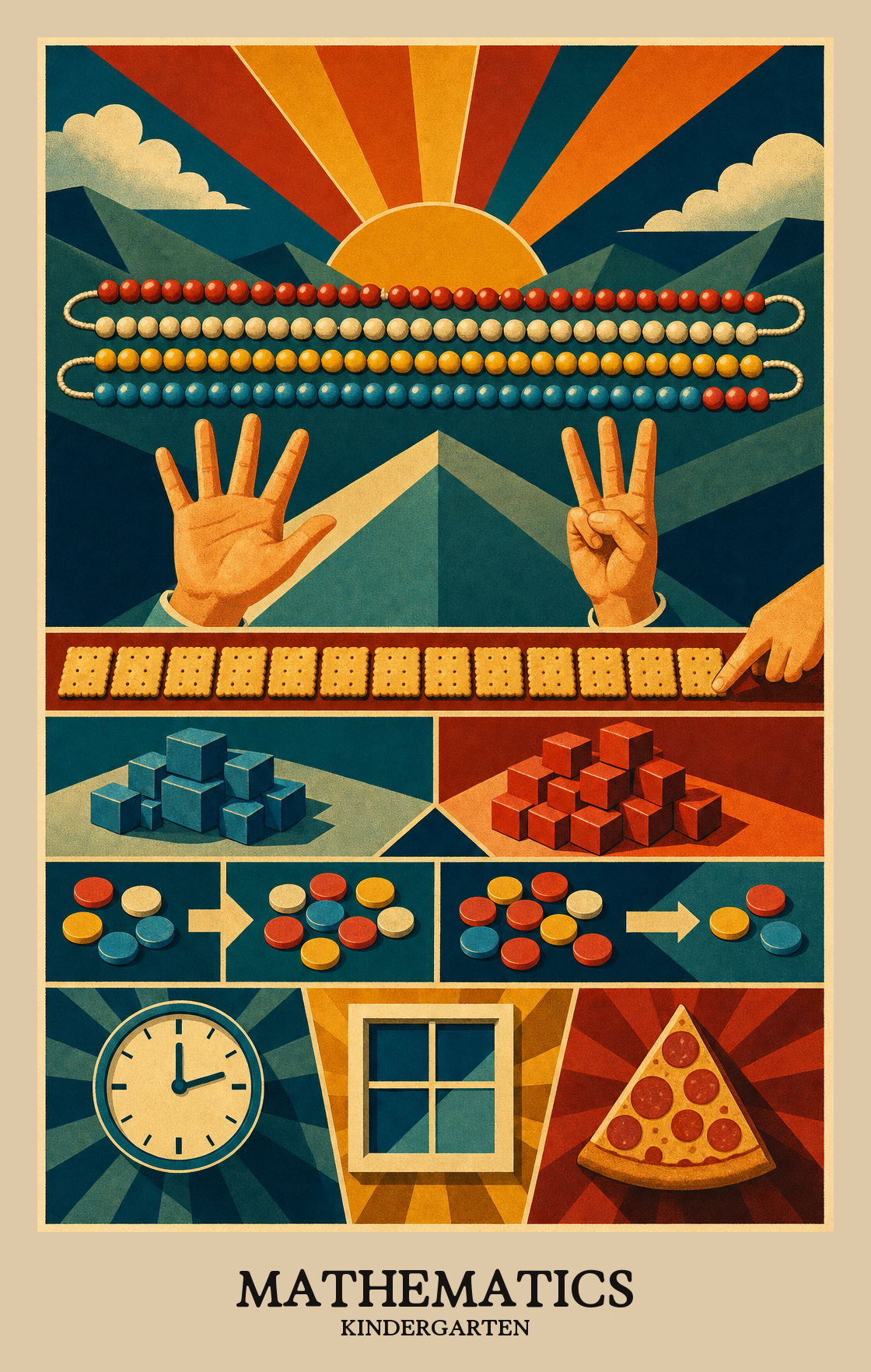
Students learn to count out loud to 100 and write the numbers 0 to 20. They practice counting groups of objects and saying how many there are in total.
Students figure out which group has more, less, or the same by matching items and counting. They start comparing written numbers up to 20 side by side.
Students use fingers, drawings, and small objects to put groups together and take them apart. They solve simple story problems and learn the pairs of numbers that make 5 and 10.
Students see that numbers like 14 are a group of ten and some extra ones. They build these numbers with blocks or drawings to get ready for place value later on.
Students compare objects by length and weight, sort items into groups, and count how many are in each. They name pennies, nickels, dimes, and quarters and count pennies up to 20.
Students name flat shapes like circles and triangles and solid shapes like cubes and spheres. They describe where shapes are in the room and put smaller shapes together to make bigger ones.
Students count out loud from 1 to 100 and learn the names and order of numbers. They practice saying numbers in sequence, including counting on from any number, not just from 1.
Students count out loud from 1 to 100, one number at a time, then practice again by jumping in steps of ten: 10, 20, 30, all the way to 100.
Starting from any number, students count forward without going back to 1 first. If asked to start at 6, they say 6, 7, 8, 9 and keep going.
Students write the numbers 0 through 20 and match each number to a group of objects. Zero means the group is empty.
Students count a small group of objects and say how many there are in total. The number they land on last is the answer.
Counting a group of objects means the last number said tells how many there are total. Students practice this by counting out loud and stopping at the right number when asked to show a certain amount.
Students count a group of objects by touching or pointing to each one exactly once, saying one number per object. This one-to-one matching is how counting gives a group its total.
When students count a group of objects, the last number they say is the total. It doesn't matter how the objects are arranged or what order they were counted in. The answer stays the same.
Each new counting number means one more object than the one before it. Students learn that 6 is just 5 with one added, and 9 is just 8 with one added.
Students count up to 20 objects arranged in a line, circle, or grid, and up to 10 objects scattered randomly. They also hear a number and count out exactly that many objects.
Students look at two numbers and decide which is bigger, which is smaller, or whether they match. This is the first step toward understanding how numbers relate to each other.
Students look at two groups of objects and decide which group has more, which has fewer, or whether both groups have the same amount. They figure this out by counting or by pairing objects one to one.
Students look at two numbers written on the page and decide which one is bigger, which is smaller, or whether they match. Numbers can be anywhere from 0 to 20.
| Standard | Definition | Code |
|---|---|---|
| Know number names and the count sequence | Students count out loud from 1 to 100 and learn the names and order of numbers. They practice saying numbers in sequence, including counting on from any number, not just from 1. | K.CC.1 |
| Count to 100 by ones and by tens | Students count out loud from 1 to 100, one number at a time, then practice again by jumping in steps of ten: 10, 20, 30, all the way to 100. | M.K.1 |
| Count forward beginning from a given number within the known sequence | Starting from any number, students count forward without going back to 1 first. If asked to start at 6, they say 6, 7, 8, 9 and keep going. | M.K.2 |
| Write numbers from 0 to 20 | Students write the numbers 0 through 20 and match each number to a group of objects. Zero means the group is empty. | M.K.3 |
| Count to tell the number of objects | Students count a small group of objects and say how many there are in total. The number they land on last is the answer. | K.CC.2 |
| Understand the relationship between numbers and quantities | Counting a group of objects means the last number said tells how many there are total. Students practice this by counting out loud and stopping at the right number when asked to show a certain amount. | M.K.4 |
| When counting objects, say the number names in the standard order, pairing each… | Students count a group of objects by touching or pointing to each one exactly once, saying one number per object. This one-to-one matching is how counting gives a group its total. | M.K.4.a |
| Understand that the last number name said tells the number of objects counted… | When students count a group of objects, the last number they say is the total. It doesn't matter how the objects are arranged or what order they were counted in. The answer stays the same. | M.K.4.b |
| Understand that each successive number name refers to a quantity that is one… | Each new counting number means one more object than the one before it. Students learn that 6 is just 5 with one added, and 9 is just 8 with one added. | M.K.4.c |
| Count to answer questions | Students count up to 20 objects arranged in a line, circle, or grid, and up to 10 objects scattered randomly. They also hear a number and count out exactly that many objects. | M.K.5 |
| Compare numbers | Students look at two numbers and decide which is bigger, which is smaller, or whether they match. This is the first step toward understanding how numbers relate to each other. | K.CC.3 |
| Identify whether the number of objects in one group is greater than, less than | Students look at two groups of objects and decide which group has more, which has fewer, or whether both groups have the same amount. They figure this out by counting or by pairing objects one to one. | M.K.6 |
| Compare and order two numbers between 0-20 presented as written numerals | Students look at two numbers written on the page and decide which one is bigger, which is smaller, or whether they match. Numbers can be anywhere from 0 to 20. | M.K.7 |
Adding means putting two groups together to get a bigger number. Subtracting means taking some away to get a smaller one. Students work with both ideas using objects, fingers, or drawings.
Students use objects, fingers, drawings, or simple movements to show what adding and subtracting mean before writing any numbers down.
Students solve simple add-and-take-away story problems using objects or drawings. The numbers stay within 10.
Students break a small number into two groups in different ways, like showing that 7 can be split into 5 and 2 or into 6 and 1. They record each split with a drawing or a simple equation.
Starting with any number from 1 to 9, students figure out what to add to reach exactly 10. They show their answer by drawing or writing a simple equation.
Students add and subtract with numbers up to 5 quickly and accurately. They build enough practice to get the answer without counting on their fingers every time.
Students spot repeating patterns, like colors in a row or shapes on a page, and figure out what comes next.
Students spot repeating patterns, like red-blue-red-blue or circle-square-circle-square, and make their own. They practice with colors, shapes, and sizes.
| Standard | Definition | Code |
|---|---|---|
| Understand addition as putting together and adding to and understand… | Adding means putting two groups together to get a bigger number. Subtracting means taking some away to get a smaller one. Students work with both ideas using objects, fingers, or drawings. | K.OAT.1 |
| Represent addition and subtraction with strategies using objects, fingers… | Students use objects, fingers, drawings, or simple movements to show what adding and subtracting mean before writing any numbers down. | M.K.8 |
| Solve addition and subtraction word problems and add and subtract within 10 by… | Students solve simple add-and-take-away story problems using objects or drawings. The numbers stay within 10. | M.K.9 |
| Decompose numbers less than or equal to 10 into pairs in more than one way by… | Students break a small number into two groups in different ways, like showing that 7 can be split into 5 and 2 or into 6 and 1. They record each split with a drawing or a simple equation. | M.K.10 |
| For any number from 1 to 9, find the number that makes 10 when added to the… | Starting with any number from 1 to 9, students figure out what to add to reach exactly 10. They show their answer by drawing or writing a simple equation. | M.K.11 |
| Fluently (efficiently, flexibly | Students add and subtract with numbers up to 5 quickly and accurately. They build enough practice to get the answer without counting on their fingers every time. | M.K.12 |
| Recognize patterns | Students spot repeating patterns, like colors in a row or shapes on a page, and figure out what comes next. | K.OAT.2 |
| Recognize and create recognizable patterns using colors, shapes, sizes | Students spot repeating patterns, like red-blue-red-blue or circle-square-circle-square, and make their own. They practice with colors, shapes, and sizes. | M.K.13 |
Students break numbers like 13 or 17 into a group of ten and some leftovers. That hands-on counting lays the groundwork for understanding how bigger numbers are built.
Students learn that teen numbers are just ten plus a few extras. Counting out 14 objects, for example, means one full group of ten and four left over. Students draw or write that as 10 + 4.
| Standard | Definition | Code |
|---|---|---|
| Work with numbers 11-19 to gain foundations for place value | Students break numbers like 13 or 17 into a group of ten and some leftovers. That hands-on counting lays the groundwork for understanding how bigger numbers are built. | K.NOBT.1 |
| Compose and decompose numbers from 11 to 19 into ten ones and larger two-digit… | Students learn that teen numbers are just ten plus a few extras. Counting out 14 objects, for example, means one full group of ten and four left over. Students draw or write that as 10 + 4. | M.K.14 |
Students pick up two objects and describe which one is longer, heavier, or taller. They use words like "bigger" and "shorter" to compare what they notice.
Students pick up an object and describe what can be measured about it, like how long it is or how heavy it feels. One object can have more than one attribute worth noticing.
Students pick up two objects and compare them directly, such as holding two pencils side by side to find which one is longer or shorter. They say out loud what they notice about the difference.
Students sort a group of objects into categories, like colors or shapes, then count how many are in each group.
Students sort everyday objects into groups, count how many are in each group, and arrange the groups from smallest to biggest. Each group has 10 or fewer items.
Students sort coins by name and recognize what each one is worth. They practice identifying pennies, nickels, dimes, and quarters by sight.
Students learn to recognize a penny, nickel, dime, and quarter by sight. They practice naming each coin and telling them apart from one another.
Students count a small pile of pennies, one by one, up to twenty. It builds the habit of careful counting with real objects they already know.
| Standard | Definition | Code |
|---|---|---|
| Describe and compare measurable attributes | Students pick up two objects and describe which one is longer, heavier, or taller. They use words like "bigger" and "shorter" to compare what they notice. | K.MD.1 |
| Describe measurable attributes of objects, such as length or weight and… | Students pick up an object and describe what can be measured about it, like how long it is or how heavy it feels. One object can have more than one attribute worth noticing. | M.K.15 |
| Directly compare two objects with a measurable attribute in common, to see… | Students pick up two objects and compare them directly, such as holding two pencils side by side to find which one is longer or shorter. They say out loud what they notice about the difference. | M.K.16 |
| Classify objects and count the number of objects in each category | Students sort a group of objects into categories, like colors or shapes, then count how many are in each group. | K.MD.2 |
| Classify objects into given categories, count the numbers of objects in each… | Students sort everyday objects into groups, count how many are in each group, and arrange the groups from smallest to biggest. Each group has 10 or fewer items. | M.K.17 |
| Work with money | Students sort coins by name and recognize what each one is worth. They practice identifying pennies, nickels, dimes, and quarters by sight. | K.MD.3 |
| Identify coins: penny, nickel, dime, quarter | Students learn to recognize a penny, nickel, dime, and quarter by sight. They practice naming each coin and telling them apart from one another. | M.K.18 |
| Count pennies to 20 | Students count a small pile of pennies, one by one, up to twenty. It builds the habit of careful counting with real objects they already know. | M.K.19 |
Students learn to name and describe basic shapes, from flat ones like circles and triangles to solid ones like cubes and spheres. They practice spotting those shapes in pictures and in the real world.
Students name the shapes they see in everyday objects, like a clock or a door, then describe where those objects sit using words like above, below, beside, and next to.
Students learn that a triangle is still a triangle whether it's tiny or tilted. The name of a shape doesn't change when it's turned, flipped, or drawn bigger or smaller.
Students sort everyday objects like a coin or a book into flat shapes and solid shapes. They learn that flat shapes lie on a surface while solid shapes take up space you can hold in your hand.
Students name everyday shapes like circles, squares, and triangles, then sort and compare them by size or side count. They also put smaller shapes together to build new ones.
Students look at flat and solid shapes, like squares, triangles, and boxes, and put into words what makes them alike or different. They notice things like how many sides or corners a shape has.
Students build and draw basic shapes like squares, triangles, and circles. They might use sticks and clay or pencil and paper to recreate shapes they see in the real world.
Students put simple shapes together to build a bigger one, like sliding two triangles side by side to make a rectangle. The focus is on how pieces fit when their full edges touch.
| Standard | Definition | Code |
|---|---|---|
| Identify and describe shapes | Students learn to name and describe basic shapes, from flat ones like circles and triangles to solid ones like cubes and spheres. They practice spotting those shapes in pictures and in the real world. | K.G.1 |
| Describe objects in the environment using names of shapes and describe the… | Students name the shapes they see in everyday objects, like a clock or a door, then describe where those objects sit using words like above, below, beside, and next to. | M.K.20 |
| Correctly name shapes regardless of their orientations or overall size | Students learn that a triangle is still a triangle whether it's tiny or tilted. The name of a shape doesn't change when it's turned, flipped, or drawn bigger or smaller. | M.K.21 |
| Using real-life objects, identify shapes as two-dimensional | Students sort everyday objects like a coin or a book into flat shapes and solid shapes. They learn that flat shapes lie on a surface while solid shapes take up space you can hold in your hand. | M.K.22 |
| Analyze, compare, create | Students name everyday shapes like circles, squares, and triangles, then sort and compare them by size or side count. They also put smaller shapes together to build new ones. | K.G.2 |
| Analyze and compare two- and three-dimensional shapes, in different sizes and… | Students look at flat and solid shapes, like squares, triangles, and boxes, and put into words what makes them alike or different. They notice things like how many sides or corners a shape has. | M.K.23 |
| Model shapes in the world by building shapes from components | Students build and draw basic shapes like squares, triangles, and circles. They might use sticks and clay or pencil and paper to recreate shapes they see in the real world. | M.K.24 |
| Compose simple shapes to form larger shapes | Students put simple shapes together to build a bigger one, like sliding two triangles side by side to make a rectangle. The focus is on how pieces fit when their full edges touch. | M.K.25 |
Annual statewide mathematics assessment for grades 3 through 8, aligned to West Virginia college- and career-readiness standards.
Dynamic Learning Maps alternate assessment for eligible students with significant cognitive disabilities, covering the same tested subjects as the general summative program.
Students count to 100 by ones and tens, write numbers 0 to 20, and add and subtract within 10 using objects or drawings. They also name common shapes, sort objects into groups, and compare which group has more or less.
Count real things together: stairs as you climb them, grapes on a plate, coins in a jar. Ask how many after counting, then mix up the order and count again so students see the total stays the same.
This is normal. Slow down and touch each object once as you say a number. Line items up in a row first, then try a circle or a scattered pile once one-to-one counting feels steady.
Start with counting, one-to-one matching, and writing numbers 0 to 10. Move into comparing groups and adding and subtracting within 5, then push counting to 100, add and subtract within 10, and build teen numbers as ten ones plus extras. Shapes, measurement, and coins can run alongside as shorter weekly blocks.
Writing numerals 0 to 20 without reversals, counting on from a number other than 1, and seeing a teen number as ten and some more. Plan short daily warm-ups for these rather than one big unit.
Not yet. Students should add and subtract within 5 quickly using fingers, objects, or mental pictures, and work out problems within 10 with drawings. Speed drills are not the goal this year.
Point out circles, squares, triangles, and rectangles on signs, plates, and windows. Compare two objects directly: which spoon is longer, which bag is heavier. Use words like above, below, and next to while putting toys away.
Students should see 14 as one group of ten and four extras, and show it with cubes, fingers, or a drawing. If a student still counts 14 as fourteen separate ones, keep working with ten-frames before moving on.
Ready students count fluently to 100, write numbers to 20, compare two written numbers, solve simple add and subtract stories within 10, and break numbers like 7 into pairs such as 4 and 3. They also name basic flat and solid shapes.