Earth, space, and the universe
Students study how the sun, stars, and planets formed and how scientists trace the history of the universe. They build models of orbits, star life cycles, and the elements made inside stars.
This is the year science stops being a tour of topics and starts asking students to explain how the world actually works. Students use math and models to back up their claims, whether they're tracing how the sun makes light, why continents drift, or how DNA shapes a living thing. They also tackle real problems like flooding, pollution, and energy use. By spring, they can read a graph or data table and write a clear, evidence-based explanation of what it shows.
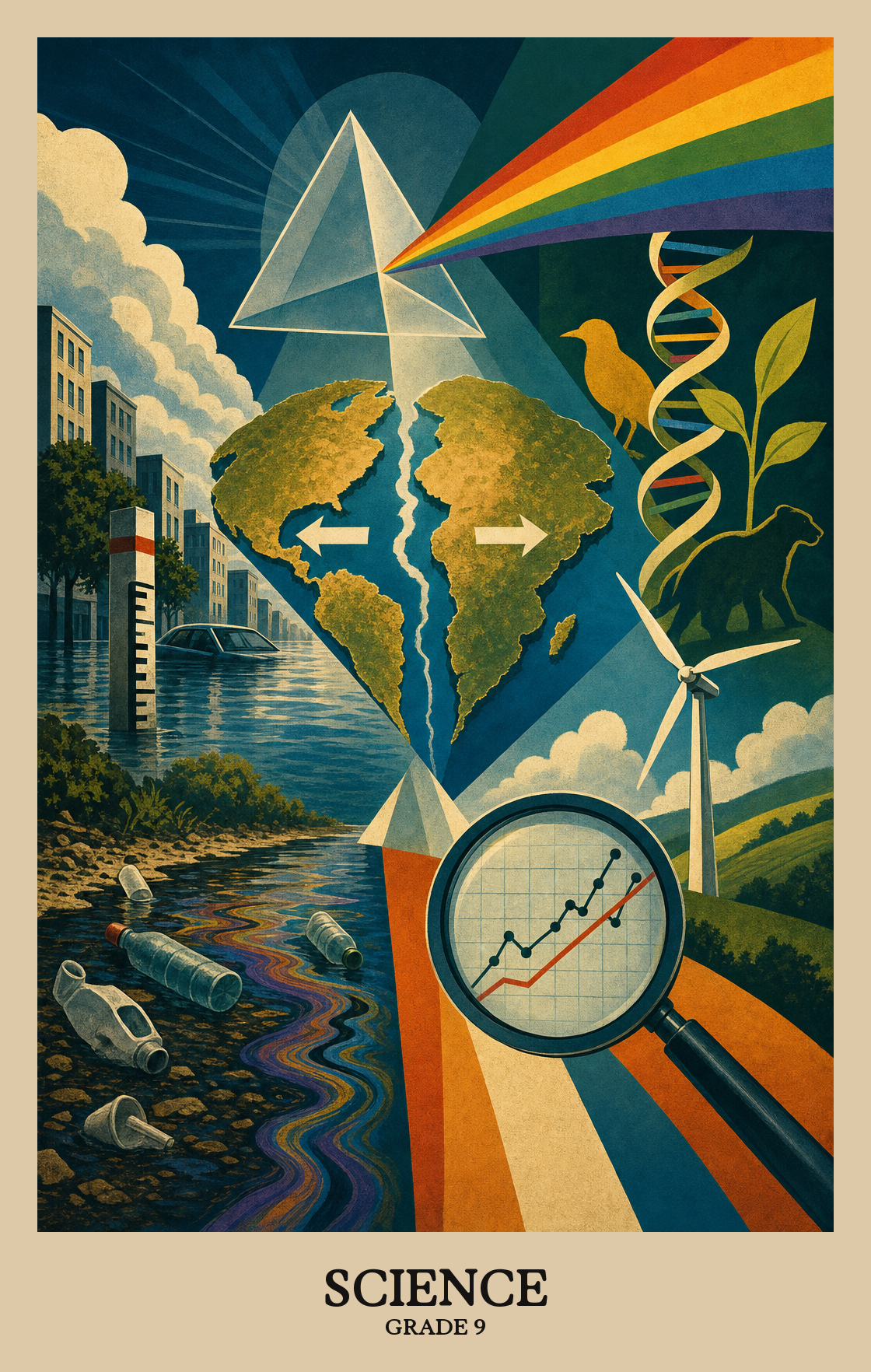
Students study how the sun, stars, and planets formed and how scientists trace the history of the universe. They build models of orbits, star life cycles, and the elements made inside stars.
Students look at what the Earth is made of and how it moves and changes. They study plate tectonics, volcanoes, earthquakes, and how mountains, oceans, and coastlines take shape over time.
Students track how water, carbon, and energy move through Earth's systems and how human activity changes them. They weigh real trade-offs around energy, water quality, and natural disasters.
Students dig into what matter is made of, from atoms and the periodic table to chemical reactions, acids, and bases. They run experiments and use math to predict how substances behave.
Students measure how things move, push, pull, and collide. They work with Newton's laws, energy transfer, waves, light, and electricity, and they design devices that put these ideas to work.
Students study cells, DNA, ecosystems, and the human body. They follow how traits pass from parents to children, how species change over time, and how organ systems keep a person alive.
Students build a model of the sun's life cycle and explain how nuclear fusion in the sun's core turns hydrogen into helium, releasing energy that travels to Earth as light and heat.
Students use real astronomical data, including how starlight shifts color when galaxies move away from us, to explain how the universe began and why it is still expanding.
Students explain how stars are born, age, and die, and how that process builds the elements on the periodic table. They present their ideas in at least two ways, such as a diagram and a written explanation.
Students use math and simple models to predict where planets and moons will be in their orbits. This includes how speed and gravity pull objects into curved paths around the sun.
Students examine fossil records, ocean floor patterns, and magnetic rock data to explain why Earth's crust shifts, how ocean floors renew themselves, and why rocks in different locations formed at different times.
Students use rock samples, meteorites, and crater patterns to piece together how Earth formed billions of years ago. Evidence like radioactive decay rates and ancient fragments help build a timeline of Earth's earliest history.
Students diagram how volcanoes, shifting tectonic plates, erosion, and subduction slowly build up and wear down the continents and ocean floor over millions of years.
Students read maps and data to explain how one change on Earth's surface, like rising ocean levels or coastal erosion, sets off a chain of changes across other parts of the planet.
Students use earthquake wave data and magnetic field patterns to build a model of Earth's layered interior, then explain how heat moving through those layers drives the slow shift of tectonic plates.
Students run experiments to see how water moves through the environment, breaks down rocks, and changes the chemistry of soil and other materials. Labs cover the water cycle, weathering, and how acids and bases behave on a pH scale.
Students build a numbers-based model showing how carbon moves between the ocean, air, land, and living things. The model tracks how much carbon each part of Earth holds and how fast it flows between them.
Students use fossil records, atmospheric data, and soil evidence to argue how living things and Earth's land, air, and water have shaped each other over billions of years.
Students use diagrams and data to explain why Earth's climate shifts over time, tracing causes like changes in Earth's orbit, volcanic eruptions, ocean currents, and the makeup of the atmosphere.
Students read real climate data, like temperature records and sea-level measurements, then use global models to predict how climate change will affect weather patterns, coastlines, and other Earth systems in the future.
Students use evidence to explain how natural resources, hazards, and climate shifts have shaped where people live, how they work, and when they move. Think fresh water, fertile soil, fossil fuels, floods, and rising seas.
Students compare real tradeoffs in how we get and manage energy and minerals, weighing what each approach costs against what it gains. That includes mining, drilling, recycling, and protecting soil.
Students build a computer simulation showing how decisions about mining, waste, and consumption affect both human populations and wildlife over time.
Students look at a real-world solution, such as a recycling program or stream cleanup effort, and judge whether it actually reduces pollution or habitat loss. They use data like satellite images or water quality readings to decide what works and what needs improving.
Students use graphs, models, or simulations to show how Earth's air, water, ice, land, and living things connect, then trace how human activity is shifting those connections, such as rising ocean temperatures or ocean acidification.
| Standard | Definition | Code |
|---|---|---|
| Develop a model based on evidence to illustrate the life span of the sun and… | Students build a model of the sun's life cycle and explain how nuclear fusion in the sun's core turns hydrogen into helium, releasing energy that travels to Earth as light and heat. | S.ESS.1 |
| Construct an explanation of the Big Bang theory based on astronomical evidence… | Students use real astronomical data, including how starlight shifts color when galaxies move away from us, to explain how the universe began and why it is still expanding. | S.ESS.2 |
| Use at least two different formats | Students explain how stars are born, age, and die, and how that process builds the elements on the periodic table. They present their ideas in at least two ways, such as a diagram and a written explanation. | S.ESS.3 |
| Use mathematical or computational representations | Students use math and simple models to predict where planets and moons will be in their orbits. This includes how speed and gravity pull objects into curved paths around the sun. | S.ESS.4 |
| Evaluate evidence of the past and current movements of continental and oceanic… | Students examine fossil records, ocean floor patterns, and magnetic rock data to explain why Earth's crust shifts, how ocean floors renew themselves, and why rocks in different locations formed at different times. | S.ESS.5 |
| Apply scientific reasoning and evidence from ancient Earth materials, meteorites | Students use rock samples, meteorites, and crater patterns to piece together how Earth formed billions of years ago. Evidence like radioactive decay rates and ancient fragments help build a timeline of Earth's earliest history. | S.ESS.6 |
| Develop a model to illustrate how Earth's internal and surface processes… | Students diagram how volcanoes, shifting tectonic plates, erosion, and subduction slowly build up and wear down the continents and ocean floor over millions of years. | S.ESS.7 |
| Analyze geoscience data to make the claim that one change to Earth's surface… | Students read maps and data to explain how one change on Earth's surface, like rising ocean levels or coastal erosion, sets off a chain of changes across other parts of the planet. | S.ESS.8 |
| Develop a model based on seismic and magnetic evidence of Earth's interior to… | Students use earthquake wave data and magnetic field patterns to build a model of Earth's layered interior, then explain how heat moving through those layers drives the slow shift of tectonic plates. | S.ESS.9 |
| Plan and conduct investigations of the properties of water and its effects on… | Students run experiments to see how water moves through the environment, breaks down rocks, and changes the chemistry of soil and other materials. Labs cover the water cycle, weathering, and how acids and bases behave on a pH scale. | S.ESS.10 |
| Develop a quantitative model to describe the cycling of carbon among the… | Students build a numbers-based model showing how carbon moves between the ocean, air, land, and living things. The model tracks how much carbon each part of Earth holds and how fast it flows between them. | S.ESS.11 |
| Construct an argument based on evidence about the simultaneous coevolution of… | Students use fossil records, atmospheric data, and soil evidence to argue how living things and Earth's land, air, and water have shaped each other over billions of years. | S.ESS.12 |
| Use a model to describe how variations in the flow of energy into and out of… | Students use diagrams and data to explain why Earth's climate shifts over time, tracing causes like changes in Earth's orbit, volcanic eruptions, ocean currents, and the makeup of the atmosphere. | S.ESS.13 |
| Analyze geoscience data and the results from the global climate models to make… | Students read real climate data, like temperature records and sea-level measurements, then use global models to predict how climate change will affect weather patterns, coastlines, and other Earth systems in the future. | S.ESS.14 |
| Construct an explanation based on evidence for how the availability of natural… | Students use evidence to explain how natural resources, hazards, and climate shifts have shaped where people live, how they work, and when they move. Think fresh water, fertile soil, fossil fuels, floods, and rising seas. | S.ESS.15 |
| Evaluate competing design solutions for developing, managing | Students compare real tradeoffs in how we get and manage energy and minerals, weighing what each approach costs against what it gains. That includes mining, drilling, recycling, and protecting soil. | S.ESS.16 |
| Create a computational simulation to illustrate the relationships among… | Students build a computer simulation showing how decisions about mining, waste, and consumption affect both human populations and wildlife over time. | S.ESS.17 |
| Evaluate or refine a technological solution that reduces impacts of human… | Students look at a real-world solution, such as a recycling program or stream cleanup effort, and judge whether it actually reduces pollution or habitat loss. They use data like satellite images or water quality readings to decide what works and what needs improving. | S.ESS.18 |
| Use a computational representation to illustrate the relationships among Earth… | Students use graphs, models, or simulations to show how Earth's air, water, ice, land, and living things connect, then trace how human activity is shifting those connections, such as rising ocean temperatures or ocean acidification. | S.ESS.19 |
Students pick a real-world problem, such as drought or a hurricane, and spell out what a good solution must do and what limits it must work within, weighing both what society needs and what it can realistically afford or build.
Students pick a real-world disaster problem, such as flood damage or poor water quality, and break it into smaller parts they can actually solve. Then they design an engineering solution that tackles those parts one by one.
Students weigh the pros and cons of an engineering solution to a natural disaster problem, such as a flood barrier or tsunami warning system, by comparing cost, safety, reliability, and the effect on nearby communities and the environment.
Students run a computer simulation, like a map-based GIS tool or a disaster model, to test whether a proposed solution actually holds up when real-world complications interact with each other.
| Standard | Definition | Code |
|---|---|---|
| Analyze a major global challenge to specify qualitative and quantitative… | Students pick a real-world problem, such as drought or a hurricane, and spell out what a good solution must do and what limits it must work within, weighing both what society needs and what it can realistically afford or build. | S.ESS.20 |
| Design a solution to a complex real-world problem by breaking it down into… | Students pick a real-world disaster problem, such as flood damage or poor water quality, and break it into smaller parts they can actually solve. Then they design an engineering solution that tackles those parts one by one. | S.ESS.21 |
| Evaluate a solution to a complex real-world problem based on prioritized… | Students weigh the pros and cons of an engineering solution to a natural disaster problem, such as a flood barrier or tsunami warning system, by comparing cost, safety, reliability, and the effect on nearby communities and the environment. | S.ESS.22 |
| Use a computer simulation to model the impact of proposed solutions to a… | Students run a computer simulation, like a map-based GIS tool or a disaster model, to test whether a proposed solution actually holds up when real-world complications interact with each other. | S.ESS.23 |
DNA holds instructions that tell cells how to build proteins. Proteins do the actual work inside the body, from carrying oxygen in blood to sending signals between cells. Students learn how that chain of information connects a gene to a living function.
Starting with a single cell, students trace how cells group into tissues, tissues into organs, and organs into body systems, then explain what each level does and how they work together to keep an organism alive.
Students sort living things into groups based on shared traits, like whether an organism has a backbone, makes its own food, or is made of one cell or many.
Students build or analyze a model showing how the body automatically corrects itself when something goes off balance, like how the body responds to getting too hot or too cold.
Photosynthesis is how plants turn sunlight into food. Students use a diagram or model to show where light goes in, where carbon dioxide and water enter, and how the plant stores the resulting energy in sugar.
Cellular respiration is how cells break down food and oxygen to release usable energy. Students model the chemical bonds that break apart in glucose and reform in new molecules, showing where that energy goes.
Students explain how living things break down food to release energy, tracing where the matter goes and how the process differs with or without oxygen. They revise their explanation when new evidence changes the picture.
Students use numbers and diagrams to show how energy moves through a food chain, from plants to herbivores to predators, and why about 90% is lost at each step. They also trace how some substances build up in animals higher in the chain.
Plants and animals swap carbon constantly. Photosynthesis pulls carbon from the air to build leaves and stems; respiration releases it back. Students model how that cycle moves carbon through living things, the atmosphere, the oceans, and the ground.
Students use graphs or simple math to explain why a habitat can only support so many animals. They look at how food, water, and space set a ceiling on population size, from a backyard pond to a whole forest.
Students use graphs and data to explain why some ecosystems have more species than others, then revise their thinking when new evidence changes the picture.
Ecosystems usually keep a steady balance of species when conditions stay stable. Students look at evidence to explain why disruptions like drought or habitat loss can shift that balance enough to produce entirely new species over time.
Students pick a real environmental problem caused by humans, then design and test a solution that could reduce the damage. The focus is on improving the idea based on evidence, not just proposing it.
Students build or adjust a computer model or scenario to test whether a proposed fix can reduce the harm humans cause to local plants and animals. The focus is on whether the solution actually works.
Cells divide to build a body and keep it running. Students learn how one original cell splits and copies itself through mitosis, and how those copies develop into different cell types like muscle, skin, or nerve cells.
DNA is the molecule inside every cell that holds instructions for building a living thing. Students model how DNA is packaged into chromosomes and how those chromosomes pass trait instructions from parents to offspring.
Students explain why offspring aren't identical to their parents by pointing to evidence: genes shuffle during reproduction, copying errors occasionally stick, and things like radiation or chemicals can alter DNA permanently.
Students use probability and simple data analysis to explain why traits like eye color or height vary across a population. They look at patterns in real groups, not just individual families.
Students read diagrams that show how species branched off from shared ancestors over time, then use that evidence to build an argument for why life on Earth is related and has changed across generations.
Evolution happens when some individuals in a species survive and reproduce more than others because they inherited useful traits. Students use evidence to explain how population growth, genetic variation, and competition for limited resources drive that process over time.
Natural selection is how a population slowly changes when certain traits help animals survive and reproduce. Students use real evidence to explain why those helpful traits spread through a population over generations.
When the environment shifts, some traits help animals survive and others don't. Students look at real evidence to explain why those helpful traits get passed down and become more common over time.
Students pick a real-world problem, such as clean water access or disease spread, and spell out exactly what a solution must do and what limits it must work within, using both numbers and broader human needs to define success.
Students take a messy real-world problem, like reducing water pollution or slowing the spread of disease, and break it into smaller pieces they can actually solve. Then they design a solution for each piece.
Students weigh the pros and cons of a proposed solution to a real problem, checking whether it meets the most important requirements while staying within limits like cost, safety, and environmental impact.
Students run a computer simulation to test a proposed fix for a real-world problem, then look at how that fix affects the connected systems around it.
| Standard | Definition | Code |
|---|---|---|
| Construct an explanation based on evidence for how the structure of DNA… | DNA holds instructions that tell cells how to build proteins. Proteins do the actual work inside the body, from carrying oxygen in blood to sending signals between cells. Students learn how that chain of information connects a gene to a living function. | S.B.1 |
| Develop and use a model to illustrate the hierarchical organization of… | Starting with a single cell, students trace how cells group into tissues, tissues into organs, and organs into body systems, then explain what each level does and how they work together to keep an organism alive. | S.B.2 |
| Identify and describe the characteristics of living organisms based on… | Students sort living things into groups based on shared traits, like whether an organism has a backbone, makes its own food, or is made of one cell or many. | S.B.3 |
| Develop and use a model to provide evidence that feedback mechanisms maintain… | Students build or analyze a model showing how the body automatically corrects itself when something goes off balance, like how the body responds to getting too hot or too cold. | S.B.4 |
| Use a model to illustrate how photosynthesis transforms light energy into… | Photosynthesis is how plants turn sunlight into food. Students use a diagram or model to show where light goes in, where carbon dioxide and water enter, and how the plant stores the resulting energy in sugar. | S.B.S |
| Use a model to illustrate that cellular respiration is a chemical process… | Cellular respiration is how cells break down food and oxygen to release usable energy. Students model the chemical bonds that break apart in glucose and reform in new molecules, showing where that energy goes. | S.B.6 |
| Construct and revise an explanation based on evidence for the cycling of matter… | Students explain how living things break down food to release energy, tracing where the matter goes and how the process differs with or without oxygen. They revise their explanation when new evidence changes the picture. | S.B.7 |
| Use mathematical representations to support claims for the cycling of matter… | Students use numbers and diagrams to show how energy moves through a food chain, from plants to herbivores to predators, and why about 90% is lost at each step. They also trace how some substances build up in animals higher in the chain. | S.B.8 |
| Develop a model to illustrate the role of photosynthesis and cellular… | Plants and animals swap carbon constantly. Photosynthesis pulls carbon from the air to build leaves and stems; respiration releases it back. Students model how that cycle moves carbon through living things, the atmosphere, the oceans, and the ground. | S.B.9 |
| Use mathematical and/or computational representations to support explanations… | Students use graphs or simple math to explain why a habitat can only support so many animals. They look at how food, water, and space set a ceiling on population size, from a backyard pond to a whole forest. | S.B.10 |
| Use mathematical representations to support and revise explanations based on… | Students use graphs and data to explain why some ecosystems have more species than others, then revise their thinking when new evidence changes the picture. | S.B.11 |
| Evaluate the claims, evidence | Ecosystems usually keep a steady balance of species when conditions stay stable. Students look at evidence to explain why disruptions like drought or habitat loss can shift that balance enough to produce entirely new species over time. | S.B.12 |
| Design, evaluate, and refine a solution for reducing the impacts of human… | Students pick a real environmental problem caused by humans, then design and test a solution that could reduce the damage. The focus is on improving the idea based on evidence, not just proposing it. | S.B.13 |
| Create or revise a simulation to test a solution to mitigate adverse impacts of… | Students build or adjust a computer model or scenario to test whether a proposed fix can reduce the harm humans cause to local plants and animals. The focus is on whether the solution actually works. | S.B.14 |
| Use a model to illustrate the role of cellular division | Cells divide to build a body and keep it running. Students learn how one original cell splits and copies itself through mitosis, and how those copies develop into different cell types like muscle, skin, or nerve cells. | S.B.15 |
| Develop and use a model to demonstrate the role of DNA and chromosomes in… | DNA is the molecule inside every cell that holds instructions for building a living thing. Students model how DNA is packaged into chromosomes and how those chromosomes pass trait instructions from parents to offspring. | S.B.16 |
| Make and defend a claim based on evidence that inheritable genetic variations… | Students explain why offspring aren't identical to their parents by pointing to evidence: genes shuffle during reproduction, copying errors occasionally stick, and things like radiation or chemicals can alter DNA permanently. | S.B.17 |
| Apply concepts of statistics and probability to explain the variation and… | Students use probability and simple data analysis to explain why traits like eye color or height vary across a population. They look at patterns in real groups, not just individual families. | S.B.18 |
| Engage in argumentation utilizing evidence to support common ancestry and… | Students read diagrams that show how species branched off from shared ancestors over time, then use that evidence to build an argument for why life on Earth is related and has changed across generations. | S.B.19 |
| Construct an explanation based on evidence that the process of evolution… | Evolution happens when some individuals in a species survive and reproduce more than others because they inherited useful traits. Students use evidence to explain how population growth, genetic variation, and competition for limited resources drive that process over time. | S.B.20 |
| Construct an explanation based on evidence for how natural selection leads to… | Natural selection is how a population slowly changes when certain traits help animals survive and reproduce. Students use real evidence to explain why those helpful traits spread through a population over generations. | S.B.21 |
| Evaluate the evidence supporting claims that changes in environmental… | When the environment shifts, some traits help animals survive and others don't. Students look at real evidence to explain why those helpful traits get passed down and become more common over time. | S.B.22 |
| Analyze a major global challenge to specify qualitative and quantitative… | Students pick a real-world problem, such as clean water access or disease spread, and spell out exactly what a solution must do and what limits it must work within, using both numbers and broader human needs to define success. | S.B.23 |
| Design a solution to a complex real-world problem by breaking it down into… | Students take a messy real-world problem, like reducing water pollution or slowing the spread of disease, and break it into smaller pieces they can actually solve. Then they design a solution for each piece. | S.B.24 |
| Evaluate a solution to a complex real-world problem based on prioritized… | Students weigh the pros and cons of a proposed solution to a real problem, checking whether it meets the most important requirements while staying within limits like cost, safety, and environmental impact. | S.B.25 |
| Use a computer simulation to model the impact of proposed solutions to a… | Students run a computer simulation to test a proposed fix for a real-world problem, then look at how that fix affects the connected systems around it. | S.B.26 |
Students convert between everyday measurements like pounds and kilograms, kilometers and miles, and grams using the math behind unit conversions. The work shows how metric and English units relate to each other.
Students sort everyday materials by what they're made of and how they behave. A handful of soil, a glass of saltwater, and a strip of copper wire each fall into different categories based on whether they mix evenly, contain one substance or many, and conduct heat or electricity.
Students test and observe materials to tell the difference between physical properties (like how dense, thick, or well something conducts heat) and chemical properties (like whether it rusts or burns). The investigation is hands-on, not just reading about it.
Atoms are built from three types of smaller particles, each with a different mass, position, and charge. Students learn how those particles determine what element an atom is, how heavy it is, how much space it takes up, and how it behaves around other atoms.
Students read the Periodic Table to spot patterns: how many outer electrons an element has, whether it forms a positive or negative ion, and whether it behaves as a metal, nonmetal, or something in between.
Students learn to read and write chemical names and formulas for ionic compounds, molecular compounds, and basic hydrocarbons by looking at how atoms bond and arrange themselves in a molecule.
Students test substances in the lab to figure out what kind of chemical bond holds them together. Strong ionic bonds explain why table salt has a high melting point; metallic bonds explain why copper bends without breaking.
Students explain how the arrangement of atoms and molecules in a material determines what that material can do. A stronger bond or different shape at the tiny level can mean the difference between a material that bends and one that breaks.
Students look at experimental results and decide whether a substance changed into something new (chemical reaction) or just changed shape or state (physical change). Think of burning wood versus melting ice.
When chemicals react, the same atoms that go in must come out. Students use equations and numbers to show that mass, energy, and charge stay the same on both sides of the reaction.
Changing the temperature or concentration of chemicals speeds up or slows down a reaction. Students use evidence to explain why, such as why heating a solution or adding more of a substance makes the reaction happen faster.
Students figure out how to get more product out of a chemical reaction by adjusting conditions like temperature or pressure. The focus is on understanding why those changes shift the reaction toward making more of what you want.
Students sort chemical reactions into four types (synthesis, decomposition, single-replacement, double-replacement) and use those patterns to predict what new substances will form when two or more chemicals combine.
Students mix acids and bases in experiments, observing what happens when they interact. They look at properties like pH, taste safety, and how the two substances change each other.
| Standard | Definition | Code |
|---|---|---|
| Perform calculations involving equivalence statements for English and Metric… | Students convert between everyday measurements like pounds and kilograms, kilometers and miles, and grams using the math behind unit conversions. The work shows how metric and English units relate to each other. | S.PS.1 |
| Compare and contrast the properties of matter to classify as homogeneous or… | Students sort everyday materials by what they're made of and how they behave. A handful of soil, a glass of saltwater, and a strip of copper wire each fall into different categories based on whether they mix evenly, contain one substance or many, and conduct heat or electricity. | S.PS.2 |
| Plan and conduct an investigation to distinguish chemical properties of matter… | Students test and observe materials to tell the difference between physical properties (like how dense, thick, or well something conducts heat) and chemical properties (like whether it rusts or burns). The investigation is hands-on, not just reading about it. | S.PS.3 |
| Compare the subatomic particles of an atom with regard to mass, location | Atoms are built from three types of smaller particles, each with a different mass, position, and charge. Students learn how those particles determine what element an atom is, how heavy it is, how much space it takes up, and how it behaves around other atoms. | S.PS.4 |
| Analyze data and interpret the Periodic Table to determine trends of the… | Students read the Periodic Table to spot patterns: how many outer electrons an element has, whether it forms a positive or negative ion, and whether it behaves as a metal, nonmetal, or something in between. | S.PS.5 |
| Identify the names/formulas of ionic and molecular compounds and simple-chained… | Students learn to read and write chemical names and formulas for ionic compounds, molecular compounds, and basic hydrocarbons by looking at how atoms bond and arrange themselves in a molecule. | S.PS.6 |
| Investigate the properties of substances to classify them based on the relative… | Students test substances in the lab to figure out what kind of chemical bond holds them together. Strong ionic bonds explain why table salt has a high melting point; metallic bonds explain why copper bends without breaking. | S.PS.7 |
| Communicate scientific and technical information about why the molecular-level… | Students explain how the arrangement of atoms and molecules in a material determines what that material can do. A stronger bond or different shape at the tiny level can mean the difference between a material that bends and one that breaks. | S.PS.8 |
| Analyze experimental evidence to distinguish between chemical and physical… | Students look at experimental results and decide whether a substance changed into something new (chemical reaction) or just changed shape or state (physical change). Think of burning wood versus melting ice. | S.PS.9 |
| Use mathematical representations to support the claim that atoms, mass, energy | When chemicals react, the same atoms that go in must come out. Students use equations and numbers to show that mass, energy, and charge stay the same on both sides of the reaction. | S.PS.10 |
| Apply scientific principles and evidence to provide an explanation about the… | Changing the temperature or concentration of chemicals speeds up or slows down a reaction. Students use evidence to explain why, such as why heating a solution or adding more of a substance makes the reaction happen faster. | S.PS.11 |
| Refine the design of a chemical system by specifying a change in conditions… | Students figure out how to get more product out of a chemical reaction by adjusting conditions like temperature or pressure. The focus is on understanding why those changes shift the reaction toward making more of what you want. | S.PS.12 |
| Use models to identify chemical reactions as synthesis, decomposition, single-… | Students sort chemical reactions into four types (synthesis, decomposition, single-replacement, double-replacement) and use those patterns to predict what new substances will form when two or more chemicals combine. | S.PS.13 |
| Experimentally evaluate the characteristics and interactions of acids and bases | Students mix acids and bases in experiments, observing what happens when they interact. They look at properties like pH, taste safety, and how the two substances change each other. | S.PS.14 |
Students build a simple calculation or spreadsheet model to track how energy moves between parts of a system. When they know how much energy each other part gained or lost, they figure out what happened to the remaining part.
Students calculate how much a push or pull changes the energy in a system, then figure out how fast that energy is changing. This connects everyday ideas like lifting a box or pedaling a bike to the math behind work and power.
Students design and build a working device that changes one type of energy into another, like turning motion into electricity or heat into light. They test it, find what isn't working, and improve it.
Students mix two materials at different temperatures and measure how heat moves between them until both reach the same temperature. The experiment shows that heat always flows from warmer to cooler, never the other way around.
Students draw or build a model showing how two magnets or charged objects push and pull each other without touching. The model shows how the force between them changes as they move closer or farther apart, and where that energy goes.
Students record how far and how fast an object moves, then plot that data on graphs. From those graphs, they work out the equations that describe motion.
Students look at data from moving objects to show that a heavier object needs more force to speed up at the same rate, and that more net force produces more acceleration. This is the math behind Newton's second law.
When two objects push or pull on each other, the forces they exchange are always equal in size and opposite in direction. Students identify both forces in a pair and explain how that balance plays out in real collisions, jumps, and pulls.
When two objects collide or push apart, their combined momentum stays the same before and after. Students use math to show that what one object gains, the other loses.
Students design and test something that absorbs or spreads out the impact when two objects collide, like padding inside a helmet or a bumper on a car. The goal is to reduce the force felt by the object being hit.
Students learn how gravity changes depending on how heavy two objects are and how far apart they sit. They use a formula and diagrams to show why a heavier planet pulls harder, and why gravity weakens the farther away you get.
Students use the wave speed formula to show how frequency and wavelength relate to each other, and explain the difference between waves that push and pull along their path (like sound) and waves that ripple side to side (like light).
Students read science articles or studies and judge whether the evidence holds up. The focus is on how different types of electromagnetic radiation, like visible light, X-rays, or microwaves, affect the materials that absorb them.
Students study how light bends and bounces when it hits surfaces like water or glass. They describe the angles light travels at before and after it hits a surface, without doing full calculations.
Students explain how everyday devices like phones, satellites, and WiFi routers send and receive information by using the behavior of waves. The focus is on connecting the physics of waves to the technology students already use.
Students look at a real-world problem, like clean water access or energy use, and spell out what a good solution must do and what limits it has to work within, such as cost, materials, or safety.
Students take a messy real-world problem, like reducing food waste or filtering dirty water, and split it into smaller pieces they can actually solve. Each piece gets its own engineering solution that fits into the whole.
Students weigh the pros and cons of an engineering solution against real-world limits like cost, safety, and environmental impact, then decide whether it actually solves the problem well enough given those constraints.
Students use computer simulations to test engineering solutions to real-world problems, checking how a proposed fix affects other parts of a system before anything is built.
| Standard | Definition | Code |
|---|---|---|
| Create a computational model to calculate the change in the energy of one… | Students build a simple calculation or spreadsheet model to track how energy moves between parts of a system. When they know how much energy each other part gained or lost, they figure out what happened to the remaining part. | S.PS.15 |
| Evaluate the forces of a system to quantify the change in energy of a system as… | Students calculate how much a push or pull changes the energy in a system, then figure out how fast that energy is changing. This connects everyday ideas like lifting a box or pedaling a bike to the math behind work and power. | S.PS.16 |
| Design, build, and refine a device that works within given constraints to… | Students design and build a working device that changes one type of energy into another, like turning motion into electricity or heat into light. They test it, find what isn't working, and improve it. | S.PS.17 |
| Plan and conduct an investigation to provide evidence that the transfer of… | Students mix two materials at different temperatures and measure how heat moves between them until both reach the same temperature. The experiment shows that heat always flows from warmer to cooler, never the other way around. | S.PS.18 |
| Develop and use a model of two objects interacting through electric or magnetic… | Students draw or build a model showing how two magnets or charged objects push and pull each other without touching. The model shows how the force between them changes as they move closer or farther apart, and where that energy goes. | S.PS.19 |
| Experimentally generate graphical data of distance, speed/velocity | Students record how far and how fast an object moves, then plot that data on graphs. From those graphs, they work out the equations that describe motion. | S.PS.20 |
| Analyze data to support the claim that Newton's second law of motion describes… | Students look at data from moving objects to show that a heavier object needs more force to speed up at the same rate, and that more net force produces more acceleration. This is the math behind Newton's second law. | S.PS.21 |
| Identify the pair of equal and opposite forces between two interacting bodies… | When two objects push or pull on each other, the forces they exchange are always equal in size and opposite in direction. Students identify both forces in a pair and explain how that balance plays out in real collisions, jumps, and pulls. | S.PS.22 |
| Use mathematical representations to support the claim that the total momentum… | When two objects collide or push apart, their combined momentum stays the same before and after. Students use math to show that what one object gains, the other loses. | S.PS.23 |
| Apply scientific and engineering ideas to design, evaluate | Students design and test something that absorbs or spreads out the impact when two objects collide, like padding inside a helmet or a bumper on a car. The goal is to reduce the force felt by the object being hit. | S.PS.24 |
| Develop and use a model to describe the mathematical relationship between mass… | Students learn how gravity changes depending on how heavy two objects are and how far apart they sit. They use a formula and diagrams to show why a heavier planet pulls harder, and why gravity weakens the farther away you get. | S.PS.25 |
| Use mathematical representations to support a claim regarding relationships… | Students use the wave speed formula to show how frequency and wavelength relate to each other, and explain the difference between waves that push and pull along their path (like sound) and waves that ripple side to side (like light). | S.PS.26 |
| Evaluate the validity and reliability of claims in published materials of the… | Students read science articles or studies and judge whether the evidence holds up. The focus is on how different types of electromagnetic radiation, like visible light, X-rays, or microwaves, affect the materials that absorb them. | S.PS.27 |
| Qualitatively analyze the law of reflection, the law of refraction | Students study how light bends and bounces when it hits surfaces like water or glass. They describe the angles light travels at before and after it hits a surface, without doing full calculations. | S.PS.28 |
| Communicate technical information about how some technological devices use the… | Students explain how everyday devices like phones, satellites, and WiFi routers send and receive information by using the behavior of waves. The focus is on connecting the physics of waves to the technology students already use. | S.PS.29 |
| Analyze a major global challenge to specify qualitative and quantitative… | Students look at a real-world problem, like clean water access or energy use, and spell out what a good solution must do and what limits it has to work within, such as cost, materials, or safety. | S.PS.30 |
| Design a solution to a complex real-world problem by breaking it down into… | Students take a messy real-world problem, like reducing food waste or filtering dirty water, and split it into smaller pieces they can actually solve. Each piece gets its own engineering solution that fits into the whole. | S.PS.31 |
| Evaluate a solution to a complex real-world problem based on prioritized… | Students weigh the pros and cons of an engineering solution against real-world limits like cost, safety, and environmental impact, then decide whether it actually solves the problem well enough given those constraints. | S.PS.32 |
| Use a computer simulation to model the impact of proposed solutions to a… | Students use computer simulations to test engineering solutions to real-world problems, checking how a proposed fix affects other parts of a system before anything is built. | S.PS.33 |
Students measure and record physical properties of matter, like how much heat a material absorbs, how dense it is, and when it melts or boils. Some properties depend on the sample size; others stay the same no matter how much material you have.
Students calculate measurements like mass or volume, then round answers to the right number of meaningful digits and write very large or very small results in scientific notation.
Students sort materials by what they're made of and how they behave: whether a substance is pure or mixed, an element or compound, a metal or something in between, and whether a mixture stays blended or separates out. The work includes comparing how tightly atoms bond in different materials.
Students trace how scientists changed the model of the atom over time, looking at how atoms can gain or lose charge, carry different masses, and be written in shorthand notation.
Students use the periodic table to predict how an element will behave by reading where it sits on the chart. Position reveals how large an atom is, how tightly it holds its electrons, and how readily it gains or loses them to form a charged particle.
Atoms and molecules aren't just dots and sticks. Students use quantum theory to describe how electrons are arranged around an atom, then use that arrangement to predict the actual 3D shape a molecule takes.
Students learn to map out where electrons sit inside an atom, then use that map to predict how the element will behave in a chemical reaction. The pattern of electrons explains why some elements bond easily and others barely react at all.
Students learn the naming rules chemists use to read and write chemical formulas. Given a compound like table salt or a simple fuel, they identify the atoms involved and write the correct name or formula based on how those atoms are bonded together.
Water dissolves more substances than almost any other liquid, and this standard explains why. Students study how water's molecular structure lets it pull apart salts, sugars, and other compounds, and how dissolved substances change water's boiling point and freezing point.
Students learn how pressure, temperature, and volume in a gas change together. When one goes up or down, the others respond in predictable ways, and students use graphs and data to show exactly how.
Students read a graph that maps how a substance changes between solid, liquid, and gas as temperature and pressure shift. They locate key points on that graph: where ice melts, where water boils, and the exact conditions where all three phases exist at once.
Students figure out why two substances react the way they do by looking at where electrons sit on the outer edge of each atom and what patterns the periodic table reveals about how elements behave.
Students learn to recognize seven types of chemical reactions, predict what new substances they'll produce, and write equations that show the same atoms on both sides of the arrow.
When chemicals react, atoms don't appear or disappear. Students use math to show that the total mass of the starting materials equals the total mass of the products.
Students convert between the mass, volume, and particle count of a substance using Avogadro's number and molar mass. The math requires scientific notation and correct significant figures throughout.
Students calculate how much of each chemical is needed for a reaction, or how much product it will make. That means converting between grams, moles, and formulas, then rounding answers to match the precision of the given data.
Reactions either release heat or absorb it. Students learn to tell which kind is happening by watching whether the temperature around a reaction rises or falls.
Two major theories explain what makes a substance an acid or a base. Students compare them: the older Arrhenius theory focuses on water solutions, while the Bronsted-Lowry theory broadens the idea to any reaction where a hydrogen ion passes between substances.
Students test liquids like vinegar and baking soda dissolved in water to figure out which are acids and which are bases. They then look at how those properties make acids and bases useful in things like medicine, cleaning products, and food.
Students compare three ways to measure how acidic or basic a solution is: dropping in a chemical that changes color, dipping in test paper, or using an electronic meter. Each method trades convenience for precision.
Reading a pH scale tells students whether a liquid is an acid or a base. Students learn that each step on the scale means a tenfold change in strength, and they use that to compare how acidic or basic a solution really is.
Students test how temperature, stirring, and particle size change how fast a solid dissolves in a liquid, then sketch or diagram what dissolving actually looks like at the particle level.
Students read a graph that shows how much of a substance dissolves in water at different temperatures, then use it to decide whether a solution holds less, exactly, or more than its normal limit.
Students explain why a chemical reaction speeds up or slows down when you heat the mixture or change how much of each substance is present. They use real evidence to back up their reasoning.
Students design a working electrolytic cell, the kind used to plate metals or split water, by applying what they know about oxidation and reduction. They decide which materials carry the charge and where each chemical reaction happens.
Students draw or diagram what happens inside an atom's nucleus during nuclear reactions, such as when a large nucleus splits apart, two small nuclei merge, or an unstable nucleus breaks down on its own and releases energy.
Students explain why the shape of a molecule determines what a material or medicine can do, connecting the chemistry of plastics, drugs, and vaccines to how they work in the real world.
Students pick a real-world problem, such as clean water access or air pollution, and spell out exactly what a good solution must do. They set measurable targets and identify the limits any solution has to work within, like cost, materials, or safety.
Students take a big, messy real-world problem, like reducing waste or purifying water, and split it into smaller pieces that engineers can actually solve. Each piece becomes its own design challenge.
Students look at a real engineering solution and judge whether it actually works, weighing what it costs, how safe it is, and what it might do to the people and environment around it. No single answer is perfect, so students explain what was gained and what was given up.
Students use computer simulations to test engineering solutions to real-world problems, checking how changes in one part of a system affect everything else. The simulation helps reveal trade-offs before anything is built.
| Standard | Definition | Code |
|---|---|---|
| Use systematic rules for measuring with certainty to determine intrinsic and… | Students measure and record physical properties of matter, like how much heat a material absorbs, how dense it is, and when it melts or boils. Some properties depend on the sample size; others stay the same no matter how much material you have. | S.C.1 |
| Calculate properties of matter using the significant figure rules for… | Students calculate measurements like mass or volume, then round answers to the right number of meaningful digits and write very large or very small results in scientific notation. | S.C.2 |
| Compare and contrast the properties of matter to classify as homogeneous or… | Students sort materials by what they're made of and how they behave: whether a substance is pure or mixed, an element or compound, a metal or something in between, and whether a mixture stays blended or separates out. The work includes comparing how tightly atoms bond in different materials. | S.C.3 |
| Research and evaluate contributions | Students trace how scientists changed the model of the atom over time, looking at how atoms can gain or lose charge, carry different masses, and be written in shorthand notation. | S.C.4 |
| Use the periodic table as a model to predict the relative properties of… | Students use the periodic table to predict how an element will behave by reading where it sits on the chart. Position reveals how large an atom is, how tightly it holds its electrons, and how readily it gains or loses them to form a charged particle. | S.C.5 |
| Describe atoms and molecules using the Quantum and VSEPR | Atoms and molecules aren't just dots and sticks. Students use quantum theory to describe how electrons are arranged around an atom, then use that arrangement to predict the actual 3D shape a molecule takes. | S.C.6 |
| Produce electron configurations and orbital diagrams for any element on the… | Students learn to map out where electrons sit inside an atom, then use that map to predict how the element will behave in a chemical reaction. The pattern of electrons explains why some elements bond easily and others barely react at all. | S.C.7 |
| Construct the names/formulas of ionic and molecular compounds and… | Students learn the naming rules chemists use to read and write chemical formulas. Given a compound like table salt or a simple fuel, they identify the atoms involved and write the correct name or formula based on how those atoms are bonded together. | S.C.8 |
| Investigate and explain water's role as a solvent based upon its physical… | Water dissolves more substances than almost any other liquid, and this standard explains why. Students study how water's molecular structure lets it pull apart salts, sugars, and other compounds, and how dissolved substances change water's boiling point and freezing point. | S.C.9 |
| Apply the relationship among pressure, temperature | Students learn how pressure, temperature, and volume in a gas change together. When one goes up or down, the others respond in predictable ways, and students use graphs and data to show exactly how. | S.C.10 |
| Construct and interpret a phase diagram/heating curve for a substance… | Students read a graph that maps how a substance changes between solid, liquid, and gas as temperature and pressure shift. They locate key points on that graph: where ice melts, where water boils, and the exact conditions where all three phases exist at once. | S.C.11 |
| Construct and revise an explanation for the outcome of a simple chemical… | Students figure out why two substances react the way they do by looking at where electrons sit on the outer edge of each atom and what patterns the periodic table reveals about how elements behave. | S.C.12 |
| Classify, predict products of | Students learn to recognize seven types of chemical reactions, predict what new substances they'll produce, and write equations that show the same atoms on both sides of the arrow. | S.C.13 |
| Use mathematical representations to support the claim that atoms | When chemicals react, atoms don't appear or disappear. Students use math to show that the total mass of the starting materials equals the total mass of the products. | S.C.14 |
| Generate mole conversions that demonstrate correct application of Avogadro's… | Students convert between the mass, volume, and particle count of a substance using Avogadro's number and molar mass. The math requires scientific notation and correct significant figures throughout. | S.C.15 |
| Perform the following "mole" calculations showing answers rounded to the… | Students calculate how much of each chemical is needed for a reaction, or how much product it will make. That means converting between grams, moles, and formulas, then rounding answers to match the precision of the given data. | S.C.16 |
| Classify exothermic & endothermic reactions by the direction of heat flow in a… | Reactions either release heat or absorb it. Students learn to tell which kind is happening by watching whether the temperature around a reaction rises or falls. | S.C.17 |
| Compare and contrast the defining characteristics of the characteristics of the… | Two major theories explain what makes a substance an acid or a base. Students compare them: the older Arrhenius theory focuses on water solutions, while the Bronsted-Lowry theory broadens the idea to any reaction where a hydrogen ion passes between substances. | S.C.18 |
| Investigate the chemical and physical properties of acids and bases and… | Students test liquids like vinegar and baking soda dissolved in water to figure out which are acids and which are bases. They then look at how those properties make acids and bases useful in things like medicine, cleaning products, and food. | S.C.19 |
| Compare methods of measuring pH:<ul><li>chemical indicators</li><li>indicator… | Students compare three ways to measure how acidic or basic a solution is: dropping in a chemical that changes color, dipping in test paper, or using an electronic meter. Each method trades convenience for precision. | S.C.20 |
| Analyze the pH of solutions based on the logarithmic pH scale and… | Reading a pH scale tells students whether a liquid is an acid or a base. Students learn that each step on the scale means a tenfold change in strength, and they use that to compare how acidic or basic a solution really is. | S.C.21 |
| Plan and conduct an investigation to evaluate the factors that affect the rate… | Students test how temperature, stirring, and particle size change how fast a solid dissolves in a liquid, then sketch or diagram what dissolving actually looks like at the particle level. | S.C.22 |
| Measure, quantitatively compare and interpret solubility curves of chemical… | Students read a graph that shows how much of a substance dissolves in water at different temperatures, then use it to decide whether a solution holds less, exactly, or more than its normal limit. | S.C.23 |
| Apply scientific principles and evidence to provide an explanation about the… | Students explain why a chemical reaction speeds up or slows down when you heat the mixture or change how much of each substance is present. They use real evidence to back up their reasoning. | S.C.24 |
| Design a properly working electrolytic cell based on redox principles | Students design a working electrolytic cell, the kind used to plate metals or split water, by applying what they know about oxidation and reduction. They decide which materials carry the charge and where each chemical reaction happens. | S.C.25 |
| Develop models to illustrate the changes in the composition of the nucleus of… | Students draw or diagram what happens inside an atom's nucleus during nuclear reactions, such as when a large nucleus splits apart, two small nuclei merge, or an unstable nucleus breaks down on its own and releases energy. | S.C.26 |
| Communicate scientific and technical information about why the molecular-level… | Students explain why the shape of a molecule determines what a material or medicine can do, connecting the chemistry of plastics, drugs, and vaccines to how they work in the real world. | S.C.27 |
| Analyze a major global challenge to specify qualitative and quantitative… | Students pick a real-world problem, such as clean water access or air pollution, and spell out exactly what a good solution must do. They set measurable targets and identify the limits any solution has to work within, like cost, materials, or safety. | S.C.28 |
| Design a solution to a complex real-world problem by breaking it down into… | Students take a big, messy real-world problem, like reducing waste or purifying water, and split it into smaller pieces that engineers can actually solve. Each piece becomes its own design challenge. | S.C.29 |
| Evaluate a solution to a complex real-world problem based on prioritized… | Students look at a real engineering solution and judge whether it actually works, weighing what it costs, how safe it is, and what it might do to the people and environment around it. No single answer is perfect, so students explain what was gained and what was given up. | S.C.30 |
| Use a computer simulation to model the impact of proposed solutions to a… | Students use computer simulations to test engineering solutions to real-world problems, checking how changes in one part of a system affect everything else. The simulation helps reveal trade-offs before anything is built. | S.C.31 |
Students measure distances and speeds precisely, then apply rounding rules to keep calculated answers as accurate as the original measurements. This covers distance, speed, and how quickly an object speeds up or slows down.
Students break a force or velocity into its horizontal and vertical parts, then use graphs or math to confirm the combined result matches the original. This shows up whenever motion points at an angle, like a ball launched across a field.
Students draw diagrams that show every force acting on an object, then use those diagrams to explain why the object stays still or starts to move. This is the visual language behind Newton's Laws.
Students look at data showing how a heavier or lighter object responds to a push, then explain why more force produces more acceleration and more mass resists it. This is the math behind F = ma.
When two objects push or pull on each other, both feel a force. Students identify those paired forces, explain why they are equal in size and opposite in direction, and connect that pattern to Newton's Third Law.
When two objects collide, their combined momentum stays the same before and after impact. Students use math to show that what one object loses in speed or mass, the other gains.
Students figure out what happens when objects collide by tracking how energy and momentum are shared or lost in the crash. They calculate results for both bouncy collisions and ones where objects stick together.
Students design and test something (a bumper, padding, or similar device) that reduces the impact force on an object during a crash. The goal is to figure out why it works, then improve it.
Students use a formula to show how gravity works between any two objects. The heavier the objects and the closer they are, the stronger the pull between them.
Students break down the path of a thrown or launched object, like a ball in flight, by reading motion data and choosing the right equation to find an unknown value, such as speed, time, or distance.
Students build a simple math model to track where energy goes in a system. If they know how much energy moves into or out of each part, they calculate what changed in the part they're focused on.
Students figure out what happens when two objects collide, whether they bounce apart or stick together, by applying the rules that energy and momentum stay constant. This covers both elastic and inelastic collisions.
Students calculate how much energy moves through a system when forces act on it, then figure out how fast that energy is moving. Think of it as measuring both the push on a machine and how quickly that machine is doing its job.
Students design and build a device that turns one kind of energy into another, such as turning movement into electricity or heat into light, then refine it until it works within the given limits.
Students mix two substances at different temperatures and track how heat moves between them until both reach the same temperature. This shows why heat always flows from warmer to cooler, never the other way on its own.
Students test metals in lab experiments to see how each one responds to heat, electricity, and magnetic force, then decide which metal suits a real-world job based on those results.
Students figure out how hard a liquid pushes up on an object, whether that object sinks to the bottom or floats at the surface. They compare that upward push to the object's weight to explain why some things float and others don't.
Students learn why gases squish down under pressure but liquids don't, then use a simple formula to figure out how fast water moves through pipes of different widths.
Bernoulli's principle explains why faster-moving air or water creates lower pressure. Students use this idea to predict what happens when fluid speeds up through a narrow pipe or under an airplane wing.
Students use the wave speed formula to show how frequency and wavelength are connected, then explain the difference between waves that push and pull in the same direction (like sound) and waves that wiggle side to side (like light).
Light can act like a wave or like a particle, and scientists use whichever model fits the situation. Students weigh the evidence for both ideas and decide which one better explains what's happening.
Students calculate how much energy different waves carry when they're absorbed by a material, like how UV light heats skin or how microwaves warm food. Then they suggest real uses for materials based on how they absorb specific waves.
Students draw ray diagrams to find where a lens or mirror forms an image, then use the lens and magnification equations to calculate how far away and how large that image is.
Light bends when it passes from one material into another, like air into water or glass. Students use Snell's Law to calculate exactly how much it bends, working with the incoming and outgoing angles to solve for whichever one is missing.
When a wave squeezes through a narrow opening or a row of openings, it bends and overlaps to form a pattern of bright and dark bands. Students explain why that pattern looks the way it does and what it tells us about the wave.
Students examine what happens when light hits a metal surface and knocks electrons loose. That experiment is the evidence physicists used to show that light travels in packets of energy called photons, not continuous waves.
Students draw the invisible force fields around bar magnets and horseshoe magnets, then read how tightly packed the field lines are to judge where the magnetic pull is strongest.
Students test two ideas in the lab: a wire carrying electricity acts like a magnet, and a moving magnet can push electricity through a wire. Both discoveries explain how motors and generators work.
Students draw diagrams showing how the invisible force around a charged particle points and spreads, then calculate how strongly that force pushes or pulls a second charge placed at different distances.
Students calculate the pull or push between two charged objects using Coulomb's Law. The closer together the charges are, or the larger those charges, the stronger the force between them.
Students build simple circuits and calculate how voltage, current, and resistance relate to each other. They work with both series and parallel wiring to see how each setup changes the way electricity flows.
Students learn the difference between two types of electric current: one that flows in a single direction (like a battery powers a flashlight) and one that rapidly switches direction (like the power in a wall outlet). They also study how each type is produced.
Students pick a real-world problem, such as clean water access or energy use, and spell out exactly what a good solution must do and what limits it must work within, including numbers where they matter.
Students take a big, messy real-world problem and split it into smaller pieces that are each solvable on their own. Then they design an engineering solution that fits those pieces back together.
Students weigh the pros and cons of an engineering solution against real-world limits like cost, safety, and environmental impact, then judge whether it actually solves the problem well enough to be worth building.
Students run a computer simulation to test how a proposed solution holds up when real-world conditions get complicated. They look at how changes in one part of the system ripple through the rest before deciding whether the solution works.
| Standard | Definition | Code |
|---|---|---|
| Use systematic rules for measuring with certainty and accurately perform… | Students measure distances and speeds precisely, then apply rounding rules to keep calculated answers as accurate as the original measurements. This covers distance, speed, and how quickly an object speeds up or slows down. | S.P.1 |
| Interpret graphical, algebraic, and/or trigonometric solutions to prove the… | Students break a force or velocity into its horizontal and vertical parts, then use graphs or math to confirm the combined result matches the original. This shows up whenever motion points at an angle, like a ball launched across a field. | S.P.2 |
| Develop free body diagrams to define a system experiencing balanced or… | Students draw diagrams that show every force acting on an object, then use those diagrams to explain why the object stays still or starts to move. This is the visual language behind Newton's Laws. | S.P.3 |
| Analyze data to support the claim that Newton's second law of motion describes… | Students look at data showing how a heavier or lighter object responds to a push, then explain why more force produces more acceleration and more mass resists it. This is the math behind F = ma. | S.P.4 |
| Identify the pair of equal and opposite forces between two interacting bodies… | When two objects push or pull on each other, both feel a force. Students identify those paired forces, explain why they are equal in size and opposite in direction, and connect that pattern to Newton's Third Law. | S.P.5 |
| Use mathematical representations to support the claim that the total momentum… | When two objects collide, their combined momentum stays the same before and after impact. Students use math to show that what one object loses in speed or mass, the other gains. | S.P.6 |
| Evaluate the conservation of energy and momentum and deduce solutions for… | Students figure out what happens when objects collide by tracking how energy and momentum are shared or lost in the crash. They calculate results for both bouncy collisions and ones where objects stick together. | S.P.7 |
| Apply scientific and engineering ideas to design, evaluate | Students design and test something (a bumper, padding, or similar device) that reduces the impact force on an object during a crash. The goal is to figure out why it works, then improve it. | S.P.8 |
| Develop and use a model to describe the mathematical relationship between mass… | Students use a formula to show how gravity works between any two objects. The heavier the objects and the closer they are, the stronger the pull between them. | S.P.9 |
| Analyze the motion of a projectile | Students break down the path of a thrown or launched object, like a ball in flight, by reading motion data and choosing the right equation to find an unknown value, such as speed, time, or distance. | S.P.10 |
| Create a computational model to calculate the change in the energy of one… | Students build a simple math model to track where energy goes in a system. If they know how much energy moves into or out of each part, they calculate what changed in the part they're focused on. | S.P.11 |
| Evaluate the conservation of energy and momentum and deduce solutions for… | Students figure out what happens when two objects collide, whether they bounce apart or stick together, by applying the rules that energy and momentum stay constant. This covers both elastic and inelastic collisions. | S.P.12 |
| Evaluate the forces of a system to quantify the change in energy of a system as… | Students calculate how much energy moves through a system when forces act on it, then figure out how fast that energy is moving. Think of it as measuring both the push on a machine and how quickly that machine is doing its job. | S.P.13 |
| Design, build, and refine a device that works within given constraints to… | Students design and build a device that turns one kind of energy into another, such as turning movement into electricity or heat into light, then refine it until it works within the given limits. | S.P.14 |
| Plan and conduct an investigation to provide evidence that the transfer of… | Students mix two substances at different temperatures and track how heat moves between them until both reach the same temperature. This shows why heat always flows from warmer to cooler, never the other way on its own. | S.P.15 |
| Conduct experiments to evaluate the application of metals based on internal… | Students test metals in lab experiments to see how each one responds to heat, electricity, and magnetic force, then decide which metal suits a real-world job based on those results. | S.P.16 |
| Assess the magnitude of buoyant force on submerged and floating objects | Students figure out how hard a liquid pushes up on an object, whether that object sinks to the bottom or floats at the surface. They compare that upward push to the object's weight to explain why some things float and others don't. | S.P.17 |
| Evaluate the compressibility of fluids and apply the equation of continuity to… | Students learn why gases squish down under pressure but liquids don't, then use a simple formula to figure out how fast water moves through pipes of different widths. | S.P.18 |
| Anticipate the effects of Bernoulli's principle on fluid motion | Bernoulli's principle explains why faster-moving air or water creates lower pressure. Students use this idea to predict what happens when fluid speeds up through a narrow pipe or under an airplane wing. | S.P.19 |
| Use mathematical representations to support a claim regarding relationships… | Students use the wave speed formula to show how frequency and wavelength are connected, then explain the difference between waves that push and pull in the same direction (like sound) and waves that wiggle side to side (like light). | S.P.20 |
| Evaluate the claims, evidence | Light can act like a wave or like a particle, and scientists use whichever model fits the situation. Students weigh the evidence for both ideas and decide which one better explains what's happening. | S.P.21 |
| Calculate the energy from electromagnetic radiation with differing frequencies… | Students calculate how much energy different waves carry when they're absorbed by a material, like how UV light heats skin or how microwaves warm food. Then they suggest real uses for materials based on how they absorb specific waves. | S.P.22 |
| Apply ray optics diagrams to lenses and mirrors | Students draw ray diagrams to find where a lens or mirror forms an image, then use the lens and magnification equations to calculate how far away and how large that image is. | S.P.23 |
| Apply Snell's Law to calculate either the angle of incidence or angle of… | Light bends when it passes from one material into another, like air into water or glass. Students use Snell's Law to calculate exactly how much it bends, working with the incoming and outgoing angles to solve for whichever one is missing. | S.P.24 |
| Make claims about the diffraction/interference patterns produced when a wave… | When a wave squeezes through a narrow opening or a row of openings, it bends and overlaps to form a pattern of bright and dark bands. Students explain why that pattern looks the way it does and what it tells us about the wave. | S.P.25 |
| Evaluate the photon model of light with evidence of the photoelectric effect | Students examine what happens when light hits a metal surface and knocks electrons loose. That experiment is the evidence physicists used to show that light travels in packets of energy called photons, not continuous waves. | S.P.26 |
| Diagram magnetic fields for different types of magnets and evaluate the… | Students draw the invisible force fields around bar magnets and horseshoe magnets, then read how tightly packed the field lines are to judge where the magnetic pull is strongest. | S.P.27 |
| Plan and conduct an investigation to provide evidence that an electric current… | Students test two ideas in the lab: a wire carrying electricity acts like a magnet, and a moving magnet can push electricity through a wire. Both discoveries explain how motors and generators work. | S.P.28 |
| Generate models of electric fields surrounding point charges and calculate the… | Students draw diagrams showing how the invisible force around a charged particle points and spreads, then calculate how strongly that force pushes or pulls a second charge placed at different distances. | S.P.29 |
| Qualitatively and quantitatively predict the interactions of charged particles… | Students calculate the pull or push between two charged objects using Coulomb's Law. The closer together the charges are, or the larger those charges, the stronger the force between them. | S.P.30 |
| Construct and analyze electrical circuits and calculate Ohm's law problems for… | Students build simple circuits and calculate how voltage, current, and resistance relate to each other. They work with both series and parallel wiring to see how each setup changes the way electricity flows. | S.P.31 |
| Distinguish between direct and alternating current and identify ways of… | Students learn the difference between two types of electric current: one that flows in a single direction (like a battery powers a flashlight) and one that rapidly switches direction (like the power in a wall outlet). They also study how each type is produced. | S.P.32 |
| Analyze a major global challenge to specify qualitative and quantitative… | Students pick a real-world problem, such as clean water access or energy use, and spell out exactly what a good solution must do and what limits it must work within, including numbers where they matter. | S.P.33 |
| Design a solution to a complex real-world problem by breaking it down into… | Students take a big, messy real-world problem and split it into smaller pieces that are each solvable on their own. Then they design an engineering solution that fits those pieces back together. | S.P.34 |
| Evaluate a solution to a complex real-world problem based on prioritized… | Students weigh the pros and cons of an engineering solution against real-world limits like cost, safety, and environmental impact, then judge whether it actually solves the problem well enough to be worth building. | S.P.35 |
| Use a computer simulation to model the impact of proposed solutions to a… | Students run a computer simulation to test how a proposed solution holds up when real-world conditions get complicated. They look at how changes in one part of the system ripple through the rest before deciding whether the solution works. | S.P.36 |
Students look at how carbon, nitrogen, oxygen, and other elements move through living things, soil, water, and air, then explain why that movement speeds up or slows down, including what humans do to change it.
Biogeochemical cycles track how elements like carbon and nitrogen move through living things, soil, water, and air. Students explain how processes like photosynthesis, decomposition, and nitrogen fixation each pass those elements from one place to the next.
Students compare energy sources like coal, solar, wind, and nuclear power, looking at how much of each exists, where it comes from, and what happens when we use it up or run out.
Students weigh the real costs and trade-offs of energy sources like coal, oil, solar, and wind. They look at what each one does to the environment and what it costs to use.
Students compare how power plants (coal, solar, wind, nuclear) convert fuel or natural forces into electricity. Each method transforms energy differently, and some waste more heat in the process than others.
Students trace how new tools and methods changed the way people manage forests, fossil fuels, and farmland, and whether those changes helped or hurt long-term resource supply.
Students learn why animal populations boom, crash, or level off over time. They connect those patterns to real causes: food running out, predators moving in, or a species reproducing faster than its habitat can support.
Students draw food webs to show what eats what, then figure out what happens to every other animal or plant when one species disappears or a new one arrives.
Students look at the main reasons wild species are disappearing, including habitat loss, pollution, invasive species, and overhunting. They weigh which causes do the most damage and why.
Students examine how many species live in an ecosystem and why that variety matters. More species usually means the ecosystem handles drought, disease, or other disruptions better.
Students trace how shrinking, splitting, or shifting habitats affect which plants and animals survive. They also look at how factors like ground temperature and reflected sunlight drive those changes.
Students compare environmental laws at every level of government, from local rules to international agreements, and explain what each one protects and how it differs from the others.
Students learn how shifts in ocean temperature and wind direction can change weather thousands of miles away. They study specific examples like El Nino, La Nina, and the Santa Ana winds to see how one change in the Pacific can bring drought, flooding, or wildfires somewhere else.
Students learn where air pollution comes from, both natural sources like volcanoes and wildfires and human sources like cars and factories. They also study how that pollution affects health and the environment.
Acid rain forms when pollution from cars and factories mixes with water in the air, creating rain that is more acidic than normal. Students explain how that rain damages crops, harms lakes and rivers, erodes stone buildings, and strips nutrients from soil.
Students learn what chemicals damage the ozone layer and study whether the 1987 global treaty that banned those chemicals has actually slowed the damage.
Students debate whether climate change comes from natural forces, human activity, or both. They look at how greenhouse gases warm the atmosphere and what laws and agreements governments have made in response.
Students learn where fresh water comes from, how people use and protect it, and why it isn't evenly available around the world.
Students draw or build a model showing how rainwater flows across the ground and seeps down into underground layers. The model explains how what happens on the surface affects the water people draw from wells.
Students learn to tell apart two types of water pollution: pollution that comes from one clear, traceable source (like a factory pipe) and pollution that seeps in from many scattered places (like fertilizer washing off lawns after rain).
Students use digital map data to study a watershed, then read water quality measurements (like temperature, chemical levels, and what organisms live there) to judge the health of that environment.
Students read and discuss real laws written to protect water, including the U.S. Clean Water Act and the 1972 international agreement that banned dumping waste into the ocean.
Wastewater treatment is how dirty water gets cleaned before it returns to rivers or taps. Students learn the steps that remove waste and chemicals from used water, then compare methods to see which work best in different situations.
Students test soil samples by checking texture, color, pH, and nutrient levels, then recommend how to protect or restore that soil. It connects lab analysis to real decisions about land and farming.
Students look at how farms manage soil, water, and pests responsibly. They evaluate practices like fertilizing crops, controlling pests without overusing chemicals, and handling runoff and waste so nearby water stays clean.
Students research real examples of how communities have cleaned up polluted land, restored damaged habitats, or protected ecosystems before harm occurs. The work covers the main strategies humans use to repair or preserve the natural world.
Students compare ways communities handle trash and toxic materials, weighing the trade-offs of recycling, burning waste, burying it in landfills, and disposing of hazardous chemicals safely.
Students pick a real global problem, like clean water access or rising temperatures, and spell out exactly what a good solution must do and what limits it must work within, balancing what people need against what's actually possible.
Students take a messy real-world problem, like polluted water or plastic waste, and split it into smaller pieces they can actually solve. Then they design an engineering solution that tackles each piece.
Students weigh a real engineering solution against what it costs, how safe it is, and how it affects the community and environment. They judge whether the trade-offs are worth it given the limits the design has to work within.
Students run a computer simulation to test how a proposed solution holds up against real-world limits and trade-offs. They look at how changes in one part of a system ripple into others before deciding whether the solution actually works.
| Standard | Definition | Code |
|---|---|---|
| Compare and contrast the rate elements cycle through the ecosphere, describing… | Students look at how carbon, nitrogen, oxygen, and other elements move through living things, soil, water, and air, then explain why that movement speeds up or slows down, including what humans do to change it. | S.ENV.1 |
| Explain how the chemical components of biological and physical processes fit in… | Biogeochemical cycles track how elements like carbon and nitrogen move through living things, soil, water, and air. Students explain how processes like photosynthesis, decomposition, and nitrogen fixation each pass those elements from one place to the next. | S.ENV.2 |
| Analyze and evaluate the use and availability of renewable and nonrenewable… | Students compare energy sources like coal, solar, wind, and nuclear power, looking at how much of each exists, where it comes from, and what happens when we use it up or run out. | S.ENV.3 |
| Evaluate environmental and economic advantages and disadvantages of using… | Students weigh the real costs and trade-offs of energy sources like coal, oil, solar, and wind. They look at what each one does to the environment and what it costs to use. | S.ENV.4 |
| Differentiate various means of generating electricity in terms of the… | Students compare how power plants (coal, solar, wind, nuclear) convert fuel or natural forces into electricity. Each method transforms energy differently, and some waste more heat in the process than others. | S.ENV.5 |
| Explain how technology has influenced the sustainability of natural resources… | Students trace how new tools and methods changed the way people manage forests, fossil fuels, and farmland, and whether those changes helped or hurt long-term resource supply. | S.ENV.6 |
| Relate logistic, exponential | Students learn why animal populations boom, crash, or level off over time. They connect those patterns to real causes: food running out, predators moving in, or a species reproducing faster than its habitat can support. | S.ENV.7 |
| Create food web diagrams to explain how adding and/or removing a species from… | Students draw food webs to show what eats what, then figure out what happens to every other animal or plant when one species disappears or a new one arrives. | S.ENV.8 |
| Evaluate the leading causes of species decline and premature… | Students look at the main reasons wild species are disappearing, including habitat loss, pollution, invasive species, and overhunting. They weigh which causes do the most damage and why. | S.ENV.9 |
| Analyze biological diversity as it relates to the stability of an ecosystem | Students examine how many species live in an ecosystem and why that variety matters. More species usually means the ecosystem handles drought, disease, or other disruptions better. | S.ENV.10 |
| Relate habitat changes to plant and animal populations and climate… | Students trace how shrinking, splitting, or shifting habitats affect which plants and animals survive. They also look at how factors like ground temperature and reflected sunlight drive those changes. | S.ENV.11 |
| Compare and contrast local, state | Students compare environmental laws at every level of government, from local rules to international agreements, and explain what each one protects and how it differs from the others. | S.ENV.12 |
| Illustrate how changes in wind patterns or ocean temperatures can affect… | Students learn how shifts in ocean temperature and wind direction can change weather thousands of miles away. They study specific examples like El Nino, La Nina, and the Santa Ana winds to see how one change in the Pacific can bring drought, flooding, or wildfires somewhere else. | S.ENV.13 |
| Identify natural and anthropogenic sources of primary, secondary | Students learn where air pollution comes from, both natural sources like volcanoes and wildfires and human sources like cars and factories. They also study how that pollution affects health and the environment. | S.ENV.14 |
| Explain the formation of acid rain and describe the resulting effect on soil… | Acid rain forms when pollution from cars and factories mixes with water in the air, creating rain that is more acidic than normal. Students explain how that rain damages crops, harms lakes and rivers, erodes stone buildings, and strips nutrients from soil. | S.ENV.15 |
| Identify causes for the thinning of the ozone layer and evaluate the… | Students learn what chemicals damage the ozone layer and study whether the 1987 global treaty that banned those chemicals has actually slowed the damage. | S.ENV.16 |
| Debate climate change as it relates to natural forces, greenhouse gases, human… | Students debate whether climate change comes from natural forces, human activity, or both. They look at how greenhouse gases warm the atmosphere and what laws and agreements governments have made in response. | S.ENV.17 |
| Identify sources, uses, quality, conservation | Students learn where fresh water comes from, how people use and protect it, and why it isn't evenly available around the world. | S.ENV.18 |
| Create models to show surface and groundwater flows in a local drainage and… | Students draw or build a model showing how rainwater flows across the ground and seeps down into underground layers. The model explains how what happens on the surface affects the water people draw from wells. | S.ENV.19 |
| Contrast point source and non-point source water pollutants | Students learn to tell apart two types of water pollution: pollution that comes from one clear, traceable source (like a factory pipe) and pollution that seeps in from many scattered places (like fertilizer washing off lawns after rain). | S.ENV.20 |
| Use GIS data to analyze the parameters of a watershed and interpret physical… | Students use digital map data to study a watershed, then read water quality measurements (like temperature, chemical levels, and what organisms live there) to judge the health of that environment. | S.ENV.21 |
| Examine legislation associated with the protection of water:<ul><li>Clean Water… | Students read and discuss real laws written to protect water, including the U.S. Clean Water Act and the 1972 international agreement that banned dumping waste into the ocean. | S.ENV.22 |
| Describe the processes involved and compare different methods of wastewater… | Wastewater treatment is how dirty water gets cleaned before it returns to rivers or taps. Students learn the steps that remove waste and chemicals from used water, then compare methods to see which work best in different situations. | S.ENV.23 |
| Utilize soil classification and analysis methods to make recommendations for… | Students test soil samples by checking texture, color, pH, and nutrient levels, then recommend how to protect or restore that soil. It connects lab analysis to real decisions about land and farming. | S.ENV.24 |
| Analyze best management practices of the agriculture… | Students look at how farms manage soil, water, and pests responsibly. They evaluate practices like fertilizing crops, controlling pests without overusing chemicals, and handling runoff and waste so nearby water stays clean. | S.ENV.25 |
| Research and describe how communities have restored or protected… | Students research real examples of how communities have cleaned up polluted land, restored damaged habitats, or protected ecosystems before harm occurs. The work covers the main strategies humans use to repair or preserve the natural world. | S.ENV.26 |
| Evaluate solid waste management… | Students compare ways communities handle trash and toxic materials, weighing the trade-offs of recycling, burning waste, burying it in landfills, and disposing of hazardous chemicals safely. | S.ENV.27 |
| Analyze a major global challenge to specify qualitative and quantitative… | Students pick a real global problem, like clean water access or rising temperatures, and spell out exactly what a good solution must do and what limits it must work within, balancing what people need against what's actually possible. | S.ENV.28 |
| Design a solution to a complex real-world problem by breaking it down into… | Students take a messy real-world problem, like polluted water or plastic waste, and split it into smaller pieces they can actually solve. Then they design an engineering solution that tackles each piece. | S.ENV.29 |
| Evaluate a solution to a complex real-world problem based on prioritized… | Students weigh a real engineering solution against what it costs, how safe it is, and how it affects the community and environment. They judge whether the trade-offs are worth it given the limits the design has to work within. | S.ENV.30 |
| Use a computer simulation to model the impact of proposed solutions to a… | Students run a computer simulation to test how a proposed solution holds up against real-world limits and trade-offs. They look at how changes in one part of a system ripple into others before deciding whether the solution actually works. | S.ENV.31 |
Physical evidence links a crime scene to a suspect or victim. Students learn to recognize what counts as evidence, from fingerprints and hair fibers to glass fragments, soil, and handwriting on disputed documents.
Forensic scientists sort evidence into categories: what a witness says, a physical object left at the scene, a number from a measurement, or a description like color or texture. Students learn which type each piece of evidence is and why the difference matters in an investigation.
When two people or objects make contact, they exchange trace materials. Students learn how evidence like fibers, hair, or soil moves between a crime scene and a suspect, and why some traces last longer than others.
Students learn to work a crime scene from start to finish: taking notes, photographing the scene, drawing it to scale, collecting physical evidence, and tracking who handles that evidence and when.
Students sort and study fingerprints to help identify individuals. They name the fingerprint type, describe its pattern, and spot the small details, like ridge endings and forks, that make each print unique.
Students practice lifting fingerprints from different surfaces using dusting powders and chemicals like iodine or super glue fumes. The goal is learning which technique works best on which material.
Students learn how alcohol, drugs, and poisons enter the bloodstream and what they do to the body once they're there. This connects to how forensic scientists determine cause of death or impairment in a case.
Students use lab tests and chemical analysis to figure out what an unknown substance is, from white powders to drugs to alcohol found in blood. They also read gas chromatography charts, which show a substance's chemical fingerprint.
Students examine real cases where fire, explosives, biological agents, or deliberate environmental damage were used as weapons. They look at the physical evidence left behind and discuss how each type of attack affects people, communities, and the natural world.
Students use insect evidence found at a crime scene to help estimate time of death. They collect bugs with a Berlese funnel and use insect life cycles to piece together a timeline.
Students examine bones and teeth to answer questions a court might ask: whose skeleton is this, how old were they, how tall, and did they show signs of injury or disease? Skeletal evidence can point investigators toward a name.
Students examine blood found at a crime scene to figure out whose it might be. They use blood type, Rh factor, DNA patterns, and the shape of blood droplets to piece together what happened.
Chromatography separates the hidden pigments and chemicals in inks, dyes, and cosmetics so investigators can match samples from a crime scene. Students also calculate Rf values, a simple ratio that identifies each substance by how far it travels up the paper.
Students learn to read soil, rocks, and minerals the way a detective reads clues. Matching dirt or stone found on a suspect to a crime scene location is a real forensic technique this standard covers.
Evidence left at a crime scene breaks down over time. Students learn how weather and animals destroy or scatter physical evidence, and why investigators need to work quickly before that damage makes the evidence harder to read.
Students use physics formulas to figure out how fast a bullet traveled or what happened in a car crash. They work through speed, force, and motion step by step to piece together what the evidence shows.
Students learn to identify people using physical measurements and body-based clues: fingerprints, facial or iris scans, and body proportions. These are the same techniques investigators use to place a suspect at a crime scene.
Students look up real forensic technologies, like DNA analysis or digital imaging, and weigh how useful or reliable each one is. They also explore the jobs those tools support, from crime lab analyst to forensic accountant.
Students examine real documents to spot faked signatures, forged writing, and counterfeit currency. They learn what trained investigators look for when deciding whether a document is genuine.
Students look at a real-world problem and figure out what a good solution would need to do. They set measurable targets and list the limits a solution has to work within, like cost, safety, or materials.
A big forensic problem, like identifying an unknown suspect, gets easier when students split it into smaller puzzles and engineer a solution for each one.
Students weigh the pros and cons of a proposed solution to a real problem, checking whether it fits within limits like cost, safety, and community impact. They decide which factors matter most and explain what gets sacrificed when trade-offs are made.
Students run a computer simulation to test a proposed solution to a messy, real-world problem. They look at how that solution affects different parts of a system and whether it meets the requirements and limits set for the problem.
| Standard | Definition | Code |
|---|---|---|
| Identify evidence which encompasses materials establishing a link between a… | Physical evidence links a crime scene to a suspect or victim. Students learn to recognize what counts as evidence, from fingerprints and hair fibers to glass fragments, soil, and handwriting on disputed documents. | S.FS.1 |
| Distinguish between types of evidence:<ul><li>testimonial</li><li>physical | Forensic scientists sort evidence into categories: what a witness says, a physical object left at the scene, a number from a measurement, or a description like color or texture. Students learn which type each piece of evidence is and why the difference matters in an investigation. | S.FS.2 |
| Analyze modes of transfer and the factors affecting persistence of evidence | When two people or objects make contact, they exchange trace materials. Students learn how evidence like fibers, hair, or soil moves between a crime scene and a suspect, and why some traces last longer than others. | S.FS.3 |
| Demonstrate steps of crime scene… | Students learn to work a crime scene from start to finish: taking notes, photographing the scene, drawing it to scale, collecting physical evidence, and tracking who handles that evidence and when. | S.FS.4 |
| Validate, classify, and analyze fingerprints as individual… | Students sort and study fingerprints to help identify individuals. They name the fingerprint type, describe its pattern, and spot the small details, like ridge endings and forks, that make each print unique. | S.FS.S |
| Model techniques of collecting and developing prints on various objects and… | Students practice lifting fingerprints from different surfaces using dusting powders and chemicals like iodine or super glue fumes. The goal is learning which technique works best on which material. | S.FS.6 |
| Examine the absorption and effects of toxins in the human… | Students learn how alcohol, drugs, and poisons enter the bloodstream and what they do to the body once they're there. This connects to how forensic scientists determine cause of death or impairment in a case. | S.FS.7 |
| Identify known and unknown substances utilizing the techniques of forensic… | Students use lab tests and chemical analysis to figure out what an unknown substance is, from white powders to drugs to alcohol found in blood. They also read gas chromatography charts, which show a substance's chemical fingerprint. | S.FS.8 |
| Discuss and cite evidence of biological and chemical hazards and their impact… | Students examine real cases where fire, explosives, biological agents, or deliberate environmental damage were used as weapons. They look at the physical evidence left behind and discuss how each type of attack affects people, communities, and the natural world. | S.FS.9 |
| Apply forensic entomology to assess a crime scene:<ul><li>Berlese… | Students use insect evidence found at a crime scene to help estimate time of death. They collect bugs with a Berlese funnel and use insect life cycles to piece together a timeline. | S.FS.10 |
| Analyze bones and teeth as forensic… | Students examine bones and teeth to answer questions a court might ask: whose skeleton is this, how old were they, how tall, and did they show signs of injury or disease? Skeletal evidence can point investigators toward a name. | S.FS.11 |
| Analyze blood samples as evidence:<ul><li>ABO system</li><li>Rh… | Students examine blood found at a crime scene to figure out whose it might be. They use blood type, Rh factor, DNA patterns, and the shape of blood droplets to piece together what happened. | S.FS.12 |
| Investigate forensic applications of chromatography:<ul><li>inks and… | Chromatography separates the hidden pigments and chemicals in inks, dyes, and cosmetics so investigators can match samples from a crime scene. Students also calculate Rf values, a simple ratio that identifies each substance by how far it travels up the paper. | S.FS.13 |
| Explore earth science concepts as they relate to forensic science:<ul><li>rock… | Students learn to read soil, rocks, and minerals the way a detective reads clues. Matching dirt or stone found on a suspect to a crime scene location is a real forensic technique this standard covers. | S.FS.14 |
| Identify and describe agents and processes of degradation of… | Evidence left at a crime scene breaks down over time. Students learn how weather and animals destroy or scatter physical evidence, and why investigators need to work quickly before that damage makes the evidence harder to read. | S.FS.15 |
| Solve multi-step problems involving velocity, acceleration, net force | Students use physics formulas to figure out how fast a bullet traveled or what happened in a car crash. They work through speed, force, and motion step by step to piece together what the evidence shows. | S.FS.16 |
| Utilize biometric techniques for forensic science… | Students learn to identify people using physical measurements and body-based clues: fingerprints, facial or iris scans, and body proportions. These are the same techniques investigators use to place a suspect at a crime scene. | S.FS.17 |
| Research and evaluate technological advances and careers related to the field… | Students look up real forensic technologies, like DNA analysis or digital imaging, and weigh how useful or reliable each one is. They also explore the jobs those tools support, from crime lab analyst to forensic accountant. | S.FS.18 |
| Investigate and analyze forensic evidence using handwriting analysis, forgery | Students examine real documents to spot faked signatures, forged writing, and counterfeit currency. They learn what trained investigators look for when deciding whether a document is genuine. | S.FS.19 |
| Analyze a major global challenge to specify qualitative and quantitative… | Students look at a real-world problem and figure out what a good solution would need to do. They set measurable targets and list the limits a solution has to work within, like cost, safety, or materials. | S.FS.20 |
| Design a solution to a complex real-world problem by breaking it down into… | A big forensic problem, like identifying an unknown suspect, gets easier when students split it into smaller puzzles and engineer a solution for each one. | S.FS.21 |
| Evaluate a solution to a complex real-world problem based on prioritized… | Students weigh the pros and cons of a proposed solution to a real problem, checking whether it fits within limits like cost, safety, and community impact. They decide which factors matter most and explain what gets sacrificed when trade-offs are made. | S.FS.22 |
| Use a computer simulation to model the impact of proposed solutions to a… | Students run a computer simulation to test a proposed solution to a messy, real-world problem. They look at how that solution affects different parts of a system and whether it meets the requirements and limits set for the problem. | S.FS.23 |
Students learn the compass directions of the body. Words like superior, medial, and proximal give doctors and scientists a shared language for saying exactly where a structure sits, so "above the knee" or "closer to the spine" means the same thing to everyone.
Students learn how the body is organized from the smallest building block (a cell) up through tissues, organs, and full body systems, and how each level depends on the others to keep the body working.
Students sort the four main tissue types in the body by what they look like and what they do. Muscle moves you, epithelial lines and covers surfaces, connective holds structures together, and nervous carries signals.
Students study how skin works: why it feels heat and pain, how it blocks bacteria and UV rays, and how sweat and blood flow help the body stay at the right temperature.
Bone tissue is the living material that builds and shapes the skeleton as the body grows. Students learn how bone cells form, harden, and repair themselves, and why that process matters for posture, movement, and protecting organs.
Bones give the body its shape and support, but the skeleton only works because of how the pieces connect. Students study how joints let bones move and how muscles anchor to bone at specific points.
Students trace how a single muscle cell contracts, from the nerve signal that triggers it down to the protein filaments that slide past each other and shorten the muscle fiber.
Students learn how bones, muscles, and nerves work together to let the body move and respond. Each system depends on the others, so a single action like catching a ball involves all three at once.
Students build or label a model showing where major muscles sit, where each muscle attaches to bone at both ends, and whether each muscle is one you control or one that works on its own.
Students sort neurons by shape and job, then explain how the two are connected. A neuron's branching pattern, length, and covering determine whether it carries signals toward the brain, away from it, or between other nerve cells.
Students trace how a single nerve cell fires, showing how charged particles rush in and out across the cell membrane to pass an electrical signal from one end of the cell to the other.
Students learn how the brain and spinal cord control the body, and how the nerves branching out from them carry signals to muscles and organs. They look at which parts handle things we control, like moving a hand, and which handle things that happen automatically, like a heartbeat.
Students trace how the physical parts of the ear and eye turn sound waves and light into signals the brain can read. They also look at what goes wrong when those parts are damaged or don't work as expected.
Students learn how enzymes work as the body's chemical helpers, speeding up reactions like breaking down food in the stomach or copying DNA in a cell. The focus is on matching each enzyme to the specific job it does in the body.
Endocrine glands release hormones that control things like growth, blood sugar, and mood. Students learn how those chemical signals keep the body running and what happens when a gland stops working properly.
Students learn how the digestive system breaks food down into nutrients the body can actually use. They trace each part of the process, from the mouth to the intestines, and explain what each organ does along the way.
The lungs, airways, and tiny air sacs in the chest pull oxygen into the blood and push carbon dioxide out. Students explain how those structures make breathing, cell energy, and even speech possible.
Students draw and label the heart, blood vessels, and lymph nodes, then explain how blood moves oxygen and nutrients to cells, supports cell function, and fights infection.
Students learn why some blood types can mix safely during a transfusion and others can't. They study the proteins on red blood cells that trigger this difference.
The kidneys, lungs, skin, and liver remove waste that would otherwise poison the blood. Students explain how that cleanup work keeps the heart, muscles, and other systems running.
Students compare how the male and female reproductive systems are built and what each one does, identifying where the two systems work the same way and where they differ.
Students trace reproduction from start to finish: how egg and sperm cells form, how fertilization happens, and how a fertilized egg develops into an embryo.
Students learn how the body fights off germs and illness. They study the parts of the immune system, like white blood cells and antibodies, and explain what each one does when a threat enters the body.
Students pick a disease and investigate what causes it, what symptoms it produces, and how it can be prevented or treated.
Students pick a real-world health problem, such as limited access to surgery or rising diabetes rates, and spell out exactly what a good solution needs to do, including measurable targets and practical limits like cost or available materials.
Students take a messy, real-world health or body problem and split it into smaller pieces, then design a solution that addresses each piece. Think of it as building a fix in parts rather than trying to solve everything at once.
Students weigh the pros and cons of a proposed medical or health-related solution, considering cost, safety, and real-world limits to decide whether it actually works for the people it's meant to help.
Students run a computer simulation to test how a proposed solution (like a new drug or medical device) affects multiple body systems at once, then use what the simulation shows to refine their design.
| Standard | Definition | Code |
|---|---|---|
| Apply directional terminology to locate human body… | Students learn the compass directions of the body. Words like superior, medial, and proximal give doctors and scientists a shared language for saying exactly where a structure sits, so "above the knee" or "closer to the spine" means the same thing to everyone. | S.HAP.1 |
| Describe the organizational levels, interdependency | Students learn how the body is organized from the smallest building block (a cell) up through tissues, organs, and full body systems, and how each level depends on the others to keep the body working. | S.HAP.2 |
| Categorize, by structure and function, the four main human tissue… | Students sort the four main tissue types in the body by what they look like and what they do. Muscle moves you, epithelial lines and covers surfaces, connective holds structures together, and nervous carries signals. | S.HAP.3 |
| Relate the structure of the integumentary system to its function as… | Students study how skin works: why it feels heat and pain, how it blocks bacteria and UV rays, and how sweat and blood flow help the body stay at the right temperature. | S.HAP.4 |
| Relate how bone tissue is important to the development of the human skeleton | Bone tissue is the living material that builds and shapes the skeleton as the body grows. Students learn how bone cells form, harden, and repair themselves, and why that process matters for posture, movement, and protecting organs. | S.HAP.S |
| Correlate the structure and function of the elements of the skeletal… | Bones give the body its shape and support, but the skeleton only works because of how the pieces connect. Students study how joints let bones move and how muscles anchor to bone at specific points. | S.HAP.6 |
| Model the mechanisms of muscular contraction on the cellular and molecular… | Students trace how a single muscle cell contracts, from the nerve signal that triggers it down to the protein filaments that slide past each other and shorten the muscle fiber. | S.HAP.7 |
| Integrate the skeletal, muscular | Students learn how bones, muscles, and nerves work together to let the body move and respond. Each system depends on the others, so a single action like catching a ball involves all three at once. | S.HAP.8 |
| Model the muscular system including:<ul><li>locations</li><li>origins</li><li>in… | Students build or label a model showing where major muscles sit, where each muscle attaches to bone at both ends, and whether each muscle is one you control or one that works on its own. | S.HAP.9 |
| Classify the various types of neurons emphasizing the relationship of structure… | Students sort neurons by shape and job, then explain how the two are connected. A neuron's branching pattern, length, and covering determine whether it carries signals toward the brain, away from it, or between other nerve cells. | S.HAP.10 |
| Model the mechanism of a nerve impulse at the cellular and molecular levels | Students trace how a single nerve cell fires, showing how charged particles rush in and out across the cell membrane to pass an electrical signal from one end of the cell to the other. | S.HAP.11 |
| Compare and contrast the parts and functions of the central and peripheral… | Students learn how the brain and spinal cord control the body, and how the nerves branching out from them carry signals to muscles and organs. They look at which parts handle things we control, like moving a hand, and which handle things that happen automatically, like a heartbeat. | S.HAP.12 |
| Apply the structure of the ear and eye to their function/dysfunction in… | Students trace how the physical parts of the ear and eye turn sound waves and light into signals the brain can read. They also look at what goes wrong when those parts are damaged or don't work as expected. | S.HAP.13 |
| Apply the action of specific enzymes to their roles in bodily functions | Students learn how enzymes work as the body's chemical helpers, speeding up reactions like breaking down food in the stomach or copying DNA in a cell. The focus is on matching each enzyme to the specific job it does in the body. | S.HAP.14 |
| Incorporate the role of endocrine glands and their hormones into the overall… | Endocrine glands release hormones that control things like growth, blood sugar, and mood. Students learn how those chemical signals keep the body running and what happens when a gland stops working properly. | S.HAP.15 |
| Analyze the role of components and processes of the digestive system in… | Students learn how the digestive system breaks food down into nutrients the body can actually use. They trace each part of the process, from the mouth to the intestines, and explain what each organ does along the way. | S.HAP.16 |
| Explain how structures of the respiratory system are essential to cellular… | The lungs, airways, and tiny air sacs in the chest pull oxygen into the blood and push carbon dioxide out. Students explain how those structures make breathing, cell energy, and even speech possible. | S.HAP.17 |
| Illustrate the structures of the circulatory and lymphatic systems and the… | Students draw and label the heart, blood vessels, and lymph nodes, then explain how blood moves oxygen and nutrients to cells, supports cell function, and fights infection. | S.HAP.18 |
| Compare the compatibility of blood types and assess the molecular basis for… | Students learn why some blood types can mix safely during a transfusion and others can't. They study the proteins on red blood cells that trigger this difference. | S.HAP.19 |
| Integrate the functions of the excretory system to the maintenance of the other… | The kidneys, lungs, skin, and liver remove waste that would otherwise poison the blood. Students explain how that cleanup work keeps the heart, muscles, and other systems running. | S.HAP.20 |
| Compare and contrast the structure and function of male and female reproductive… | Students compare how the male and female reproductive systems are built and what each one does, identifying where the two systems work the same way and where they differ. | S.HAP.21 |
| Outline the events of reproduction for the formation of gametes through… | Students trace reproduction from start to finish: how egg and sperm cells form, how fertilization happens, and how a fertilized egg develops into an embryo. | S.HAP.22 |
| Assess the role of components of the immune system in defending the body | Students learn how the body fights off germs and illness. They study the parts of the immune system, like white blood cells and antibodies, and explain what each one does when a threat enters the body. | S.HAP.23 |
| Research disease causative factors, symptoms, prevention | Students pick a disease and investigate what causes it, what symptoms it produces, and how it can be prevented or treated. | S.HAP.24 |
| Analyze a major global challenge to specify qualitative and quantitative… | Students pick a real-world health problem, such as limited access to surgery or rising diabetes rates, and spell out exactly what a good solution needs to do, including measurable targets and practical limits like cost or available materials. | S.HAP.25 |
| Design a solution to a complex real-world problem by breaking it down into… | Students take a messy, real-world health or body problem and split it into smaller pieces, then design a solution that addresses each piece. Think of it as building a fix in parts rather than trying to solve everything at once. | S.HAP.26 |
| Evaluate a solution to a complex real-world problem based on prioritized… | Students weigh the pros and cons of a proposed medical or health-related solution, considering cost, safety, and real-world limits to decide whether it actually works for the people it's meant to help. | S.HAP.27 |
| Use a computer simulation to model the impact of proposed solutions to a… | Students run a computer simulation to test how a proposed solution (like a new drug or medical device) affects multiple body systems at once, then use what the simulation shows to refine their design. | S.HAP.28 |
Dynamic Learning Maps alternate assessment for eligible students with significant cognitive disabilities, covering the same tested subjects as the general summative program.
Ninth grade is a survey year. Students get a taste of earth science, biology, chemistry, physics, and applied fields like forensics or environmental science. The goal is to build a shared base of vocabulary and habits before students pick a focused science course later in high school.
Ask students to explain one idea from class in their own words at dinner. If they get stuck, look up a short video together and have them re-explain it. Five minutes of explaining out loud does more than rereading a chapter.
Some math shows up, especially unit conversions, scientific notation, and simple formulas like speed, force, and pH. The math itself is not advanced, but it has to be accurate. Keep a calculator handy at home and practice plugging numbers into a formula until it feels routine.
Most teachers pick one anchor strand (often earth and space, biology, or physical science) and weave engineering design and data work through it. Pulling in chemistry concepts when they support the anchor, rather than teaching every strand in full, keeps the year coherent.
Unit conversions, reading graphs, balancing equations, and writing a clear claim backed by evidence. Students often handle the content but stumble on the quantitative and writing pieces. Build short, repeated practice on these into every unit instead of saving them for a review week.
Students should be able to read a science article or data set, pull out the claim and evidence, and explain whether the reasoning holds up. They should also be comfortable designing a simple investigation, collecting data, and using a model to explain a real-world system.
Less than students expect. The periodic table, common formulas, and key vocabulary need to be familiar, but most tasks ask students to use information, not recite it. Quick flashcard sessions for vocabulary are useful, but spend more time on practice problems and short writing.
Pick three or four labs per strand that anchor the big ideas, and use shorter data-analysis or simulation tasks for the rest. Online phenomena, GIS maps, and free simulations cover a lot of ground when physical materials are tight.
They can read a graph or data table and explain what it shows. They can write a short paragraph that makes a claim, cites evidence, and explains the reasoning. They can also follow a multi-step calculation with units. If those three habits are solid, they are ready.