Rules, fairness, and citizenship
Students learn why classrooms and communities have rules and how those rules get made. They practice fair play, taking turns, and treating others the way they want to be treated.
This is the year students step outside their own classroom and start seeing themselves as part of bigger places and groups. Students learn how rules get made, how to find their town on a map, and why people salute the flag or sing patriotic songs. They also look at how families lived long ago and how money is traded for goods. By spring, students can name a few American symbols, point to their state on a map, and explain why fair play matters.
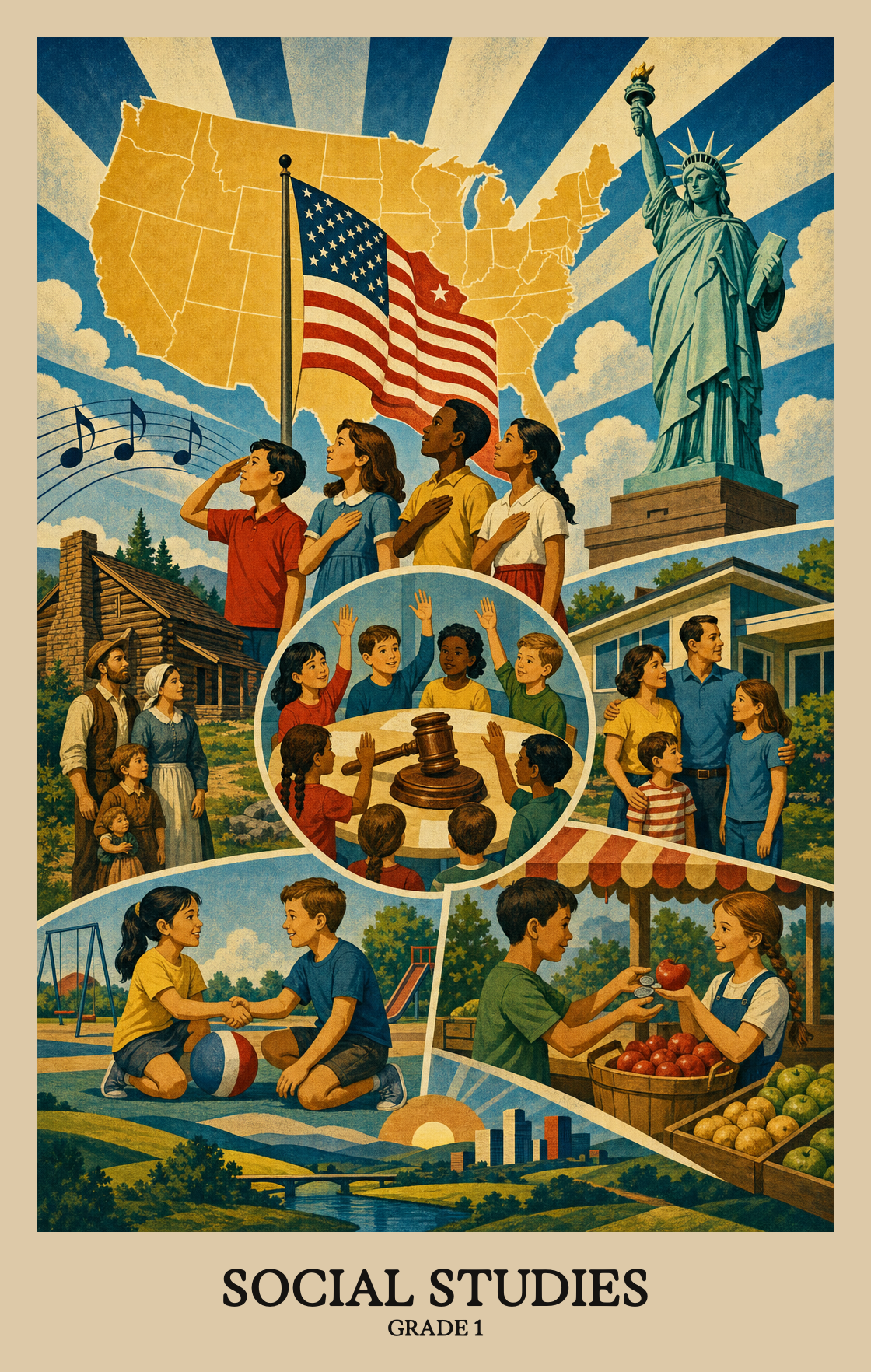
Students learn why classrooms and communities have rules and how those rules get made. They practice fair play, taking turns, and treating others the way they want to be treated.
Students get to know the flag, the Pledge of Allegiance, the Statue of Liberty, and the bald eagle. They learn the stories behind national holidays and the people those holidays honor.
Students find their town, California, the United States, the continents, and the oceans on maps and globes. They draw simple maps with symbols and a compass, and talk about how weather and landscape shape daily life.
Students compare schools, homes, clothes, games, and travel from earlier times to now. Stories, photos, and family histories show what has changed and what has stayed the same.
Students look at the many backgrounds that make up their school and town. They learn how American Indians and immigrants have shaped California and share customs and stories from different cultures.
Students learn how people use money to buy goods and services. They see the different jobs it takes to make, move, and sell the things families use every day, including work done at home.
Students learn what it means to be a good citizen, like following rules, taking turns, and helping others. They also learn the basic rights everyone has, such as being treated fairly.
Students learn the difference between a class voting on a rule together and a group of elected people making rules on everyone's behalf. They find examples of both in their school and neighborhood.
Fair play means treating others the way you want to be treated. Students learn why rules matter, how to respect different opinions, and what it looks like to be a good sport in games and everyday life.
Students learn to describe where places are using exact addresses or directions like "north of the park," then notice what makes each place look and feel different, such as its hills, buildings, or weather.
Students find their neighborhood, state, and country on a map or globe, then locate the seven continents and four oceans. It's basic map reading with real places they've heard of.
Students look at a globe or model of a place, then look at a photo of the same spot, and explain what each one shows that the other doesn't.
Students draw a basic map of a familiar place, label North, South, East, and West, and use small symbols (like a dot for a building) to show what's where.
Where people live shapes how they dress, what they eat, and how they get around. Students look at places with different climates and landscapes and explain why people there live the way they do.
Students learn what symbols like the American flag and landmarks like the Statue of Liberty mean, and why Americans have shared them across generations. These symbols help connect people from different places and times into one country.
Students practice saying the Pledge of Allegiance and learn patriotic songs that reflect what America stands for. These traditions connect students to shared values and a sense of belonging in the country.
Students learn why holidays like Veterans Day or the Fourth of July matter, and who the real people behind them were. Each holiday connects to a moment or a person worth remembering.
Students learn to recognize American symbols and landmarks like the flag, the Statue of Liberty, and the bald eagle, and connect each one to the people and history behind it.
Students look at how daily life, like what people eat, wear, and do for work, has changed over the years and what has stayed the same. They compare life in different places and times to spot those differences and similarities.
Students look at what schools and neighborhoods looked like in the past and notice what has changed since then.
Students look at how people traveled before cars and planes existed, comparing older ways like horse-drawn wagons or boats to how we get around today.
Students look at photos, stories, and family histories to spot what was different about daily life long ago, like how people worked or what games children played, and what has stayed the same.
Students look at their school, neighborhood, and community and notice that the people there come from many different backgrounds, cultures, and family histories.
Students learn that people in their school and neighborhood share common rules and celebrations even when their families come from different places. Being part of a community means finding what everyone has in common alongside what makes each person different.
Students learn how Native American groups and immigrants from around the world shaped the food, language, art, and traditions that make up California and American life today.
Students look at stories and folktales from different cultures and find what those groups have in common and what makes each one different, focusing on celebrations, customs, and daily traditions.
Students learn how people decide what to buy, sell, or make with the money and resources they have. They explore why choices matter when there is not enough of something for everyone.
Students learn why people trade and use money to get things they need or want, like food, toys, or a haircut.
Students learn how goods get from a factory shelf to a store and then home, and how different jobs, including work done at home, fit together to make that happen.
| Standard | Definition | Code |
|---|---|---|
| Students describe the rights and individual responsibilities of citizenship | Students learn what it means to be a good citizen, like following rules, taking turns, and helping others. They also learn the basic rights everyone has, such as being treated fairly. | CA-HSS.1.1 |
| Understand the rule-making process in a direct democracy | Students learn the difference between a class voting on a rule together and a group of elected people making rules on everyone's behalf. They find examples of both in their school and neighborhood. | CA-HSS.1.1.1 |
| Understand the elements of fair play and good sportsmanship, respect for the… | Fair play means treating others the way you want to be treated. Students learn why rules matter, how to respect different opinions, and what it looks like to be a good sport in games and everyday life. | CA-HSS.1.1.2 |
| Students compare and contrast the absolute and relative locations of places and… | Students learn to describe where places are using exact addresses or directions like "north of the park," then notice what makes each place look and feel different, such as its hills, buildings, or weather. | CA-HSS.1.2 |
| Locate on maps and globes their local community, California, the United States… | Students find their neighborhood, state, and country on a map or globe, then locate the seven continents and four oceans. It's basic map reading with real places they've heard of. | CA-HSS.1.2.1 |
| Compare the information that can be derived from a three-dimensional model to… | Students look at a globe or model of a place, then look at a photo of the same spot, and explain what each one shows that the other doesn't. | CA-HSS.1.2.2 |
| Construct a simple map, using cardinal directions and map symbols | Students draw a basic map of a familiar place, label North, South, East, and West, and use small symbols (like a dot for a building) to show what's where. | CA-HSS.1.2.3 |
| Describe how location, weather | Where people live shapes how they dress, what they eat, and how they get around. Students look at places with different climates and landscapes and explain why people there live the way they do. | CA-HSS.1.2.4 |
| Students know and understand the symbols, icons | Students learn what symbols like the American flag and landmarks like the Statue of Liberty mean, and why Americans have shared them across generations. These symbols help connect people from different places and times into one country. | CA-HSS.1.3 |
| Recite the Pledge of Allegiance and sing songs that express American ideals | Students practice saying the Pledge of Allegiance and learn patriotic songs that reflect what America stands for. These traditions connect students to shared values and a sense of belonging in the country. | CA-HSS.1.3.1 |
| Understand the significance of our national holidays and the heroism and… | Students learn why holidays like Veterans Day or the Fourth of July matter, and who the real people behind them were. Each holiday connects to a moment or a person worth remembering. | CA-HSS.1.3.2 |
| Identify American symbols, landmarks | Students learn to recognize American symbols and landmarks like the flag, the Statue of Liberty, and the bald eagle, and connect each one to the people and history behind it. | CA-HSS.1.3.3 |
| Students compare and contrast everyday life in different times and places… | Students look at how daily life, like what people eat, wear, and do for work, has changed over the years and what has stayed the same. They compare life in different places and times to spot those differences and similarities. | CA-HSS.1.4 |
| Examine the structure of schools and communities in the past | Students look at what schools and neighborhoods looked like in the past and notice what has changed since then. | CA-HSS.1.4.1 |
| Study transportation methods of earlier days | Students look at how people traveled before cars and planes existed, comparing older ways like horse-drawn wagons or boats to how we get around today. | CA-HSS.1.4.2 |
| Recognize similarities and differences of earlier generations in such areas as… | Students look at photos, stories, and family histories to spot what was different about daily life long ago, like how people worked or what games children played, and what has stayed the same. | CA-HSS.1.4.3 |
| Students describe the human characteristics of familiar places and the varied… | Students look at their school, neighborhood, and community and notice that the people there come from many different backgrounds, cultures, and family histories. | CA-HSS.1.5 |
| Recognize the ways in which they are all part of the same community, sharing… | Students learn that people in their school and neighborhood share common rules and celebrations even when their families come from different places. Being part of a community means finding what everyone has in common alongside what makes each person different. | CA-HSS.1.5.1 |
| Understand the ways in which American Indians and immigrants have helped define… | Students learn how Native American groups and immigrants from around the world shaped the food, language, art, and traditions that make up California and American life today. | CA-HSS.1.5.2 |
| Compare the beliefs, customs, ceremonies, traditions | Students look at stories and folktales from different cultures and find what those groups have in common and what makes each one different, focusing on celebrations, customs, and daily traditions. | CA-HSS.1.5.3 |
| Students understand basic economic concepts and the role of individual choice… | Students learn how people decide what to buy, sell, or make with the money and resources they have. They explore why choices matter when there is not enough of something for everyone. | CA-HSS.1.6 |
| Understand the concept of exchange and the use of money to purchase goods and… | Students learn why people trade and use money to get things they need or want, like food, toys, or a haircut. | CA-HSS.1.6.1 |
| Identify the specialized work that people do to manufacture, transport | Students learn how goods get from a factory shelf to a store and then home, and how different jobs, including work done at home, fit together to make that happen. | CA-HSS.1.6.2 |
Students learn about rules, fairness, and what it means to be part of a group. They start using maps and globes, learn American symbols and holidays, and compare life today with life long ago. They also learn how people trade money for goods and services.
Pull up a globe or a paper map and find the local town, the state, the country, and the oceans. Take turns giving directions using north, south, east, and west on a walk or while drawing a simple map of the bedroom. Five minutes a few times a week is plenty.
Students should recognize the flag, the bald eagle, the Statue of Liberty, and know the Pledge of Allegiance. They should also know why days like Independence Day, Presidents' Day, and Martin Luther King Jr. Day matter, and a few people connected to them.
Many teachers start with classroom rules and fairness in the first weeks, since it sets the tone for everything else. Maps and geography fit well in fall, holidays and symbols line up with the calendar, and life long ago and economics often anchor the spring.
Students learn the difference between everyone voting on a rule and choosing a leader to make rules. They practice fair play, taking turns, listening to other opinions, and the idea of treating others the way they want to be treated.
Tell stories about what school, games, chores, or travel were like when grandparents were young. Old family photos work well. Students are asked to notice what has changed, like how people get around, and what has stayed the same, like playing tag or sharing meals.
Cardinal directions and the difference between a map and a globe usually need more than one pass. The two kinds of rule-making, direct and representative, also take repeated examples from the classroom and school before it sticks.
By spring, students can point out the state, country, continents, and oceans on a map, draw a simple map with directions, and explain a few American symbols and holidays. They can also describe how people use money to buy goods and services, and give examples of fair behavior.
Students learn that people trade money for goods and services, and that different jobs help make, move, and sell those things. Work done at home counts too. A trip to a grocery store or a chat about a family member's job brings it to life.