Pretending and making believe
Students start the year by stepping into characters from stories they already know. They use their voice, face, and body to show who they are pretending to be.
This is the year pretend play becomes real theater. Students invent characters, act out short scenes, and use their voice and body to show how someone feels. They start to notice choices other actors and storytellers make, and say what they liked or what felt confusing. By spring, they can take on a role in a class skit and explain why their character did what they did.
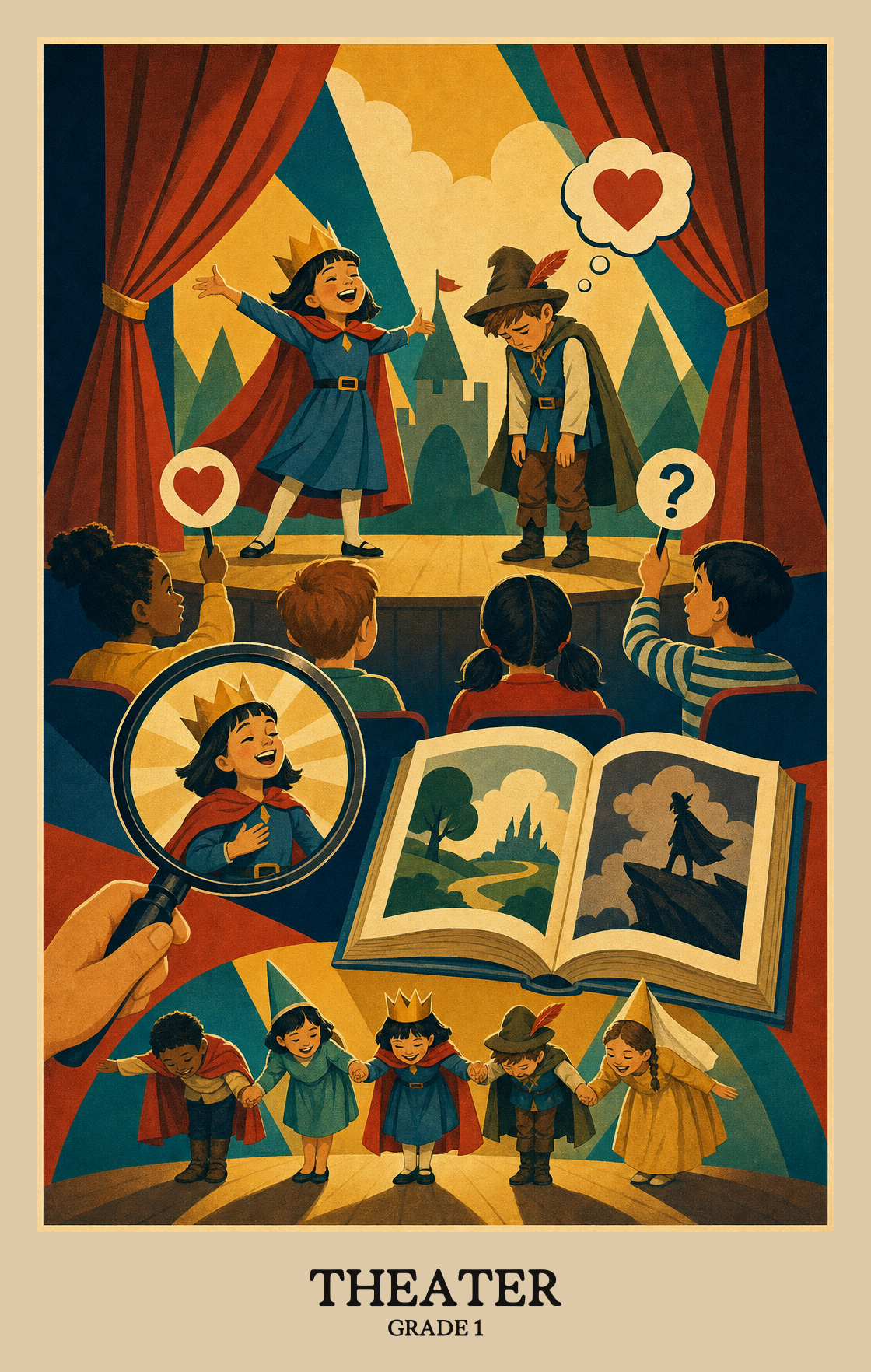
Students start the year by stepping into characters from stories they already know. They use their voice, face, and body to show who they are pretending to be.
Students help build short scenes by adding ideas about who is in the story, where it happens, and what goes wrong. They learn that a scene needs a beginning, a middle, and an end.
Students rehearse short scenes and try them again to make them clearer for an audience. They learn to speak so others can hear and to listen for their turn.
Students watch scenes and talk about what they noticed, what the story meant, and what worked well. They connect what they see on stage to their own lives and to stories from other places and times.
Students connect something from their own life to a story or character they are performing. A memory, a feeling, or something they have seen helps make the performance more real.
Students look at a play, puppet show, or story performance and talk about where it comes from. A folk tale from another country or a holiday pageant connects to real life and helps students understand people different from themselves.
| Standard | Definition | Code |
|---|---|---|
| Using personal experiences to make theater | Students connect something from their own life to a story or character they are performing. A memory, a feeling, or something they have seen helps make the performance more real. | CA-TH:Cn10.1.1 |
| Stories from different times and places | Students look at a play, puppet show, or story performance and talk about where it comes from. A folk tale from another country or a holiday pageant connects to real life and helps students understand people different from themselves. | CA-TH:Cn11.1.1 |
Students come up with their own ideas for a character or short scene. This is the starting point for making theater.
Students pick a character and figure out what that character would say or do in a simple story scene. They practice making those choices before performing.
Students revisit a short scene or character choice, make one or two changes to improve it, and practice until the work feels finished.
| Standard | Definition | Code |
|---|---|---|
| Imagine and create theater ideas | Students come up with their own ideas for a character or short scene. This is the starting point for making theater. | CA-TH:Cr1.1.1 |
| Turning an idea into a short play | Students pick a character and figure out what that character would say or do in a simple story scene. They practice making those choices before performing. | CA-TH:Cr2.1.1 |
| Finish and polish a theater piece | Students revisit a short scene or character choice, make one or two changes to improve it, and practice until the work feels finished. | CA-TH:Cr3.1.1 |
Students choose a character or scene to perform and explain why it fits the story they want to tell.
Students practice how to move, speak, and use their voice so a performance looks and sounds clear to an audience.
Students perform a short scene or character and make clear choices so the audience understands the story or feeling being shared.
| Standard | Definition | Code |
|---|---|---|
| Choosing which performance to put on | Students choose a character or scene to perform and explain why it fits the story they want to tell. | CA-TH:Pr4.1.1 |
| Practicing a performance until it's ready | Students practice how to move, speak, and use their voice so a performance looks and sounds clear to an audience. | CA-TH:Pr5.1.1 |
| Perform a story for an audience | Students perform a short scene or character and make clear choices so the audience understands the story or feeling being shared. | CA-TH:Pr6.1.1 |
Students look at a short performance or scene and describe what they noticed: what the characters did, how they moved, and what seemed to be happening.
Students look at a short play or puppet show and explain what they think the performer was trying to show, using details from what they saw or heard.
Students look at a scene or performance and say what worked and what did not, using a simple reason to back up their opinion.
| Standard | Definition | Code |
|---|---|---|
| Watching and thinking about a performance | Students look at a short performance or scene and describe what they noticed: what the characters did, how they moved, and what seemed to be happening. | CA-TH:Re7.1.1 |
| What a story is trying to say | Students look at a short play or puppet show and explain what they think the performer was trying to show, using details from what they saw or heard. | CA-TH:Re8.1.1 |
| Deciding what makes a performance good | Students look at a scene or performance and say what worked and what did not, using a simple reason to back up their opinion. | CA-TH:Re9.1.1 |
Students play pretend with purpose. They act out short scenes, take on simple characters like a tired farmer or a hungry cat, and use their voice and body to show feelings. Most of the work happens through play, not memorized scripts.
Read a picture book together and act out a favorite part. Take turns being different characters and try changing your voice for each one. Five minutes of pretend after dinner is plenty to build confidence.
No. The focus is on inventing characters, showing feelings, and sharing short scenes with a small group. If a child wants to make up lines on the spot, that counts.
Start small. Let students perform for one stuffed animal, then one family member, then two. Puppets and masks also help, since the character does the talking instead of the student.
Begin with imagination games and character play in the fall. Move into building short scenes from familiar stories in the winter. Spring is a good time for small group scenes that students rehearse, refine, and share with an audience.
Students can invent a character, stay in that character through a short scene, and explain what their character wanted. They can also watch a classmate's scene and say one thing that worked and one thing they wondered about.
Give them two simple sentence starters: I noticed and I wondered. Use them after every share. Over the year, students move from general comments like it was good to specific ones like I noticed you stomped when you were angry.
Acting out stories deepens reading comprehension, and inventing scenes builds the same skills as writing. Students also pull from their own lives and from stories about other cultures, which ties into social studies.
A ready student can work with a small group to plan a short scene, stay in role from start to finish, and share an idea about what a classmate's scene meant. Comfort speaking in front of the class matters more than polish.