Building characters and ideas
Students start the year by inventing characters and story ideas from their own lives. They try out voices, gestures, and short scenes to see what feels believable on stage.
This is the year theater shifts from playing a role to shaping a role with intent. Students pull from their own lives and from the world around a play to build characters that feel real. They rehearse, get notes, and revise their choices before stepping onstage. By spring, they can perform a scene with clear motivation and explain why a peer's scene worked or fell flat.
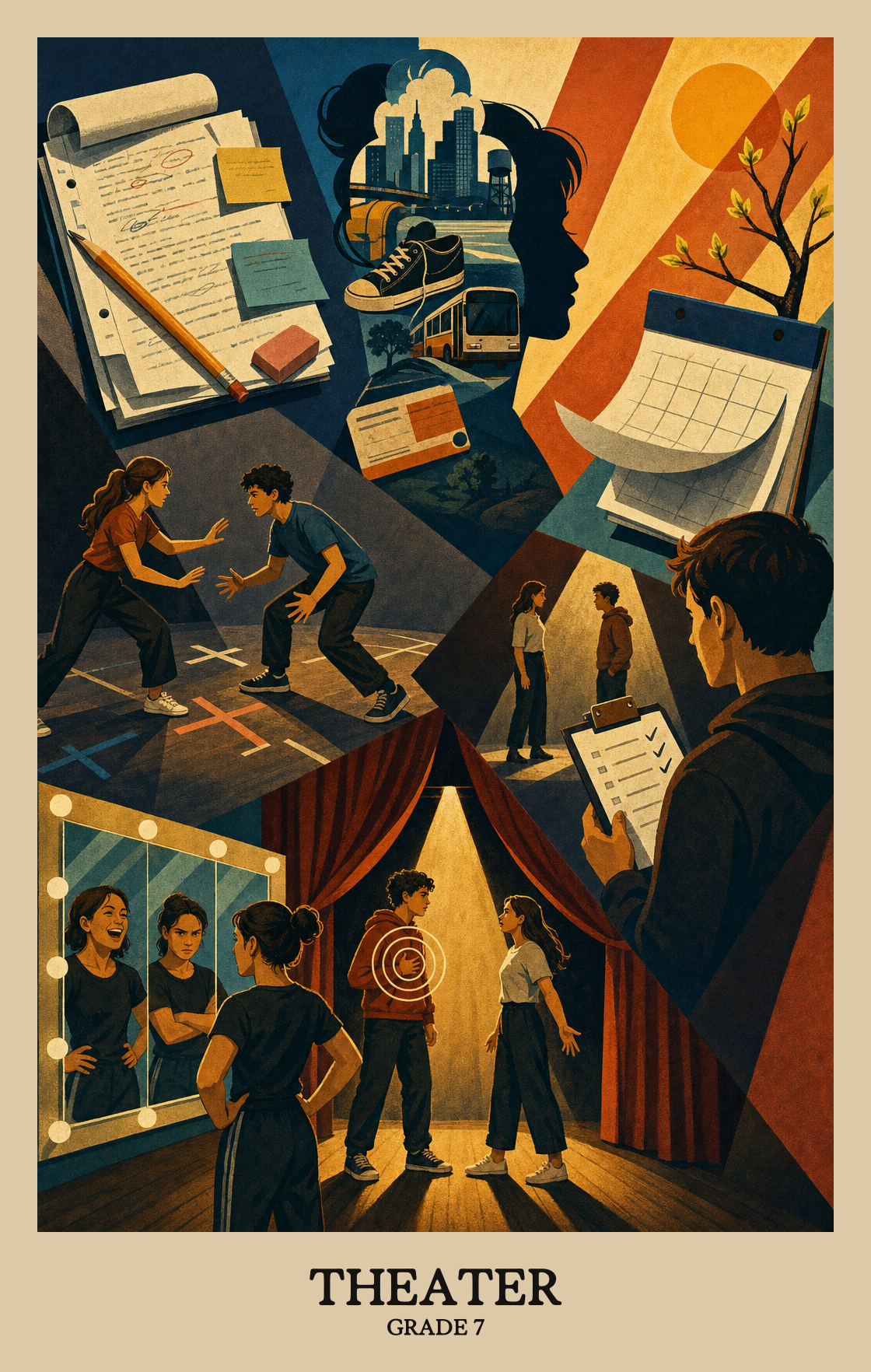
Students start the year by inventing characters and story ideas from their own lives. They try out voices, gestures, and short scenes to see what feels believable on stage.
Students work in small groups to turn rough ideas into scenes with a beginning, middle, and end. They take notes from classmates and rewrite parts that do not land.
Students pick scenes to perform and practice the craft behind them: clear voices, intentional movement, and choices about what the audience should feel.
Students watch performances and talk about what worked and why. They connect plays to history and culture and use shared criteria to give honest, useful feedback.
Students connect something from their own life to a theater piece they are creating or performing. Personal experience shapes the choices they make on stage.
Students look at a play or performance and ask why it was made when and where it was. They connect what happens on stage to the time in history, the culture, or the community that shaped it.
| Standard | Definition | Code |
|---|---|---|
| Using life experience to make theater | Students connect something from their own life to a theater piece they are creating or performing. Personal experience shapes the choices they make on stage. | CA-TH:Cn10.7.7 |
| Theater's place in history and culture | Students look at a play or performance and ask why it was made when and where it was. They connect what happens on stage to the time in history, the culture, or the community that shaped it. | CA-TH:Cn11.7.7 |
Students brainstorm original ideas for scenes or characters and start shaping those ideas into something that could actually be performed.
Students take a rough idea for a scene or character and shape it into something stageable, making choices about dialogue, action, and structure until the piece holds together.
Students revisit a scene or monologue, make specific changes based on feedback, and bring the piece to a finished, performance-ready state.
| Standard | Definition | Code |
|---|---|---|
| Coming up with ideas for a scene | Students brainstorm original ideas for scenes or characters and start shaping those ideas into something that could actually be performed. | CA-TH:Cr1.7.7 |
| Develop a scene from your own ideas | Students take a rough idea for a scene or character and shape it into something stageable, making choices about dialogue, action, and structure until the piece holds together. | CA-TH:Cr2.7.7 |
| Finishing and polishing a scene | Students revisit a scene or monologue, make specific changes based on feedback, and bring the piece to a finished, performance-ready state. | CA-TH:Cr3.7.7 |
Students choose a scene or monologue to perform and explain why it fits their skills and the purpose of the performance.
Students rehearse and revise a scene or performance until it's ready to share with an audience. The focus is on sharpening the craft, not just running through the lines.
Students perform a scene or monologue with a clear intention, making choices about voice, movement, and timing so the audience understands what the piece is really about.
| Standard | Definition | Code |
|---|---|---|
| Choosing the right scene to perform | Students choose a scene or monologue to perform and explain why it fits their skills and the purpose of the performance. | CA-TH:Pr4.7.7 |
| Rehearsing and refining a performance | Students rehearse and revise a scene or performance until it's ready to share with an audience. The focus is on sharpening the craft, not just running through the lines. | CA-TH:Pr5.7.7 |
| Perform to make the audience feel something | Students perform a scene or monologue with a clear intention, making choices about voice, movement, and timing so the audience understands what the piece is really about. | CA-TH:Pr6.7.7 |
Students watch a scene or performance and explain what specific choices, like blocking, lighting, or dialogue, are doing and why they matter. The goal is to move past "I liked it" toward a real reason.
Students examine a scene or performance and explain what choices the artist made and why those choices matter. They look past what happens on stage to figure out what the work is really trying to say.
Students watch or read a piece of theater and judge it using a clear set of criteria, explaining what worked and what didn't with specific reasons from the performance itself.
| Standard | Definition | Code |
|---|---|---|
| Reading a performance with intention | Students watch a scene or performance and explain what specific choices, like blocking, lighting, or dialogue, are doing and why they matter. The goal is to move past "I liked it" toward a real reason. | CA-TH:Re7.7.7 |
| Reading meaning in a performance | Students examine a scene or performance and explain what choices the artist made and why those choices matter. They look past what happens on stage to figure out what the work is really trying to say. | CA-TH:Re8.7.7 |
| Judging whether a performance works | Students watch or read a piece of theater and judge it using a clear set of criteria, explaining what worked and what didn't with specific reasons from the performance itself. | CA-TH:Re9.7.7 |
Students build short scenes, try out characters, and talk about what works and what does not. They also watch plays or clips and dig into what the writer and actors were trying to say. Expect a mix of making, performing, and discussing.
Start small. Ask them to read a picture book aloud using different voices for each character, or act out a funny family story at dinner. Five minutes of low-stakes play at home builds the confidence they need to take a risk in class.
Some memorization comes up, but the focus is on making thoughtful choices, not perfect recall. Help them practice by running lines together and asking why a character might say something a certain way. Understanding the line matters more than reciting it.
Most teachers start with ensemble and improv work in the fall, move into devised or scripted scene work by winter, and build toward a longer performance project in spring. Responding and analysis can thread through each unit rather than sit as its own block.
Students can take an idea from brainstorm to performance, make specific acting choices on purpose, and explain why they made them. They can also watch a piece of theater and say what worked, what did not, and what evidence from the performance led them there.
Pick scripts or scene prompts that connect to a time period or social question students are already studying. Ask them to research the world of the play before staging it, and to compare a character's situation to something happening now.
Ask what the scene was about, which moment stuck with them, and what choice an actor made that they noticed. These questions push students to back up opinions with specifics, which is exactly the kind of thinking the class is building.
Giving and using specific feedback is the big one. Students tend to default to good or boring and need repeated practice naming what they saw and why it worked. Revision of their own work based on that feedback is the second hurdle.