Finding ideas to move
Students start the year by turning their own memories, interests, and questions into movement. Parents may hear about short dances built from something personal, like a place, a feeling, or a story.
This is the year dance becomes a way to say something on purpose. Students take an idea from their own life or from history and shape it into a piece they can perform. They practice the moves, polish the timing, and watch other dances with a careful eye for what the choreographer meant. By spring, students can perform a short dance they helped create and explain the meaning behind it.
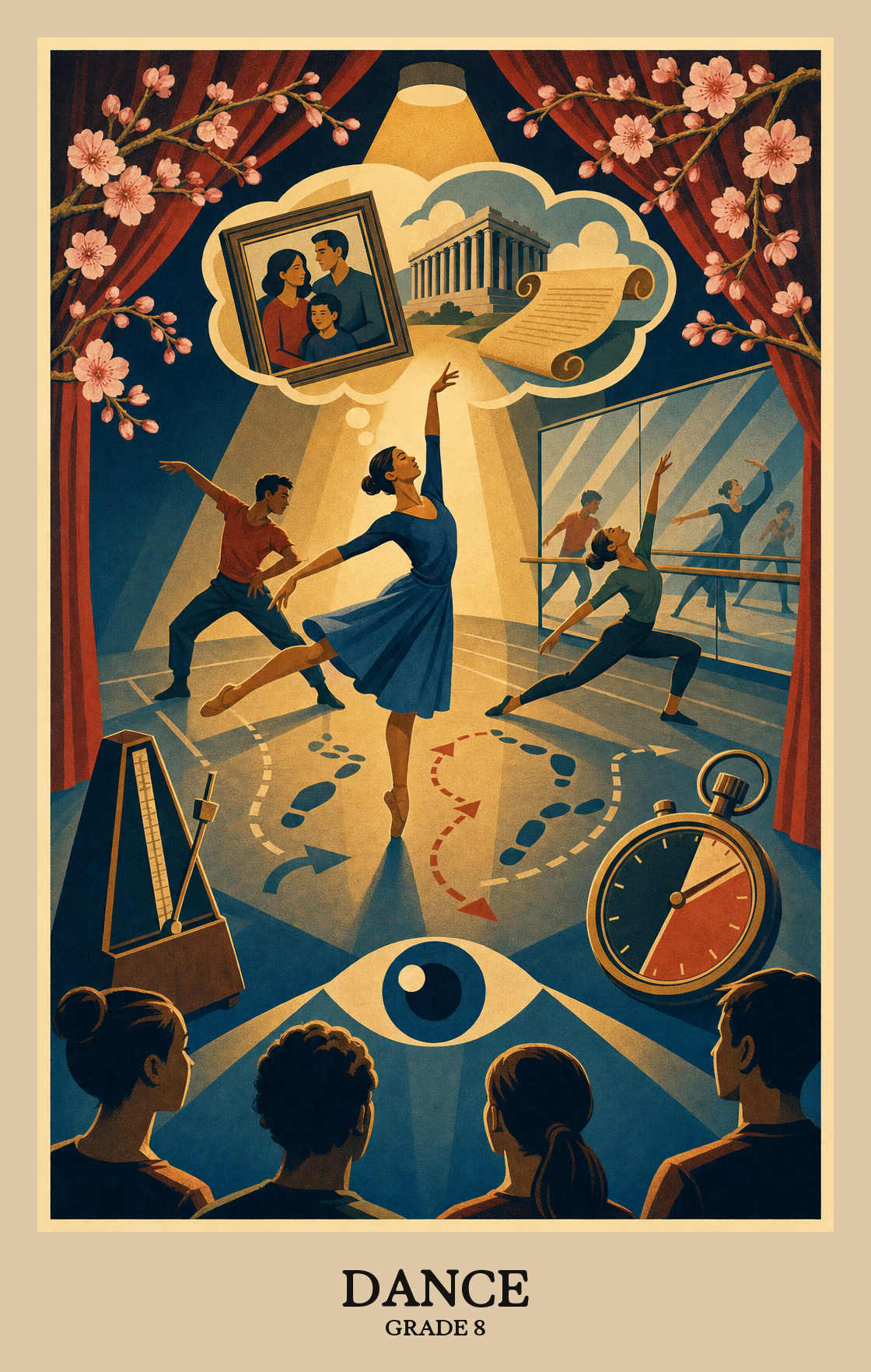
Students start the year by turning their own memories, interests, and questions into movement. Parents may hear about short dances built from something personal, like a place, a feeling, or a story.
Students take rough ideas and build them into real dances with a clear beginning, middle, and end. They try different orders, test what works, and revise based on feedback from classmates and the teacher.
Students look at dances from different cultures, time periods, and communities. They notice what a dance is saying and how where it comes from shapes the movement, the music, and the message.
Students focus on how they move, working on control, balance, timing, and clarity. They practice the same sequences many times so the dance reads clearly to someone watching from the audience.
Students share finished dances with an audience and use clear criteria to talk about what worked. They give and receive specific feedback and use it to set goals for the next piece.
Students connect their own memories, feelings, and outside knowledge to the choices they make while creating a dance. Personal experience shapes the movement, not just technique.
Students connect a dance piece to the time, place, or culture it came from, explaining what that context reveals about the work's meaning.
| Standard | Definition | Code |
|---|---|---|
| Synthesize and relate knowledge and personal experiences to make art | Students connect their own memories, feelings, and outside knowledge to the choices they make while creating a dance. Personal experience shapes the movement, not just technique. | DA:Cn10.8 |
| Relate artistic ideas and works with societal, cultural | Students connect a dance piece to the time, place, or culture it came from, explaining what that context reveals about the work's meaning. | DA:Cn11.8 |
Students brainstorm and develop original ideas for a dance, deciding what movements, themes, or stories they want to explore before they start creating.
Students take their movement ideas and shape them into a full piece, making choices about structure, order, and how different parts connect.
Students revisit a dance they've been building, make specific changes to improve how it looks and feels, and prepare it to share with an audience.
| Standard | Definition | Code |
|---|---|---|
| Generate and conceptualize artistic ideas and work | Students brainstorm and develop original ideas for a dance, deciding what movements, themes, or stories they want to explore before they start creating. | DA:Cr1.8 |
| Organize and develop artistic ideas and work | Students take their movement ideas and shape them into a full piece, making choices about structure, order, and how different parts connect. | DA:Cr2.8 |
| Refine and complete artistic work | Students revisit a dance they've been building, make specific changes to improve how it looks and feels, and prepare it to share with an audience. | DA:Cr3.8 |
Students choose which dances to perform and explain why those pieces best show their skills and artistic choices.
Students practice and improve their dance technique to get ready for a performance, refining specific movements and sequences until they are stage-ready.
Students perform a dance to communicate a clear idea or feeling to an audience, making deliberate choices about movement so the meaning comes through.
| Standard | Definition | Code |
|---|---|---|
| Analyze, interpret, and select artistic work for presentation | Students choose which dances to perform and explain why those pieces best show their skills and artistic choices. | DA:Pr4.8 |
| Develop and refine artistic techniques and work for presentation | Students practice and improve their dance technique to get ready for a performance, refining specific movements and sequences until they are stage-ready. | DA:Pr5.8 |
| Convey meaning through the presentation of artistic work | Students perform a dance to communicate a clear idea or feeling to an audience, making deliberate choices about movement so the meaning comes through. | DA:Pr6.8 |
Students watch a dance performance and break down how the choreographer used movement, timing, and space to build meaning. They explain what they notice using specific details from what they saw.
Students analyze a dance performance and explain what the choreographer was trying to say. They support their interpretation with specific movements, patterns, or staging they observed.
Students use a set of criteria to judge a piece of dance, explaining what works, what doesn't, and why, based on specific qualities in the movement itself.
| Standard | Definition | Code |
|---|---|---|
| Perceive and analyze artistic work | Students watch a dance performance and break down how the choreographer used movement, timing, and space to build meaning. They explain what they notice using specific details from what they saw. | DA:Re7.8 |
| Interpret intent and meaning in artistic work | Students analyze a dance performance and explain what the choreographer was trying to say. They support their interpretation with specific movements, patterns, or staging they observed. | DA:Re8.8 |
| Apply criteria to evaluate artistic work | Students use a set of criteria to judge a piece of dance, explaining what works, what doesn't, and why, based on specific qualities in the movement itself. | DA:Re9.8 |
Students create short dances, perform them, watch other dances, and talk about what the movement means. They use ideas from their own lives, history, and culture as starting points, and they revise their work after getting feedback.
Ask about the dance students are making and what it is supposed to say. Watch a short dance clip together and ask what stood out. Clearing a small space in a room so students can practice for ten minutes also goes a long way.
By spring, students can build a short dance with a clear idea behind it, rehearse it, and perform it for an audience. They can also watch another dance and explain what the choreographer was trying to say and how the movement supports that meaning.
Start with short movement studies that build vocabulary and habits for giving feedback. Move into longer choreography projects in the middle of the year, then end with a polished performance piece. Weave responding work into every unit so students practice analyzing dance, not just making it.
Yes. The class is about making meaning with the body, not about being a trained dancer. Students who are new to dance still learn to plan a piece, rehearse, perform, and talk about art, and those skills carry into music, theater, and writing.
Work is judged against criteria, not against other students. A rubric usually looks at the idea behind the dance, the craft of the movement, the quality of rehearsal and performance, and how thoughtfully a student responds to other dances.
Revision is the hardest part. Students often want to keep the first version of a dance instead of reworking it. Plan time for structured peer feedback and a second draft, and model how to change one element at a time rather than starting over.
A ready student can come up with a dance idea, shape it into something an audience can follow, and talk about another artist's work with specifics instead of just liking or disliking it. If those three things feel solid, they are in good shape.