Finding ideas worth making
Students start the year gathering ideas from their own lives, sketchbooks, and the world around them. Expect to hear about brainstorming, rough sketches, and choosing a direction before anything gets finished.
This is the year art shifts from learning techniques to using art as a way to say something. Students plan a piece around their own ideas and experiences, then revise it before showing it. They look closely at other artists' work and explain what the artist might have meant and why. By spring, they can talk about their own piece, name the choices they made, and tie those choices to a clear message.
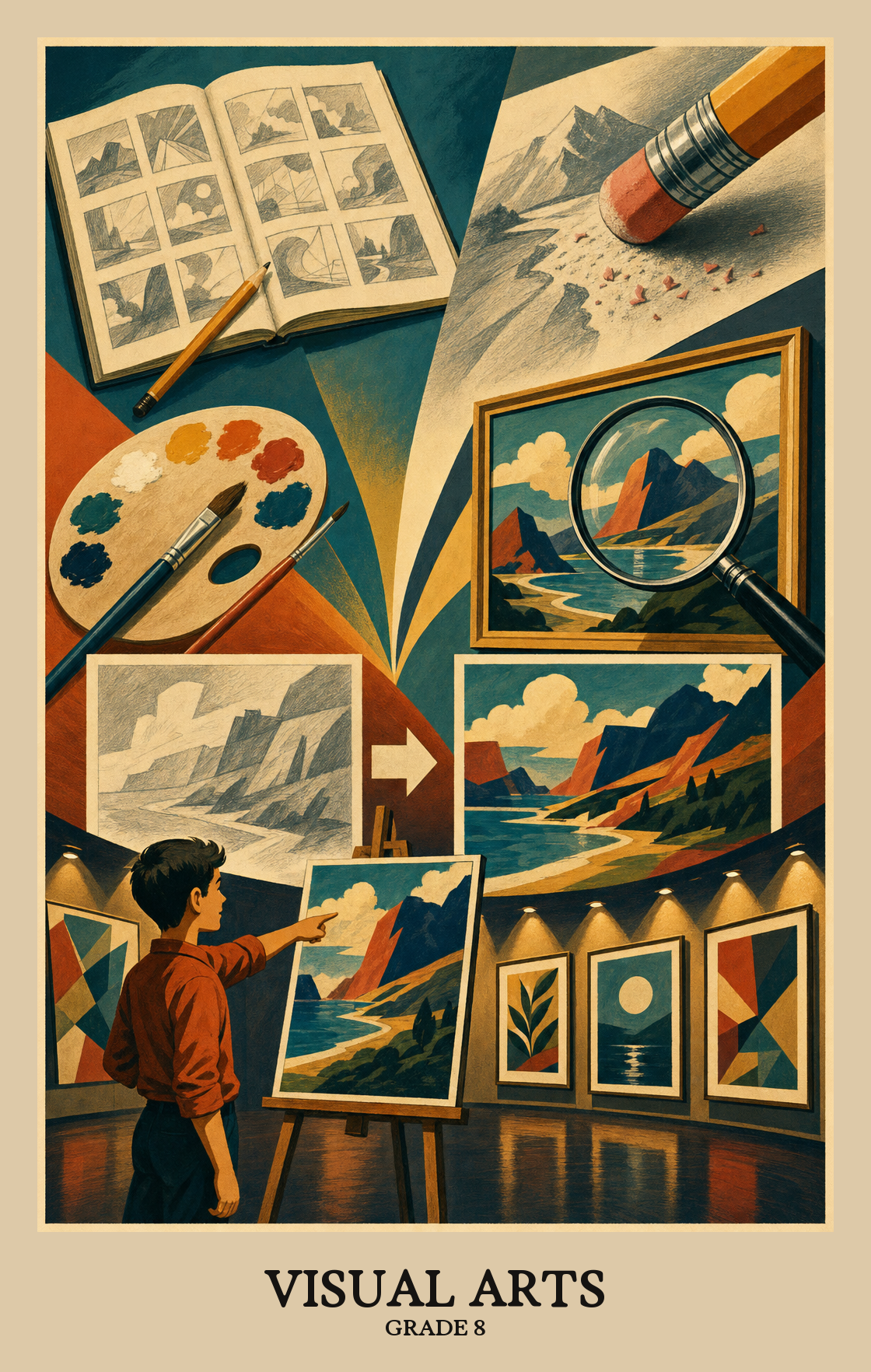
Students start the year gathering ideas from their own lives, sketchbooks, and the world around them. Expect to hear about brainstorming, rough sketches, and choosing a direction before anything gets finished.
Students practice with materials and tools, from drawing and painting to digital or three-dimensional work. The focus is on developing real craft, not just finishing a project.
Students look at art from different cultures, time periods, and communities, and connect it to what they are making. Conversations at home might turn to why an artist made certain choices.
Students take a piece from rough draft to finished. They get feedback, make changes, and learn to push past the first attempt instead of calling it done too early.
Students choose pieces to present, think about how the work is displayed, and explain what they were trying to say. They also learn to talk about other artists' work using clear criteria.
Students pull from what they know and what they've lived through to make creative choices in their artwork. Personal experience becomes part of the work itself.
Students look at an artwork and connect it to the time, place, or culture it came from. That context changes what the work means and why it matters.
| Standard | Definition | Code |
|---|---|---|
| Synthesize and relate knowledge and personal experiences to make art | Students pull from what they know and what they've lived through to make creative choices in their artwork. Personal experience becomes part of the work itself. | VA:Cn10.8 |
| Relate artistic ideas and works with societal, cultural | Students look at an artwork and connect it to the time, place, or culture it came from. That context changes what the work means and why it matters. | VA:Cn11.8 |
Students brainstorm and develop original ideas before they start making art, experimenting with concepts, images, or approaches until a direction starts to take shape.
Students plan and refine their artwork by making deliberate choices about materials, composition, and technique. The work shows evidence of revision, not just a first attempt.
Students revisit a piece of art they started, make deliberate changes based on their own judgment, and bring it to a finished state.
| Standard | Definition | Code |
|---|---|---|
| Generate and conceptualize artistic ideas and work | Students brainstorm and develop original ideas before they start making art, experimenting with concepts, images, or approaches until a direction starts to take shape. | VA:Cr1.8 |
| Organize and develop artistic ideas and work | Students plan and refine their artwork by making deliberate choices about materials, composition, and technique. The work shows evidence of revision, not just a first attempt. | VA:Cr2.8 |
| Refine and complete artistic work | Students revisit a piece of art they started, make deliberate changes based on their own judgment, and bring it to a finished state. | VA:Cr3.8 |
Students review a collection of their own artwork and choose which pieces are strong enough to show others, explaining why each selected work belongs in the presentation.
Students practice and improve their artwork until it's ready to show others, making deliberate choices about what to adjust before the final piece is presented.
Students choose how to display or share their artwork so the viewer understands what the piece is meant to express. The arrangement, setting, and context all shape how the work lands.
| Standard | Definition | Code |
|---|---|---|
| Analyze, interpret, and select artistic work for presentation | Students review a collection of their own artwork and choose which pieces are strong enough to show others, explaining why each selected work belongs in the presentation. | VA:Pr4.8 |
| Develop and refine artistic techniques and work for presentation | Students practice and improve their artwork until it's ready to show others, making deliberate choices about what to adjust before the final piece is presented. | VA:Pr5.8 |
| Convey meaning through the presentation of artistic work | Students choose how to display or share their artwork so the viewer understands what the piece is meant to express. The arrangement, setting, and context all shape how the work lands. | VA:Pr6.8 |
Students look closely at a piece of art and explain what they notice, from the colors and shapes the artist chose to how those choices create a mood or meaning.
Students look at a piece of art and explain what the artist was trying to say, using details in the work to back up their thinking.
Students judge a piece of artwork by measuring it against clear criteria, such as how well the artist used color, composition, or technique to carry out an intention.
| Standard | Definition | Code |
|---|---|---|
| Perceive and analyze artistic work | Students look closely at a piece of art and explain what they notice, from the colors and shapes the artist chose to how those choices create a mood or meaning. | VA:Re7.8 |
| Interpret intent and meaning in artistic work | Students look at a piece of art and explain what the artist was trying to say, using details in the work to back up their thinking. | VA:Re8.8 |
| Apply criteria to evaluate artistic work | Students judge a piece of artwork by measuring it against clear criteria, such as how well the artist used color, composition, or technique to carry out an intention. | VA:Re9.8 |
Students move beyond following directions and start making real artistic choices. They generate their own ideas, plan a piece, revise it, and explain why they made the choices they did. They also study how artists from different cultures and time periods used art to say something.
Skill matters less than thinking like an artist. Ask what they were trying to say, what they tried first, and what they changed. Keep a small sketchbook around for doodling, and visit a museum website or local gallery together. The goal is comfort with making and revising, not pretty results.
Start with idea generation and sketchbook habits so students have something to work from. Build technique units in the middle with clear criteria for revision. End with a portfolio or exhibition unit where students select, refine, and present work with an artist statement.
No. A pencil, a sketchbook or scrap paper, and any cheap materials around the house are enough. What matters most is time to sketch, try things, and look at work by other artists. Phone photos of their work also help them step back and see what to change.
A student can take an idea from a rough sketch to a finished piece, explain the choices they made, and connect their work to a wider context. They can also look at someone else's art and say what it might mean and how well it works.
Revision is the hardest shift. Many students still want to finish in one sitting and call it done. Building in required checkpoints, peer critique, and language for talking about choices tends to do more than another technique lesson.
Looking at art carefully and explaining what it means is half the subject this year. Students learn to back up an opinion with evidence from the piece itself. That habit also strengthens their own work, because they start making choices on purpose instead of by accident.
They keep a working sketchbook, can plan and finish a piece without constant prompting, and can talk about their choices using basic art vocabulary. They can also accept feedback and revise rather than start over or give up.