Moving and exploring space
Students try out big and small movements, fast and slow speeds, and different ways to travel across the room. They learn that the body can show ideas without using words.
This is the year movement becomes a way to tell a story. Students explore how their bodies can show ideas, feelings, and pictures from their own lives. They make up short dances, practice them, and share them with classmates, then talk about what they noticed in someone else's dance. By spring, students can shape a simple movement idea into a short dance and say what it was about.
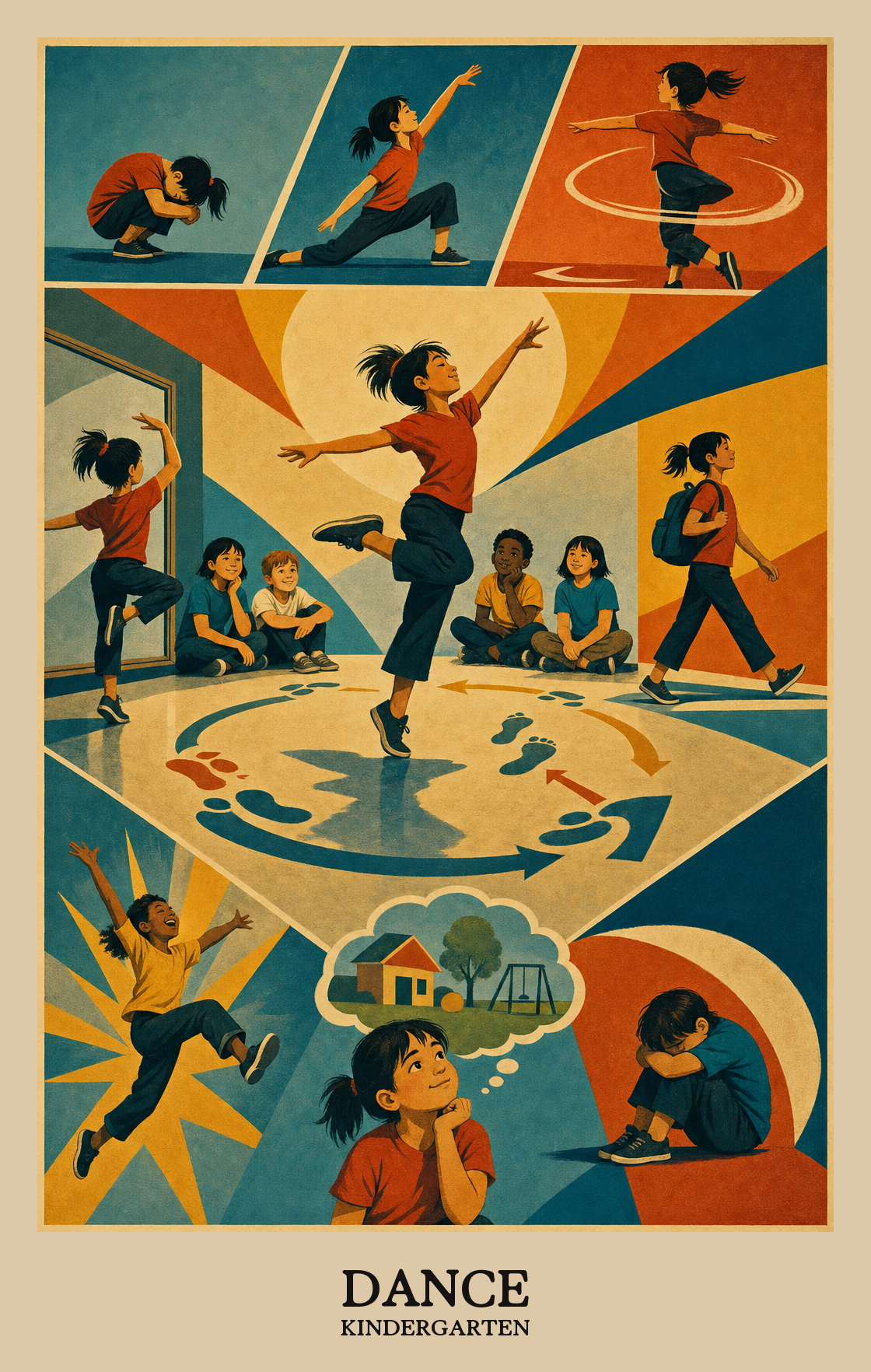
Students try out big and small movements, fast and slow speeds, and different ways to travel across the room. They learn that the body can show ideas without using words.
Students start inventing their own movements based on things they know, like animals, weather, or a favorite story. They put a few moves together to make a short dance of their own.
Students practice their dances and show them to classmates. They learn to start, hold a shape, and finish on purpose so the audience can follow along.
Students watch each other and short dance clips, then talk about what they noticed and what the dance might mean. They learn that people can dance for many reasons and from many places.
Students connect something from their own life to a dance they make or watch. A memory, a feeling, or something they've seen at home can shape the way they move.
Dance connects to the world outside the studio. Students begin to notice how the dances they learn and create reflect where people come from and how they live.
| Standard | Definition | Code |
|---|---|---|
| Synthesize and relate knowledge and personal experiences to make art | Students connect something from their own life to a dance they make or watch. A memory, a feeling, or something they've seen at home can shape the way they move. | DA:Cn10.k |
| Relate artistic ideas and works with societal, cultural | Dance connects to the world outside the studio. Students begin to notice how the dances they learn and create reflect where people come from and how they live. | DA:Cn11.k |
Students come up with their own movement ideas, deciding how their body could tell a story or show a feeling through dance.
Students choose movements and put them in order to make a short dance. They practice arranging what their body does so the dance has a beginning and an end.
Students finish a dance they have been working on, making small changes until it feels ready to share.
| Standard | Definition | Code |
|---|---|---|
| Generate and conceptualize artistic ideas and work | Students come up with their own movement ideas, deciding how their body could tell a story or show a feeling through dance. | DA:Cr1.k |
| Organize and develop artistic ideas and work | Students choose movements and put them in order to make a short dance. They practice arranging what their body does so the dance has a beginning and an end. | DA:Cr2.k |
| Refine and complete artistic work | Students finish a dance they have been working on, making small changes until it feels ready to share. | DA:Cr3.k |
Students choose which dances or movements to show others. They think about why one choice fits better than another.
Students practice a dance movement again and again until it looks the way they want it to. They work on getting the steps clean and ready to show someone else.
Students perform a short dance to share a feeling or idea with an audience.
| Standard | Definition | Code |
|---|---|---|
| Analyze, interpret, and select artistic work for presentation | Students choose which dances or movements to show others. They think about why one choice fits better than another. | DA:Pr4.k |
| Develop and refine artistic techniques and work for presentation | Students practice a dance movement again and again until it looks the way they want it to. They work on getting the steps clean and ready to show someone else. | DA:Pr5.k |
| Convey meaning through the presentation of artistic work | Students perform a short dance to share a feeling or idea with an audience. | DA:Pr6.k |
Students watch a dance and share what they notice, such as how the dancer moves or how fast or slow the movement feels.
Students watch a dance and share what they think the dancer is trying to show, using words like happy, strong, or telling a story.
Students watch a dance and say what they noticed, like whether the movements were big or small, fast or slow. They start learning to give a reason for what they liked or thought could change.
| Standard | Definition | Code |
|---|---|---|
| Perceive and analyze artistic work | Students watch a dance and share what they notice, such as how the dancer moves or how fast or slow the movement feels. | DA:Re7.k |
| Interpret intent and meaning in artistic work | Students watch a dance and share what they think the dancer is trying to show, using words like happy, strong, or telling a story. | DA:Re8.k |
| Apply criteria to evaluate artistic work | Students watch a dance and say what they noticed, like whether the movements were big or small, fast or slow. They start learning to give a reason for what they liked or thought could change. | DA:Re9.k |
Students move their bodies in safe, structured ways to explore ideas, stories, and feelings. They practice basic movements like skipping, swaying, bending, and freezing, and they start to notice how movement can show a mood or tell a small story.
Put on music and let students show you how a happy song or a sleepy song looks in movement. Ask them to move like an animal, a tree in the wind, or a character from a story. Five minutes of free dancing in the living room counts.
Students should be able to make up a short movement to match an idea, copy and remember a few steps, and share what they noticed when watching someone else dance. They should also move safely in a shared space without bumping into others.
Start with body awareness and safe movement in shared space, then build into the elements of movement like fast and slow, high and low, smooth and sharp. Move into making short movement ideas, then sharing them with a partner or small group by spring.
Start with movement that does not feel like a performance, such as stretching together, marching to a beat, or acting out a picture book. Shyness usually fades once students see that there is no single right way to move.
Personal space and safe stopping take the most practice. Many students also need repeated work on holding a shape still, since freezing on a count is harder than it looks at this age.
Movement helps students show what a story is about, count a steady beat, and notice patterns. Acting out a poem or a math pattern with the body gives students another way to understand it.
Students should move safely in a group, copy a short sequence of movements, and offer a simple comment about what they saw in a peer's dance, such as it was fast or it looked sad. Confidence sharing movement in front of others is the strongest signal.