Settling into the music room
Students start the year by listening closely to short pieces and talking about what they hear. They connect the music to their own lives and to what was happening when it was written.
This is the year music shifts from learning songs to making real musical choices. Students come up with their own short pieces, then revise them based on feedback and what they hear. They also start explaining why a song works, using words like tempo, dynamics, and form instead of just liking or disliking it. By spring, students can perform a prepared piece with care and talk about the choices behind it.
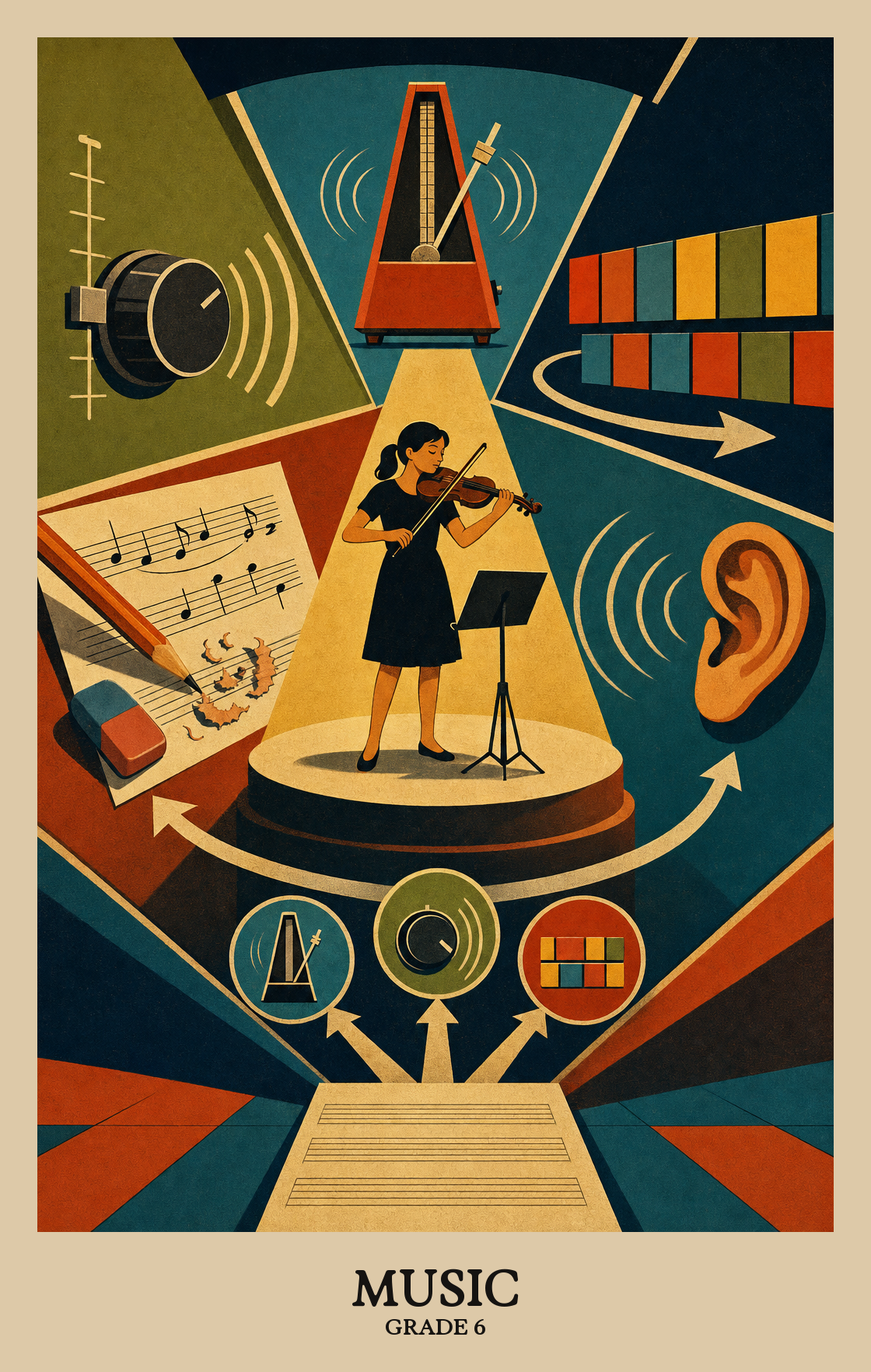
Students start the year by listening closely to short pieces and talking about what they hear. They connect the music to their own lives and to what was happening when it was written.
Students try out their own short tunes and rhythms, on instruments or with their voices. They learn that a first idea is just a starting point and gets shaped over time.
Students pick a song or composition to work on and practice the tricky parts. They get more comfortable playing or singing in front of others and make choices about how the music should feel.
Students perform for classmates, families, or a school audience and think about what they want listeners to feel. They learn to present their work with intention, not just play the notes.
Students wrap up the year by giving real feedback on music, including their own. They use clear reasons instead of just liking or disliking a song, and notice how a piece reflects its time and place.
Students connect what they already know and have lived through to the music they create or perform. Personal experiences shape the choices they make in their work.
Students connect a piece of music to the time, place, or culture it came from. Understanding that context changes how they hear and interpret the work.
| Standard | Definition | Code |
|---|---|---|
| Synthesize and relate knowledge and personal experiences to make art | Students connect what they already know and have lived through to the music they create or perform. Personal experiences shape the choices they make in their work. | MU:Cn10.6 |
| Relate artistic ideas and works with societal, cultural | Students connect a piece of music to the time, place, or culture it came from. Understanding that context changes how they hear and interpret the work. | MU:Cn11.6 |
Students brainstorm musical ideas, such as melodies or rhythms, and start shaping them into something original. This is where a piece of music begins.
Students take a musical idea and shape it into something more complete, choosing how to arrange, revise, and build on it until the piece reflects their intentions.
Students revisit a piece of music they've composed or arranged, make specific changes to improve it, and bring it to a finished state ready to share or perform.
| Standard | Definition | Code |
|---|---|---|
| Generate and conceptualize artistic ideas and work | Students brainstorm musical ideas, such as melodies or rhythms, and start shaping them into something original. This is where a piece of music begins. | MU:Cr1.6 |
| Organize and develop artistic ideas and work | Students take a musical idea and shape it into something more complete, choosing how to arrange, revise, and build on it until the piece reflects their intentions. | MU:Cr2.6 |
| Refine and complete artistic work | Students revisit a piece of music they've composed or arranged, make specific changes to improve it, and bring it to a finished state ready to share or perform. | MU:Cr3.6 |
Students choose a piece of music to perform and explain why it suits their skills and the audience. The selection is intentional, not random.
Students rehearse a piece of music and work out the technical problems before performing it for others. The goal is to play or sing it as well as they can, not just run through it once.
Students perform a piece of music with clear intention, shaping tempo, dynamics, or expression to communicate a specific mood or idea to the audience.
| Standard | Definition | Code |
|---|---|---|
| Analyze, interpret, and select artistic work for presentation | Students choose a piece of music to perform and explain why it suits their skills and the audience. The selection is intentional, not random. | MU:Pr4.6 |
| Develop and refine artistic techniques and work for presentation | Students rehearse a piece of music and work out the technical problems before performing it for others. The goal is to play or sing it as well as they can, not just run through it once. | MU:Pr5.6 |
| Convey meaning through the presentation of artistic work | Students perform a piece of music with clear intention, shaping tempo, dynamics, or expression to communicate a specific mood or idea to the audience. | MU:Pr6.6 |
Students listen to a piece of music and describe what they notice: how the melody moves, where the rhythm shifts, and what choices the composer made. They explain what they hear, not just whether they liked it.
Students explain what a piece of music is trying to say and why the composer made specific choices, like tempo, dynamics, or instrumentation, to create a feeling or tell a story.
Students listen to a piece of music and use specific criteria, like rhythm, melody, or tone, to explain what works and what doesn't. The judgment has to be backed by what they actually heard.
| Standard | Definition | Code |
|---|---|---|
| Perceive and analyze artistic work | Students listen to a piece of music and describe what they notice: how the melody moves, where the rhythm shifts, and what choices the composer made. They explain what they hear, not just whether they liked it. | MU:Re7.6 |
| Interpret intent and meaning in artistic work | Students explain what a piece of music is trying to say and why the composer made specific choices, like tempo, dynamics, or instrumentation, to create a feeling or tell a story. | MU:Re8.6 |
| Apply criteria to evaluate artistic work | Students listen to a piece of music and use specific criteria, like rhythm, melody, or tone, to explain what works and what doesn't. The judgment has to be backed by what they actually heard. | MU:Re9.6 |
Students make their own short pieces, perform music alone and with a group, and listen carefully to music from different times and places. They also learn to talk about why a piece sounds the way it does and what the composer might have wanted listeners to feel.
Treat music like talking. Sing along in the car, tap rhythms on the table, or ask which song fits a mood. Five minutes of humming a tune and clapping the beat builds the same skills used in class, and it takes the pressure off being good.
No. Voice, body percussion, and household objects are enough. If a student is learning an instrument, short daily practice of 10 to 15 minutes helps more than one long session on the weekend.
Start with listening and short creating tasks so students build a shared vocabulary. Move into longer composing and performing projects in the middle of the year, then close with a presentation that asks students to explain their choices and reflect on feedback.
Notating rhythms accurately, revising a draft instead of starting over, and giving feedback that points to a specific moment in the music. Build in short routines for each one rather than saving them for a single unit.
Ask students to play or sing what they have so far, then ask one question: what should happen next, and why? Talking the idea out loud often unsticks it. Avoid suggesting notes or fixing it for them.
Students can create a short piece with a clear beginning, middle, and end, perform a prepared piece with steady rhythm and accurate pitch, and explain how a piece of music connects to its time, place, or purpose using specific evidence from what they heard.
Sixth graders link songs and pieces to history, culture, and personal experience. A parent can support this by asking what a song reminds students of, or what was happening in the world when it was written. These conversations build the same thinking used in class.