Settling into the music room
Students start the year by listening closely to songs and naming what they hear, like a steady beat, a high or low pitch, and a loud or soft sound. They begin sharing what a piece reminds them of.
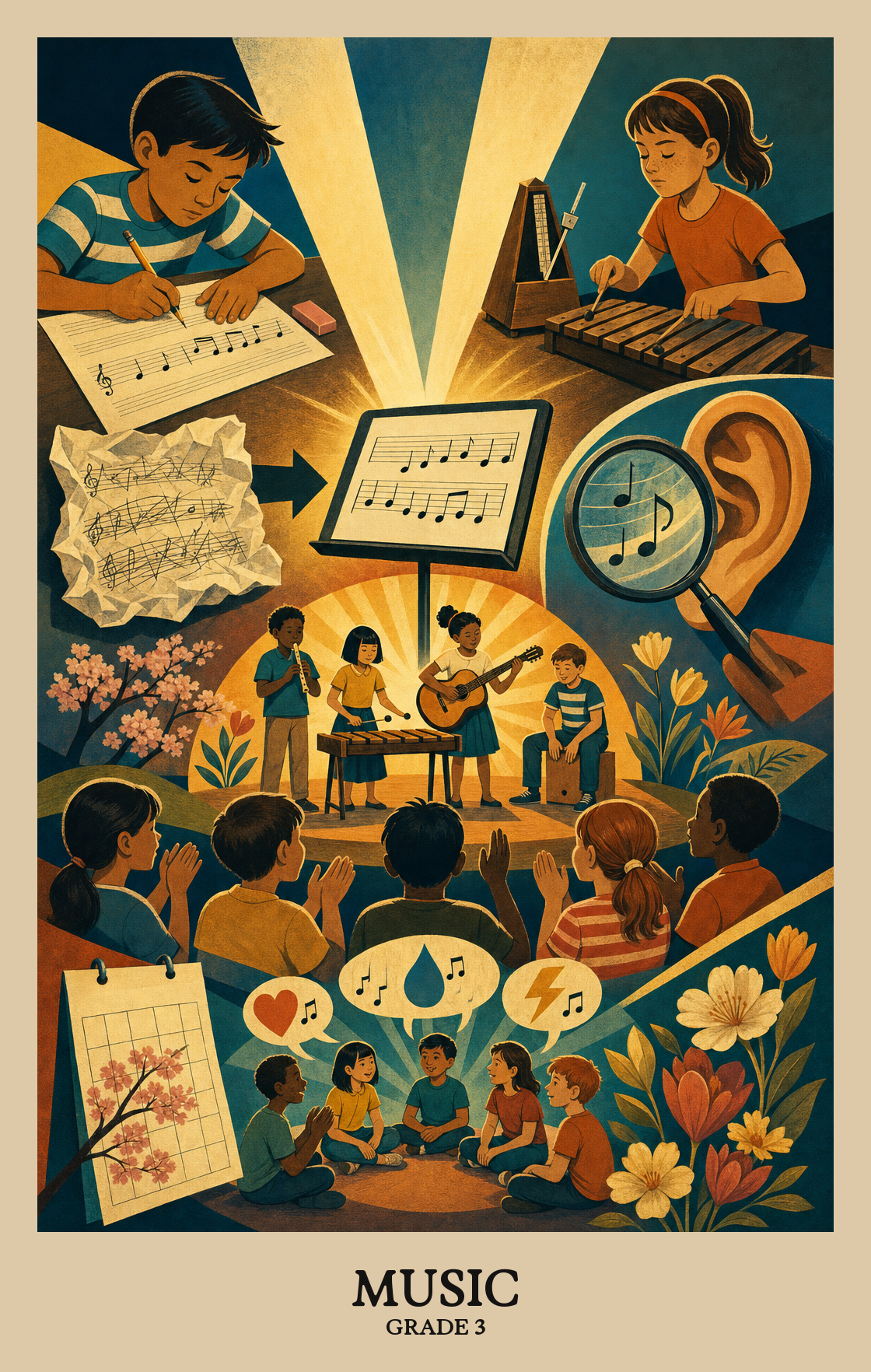
This is the year music shifts from simple singing and playing to making real musical choices. Students come up with their own short musical ideas, then practice and polish them for an audience. They also learn to listen with a purpose, talking about what a piece of music feels like and why. By spring, students can perform a short piece they helped shape and explain what it means to them.
Students start the year by listening closely to songs and naming what they hear, like a steady beat, a high or low pitch, and a loud or soft sound. They begin sharing what a piece reminds them of.
Students try out their own short rhythms and melodies using voices, classroom instruments, or simple notation. They pick which ideas they like best and start shaping them into something they can share.
Students learn songs and pieces to play or sing for others. They work on singing in tune, keeping a steady beat, and matching the mood of the music so a listener can tell what the song is about.
Students listen to music from different cultures and time periods and talk about why people wrote it and how it was used. They start to notice how a song fits the place and moment it came from.
Students perform their finished pieces and listen to classmates do the same. They use simple guidelines to say what worked, what the music seemed to mean, and what they would change next time.
Students connect what they know and what they've lived through to the music they create or perform. A song can reflect a memory, a feeling, or something learned in another class.
Students look at a song or piece of music and ask where it came from. They connect it to the time, place, or culture that shaped it.
| Standard | Definition | Code |
|---|---|---|
| Synthesize and relate knowledge and personal experiences to make art | Students connect what they know and what they've lived through to the music they create or perform. A song can reflect a memory, a feeling, or something learned in another class. | MU:Cn10.3 |
| Relate artistic ideas and works with societal, cultural | Students look at a song or piece of music and ask where it came from. They connect it to the time, place, or culture that shaped it. | MU:Cn11.3 |
Students come up with original musical ideas, like a short melody or a rhythm pattern, and start shaping them into something they could perform or share.
Students take a musical idea and shape it into a short piece, making choices about which sounds, rhythms, or patterns to keep and how to arrange them.
Students revisit a piece of music they started, make changes to improve it, and decide when it's ready to share.
| Standard | Definition | Code |
|---|---|---|
| Generate and conceptualize artistic ideas and work | Students come up with original musical ideas, like a short melody or a rhythm pattern, and start shaping them into something they could perform or share. | MU:Cr1.3 |
| Organize and develop artistic ideas and work | Students take a musical idea and shape it into a short piece, making choices about which sounds, rhythms, or patterns to keep and how to arrange them. | MU:Cr2.3 |
| Refine and complete artistic work | Students revisit a piece of music they started, make changes to improve it, and decide when it's ready to share. | MU:Cr3.3 |
Students choose a piece of music to perform and explain why it suits them. They think about what the music asks of the performer before they start practicing it.
Students practice a song or piece until it sounds the way they want it to, then work on fixing specific parts before performing for others.
Students perform a song or piece of music with intention, making choices about dynamics and expression to communicate a feeling or idea to the audience.
| Standard | Definition | Code |
|---|---|---|
| Analyze, interpret, and select artistic work for presentation | Students choose a piece of music to perform and explain why it suits them. They think about what the music asks of the performer before they start practicing it. | MU:Pr4.3 |
| Develop and refine artistic techniques and work for presentation | Students practice a song or piece until it sounds the way they want it to, then work on fixing specific parts before performing for others. | MU:Pr5.3 |
| Convey meaning through the presentation of artistic work | Students perform a song or piece of music with intention, making choices about dynamics and expression to communicate a feeling or idea to the audience. | MU:Pr6.3 |
Students listen to a short piece of music and describe what they notice, like changes in speed, volume, or mood. They explain what the composer might have been trying to express.
Students listen to a piece of music and explain what they think the composer or performer meant to express. They use what they hear in the melody, rhythm, or mood to back up their thinking.
Students listen to a piece of music and use a short checklist or set of questions to explain what works and what doesn't. They back up their opinion with specific reasons, not just "I liked it."
| Standard | Definition | Code |
|---|---|---|
| Perceive and analyze artistic work | Students listen to a short piece of music and describe what they notice, like changes in speed, volume, or mood. They explain what the composer might have been trying to express. | MU:Re7.3 |
| Interpret intent and meaning in artistic work | Students listen to a piece of music and explain what they think the composer or performer meant to express. They use what they hear in the melody, rhythm, or mood to back up their thinking. | MU:Re8.3 |
| Apply criteria to evaluate artistic work | Students listen to a piece of music and use a short checklist or set of questions to explain what works and what doesn't. They back up their opinion with specific reasons, not just "I liked it." | MU:Re9.3 |
Students sing, play simple instruments, move to a steady beat, and start making up short musical ideas of their own. They also listen to different kinds of music and talk about what they notice. Performing for classmates becomes a regular part of class.
Sing in the car, clap rhythms back and forth, or tap a steady beat while music plays. Ask what students are working on in music class and listen to a song together. Five minutes of shared listening counts.
Students start to recognize basic rhythm and pitch patterns and may follow along with simple notation. Full music reading is not the goal yet. The focus is hearing patterns, keeping a beat, and matching pitch.
Start with steady beat, singing voice, and basic rhythm patterns. Move into reading short rhythm and pitch patterns, then into small composing tasks and group performance. Save longer performance pieces and reflection work for the second half of the year.
Students can keep a steady beat, sing in tune with a group, perform a short prepared piece, and make up a few measures of their own music. They can also listen to a piece and say something specific about how it sounds and what it might mean.
Most students this age are still learning to match pitch, and that improves with practice. Sing easy songs together at home and let them hear their own voice without pressure. Avoid labeling anyone as not a singer.
Steady beat under changing rhythms trips students up, and so does matching pitch in a group. Building in short warm-ups at the start of every class pays off more than one long unit. Composing tasks also need clear limits to keep students from freezing.
They can keep a steady beat, sing a short song in tune with the class, play a simple rhythm on a classroom instrument, and talk about a piece of music using words like fast, slow, loud, soft, happy, or sad. Comfort performing in a small group also matters.