Building characters and ideas
Students start the year by inventing characters and story ideas from their own lives and observations. They try out voices, movements, and quick scenes to see what sparks a play worth making.
This is the year theatre work gets more serious and more personal. Students pull from their own lives and from history to build characters and scenes that mean something. They rehearse with real technique, give and take feedback, then shape a performance for an audience. By spring, they can take a script or an idea, develop it through rehearsal, and perform it with clear choices a viewer can read.
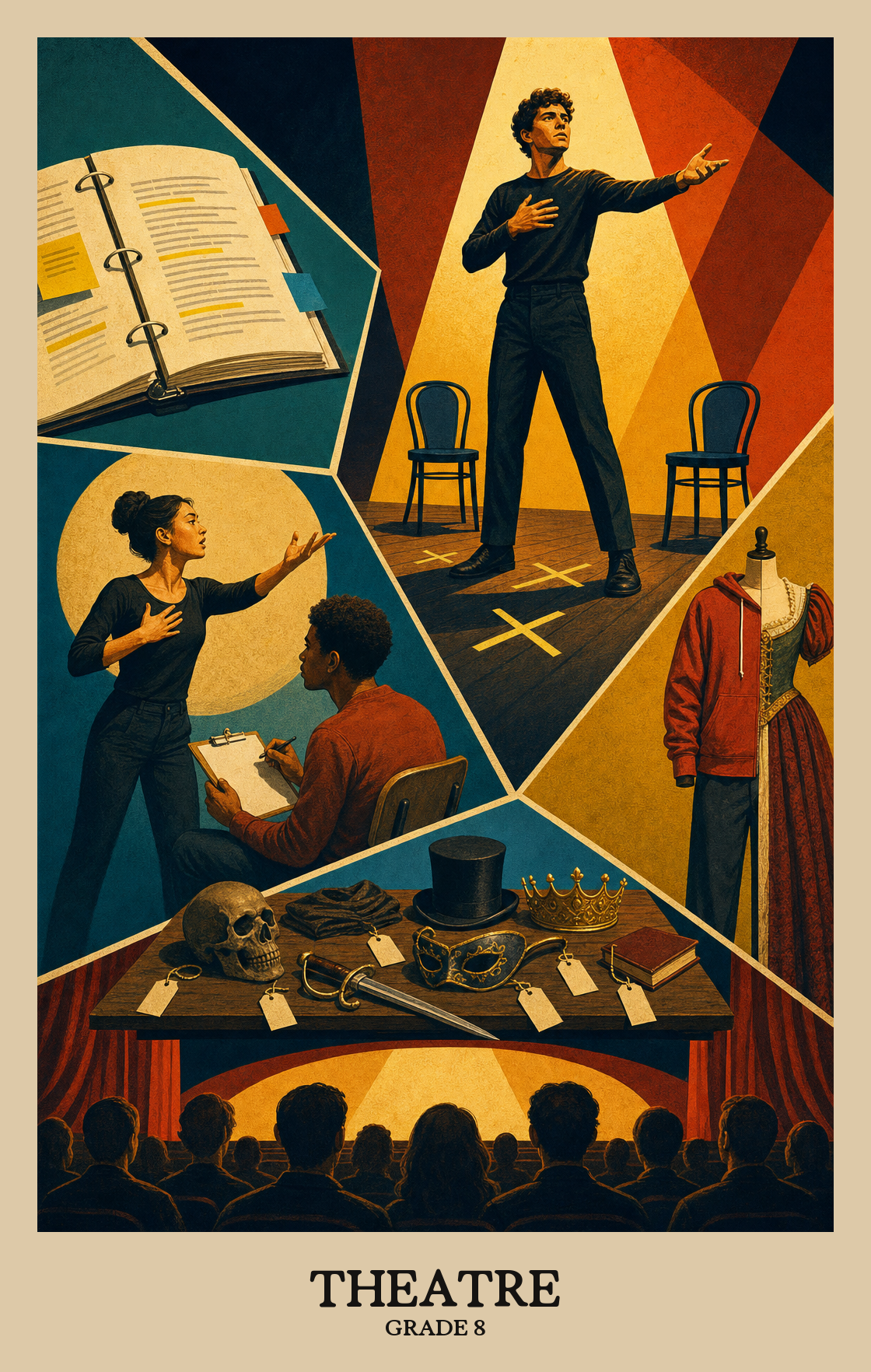
Students start the year by inventing characters and story ideas from their own lives and observations. They try out voices, movements, and quick scenes to see what sparks a play worth making.
Students take rough ideas and turn them into scenes with a clear beginning, middle, and end. They write, block, and rework scripts based on what is actually landing with classmates.
Students focus on the craft of performing. They work on voice, body, timing, and choices that make a character feel real, and they decide which pieces are ready to share.
Students present finished work and watch the work of others with a critical eye. They give and receive specific feedback, and they connect what they made to history, culture, and their own experiences.
Students connect something from their own life to a character, scene, or script they are creating. That personal link shapes the choices they make in rehearsal and performance.
Students look at a play or performance and connect it to the time, place, or culture it came from. That context helps explain why the story was told and what it meant to the people who first saw it.
| Standard | Definition | Code |
|---|---|---|
| Synthesize and relate knowledge and personal experiences to make art | Students connect something from their own life to a character, scene, or script they are creating. That personal link shapes the choices they make in rehearsal and performance. | TH:Cn10.8 |
| Relate artistic ideas and works with societal, cultural | Students look at a play or performance and connect it to the time, place, or culture it came from. That context helps explain why the story was told and what it meant to the people who first saw it. | TH:Cn11.8 |
Students brainstorm and develop original ideas for a scene or performance, experimenting with character, story, and setting before settling on a creative direction.
Students take a rough theatre idea and shape it into something stageable, making specific choices about character, story, and staging until the work is ready to share.
Students revise a scene or script based on feedback, making deliberate choices about dialogue, staging, and character until the piece is ready to perform or present.
| Standard | Definition | Code |
|---|---|---|
| Generate and conceptualize artistic ideas and work | Students brainstorm and develop original ideas for a scene or performance, experimenting with character, story, and setting before settling on a creative direction. | TH:Cr1.8 |
| Organize and develop artistic ideas and work | Students take a rough theatre idea and shape it into something stageable, making specific choices about character, story, and staging until the work is ready to share. | TH:Cr2.8 |
| Refine and complete artistic work | Students revise a scene or script based on feedback, making deliberate choices about dialogue, staging, and character until the piece is ready to perform or present. | TH:Cr3.8 |
Students choose a scene or monologue and explain why it fits the audience and purpose. They back up that choice by pointing to specific moments in the text.
Students rehearse a scene or monologue, then revise their performance based on feedback until the work is ready to present to an audience.
Students perform a scene or monologue with a clear purpose, making deliberate choices about voice, movement, and expression so the audience understands what the piece is about.
| Standard | Definition | Code |
|---|---|---|
| Analyze, interpret, and select artistic work for presentation | Students choose a scene or monologue and explain why it fits the audience and purpose. They back up that choice by pointing to specific moments in the text. | TH:Pr4.8 |
| Develop and refine artistic techniques and work for presentation | Students rehearse a scene or monologue, then revise their performance based on feedback until the work is ready to present to an audience. | TH:Pr5.8 |
| Convey meaning through the presentation of artistic work | Students perform a scene or monologue with a clear purpose, making deliberate choices about voice, movement, and expression so the audience understands what the piece is about. | TH:Pr6.8 |
Students watch a scene or performance and explain what choices the playwright or director made, such as how staging, dialogue, or character movement shapes the story's meaning.
Students analyze a scene, character choice, or design element and explain what the theatre maker was trying to say. They support their reading with specific details from the performance or script.
Students pick a standard for judging a scene or performance, then use it to explain what works and what could be stronger.
| Standard | Definition | Code |
|---|---|---|
| Perceive and analyze artistic work | Students watch a scene or performance and explain what choices the playwright or director made, such as how staging, dialogue, or character movement shapes the story's meaning. | TH:Re7.8 |
| Interpret intent and meaning in artistic work | Students analyze a scene, character choice, or design element and explain what the theatre maker was trying to say. They support their reading with specific details from the performance or script. | TH:Re8.8 |
| Apply criteria to evaluate artistic work | Students pick a standard for judging a scene or performance, then use it to explain what works and what could be stronger. | TH:Re9.8 |
Students move past basic acting games into building real scenes and short plays. They write or shape their own material, rehearse it with a purpose, and perform it for an audience. They also watch other work and explain what it meant and how it was made.
Start small. Have students read a short scene out loud at the dinner table, or rehearse a monologue facing a mirror for five minutes a day. Confidence grows from low-pressure reps, not from one big push before a performance.
Yes. Most of the work is about reading a script closely, making choices about a character, and speaking clearly in front of people. Those skills show up in English class, job interviews, and group projects long after the curtain closes.
A common arc is to start with ensemble and devising work, move into scene study and character analysis in the middle of the year, and end with a polished performance project. Build response and critique skills alongside performance from week one.
Students can take a scene from a cold read to a rehearsed performance, defend the choices they made about a character, and give specific feedback on a classmate's work using shared criteria. They can also connect a play to its time period or to their own lives.
Give them a short, shared rubric before they watch, with two or three things to look for such as vocal clarity, character choices, and use of space. Require evidence from what they actually saw on stage. Without that structure, feedback drifts into liking or disliking the performer.
Run lines with them and read the other parts out loud, even if it feels silly. Ask what the character wants in the scene and why they say each line. Five or ten minutes a night beats one long cram session.
Students should be able to break down a short script, make clear choices about a character, and perform a memorized piece without stopping. They should also be able to talk about a play they saw or read and explain what it was trying to say.