Exploring how the body moves
Students start the year learning the basic ways their body can move. They try out walking, jumping, twisting, and balancing, and notice how movement feels at different speeds and levels.
This is the year dance shifts from copying moves to making them up on purpose. Students invent short movement ideas from a picture, a story, or a feeling, then practice them until the dance has a clear beginning and end. They also start watching dances and talking about what the movement might mean. By spring, students can perform a short dance they helped create and explain one idea behind it.
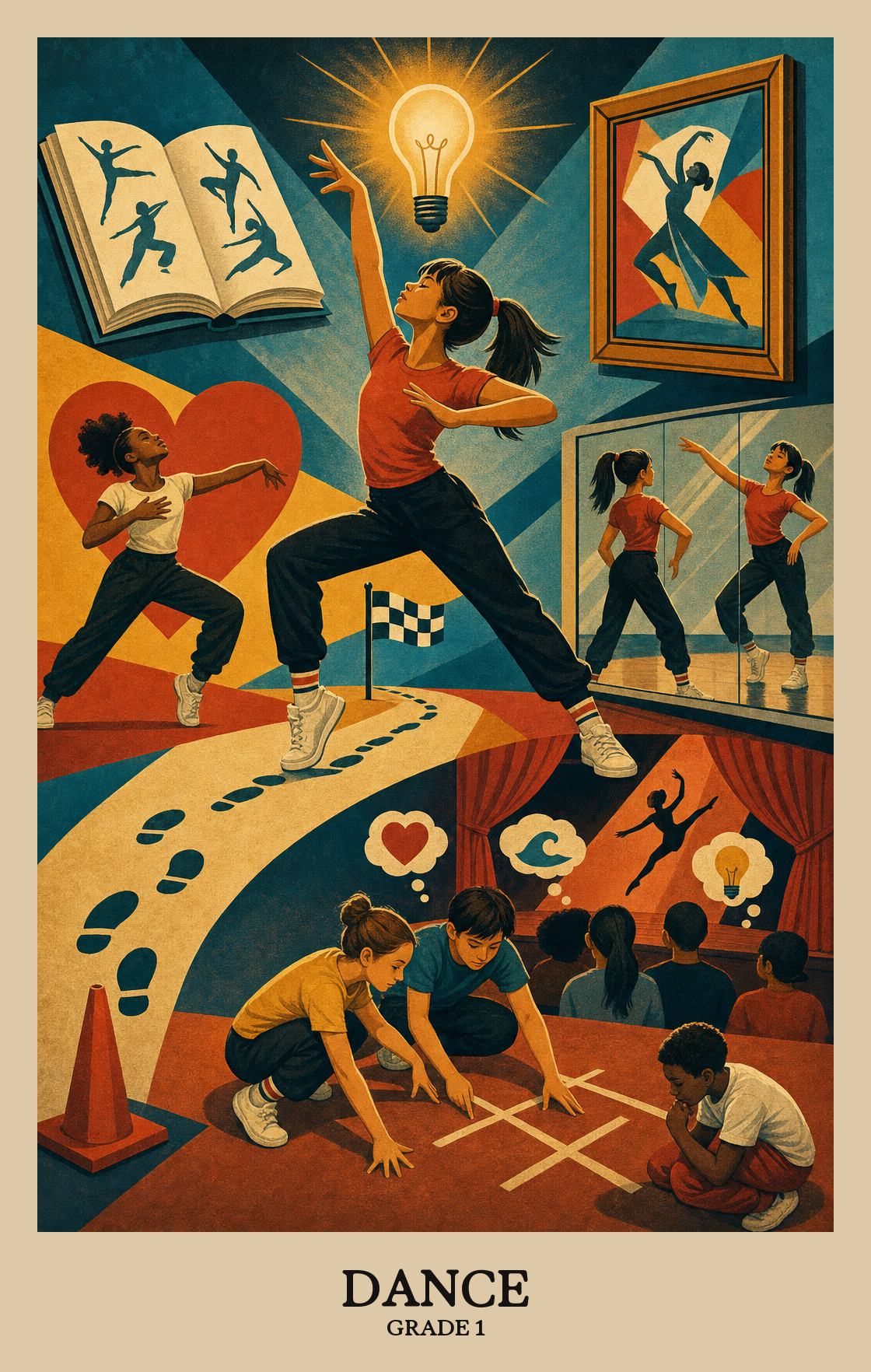
Students start the year learning the basic ways their body can move. They try out walking, jumping, twisting, and balancing, and notice how movement feels at different speeds and levels.
Students begin to invent their own movement ideas. They pick a feeling, a story, or a picture and turn it into a few movements they can repeat and share with a partner.
Students work on doing their dances the same way each time. They practice starting and ending clearly, staying with the music, and giving each other simple, kind feedback to make a dance better.
Students perform short dances for classmates and talk about what they saw. They notice what a dance might mean, connect it to things from home or stories they know, and say what made a dance work.
Students connect something from their own life to a dance they make or watch, explaining how the two relate.
Students look at a dance and talk about where it comes from, who made it, and why. That connection helps the dance mean more than just the steps.
| Standard | Definition | Code |
|---|---|---|
| Synthesize and relate knowledge and personal experiences to make art | Students connect something from their own life to a dance they make or watch, explaining how the two relate. | DA:Cn10.1 |
| Relate artistic ideas and works with societal, cultural | Students look at a dance and talk about where it comes from, who made it, and why. That connection helps the dance mean more than just the steps. | DA:Cn11.1 |
Students come up with their own movement ideas, exploring ways the body can travel, pause, or change shape to start building a short dance.
Students put together a short dance by choosing movements that go well together and deciding what order they happen in.
Students pick their best moves from practice, make small fixes, and put together a finished dance to share.
| Standard | Definition | Code |
|---|---|---|
| Generate and conceptualize artistic ideas and work | Students come up with their own movement ideas, exploring ways the body can travel, pause, or change shape to start building a short dance. | DA:Cr1.1 |
| Organize and develop artistic ideas and work | Students put together a short dance by choosing movements that go well together and deciding what order they happen in. | DA:Cr2.1 |
| Refine and complete artistic work | Students pick their best moves from practice, make small fixes, and put together a finished dance to share. | DA:Cr3.1 |
Students choose which dances or movements to perform and think about why those choices work. They learn that picking what to share is part of being a performer.
Students practice a dance move again and again until it looks the way they want it to. They learn how to use their body with more control before performing for others.
Students perform a dance for others and think about what feeling or idea the movement shares with the audience.
| Standard | Definition | Code |
|---|---|---|
| Analyze, interpret, and select artistic work for presentation | Students choose which dances or movements to perform and think about why those choices work. They learn that picking what to share is part of being a performer. | DA:Pr4.1 |
| Develop and refine artistic techniques and work for presentation | Students practice a dance move again and again until it looks the way they want it to. They learn how to use their body with more control before performing for others. | DA:Pr5.1 |
| Convey meaning through the presentation of artistic work | Students perform a dance for others and think about what feeling or idea the movement shares with the audience. | DA:Pr6.1 |
Students look at a dance and describe what they notice, like how the dancer moves fast or slow, uses big or small gestures, or changes direction. They start to ask why a dancer might have made those choices.
Students look at a dance and say what they think the dancer is feeling or trying to show. They explain what moves or moments made them think that.
Students look at a dance and say what makes it work well or what could be stronger, using simple criteria like clear shapes, steady beat, or energy.
| Standard | Definition | Code |
|---|---|---|
| Perceive and analyze artistic work | Students look at a dance and describe what they notice, like how the dancer moves fast or slow, uses big or small gestures, or changes direction. They start to ask why a dancer might have made those choices. | DA:Re7.1 |
| Interpret intent and meaning in artistic work | Students look at a dance and say what they think the dancer is feeling or trying to show. They explain what moves or moments made them think that. | DA:Re8.1 |
| Apply criteria to evaluate artistic work | Students look at a dance and say what makes it work well or what could be stronger, using simple criteria like clear shapes, steady beat, or energy. | DA:Re9.1 |
Students explore how their bodies can move through space using different shapes, speeds, and levels. They make up short movement ideas, practice them, and share them with classmates. A lot of the year is about noticing what their bodies can do and putting movements together on purpose.
Put on a song and move together for a few minutes. Try copying each other, freezing on the beat, or pretending to be animals or weather. Shy students often loosen up when a grown-up is moving too and no one is watching.
No. First grade dance is about exploring movement, not learning steps from a studio. Walking, skipping, tiptoeing, and making shapes with the body are exactly the skills students practice.
Start with body awareness and basic movement words like high, low, fast, and slow. Move into making short movement phrases, then shaping and refining them. Save sharing and responding to others' work for once students feel safe moving in front of peers.
Refining a movement phrase is the hardest part. Students often make something up once and want to stop there. Plan time to revisit the same short phrase across several lessons so students learn that dance gets better with practice.
Ask what a movement reminds them of, like wind, a story character, or a feeling. Talk about dances from family celebrations or videos you watch together. These small conversations build the connection between movement and meaning.
Students can invent a short movement phrase, practice it, and perform it for others. They can describe what they see in a classmate's dance using simple words and say what a movement might mean. They can also talk about dances from different places and times.