Imagining characters and stories
Students start the year by inventing characters, settings, and short story ideas. They draw on favorite books and their own lives to come up with people to play and places to pretend.
This is the year pretend play turns into shared storytelling on purpose. Students invent characters, make up short scenes with a partner, and practice using their voice and body to show how someone feels. They also watch classmates perform and talk about what they noticed. By spring, they can act out a simple story with a clear beginning, middle, and end in front of the class.
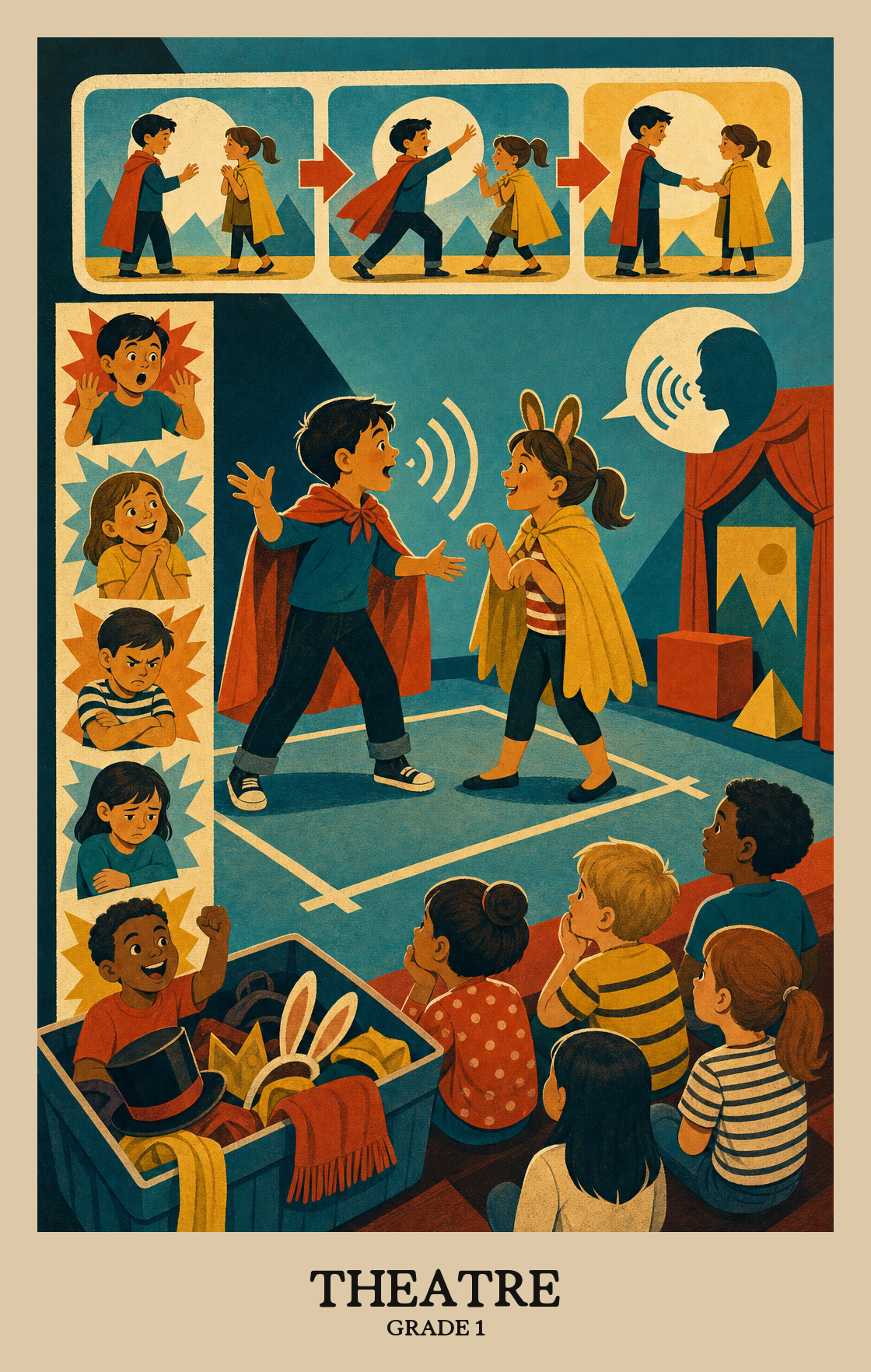
Students start the year by inventing characters, settings, and short story ideas. They draw on favorite books and their own lives to come up with people to play and places to pretend.
Students take their ideas and turn them into short scenes with a partner or small group. They practice agreeing on what happens, who plays which part, and how the scene ends.
Students try out different voices, faces, and movements to bring a character to life. They practice the same scene a few times and pick the version that feels clearest for an audience.
Students perform short scenes for classmates and talk about what the story means. They learn to focus on stage, speak up, and stay in character from start to finish.
Students watch classmates and other performances and share what they noticed. They learn to say what worked, ask questions about a character, and connect a story to their own world.
Students connect something from their own life to a character or story in a play. A memory, a feeling, or a person they know can shape the choices they make when acting or creating theatre.
Students connect a play or performance to the world around it, asking questions like where this story comes from or why people told it. That curiosity helps the work mean more.
| Standard | Definition | Code |
|---|---|---|
| Synthesize and relate knowledge and personal experiences to make art | Students connect something from their own life to a character or story in a play. A memory, a feeling, or a person they know can shape the choices they make when acting or creating theatre. | TH:Cn10.1 |
| Relate artistic ideas and works with societal, cultural | Students connect a play or performance to the world around it, asking questions like where this story comes from or why people told it. That curiosity helps the work mean more. | TH:Cn11.1 |
Students come up with ideas for a character or a short scene, then decide what that character wants and how they move or speak.
Students take a story idea and shape it into a short scene, deciding who the characters are, what they want, and what happens next.
Students revisit a short scene or character choice and make at least one change to improve it before sharing it with others.
| Standard | Definition | Code |
|---|---|---|
| Generate and conceptualize artistic ideas and work | Students come up with ideas for a character or a short scene, then decide what that character wants and how they move or speak. | TH:Cr1.1 |
| Organize and develop artistic ideas and work | Students take a story idea and shape it into a short scene, deciding who the characters are, what they want, and what happens next. | TH:Cr2.1 |
| Refine and complete artistic work | Students revisit a short scene or character choice and make at least one change to improve it before sharing it with others. | TH:Cr3.1 |
Students choose a character or short scene to perform and practice showing that character's feelings through their voice and body.
Students practice their lines, movement, and voice so a performance gets better each time they rehearse it.
Students perform a short scene or story in front of others and make choices, like how to move or speak, to show what the piece is about.
| Standard | Definition | Code |
|---|---|---|
| Analyze, interpret, and select artistic work for presentation | Students choose a character or short scene to perform and practice showing that character's feelings through their voice and body. | TH:Pr4.1 |
| Develop and refine artistic techniques and work for presentation | Students practice their lines, movement, and voice so a performance gets better each time they rehearse it. | TH:Pr5.1 |
| Convey meaning through the presentation of artistic work | Students perform a short scene or story in front of others and make choices, like how to move or speak, to show what the piece is about. | TH:Pr6.1 |
Students look at a short performance or scene and describe what they noticed, such as what a character did or how the story felt.
Students look at a scene or puppet show and say what they think the performer was trying to show. They explain why a character seemed happy, scared, or excited based on what they saw and heard.
Students look at a scene or performance and say what worked and why, using simple reasons like "the actor spoke loudly enough to hear" or "the story made sense."
| Standard | Definition | Code |
|---|---|---|
| Perceive and analyze artistic work | Students look at a short performance or scene and describe what they noticed, such as what a character did or how the story felt. | TH:Re7.1 |
| Interpret intent and meaning in artistic work | Students look at a scene or puppet show and say what they think the performer was trying to show. They explain why a character seemed happy, scared, or excited based on what they saw and heard. | TH:Re8.1 |
| Apply criteria to evaluate artistic work | Students look at a scene or performance and say what worked and why, using simple reasons like "the actor spoke loudly enough to hear" or "the story made sense." | TH:Re9.1 |
Students play characters, act out short stories, and make up scenes with classmates. A lot of the work happens through pretend play, simple props, and acting out feelings. The focus is on imagination and working together, not memorizing lines for a big show.
Act out a favorite picture book together. Take turns playing different characters and try out funny voices, big movements, or different feelings. Even five minutes of pretend play after reading builds the same skills students use in class.
No. Theatre at this age is about trying things out, not performing perfectly. Quiet students can join through movement, drawing scenes, or working in a small group before sharing with the class.
Students should be able to invent a character, act out a short scene with a beginning and end, and share what a scene was about after watching it. They should also be able to say one thing they liked and one thing they would change.
Start with imagination games and character work, then move into short scenes built from familiar stories. Save original student-made scenes and simple sharing for the back half of the year, once students are comfortable working in pairs and small groups.
Staying in character and listening to a scene partner are the hardest parts at this age. Build in short, repeated practice with freeze games, mirror games, and call-and-response warmups before asking for longer scenes.
Acting out a story helps students understand characters, settings, and what happens first, next, and last. Parents can lean into this by asking what a character wanted or how a character felt during a bedtime story.
Use a simple two-part response: name one thing the scene showed clearly, then ask one question about a choice the actors made. Model this early so students copy the pattern when responding to classmates.