Building characters and ideas
Students start the year by inventing characters and story ideas from their own lives and imagination. They try out voices, movements, and quick scenes to see what feels true on stage.
This is the year theatre shifts from playing a role to shaping it on purpose. Students build characters by pulling from their own lives and from the time and place a play comes from. They rehearse with intention, take notes from others, and explain the choices behind a scene. By spring, they can perform a short scene and talk about why a character speaks and moves the way they do.
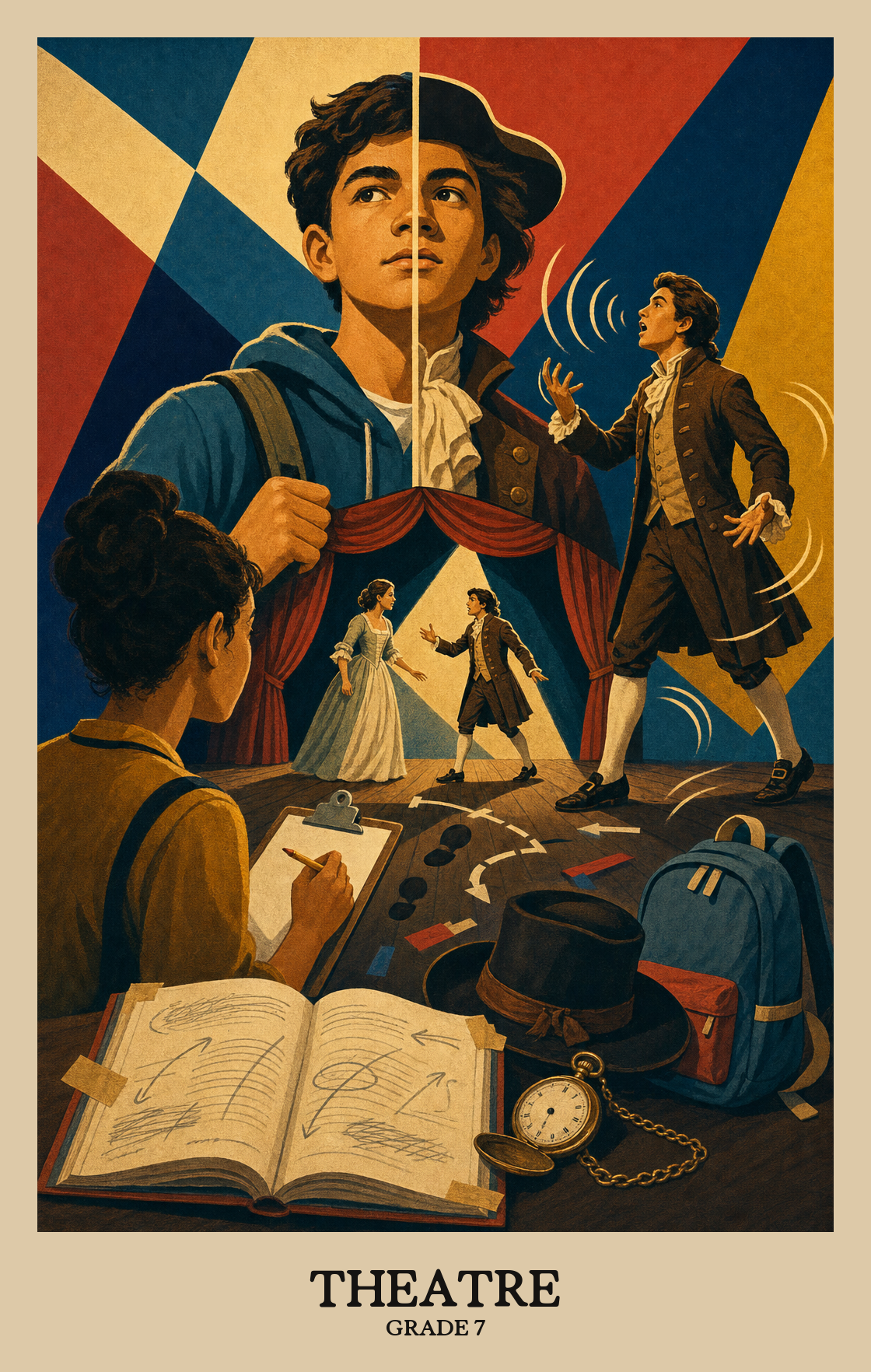
Students start the year by inventing characters and story ideas from their own lives and imagination. They try out voices, movements, and quick scenes to see what feels true on stage.
Students work in small groups to turn rough ideas into scenes with a clear beginning, middle, and end. They take notes from classmates and rewrite parts that do not land.
Students pick scenes or monologues to perform and practice the craft of acting. They work on voice, body, and timing so an audience can follow the story and feel what the character feels.
Students connect what they perform to real life and history. They look at where a play came from, what it was trying to say, and how its meaning changes for an audience today.
Students watch performances by classmates and professionals and talk about what worked. They use clear reasons, not just opinions, to explain what a play meant and how well it was made.
Students connect something from their own life to a scene, character, or story they're building in class. Personal experience shapes the choices they make in their work.
Students look at a play or scene and connect it to the time period, culture, or real-world events that shaped it. That context helps them understand why the story was told and what it meant to its audience.
| Standard | Definition | Code |
|---|---|---|
| Synthesize and relate knowledge and personal experiences to make art | Students connect something from their own life to a scene, character, or story they're building in class. Personal experience shapes the choices they make in their work. | TH:Cn10.7 |
| Relate artistic ideas and works with societal, cultural | Students look at a play or scene and connect it to the time period, culture, or real-world events that shaped it. That context helps them understand why the story was told and what it meant to its audience. | TH:Cn11.7 |
Students brainstorm and develop original ideas for a scene or performance, turning a spark of inspiration into a concrete plan for what the story, characters, and action will look like on stage.
Students take a rough theatre idea and shape it into something stageable, making choices about character, dialogue, and staging that move the work forward.
Students revisit a scene or script they've drafted, making specific changes to dialogue, movement, or character choices until the piece is ready to perform or share.
| Standard | Definition | Code |
|---|---|---|
| Generate and conceptualize artistic ideas and work | Students brainstorm and develop original ideas for a scene or performance, turning a spark of inspiration into a concrete plan for what the story, characters, and action will look like on stage. | TH:Cr1.7 |
| Organize and develop artistic ideas and work | Students take a rough theatre idea and shape it into something stageable, making choices about character, dialogue, and staging that move the work forward. | TH:Cr2.7 |
| Refine and complete artistic work | Students revisit a scene or script they've drafted, making specific changes to dialogue, movement, or character choices until the piece is ready to perform or share. | TH:Cr3.7 |
Students choose a scene or script to perform and explain why it suits the story they want to tell. The decision involves looking closely at the material and making a case for it.
Students rehearse and improve their performance before showing it to an audience. That means sharpening voice, movement, and timing until the scene is ready to present.
Students perform a scene or monologue and make deliberate choices, like tone, movement, and timing, so the audience understands what the moment means.
| Standard | Definition | Code |
|---|---|---|
| Analyze, interpret, and select artistic work for presentation | Students choose a scene or script to perform and explain why it suits the story they want to tell. The decision involves looking closely at the material and making a case for it. | TH:Pr4.7 |
| Develop and refine artistic techniques and work for presentation | Students rehearse and improve their performance before showing it to an audience. That means sharpening voice, movement, and timing until the scene is ready to present. | TH:Pr5.7 |
| Convey meaning through the presentation of artistic work | Students perform a scene or monologue and make deliberate choices, like tone, movement, and timing, so the audience understands what the moment means. | TH:Pr6.7 |
Students watch a scene or performance and explain what choices the playwright or actor made, and why those choices matter to the story.
Students read a scene or performance and explain what choices the playwright or actor made on purpose. They back up their thinking with specific details from the work itself.
Students judge a scene or performance using specific criteria, like whether the acting felt believable or the story came through clearly. They explain why a choice works or falls flat, using evidence from what they watched.
| Standard | Definition | Code |
|---|---|---|
| Perceive and analyze artistic work | Students watch a scene or performance and explain what choices the playwright or actor made, and why those choices matter to the story. | TH:Re7.7 |
| Interpret intent and meaning in artistic work | Students read a scene or performance and explain what choices the playwright or actor made on purpose. They back up their thinking with specific details from the work itself. | TH:Re8.7 |
| Apply criteria to evaluate artistic work | Students judge a scene or performance using specific criteria, like whether the acting felt believable or the story came through clearly. They explain why a choice works or falls flat, using evidence from what they watched. | TH:Re9.7 |
Students build short scenes, take on characters, and put work in front of an audience. They also watch plays and films and talk about what worked and why. Expect a mix of acting, writing, designing, and reflecting in writing or discussion.
Read a short scene out loud together and trade parts. Ask what the character wants in the scene and how their voice or face would show it. Five minutes of low-stakes practice at the kitchen table builds the comfort needed for class.
Start with short response work using video clips and live scenes so students build a shared vocabulary. Move into devising and scene work in the middle of the year. Save longer rehearsed pieces and self-evaluation against criteria for the final stretch.
Memorizing is a small part of it. Most of the work is making choices about a character, shaping a scene with others, and revising after feedback. Ask what choice they made in their last scene and why.
Specific character choices and giving feedback that goes past liked or disliked. Students often play attitude instead of action, and their critiques stay vague. Plan to revisit objective and obstacle, and model what a useful peer comment sounds like.
After watching a show or reading a scene, ask when and where it takes place and what was happening in the world then. Then ask what feels similar today. Two questions over dinner is enough to push the thinking class is asking for.
Students can take an idea from brainstorm to a polished short performance, make defensible choices about character and staging, and use set criteria to evaluate their own and others' work. They can also explain how a piece reflects a time, place, or community.
No. A short scene from a library book, a poem, or even a picture book works. A scarf, a hat, and a chair are plenty for trying out a character. Class supplies whatever scripts and materials are needed.
Build a short rubric tied to the standards students are working on, such as specific character choices, clear storytelling, and use of voice and body. Share it before the performance and have students self-score against it. Grading the process and the product keeps it fair.