Sketchbooks and starting ideas
Students start the year keeping a sketchbook of ideas they care about. They pull from things they have lived, seen, or read, and turn small thoughts into starting points for real artwork.
This is the year art shifts from making projects to making choices on purpose. Students plan their work with a clear idea in mind, then revise it instead of stopping at the first try. They look closely at art from different cultures and time periods and explain what an artist might have meant. By spring, they can pick a finished piece, prepare it for display, and talk about why they made the choices they did.
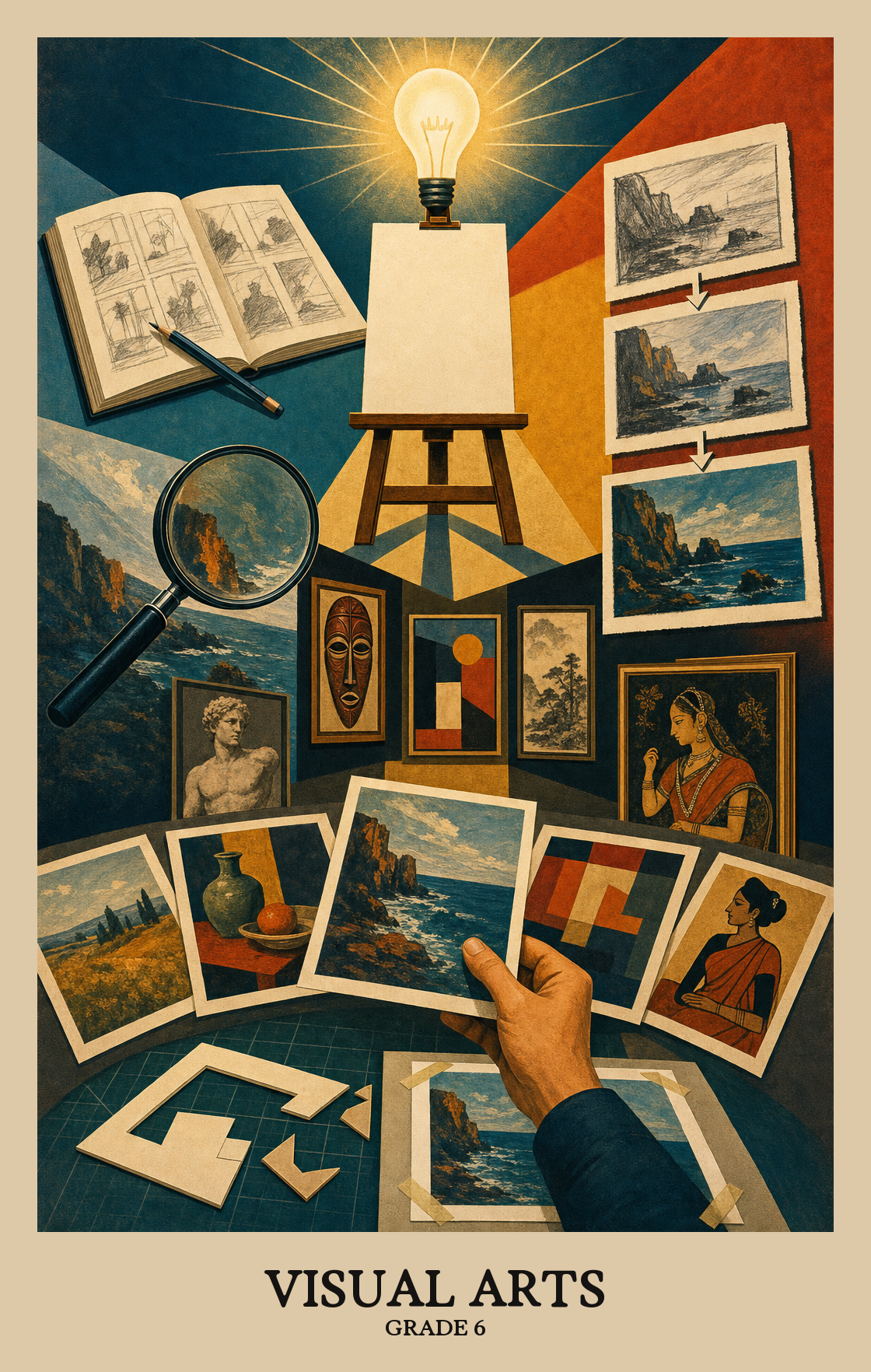
Students start the year keeping a sketchbook of ideas they care about. They pull from things they have lived, seen, or read, and turn small thoughts into starting points for real artwork.
Students practice the hands-on craft of making art. They try out drawing, painting, and other materials, learning how to handle tools well enough to put their own ideas on the page.
Students look at art from different times and places and notice how artists respond to the world around them. They begin connecting their own choices to traditions and ideas bigger than the classroom.
Students slow down and study artwork, including their classmates' pieces. They describe what they see, talk about what an artist might mean, and use shared criteria to judge what is working.
Students choose pieces worth sharing and get them ready for an audience. They revise, refine, and think about how the way a piece is displayed shapes what viewers take from it.
Students draw on things they already know and have lived through to make choices in their own artwork.
Students look at a piece of art and ask where it came from: what was happening in that place, that culture, or that moment in history. Understanding the context helps them make sense of what the artist was doing and why.
| Standard | Definition | Code |
|---|---|---|
| Synthesize and relate knowledge and personal experiences to make art | Students draw on things they already know and have lived through to make choices in their own artwork. | VA:Cn10.6 |
| Relate artistic ideas and works with societal, cultural | Students look at a piece of art and ask where it came from: what was happening in that place, that culture, or that moment in history. Understanding the context helps them make sense of what the artist was doing and why. | VA:Cn11.6 |
Students brainstorm ideas for an original artwork, then sketch or plan how to bring that idea to life before picking up a brush or tool.
Students take a rough idea and shape it into finished artwork by making deliberate choices about composition, materials, and technique.
Students review their own artwork, make deliberate changes, and bring a piece to a finished state. The focus is on the choices made between a first draft and a final work.
| Standard | Definition | Code |
|---|---|---|
| Generate and conceptualize artistic ideas and work | Students brainstorm ideas for an original artwork, then sketch or plan how to bring that idea to life before picking up a brush or tool. | VA:Cr1.6 |
| Organize and develop artistic ideas and work | Students take a rough idea and shape it into finished artwork by making deliberate choices about composition, materials, and technique. | VA:Cr2.6 |
| Refine and complete artistic work | Students review their own artwork, make deliberate changes, and bring a piece to a finished state. The focus is on the choices made between a first draft and a final work. | VA:Cr3.6 |
Students look at a collection of their own artwork and decide which pieces are strong enough to share with an audience, explaining why each chosen work belongs.
Students practice and improve a piece of visual art until it's ready to share with an audience. That means making deliberate choices about technique and finishing the work to a standard worth showing.
Students choose how to display or share their artwork so the idea or feeling behind it comes through to the viewer.
| Standard | Definition | Code |
|---|---|---|
| Analyze, interpret, and select artistic work for presentation | Students look at a collection of their own artwork and decide which pieces are strong enough to share with an audience, explaining why each chosen work belongs. | VA:Pr4.6 |
| Develop and refine artistic techniques and work for presentation | Students practice and improve a piece of visual art until it's ready to share with an audience. That means making deliberate choices about technique and finishing the work to a standard worth showing. | VA:Pr5.6 |
| Convey meaning through the presentation of artistic work | Students choose how to display or share their artwork so the idea or feeling behind it comes through to the viewer. | VA:Pr6.6 |
Students look closely at a piece of art and describe what they notice, then explain how the artist's choices, like color, shape, or composition, create meaning or mood.
Students look closely at a piece of art and explain what they think the artist meant, using details from the work itself to back up their thinking.
Students look at a piece of artwork and judge it using a set of criteria, explaining what works, what doesn't, and why. The focus is on reasoned judgment, not just personal taste.
| Standard | Definition | Code |
|---|---|---|
| Perceive and analyze artistic work | Students look closely at a piece of art and describe what they notice, then explain how the artist's choices, like color, shape, or composition, create meaning or mood. | VA:Re7.6 |
| Interpret intent and meaning in artistic work | Students look closely at a piece of art and explain what they think the artist meant, using details from the work itself to back up their thinking. | VA:Re8.6 |
| Apply criteria to evaluate artistic work | Students look at a piece of artwork and judge it using a set of criteria, explaining what works, what doesn't, and why. The focus is on reasoned judgment, not just personal taste. | VA:Re9.6 |
Students make their own artwork from start to finish, talk about what other artists are doing, and learn how to show their work to others. Expect sketchbooks, planning, drafts, and a final piece. They also learn to explain choices, not just hand in a drawing.
You do not need to know how to draw. Ask students to walk you through a piece in progress: what is it about, what changed since last time, what is next. Five minutes of real questions does more than a how-to video.
Treat art like writing. The first try is a draft, not a verdict. Keep cheap paper and pencils where students can grab them, and praise specific choices like a color or a shape rather than the whole picture.
No. A pencil, an eraser, plain paper, and a folder to keep work in are enough. A small set of colored pencils or markers is a bonus. Phone photos of finished pieces help students see their own progress over months.
Start with idea generation and sketchbook habits, then move into longer projects that go through planning, drafts, and refinement. Build in regular critique from the first month so students get used to talking about choices before stakes get higher.
Revision. Sixth graders tend to call a piece done the moment it looks like something. Plan extra time for a second pass: re-seeing the work, taking outside feedback, and changing one specific thing before calling it final.
Use a simple frame: describe what you see, then ask one question about a choice the artist made. Save evaluation for later in the year, once students trust the room. Model it with your own work first so they hear what useful feedback sounds like.
They can take an idea from sketch to finished piece, explain why they made specific choices, and use feedback to revise rather than start over. They can also talk about another artist's work with more than just like or dislike.