Listening with a musical ear
Students start the year listening closely to songs and short pieces. They notice the beat, the mood, and the instruments, and begin describing what they hear in plain words.
This is the year music shifts from simple imitation to making real choices. Students start crafting their own short musical ideas, then revise them based on what sounds right. They also learn to talk about why a piece of music works, using words like rhythm, tempo, and mood. By spring, they can perform a short piece for the class and explain the choices they made.
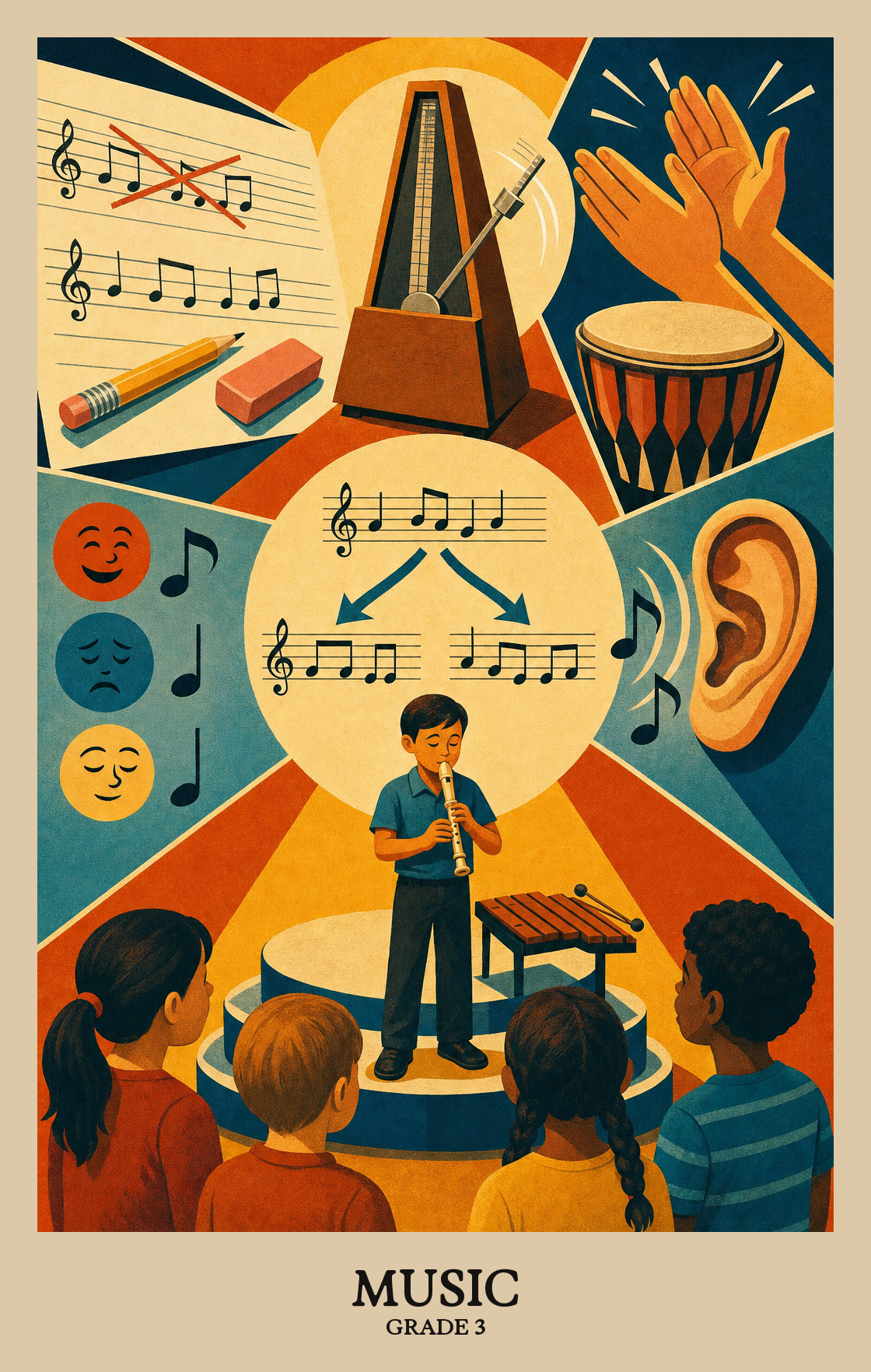
Students start the year listening closely to songs and short pieces. They notice the beat, the mood, and the instruments, and begin describing what they hear in plain words.
Students try out their own rhythms and short melodies using voice, classroom instruments, or simple notation. Expect humming around the house and tapping out patterns on the kitchen table.
Students pick music to work on and practice it carefully. They learn to fix rough spots, follow the conductor or a recording, and play or sing with steady timing.
Students connect songs to where they come from and what they are about. They share what a piece reminds them of and judge performances using clear reasons, not just whether they liked it.
Students connect what they already know and feel to the music they make or perform. Personal experiences shape creative choices in sound.
Students look at songs and music from different times and places to understand why people created them and what those songs meant to the communities they came from.
| Standard | Definition | Code |
|---|---|---|
| Synthesize and relate knowledge and personal experiences to make art | Students connect what they already know and feel to the music they make or perform. Personal experiences shape creative choices in sound. | MU:Cn10.3 |
| Relate artistic ideas and works with societal, cultural | Students look at songs and music from different times and places to understand why people created them and what those songs meant to the communities they came from. | MU:Cn11.3 |
Students brainstorm and sketch out musical ideas, such as a short melody or rhythm pattern, as a starting point for creating their own music.
Students take a musical idea (a short melody or rhythm pattern) and shape it into something more complete, arranging the pieces until the music holds together the way they want it to.
Students revise a piece of music they composed, making small changes to rhythm, melody, or dynamics until the piece feels finished and ready to share.
| Standard | Definition | Code |
|---|---|---|
| Generate and conceptualize artistic ideas and work | Students brainstorm and sketch out musical ideas, such as a short melody or rhythm pattern, as a starting point for creating their own music. | MU:Cr1.3 |
| Organize and develop artistic ideas and work | Students take a musical idea (a short melody or rhythm pattern) and shape it into something more complete, arranging the pieces until the music holds together the way they want it to. | MU:Cr2.3 |
| Refine and complete artistic work | Students revise a piece of music they composed, making small changes to rhythm, melody, or dynamics until the piece feels finished and ready to share. | MU:Cr3.3 |
Students choose a piece of music to perform and explain why it suits them. They think about what the music means and how they want to present it to an audience.
Students practice a song or piece of music until it sounds the way they want it to, fixing notes, rhythm, or dynamics along the way before performing it for others.
Students perform a song or piece of music with intention, making choices about how loud, soft, fast, or slow to play so the music communicates something to the audience.
| Standard | Definition | Code |
|---|---|---|
| Analyze, interpret, and select artistic work for presentation | Students choose a piece of music to perform and explain why it suits them. They think about what the music means and how they want to present it to an audience. | MU:Pr4.3 |
| Develop and refine artistic techniques and work for presentation | Students practice a song or piece of music until it sounds the way they want it to, fixing notes, rhythm, or dynamics along the way before performing it for others. | MU:Pr5.3 |
| Convey meaning through the presentation of artistic work | Students perform a song or piece of music with intention, making choices about how loud, soft, fast, or slow to play so the music communicates something to the audience. | MU:Pr6.3 |
Students listen to a short piece of music and describe what they notice, like changes in speed, volume, or mood. Then they explain what the composer might have done on purpose to create that effect.
Students listen to a piece of music and explain what feeling or idea they think it expresses, using details from the music to back up their thinking.
Students listen to a piece of music and explain, using specific reasons, why it works well or where it falls short.
| Standard | Definition | Code |
|---|---|---|
| Perceive and analyze artistic work | Students listen to a short piece of music and describe what they notice, like changes in speed, volume, or mood. Then they explain what the composer might have done on purpose to create that effect. | MU:Re7.3 |
| Interpret intent and meaning in artistic work | Students listen to a piece of music and explain what feeling or idea they think it expresses, using details from the music to back up their thinking. | MU:Re8.3 |
| Apply criteria to evaluate artistic work | Students listen to a piece of music and explain, using specific reasons, why it works well or where it falls short. | MU:Re9.3 |
Students sing, play simple instruments, and read basic rhythms and notes. They also make up short musical ideas of their own, perform them, and listen to music from different times and places to talk about what they hear.
Sing in the car, clap rhythms while cooking, or play music from different cultures at dinner. Ask what a song reminds them of or how it makes them feel. Five minutes of listening and talking goes a long way.
No. Lessons and instruments are not required. If there is a keyboard, recorder, or ukulele around, short bits of free play help. Otherwise, singing and clapping along to songs is plenty.
Start with steady beat, simple rhythms, and singing in tune. Move into reading basic notation, creating short patterns, and performing for the class. Save deeper listening and cultural connections for later units once students have shared musical vocabulary.
Students make up short rhythm patterns or melodies, write them down in simple ways, and revise them after feedback. The work is small on purpose, often four to eight beats, so students can finish a piece and perform it.
Keeping a steady beat under a changing rhythm, matching pitch while singing in a group, and reading rhythms with rests. Build these in short warm-ups across every class rather than one long unit.
They use words like fast, slow, loud, soft, high, and low to describe what they notice. They also start to say what a piece might mean or why a composer made certain choices. At home, ask what stood out in a song.
By spring, students should keep a steady beat, sing simple songs in tune with a group, read basic rhythm patterns, and perform a short piece they helped create. They should also share an opinion about a piece of music using musical words.
Musical skill grows with practice, like reading. Keep it low pressure. Sing together, tap rhythms, and praise effort over talent. Most students who feel stuck just need more time singing and listening without being judged.