Listening and noticing music
Students start the year by listening closely to songs and noticing what they hear. They talk about fast and slow, loud and soft, and what a piece of music reminds them of.
This is the year music shifts from playing along to making real choices. Students come up with their own short musical ideas, then practice and polish them before sharing with the class. They start to notice why a song sounds happy, calm, or marching, and connect songs to where they come from. By spring, students can perform a short piece they helped shape and say what they like or want to fix about it.
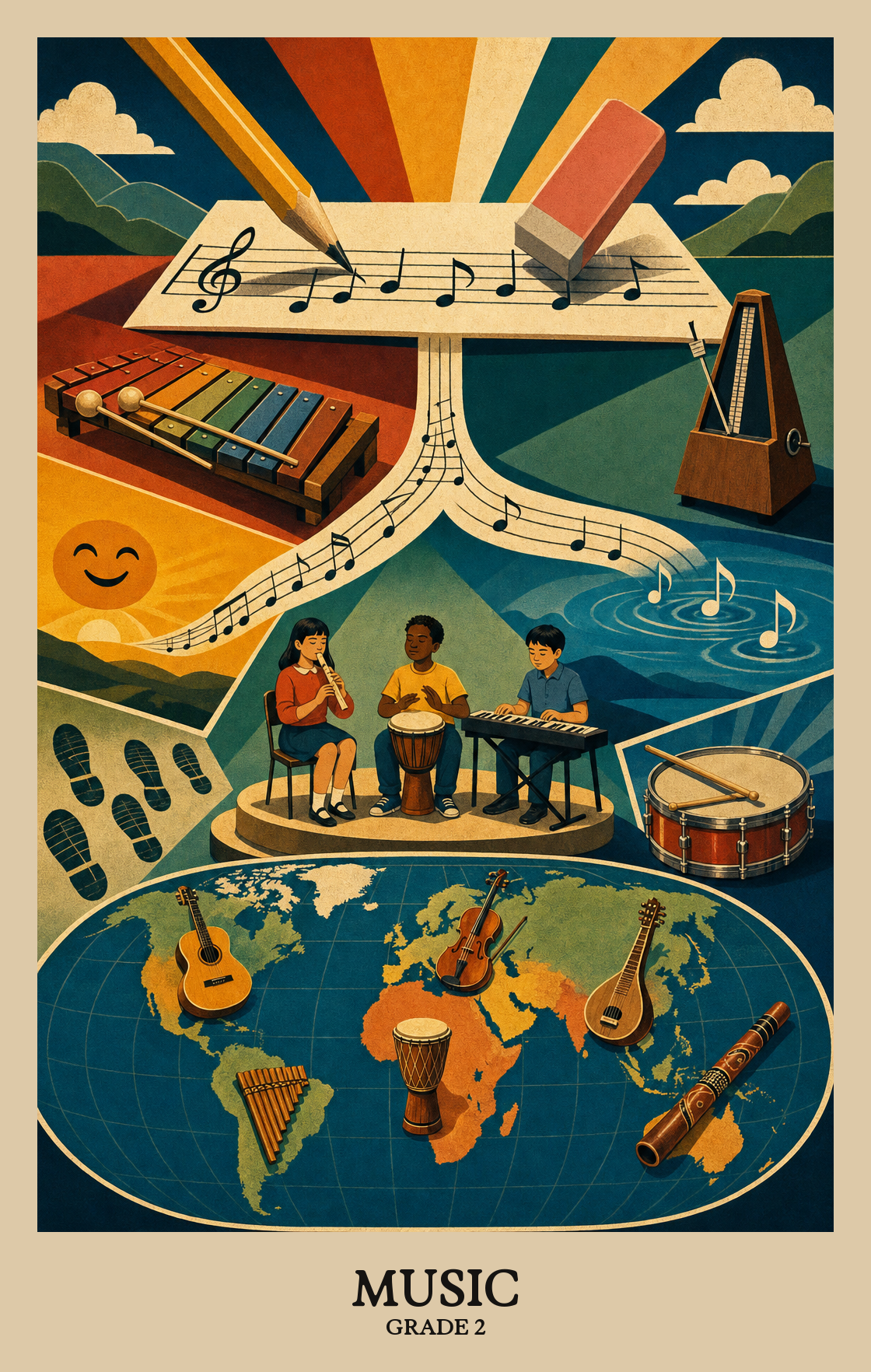
Students start the year by listening closely to songs and noticing what they hear. They talk about fast and slow, loud and soft, and what a piece of music reminds them of.
Students invent their own short rhythms and melodies using voices, body sounds, and simple classroom instruments. They try out ideas, pick the ones they like, and shape them into something they can play again.
Students rehearse songs and short pieces in a group. They work on singing in tune, keeping a steady beat, and choosing how a song should sound so it carries the feeling they want.
Students perform for classmates or family and reflect on how it went. They learn how music connects to holidays, family traditions, and other cultures, and they give kind, useful feedback to each other.
Students connect what they know from everyday life to the music they create and perform. A song might remind them of a place, a feeling, or something they have learned in another class.
Songs and music come from real places and times. Students learn how a piece of music connects to the culture or moment that created it.
| Standard | Definition | Code |
|---|---|---|
| Synthesize and relate knowledge and personal experiences to make art | Students connect what they know from everyday life to the music they create and perform. A song might remind them of a place, a feeling, or something they have learned in another class. | MU:Cn10.2 |
| Relate artistic ideas and works with societal, cultural | Songs and music come from real places and times. Students learn how a piece of music connects to the culture or moment that created it. | MU:Cn11.2 |
Students come up with their own musical ideas, like a short melody or rhythm pattern, and start turning those ideas into something they can sing or play.
Students take a musical idea (a simple melody or rhythm pattern) and shape it into a short piece they can perform or write down.
Students revisit a piece of music they started, fix parts that feel off, and practice until the song is ready to share.
| Standard | Definition | Code |
|---|---|---|
| Generate and conceptualize artistic ideas and work | Students come up with their own musical ideas, like a short melody or rhythm pattern, and start turning those ideas into something they can sing or play. | MU:Cr1.2 |
| Organize and develop artistic ideas and work | Students take a musical idea (a simple melody or rhythm pattern) and shape it into a short piece they can perform or write down. | MU:Cr2.2 |
| Refine and complete artistic work | Students revisit a piece of music they started, fix parts that feel off, and practice until the song is ready to share. | MU:Cr3.2 |
Students choose a piece of music to perform and think about how they want it to sound before they play or sing it.
Students practice a song or piece of music repeatedly, fixing mistakes and cleaning up rough spots before performing it for others.
Students perform a song or piece of music and make deliberate choices, like tempo or dynamics, to express a clear idea or feeling to the audience.
| Standard | Definition | Code |
|---|---|---|
| Analyze, interpret, and select artistic work for presentation | Students choose a piece of music to perform and think about how they want it to sound before they play or sing it. | MU:Pr4.2 |
| Develop and refine artistic techniques and work for presentation | Students practice a song or piece of music repeatedly, fixing mistakes and cleaning up rough spots before performing it for others. | MU:Pr5.2 |
| Convey meaning through the presentation of artistic work | Students perform a song or piece of music and make deliberate choices, like tempo or dynamics, to express a clear idea or feeling to the audience. | MU:Pr6.2 |
Students listen to a short piece of music and describe what they notice, like a melody that repeats or a section that gets louder. Then they explain what those choices do to the song.
Students listen to a piece of music and explain what they think it means or how it makes them feel, using what they hear in the melody or rhythm to back up their thinking.
Students listen to a piece of music and decide what makes it good or not so good, using simple reasons like whether the rhythm was steady or the melody was easy to follow.
| Standard | Definition | Code |
|---|---|---|
| Perceive and analyze artistic work | Students listen to a short piece of music and describe what they notice, like a melody that repeats or a section that gets louder. Then they explain what those choices do to the song. | MU:Re7.2 |
| Interpret intent and meaning in artistic work | Students listen to a piece of music and explain what they think it means or how it makes them feel, using what they hear in the melody or rhythm to back up their thinking. | MU:Re8.2 |
| Apply criteria to evaluate artistic work | Students listen to a piece of music and decide what makes it good or not so good, using simple reasons like whether the rhythm was steady or the melody was easy to follow. | MU:Re9.2 |
Students sing, play simple instruments, and move to the beat. They start making up short musical ideas of their own, like a four-beat rhythm or a little melody. They also begin to listen with a purpose and talk about what they hear in a song.
Play music from different styles in the car or kitchen and ask what students notice: fast or slow, happy or calm, loud or soft. Clap rhythms back and forth, sing along to favorite songs, and let students tap on pots or a keyboard. Five minutes a day adds up.
No. Students should be able to keep a steady beat, match simple pitches with their voice, and follow basic rhythm patterns by ear and eye. Reading full notation and playing a band instrument come later. Singing in tune and feeling the beat matter most right now.
Start with steady beat, singing voice, and echo patterns in the first weeks. Move into reading simple rhythms and high or low pitches by winter. Spend the second half of the year on creating short pieces, refining them, and performing for a small audience.
By spring, students can keep a steady beat, sing a familiar song in tune with a group, and read short rhythm patterns with quarter and eighth notes. They can also make up a short musical idea, perform it, and say one thing they would change next time.
Matching pitch and staying on beat during a group song are the two stickiest skills. Many students also struggle to keep a steady beat while singing different rhythms on top. Short, frequent practice with echo singing and body percussion helps more than long drills.
Use icons, body percussion, and classroom instruments so students can compose by ear. Give a clear frame, like a four-beat pattern using two sounds, then let students arrange and revise it. Record short attempts so students can listen back and decide what to keep.
Keep them small and frequent. A short song for another class, a hallway share, or a family sing-along gives students real practice presenting without the pressure of a big concert. Talk through what the song is about so students can perform with feeling, not just words.
Students should sing in tune with a group, keep a steady beat on an instrument, read simple quarter and eighth note rhythms, and create a short musical idea on their own. They should also be able to listen to a piece and describe one thing about it using music words like tempo or dynamics.