Finding ideas to draw and make
Students start the year by turning their own lives into art. They sketch from memory, talk about what they want to make, and try out ideas before settling on one.
This is the year art shifts from making marks to making choices on purpose. Students try out different materials and tools, then talk about why they picked one over another. When they look at a painting or sculpture, they share what they think it means and back it up with what they see. By spring, they can finish a piece, hang it for others, and explain the idea behind it.
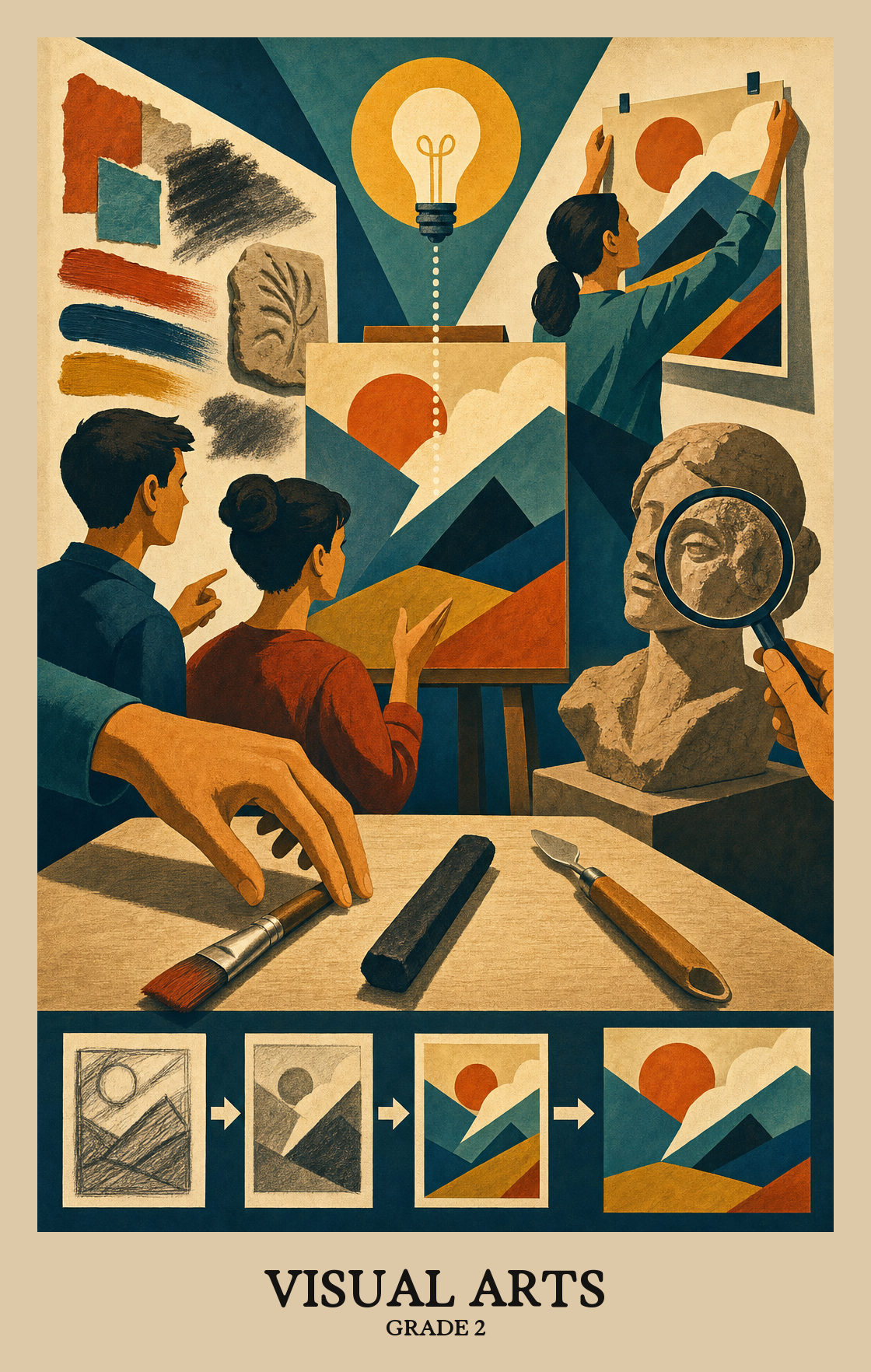
Students start the year by turning their own lives into art. They sketch from memory, talk about what they want to make, and try out ideas before settling on one.
Students practice with pencils, paint, scissors, and clay. They learn how to use each tool with more care and pick the right one for what they want to make.
Students slow down in front of paintings, sculptures, and crafts from different times and places. They notice what they see and talk about what the artist might be saying.
Students take a piece from rough draft to finished. They decide what to fix, choose a favorite to display, and explain to others what their art is about.
Students draw on things they already know and moments from their own life to make choices about what to create and how to create it.
Students look at artwork and talk about when, where, and why it was made. Connecting a painting or sculpture to its time and place helps them understand what the artist was trying to say.
| Standard | Definition | Code |
|---|---|---|
| Synthesize and relate knowledge and personal experiences to make art | Students draw on things they already know and moments from their own life to make choices about what to create and how to create it. | VA:Cn10.2 |
| Relate artistic ideas and works with societal, cultural | Students look at artwork and talk about when, where, and why it was made. Connecting a painting or sculpture to its time and place helps them understand what the artist was trying to say. | VA:Cn11.2 |
Students brainstorm ideas for artwork before picking up a brush or pencil. They think through what they want to make and why before starting.
Students arrange shapes, colors, and materials to build a picture or artwork that shows their idea clearly. They make choices about what to add, move, or change as they go.
Students look at their own artwork, decide what needs fixing or finishing, and make changes before calling it done.
| Standard | Definition | Code |
|---|---|---|
| Generate and conceptualize artistic ideas and work | Students brainstorm ideas for artwork before picking up a brush or pencil. They think through what they want to make and why before starting. | VA:Cr1.2 |
| Organize and develop artistic ideas and work | Students arrange shapes, colors, and materials to build a picture or artwork that shows their idea clearly. They make choices about what to add, move, or change as they go. | VA:Cr2.2 |
| Refine and complete artistic work | Students look at their own artwork, decide what needs fixing or finishing, and make changes before calling it done. | VA:Cr3.2 |
Students look at several pieces of their own artwork and choose one to share or display, thinking about why that piece is their best or most interesting work.
Students practice and improve a piece of artwork until it is ready to share with others.
Students choose how to display their artwork and explain what they want viewers to notice or feel. The way a piece is shown is part of its meaning.
| Standard | Definition | Code |
|---|---|---|
| Analyze, interpret, and select artistic work for presentation | Students look at several pieces of their own artwork and choose one to share or display, thinking about why that piece is their best or most interesting work. | VA:Pr4.2 |
| Develop and refine artistic techniques and work for presentation | Students practice and improve a piece of artwork until it is ready to share with others. | VA:Pr5.2 |
| Convey meaning through the presentation of artistic work | Students choose how to display their artwork and explain what they want viewers to notice or feel. The way a piece is shown is part of its meaning. | VA:Pr6.2 |
Students look closely at a piece of artwork and describe what they notice, like shapes, colors, or lines, then talk about what the artist might have been trying to do.
Students look at a piece of art and explain what they think the artist was trying to say or show. They use details they see in the work to back up their thinking.
Students look at a piece of art and decide what makes it good or not so good, using a simple set of questions or rules to explain their thinking.
| Standard | Definition | Code |
|---|---|---|
| Perceive and analyze artistic work | Students look closely at a piece of artwork and describe what they notice, like shapes, colors, or lines, then talk about what the artist might have been trying to do. | VA:Re7.2 |
| Interpret intent and meaning in artistic work | Students look at a piece of art and explain what they think the artist was trying to say or show. They use details they see in the work to back up their thinking. | VA:Re8.2 |
| Apply criteria to evaluate artistic work | Students look at a piece of art and decide what makes it good or not so good, using a simple set of questions or rules to explain their thinking. | VA:Re9.2 |
Students make art that comes from their own ideas and experiences. They try out drawing, painting, sculpture, and collage, and learn to talk about what they see in their own work and the work of others. They also start thinking about why artists make the choices they make.
Keep simple supplies within reach: paper, crayons, markers, scissors, and glue. Ask what the picture is about and what part was tricky to make. Looking at art together, in books or on a museum website, also counts and only takes a few minutes.
Focus on the choices, not the finished look. Ask why they picked that color, or what they want someone to notice first. Praise the thinking and the second try, since artists redo parts all the time at this age.
Start with idea generation and basic tool habits, then move into projects that ask for planning before making. Mid-year is a good time to introduce revision, where students rework a piece instead of starting over. End the year with presentation choices and reflection on a body of work.
Two things tend to lag: planning before making, and talking about art using specifics instead of just liking or disliking it. Short warm-ups where students sketch a plan, or describe one small part of an artwork, build both habits over time.
Not in a formal way. Students look at art from different cultures and times and connect it to things they know, like family stories, holidays, or places they have been. A trip to a museum or a few minutes with an art book at home supports this well.
Students should move past good or bad and point to what they see: the colors, the shapes, the mood, what the artist might be showing. Sentence stems like I notice, I wonder, and I think the artist wanted help students give reasons for their opinions.
By spring, students can come up with an idea, plan it, make changes as they go, and explain what their finished piece is about. They can also share an opinion about another artwork and back it up with something they actually see in the piece.