Place value and rounding
Students start the year with bigger numbers. They round to the nearest ten or hundred, and add and subtract within 1,000 using strategies that make sense to them.
This is the year math grows past adding and subtracting into multiplying and dividing. Students learn their times tables, use them to solve word problems, and start seeing fractions as real numbers on a ruler or number line. They also measure area by counting squares inside a rectangle. By spring, students can recall multiplication facts up to ten quickly and explain why one half equals two fourths.
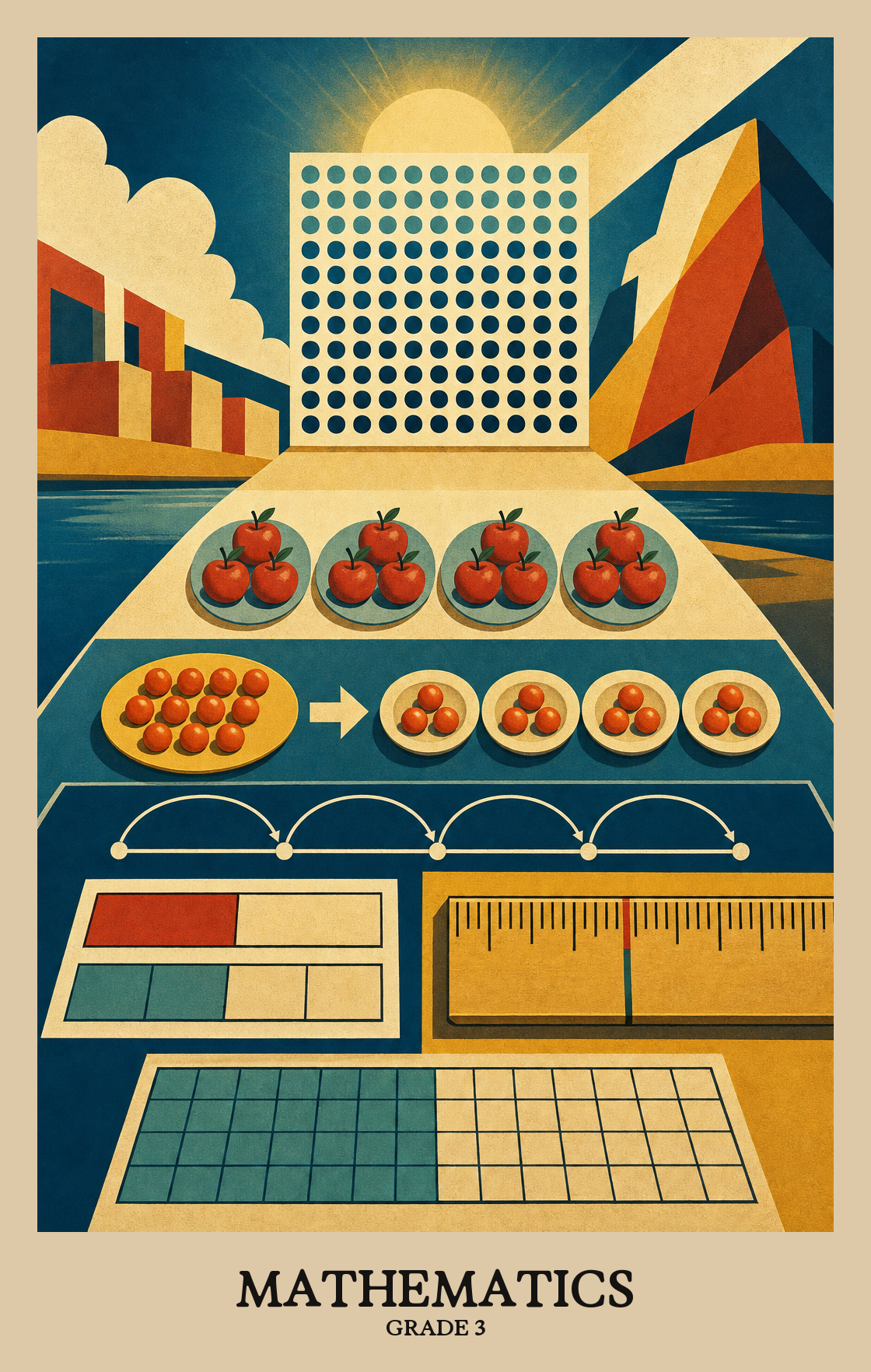
Students start the year with bigger numbers. They round to the nearest ten or hundred, and add and subtract within 1,000 using strategies that make sense to them.
Students learn what multiplication and division actually mean. They picture equal groups and rows, and solve word problems by drawing pictures or writing equations.
Students get faster and more flexible with their times tables. They notice patterns in the multiplication chart and use shortcuts like doubling to figure out harder facts.
Fractions become real numbers, not just pieces of a pizza. Students place fractions on a number line, find ones that are equal, and compare which is bigger.
Students tell time to the minute and figure out how long things take. They measure with rulers down to the quarter inch, weigh and pour everyday objects, and read bar graphs.
Students sort shapes by their sides and corners, then find how much space a rectangle covers by counting squares or multiplying. They also measure the distance around a shape.
Multiplication means putting equal groups together. Students learn that 5 x 7 means 5 groups with 7 objects in each group, not just a fact to memorize.
Division means splitting a total into equal groups. Students figure out either how many go in each group or how many groups there are, using the same equation two ways.
Students solve word problems by multiplying or dividing numbers up to 100. They work with equal groups, rows of objects, and measurements, and draw pictures or write equations to find a missing number.
Students find the missing number in a multiplication or division problem, such as 3 x ? = 12 or 12 / 3 = ?, by thinking about how those two operations work together.
Knowing that 6x4 gives the same answer as 4x6, or that 3x5x2 can be solved in any order, helps students multiply and divide without memorizing every fact from scratch.
Division is the flip side of multiplication. Students solve a division problem by asking "what number times this gives me that?" rather than memorizing a separate set of rules.
Students practice multiplication and division facts up to 10 x 10 until the answers come quickly and reliably. They use shortcuts like doubling or working backward from a known fact instead of counting on their fingers.
Students solve two-step story problems by adding, subtracting, multiplying, or dividing, then check whether the answer makes sense by rounding or estimating in their head.
Students spot patterns in addition and multiplication charts, such as why all multiples of 2 end in an even number, and explain why those patterns work.
| Standard | Definition | Code |
|---|---|---|
| Interpret products of whole numbers | Multiplication means putting equal groups together. Students learn that 5 x 7 means 5 groups with 7 objects in each group, not just a fact to memorize. | 3.OA.1 |
| Interpret whole-number quotients of whole numbers | Division means splitting a total into equal groups. Students figure out either how many go in each group or how many groups there are, using the same equation two ways. | 3.OA.2 |
| Use multiplication and division within 100 to solve word problems in situations… | Students solve word problems by multiplying or dividing numbers up to 100. They work with equal groups, rows of objects, and measurements, and draw pictures or write equations to find a missing number. | 3.OA.3 |
| Determine the unknown whole number in a multiplication or division equation by… | Students find the missing number in a multiplication or division problem, such as 3 x ? = 12 or 12 / 3 = ?, by thinking about how those two operations work together. | 3.OA.4 |
| Apply properties of operations as strategies to multiply and divide | Knowing that 6x4 gives the same answer as 4x6, or that 3x5x2 can be solved in any order, helps students multiply and divide without memorizing every fact from scratch. | 3.OA.5 |
| Understand division as an unknown-factor problem | Division is the flip side of multiplication. Students solve a division problem by asking "what number times this gives me that?" rather than memorizing a separate set of rules. | 3.OA.6 |
| Fluently (efficiently, accurately | Students practice multiplication and division facts up to 10 x 10 until the answers come quickly and reliably. They use shortcuts like doubling or working backward from a known fact instead of counting on their fingers. | 3.OA.7 |
| Solve two-step word problems using any of the four operations | Students solve two-step story problems by adding, subtracting, multiplying, or dividing, then check whether the answer makes sense by rounding or estimating in their head. | 3.OA.8 |
| Identify arithmetic patterns | Students spot patterns in addition and multiplication charts, such as why all multiples of 2 end in an even number, and explain why those patterns work. | 3.OA.9 |
Students round a number to the nearest ten or hundred, deciding whether 47 is closer to 40 or 50, and whether 347 is closer to 300 or 400. Place value is the tool.
Students add and subtract numbers up to 1,000 quickly and accurately. They use more than one method, like breaking numbers into hundreds, tens, and ones, or adjusting to a round number to make the math easier.
Students multiply a single number by a round multiple like 30, 60, or 80. They use what they know about tens to find the answer, so 4 x 70 becomes four groups of seven tens.
| Standard | Definition | Code |
|---|---|---|
| Use place value understanding to round whole numbers to the nearest 10 or 100 | Students round a number to the nearest ten or hundred, deciding whether 47 is closer to 40 or 50, and whether 347 is closer to 300 or 400. Place value is the tool. | 3.NBT.1 |
| Fluently (efficiently, accurately, & flexibly) add and subtract within 1000… | Students add and subtract numbers up to 1,000 quickly and accurately. They use more than one method, like breaking numbers into hundreds, tens, and ones, or adjusting to a round number to make the math easier. | 3.NBT.2 |
| Multiply one-digit whole numbers by multiples of 10 in the range 10 to 90 | Students multiply a single number by a round multiple like 30, 60, or 80. They use what they know about tens to find the answer, so 4 x 70 becomes four groups of seven tens. | 3.NBT.3 |
Students draw picture graphs and bar graphs to organize information into categories, then use those graphs to answer questions like "how many more" or "how many fewer." Each symbol or bar stands for more than one item, so students have to multiply or skip-count to read the data.
Students measure objects to the nearest half or quarter inch, then plot each measurement on a number line to show how the results are spread out.
Students read a clock to the nearest minute, label times as a.m. or p.m., and figure out how many minutes pass between two events. They solve problems by adding or subtracting those minutes, sometimes by plotting the times on a number line.
Students weigh objects and measure liquids using grams, kilograms, and liters. They also practice estimating, so they can judge whether a water bottle holds about one liter or whether an apple weighs closer to 100 grams.
Students solve word problems about how much something weighs or how much liquid fits in a container. They use addition, subtraction, multiplication, or division, and may sketch a simple diagram to work it out.
| Standard | Definition | Code |
|---|---|---|
| Draw a scaled picture graph and a scaled bar graph to represent a data set with… | Students draw picture graphs and bar graphs to organize information into categories, then use those graphs to answer questions like "how many more" or "how many fewer." Each symbol or bar stands for more than one item, so students have to multiply or skip-count to read the data. | 3.MD.4 |
| Generate measurement data by measuring lengths using rulers marked with halves… | Students measure objects to the nearest half or quarter inch, then plot each measurement on a number line to show how the results are spread out. | 3.MD.5 |
| Tell and write time to the nearest minute using a.m | Students read a clock to the nearest minute, label times as a.m. or p.m., and figure out how many minutes pass between two events. They solve problems by adding or subtracting those minutes, sometimes by plotting the times on a number line. | 3.MD.1 |
| Measure and estimate liquid volumes and masses of objects using standard units… | Students weigh objects and measure liquids using grams, kilograms, and liters. They also practice estimating, so they can judge whether a water bottle holds about one liter or whether an apple weighs closer to 100 grams. | 3.MD.2 |
| Add, subtract, multiply | Students solve word problems about how much something weighs or how much liquid fits in a container. They use addition, subtraction, multiplication, or division, and may sketch a simple diagram to work it out. | 3.MD.3 |
Shapes like squares and rectangles all have four sides, which puts them in the same family called quadrilaterals. Students sort shapes into that family, spot what they share, and draw four-sided shapes that don't fit the familiar types.
Students cut shapes like squares or circles into equal pieces and name each piece as a fraction of the whole, such as one-fourth when a square is split into four equal parts.
Students count the square units that fit inside a flat shape to measure how much surface it covers. This is called area.
A unit square is a square where each side is 1 unit long, and it covers exactly 1 square unit of area. Students use copies of that small square as a measuring tool to find how much flat space a shape takes up.
Covering a flat shape with same-size squares, with no gaps or overlaps, tells you its area. The number of squares needed is the area, counted in square units.
Students count the square tiles that fit inside a shape to measure how much surface it covers. The squares can be centimeters, inches, feet, or any same-size square a teacher chooses.
Students learn that the area of a rectangle can be found by multiplying its side lengths, not just by counting squares one by one. They also see how splitting a shape into two parts lets them add the areas together.
Students cover a rectangle with same-sized tiles, count them, then confirm the total matches the result of multiplying the two side lengths. Both methods give the same answer.
Students multiply the lengths of two sides of a rectangle to find its area. They also work the other way: picture a multiplication problem as a rectangle where the answer equals the total space inside.
Students use rows of tiles to show why multiplying a rectangle's side by two added numbers gives the same answer as multiplying each number separately and adding the results. It connects a shape on paper to how multiplication actually works.
Odd-shaped rooms and floor plans can be split into smaller rectangles. Students find the area of each rectangle, then add those areas together to find the total.
Students add up the side lengths of shapes to find the distance around them. They also work backward to find a missing side, and compare rectangles that have the same perimeter but different amounts of space inside.
| Standard | Definition | Code |
|---|---|---|
| Understand that shapes in different categories | Shapes like squares and rectangles all have four sides, which puts them in the same family called quadrilaterals. Students sort shapes into that family, spot what they share, and draw four-sided shapes that don't fit the familiar types. | 3.G.1 |
| Partition shapes into parts with equal areas | Students cut shapes like squares or circles into equal pieces and name each piece as a fraction of the whole, such as one-fourth when a square is split into four equal parts. | 3.G.2 |
| Recognize area as an attribute of plane figures and understand concepts of area… | Students count the square units that fit inside a flat shape to measure how much surface it covers. This is called area. | 3.MD.6 |
| A square with side length 1 unit, called "a unit square," is said to have "one… | A unit square is a square where each side is 1 unit long, and it covers exactly 1 square unit of area. Students use copies of that small square as a measuring tool to find how much flat space a shape takes up. | 3.MD.6.a |
| A plane figure which can be covered without gaps or overlaps by n unit squares… | Covering a flat shape with same-size squares, with no gaps or overlaps, tells you its area. The number of squares needed is the area, counted in square units. | 3.MD.6.b |
| Measure areas by counting unit squares | Students count the square tiles that fit inside a shape to measure how much surface it covers. The squares can be centimeters, inches, feet, or any same-size square a teacher chooses. | 3.MD.7 |
| Relate area to the operations of multiplication and addition | Students learn that the area of a rectangle can be found by multiplying its side lengths, not just by counting squares one by one. They also see how splitting a shape into two parts lets them add the areas together. | 3.MD.8 |
| Find the area of a rectangle with whole-number side lengths by tiling it | Students cover a rectangle with same-sized tiles, count them, then confirm the total matches the result of multiplying the two side lengths. Both methods give the same answer. | 3.MD.8.a |
| Multiply side lengths to find areas of rectangles with whole-number side… | Students multiply the lengths of two sides of a rectangle to find its area. They also work the other way: picture a multiplication problem as a rectangle where the answer equals the total space inside. | 3.MD.8.b |
| Use tiling to show in a concrete case that the area of a rectangle with… | Students use rows of tiles to show why multiplying a rectangle's side by two added numbers gives the same answer as multiplying each number separately and adding the results. It connects a shape on paper to how multiplication actually works. | 3.MD.8.c |
| Recognize area as additive | Odd-shaped rooms and floor plans can be split into smaller rectangles. Students find the area of each rectangle, then add those areas together to find the total. | 3.MD.8.d |
| Solve real world and mathematical problems involving perimeters of polygons… | Students add up the side lengths of shapes to find the distance around them. They also work backward to find a missing side, and compare rectangles that have the same perimeter but different amounts of space inside. | 3.MD.9 |
Students learn that a fraction describes equal pieces of a whole. Cut a shape into 4 equal pieces and one piece is 1/4; three pieces is 3/4.
Students place fractions on a number line, marking where a fraction like 1/2 or 3/4 falls between 0 and 1. This shows that fractions are real numbers with a specific position, not just pieces of a shape.
Students place a fraction like 1/4 on a number line by splitting the space between 0 and 1 into equal parts and marking where the first part ends. That mark shows exactly where the fraction lives on the line.
Students place a fraction on a number line by starting at zero and counting off equal-sized jumps. After enough jumps, the endpoint shows exactly where that fraction sits between two whole numbers.
Students learn that two fractions can look different but mean the same amount, like 2/4 and 1/2 both covering the same slice of a pizza. They also practice deciding which of two fractions is larger when both come from the same-sized whole.
Two fractions are equivalent when they take up the same amount of space or land on the same spot on a number line. For example, 2/4 and 1/2 are different ways of naming the same amount.
Students learn that two fractions can name the same amount, like one half of a pizza and two fourths of the same pizza. They practice finding matching fractions and use drawings or diagrams to show why the amounts are equal.
Whole numbers can be written as fractions. Students learn that 3 can also be written as 3/1, and that fractions like 4/4 equal exactly 1. A whole number and a fraction can name the same amount.
Students compare two fractions by thinking about their size, then write which is larger, smaller, or equal using the symbols >, <, or =. Both fractions must come from the same whole for the comparison to count.
| Standard | Definition | Code |
|---|---|---|
| Understand a fraction 1/b as the quantity formed by 1 part when a whole is… | Students learn that a fraction describes equal pieces of a whole. Cut a shape into 4 equal pieces and one piece is 1/4; three pieces is 3/4. | 3.NF.1 |
| Understand a fraction as a number on the number line | Students place fractions on a number line, marking where a fraction like 1/2 or 3/4 falls between 0 and 1. This shows that fractions are real numbers with a specific position, not just pieces of a shape. | 3.NF.2 |
| Represent a fraction 1/b on a number line diagram by defining the interval from… | Students place a fraction like 1/4 on a number line by splitting the space between 0 and 1 into equal parts and marking where the first part ends. That mark shows exactly where the fraction lives on the line. | 3.NF.2.a |
| Represent a fraction a/b on a number line diagram by marking off a lengths 1/b… | Students place a fraction on a number line by starting at zero and counting off equal-sized jumps. After enough jumps, the endpoint shows exactly where that fraction sits between two whole numbers. | 3.NF.2.b |
| Explain equivalence of fractions | Students learn that two fractions can look different but mean the same amount, like 2/4 and 1/2 both covering the same slice of a pizza. They also practice deciding which of two fractions is larger when both come from the same-sized whole. | 3.NF.3 |
| Understand two fractions as equivalent | Two fractions are equivalent when they take up the same amount of space or land on the same spot on a number line. For example, 2/4 and 1/2 are different ways of naming the same amount. | 3.NF.3.a |
| Recognize and generate simple equivalent fractions | Students learn that two fractions can name the same amount, like one half of a pizza and two fourths of the same pizza. They practice finding matching fractions and use drawings or diagrams to show why the amounts are equal. | 3.NF.3.b |
| Express whole numbers as fractions | Whole numbers can be written as fractions. Students learn that 3 can also be written as 3/1, and that fractions like 4/4 equal exactly 1. A whole number and a fraction can name the same amount. | 3.NF.3.c |
| Compare two fractions with the same numerator or the same denominator by… | Students compare two fractions by thinking about their size, then write which is larger, smaller, or equal using the symbols >, <, or =. Both fractions must come from the same whole for the comparison to count. | 3.NF.3.d |
KAP mathematics assessment for grades 3 through 8 and grade 10, aligned to the Kansas Mathematics Standards.
Multiplication and division become the main event. Students move from counting and adding in groups to seeing that 4 groups of 6 is 4 times 6. By spring, most students should know their times tables through 10 quickly and accurately.
Five minutes a day beats an hour on Sunday. Pick one fact family, like the 4s, and practice it on the walk to school or while setting the table. Mix in division with the same numbers so 6 times 7 and 42 divided by 7 feel like the same fact.
Students learn that a fraction is a real number, not just a piece of pizza. They cut shapes into equal parts, place fractions on a number line, and compare sizes like 2/3 and 2/6. Halves, thirds, fourths, sixths, and eighths are the main ones.
Most teachers start with multiplication and division concepts, then build fluency through fact strategies. Area and the distributive property come next because they reinforce multiplication. Save fractions for the second half once students trust the idea of equal groups and equal parts.
Fraction comparison trips students up when the wholes are different sizes, and word problems with two steps are a common stumbling block. Time intervals across the hour also need extra practice. Build in short review cycles rather than one long unit.
Ask students to draw the problem before writing any numbers. A quick sketch of groups, a bar, or a number line usually shows what to do. Then ask whether the answer makes sense, since a pencil should not cost 400 dollars.
Students tell time to the minute and figure out how long something takes, like 8:15 to 8:50. They also weigh things in grams and kilograms and measure liquid in liters. A kitchen scale, a measuring cup, and an analog clock at home cover most of it.
Students should multiply and divide within 100 quickly, add and subtract within 1000, find the area of a rectangle by multiplying its sides, and compare simple fractions with reasoning. Two-step word problems should feel doable, even if they still need scratch paper.
Ask them to solve 7 times 8 without counting, split a rectangle into 4 equal parts and name each part as 1/4, and tell how many minutes from 2:40 to 3:15. If those feel steady, the foundation is in place.