Coming up with musical ideas
Students start the year by sketching their own musical ideas. They try out short melodies or rhythms, write down what they like, and explain why a piece is worth developing.
This is the year music moves from playing what's in front of students to shaping it on purpose. Students take a musical idea, work it into something with structure, and refine it until it says what they want it to say. They also start connecting the music they hear to the time and place it came from. By spring, students can perform or share a piece they helped shape and explain the choices behind it.
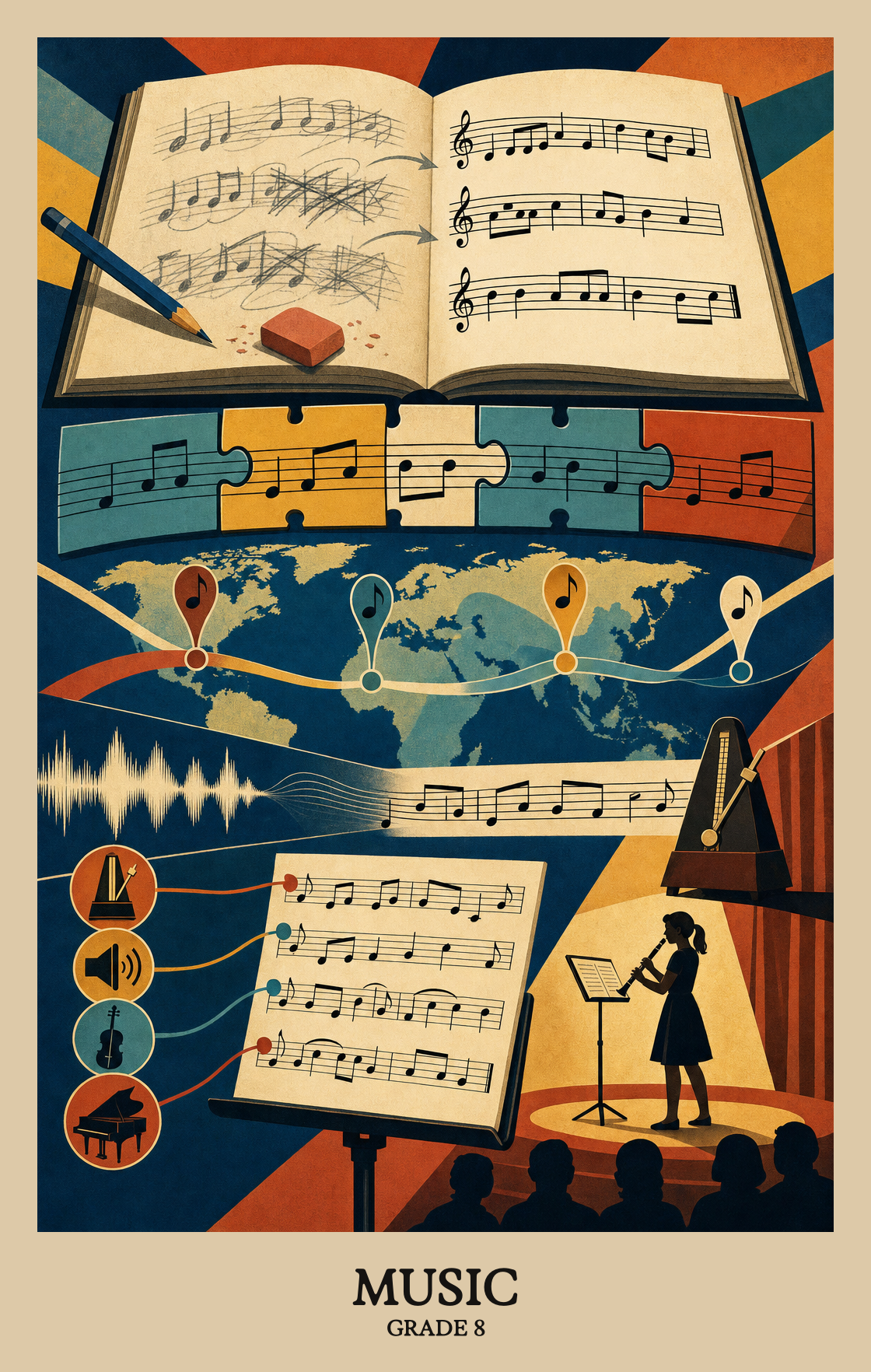
Students start the year by sketching their own musical ideas. They try out short melodies or rhythms, write down what they like, and explain why a piece is worth developing.
Students take rough ideas and turn them into finished work. They organize sections, revise based on feedback, and polish a piece until it feels ready to share.
Students pick music to perform and work on the skills needed to play or sing it well. They focus on technique, expression, and getting the mood of the piece across to a listener.
Students listen closely to music made by others and by themselves. They describe what they hear, talk about what the music might mean, and use clear reasons to judge how well it works.
Students connect music to their own lives and to history and culture. They look at how a song fits its time and place, and how personal experience shapes the music people make and enjoy.
Students connect what they know and what they've lived through to the music they create or perform. Personal experience shapes the choices they make as musicians.
Students connect a piece of music to the time, place, and culture it came from. Understanding that context helps them hear the music differently and grasp what it meant to the people who made it.
| Standard | Definition | Code |
|---|---|---|
| Making music from life experience | Students connect what they know and what they've lived through to the music they create or perform. Personal experience shapes the choices they make as musicians. | MU:Cn10.8 |
| Music in its time and place | Students connect a piece of music to the time, place, and culture it came from. Understanding that context helps them hear the music differently and grasp what it meant to the people who made it. | MU:Cn11.8 |
Students brainstorm original musical ideas, whether a melody, rhythm, or lyric, and begin shaping them into something worth developing further.
Students take their musical ideas and shape them into a structured piece, making choices about melody, rhythm, and how the parts fit together.
Students revise a piece of music based on feedback, then finish it in a form ready to share or perform.
| Standard | Definition | Code |
|---|---|---|
| Coming up with original musical ideas | Students brainstorm original musical ideas, whether a melody, rhythm, or lyric, and begin shaping them into something worth developing further. | MU:Cr1.8 |
| Develop a musical idea into a full piece | Students take their musical ideas and shape them into a structured piece, making choices about melody, rhythm, and how the parts fit together. | MU:Cr2.8 |
| Finish and polish a musical piece | Students revise a piece of music based on feedback, then finish it in a form ready to share or perform. | MU:Cr3.8 |
Students choose a piece of music to perform and explain why it suits the moment, the audience, or their own strengths as a musician.
Students practice and polish a piece of music until it's ready to perform in front of an audience, fixing technical problems and making deliberate choices about how the music should sound.
Students perform a piece of music with a clear purpose in mind, making choices about dynamics, tempo, and expression so the audience feels what the music is meant to communicate.
| Standard | Definition | Code |
|---|---|---|
| Choosing music worth performing | Students choose a piece of music to perform and explain why it suits the moment, the audience, or their own strengths as a musician. | MU:Pr4.8 |
| Rehearse and refine music for performance | Students practice and polish a piece of music until it's ready to perform in front of an audience, fixing technical problems and making deliberate choices about how the music should sound. | MU:Pr5.8 |
| Perform music that means something | Students perform a piece of music with a clear purpose in mind, making choices about dynamics, tempo, and expression so the audience feels what the music is meant to communicate. | MU:Pr6.8 |
Students listen to a piece of music and break down what they hear, noting how rhythm, melody, or structure shape the way the music feels and works.
Students explain what a piece of music means and what the composer or performer was trying to express, using specific details from the music itself to support their thinking.
Students listen to a piece of music and judge it using a set of clear criteria, explaining why it succeeds or falls short. The focus is on backing up an opinion with specific reasons, not just saying something sounds good or bad.
| Standard | Definition | Code |
|---|---|---|
| Listening closely to music and analyzing it | Students listen to a piece of music and break down what they hear, noting how rhythm, melody, or structure shape the way the music feels and works. | MU:Re7.8 |
| Reading what music is trying to say | Students explain what a piece of music means and what the composer or performer was trying to express, using specific details from the music itself to support their thinking. | MU:Re8.8 |
| How to judge music with real criteria | Students listen to a piece of music and judge it using a set of clear criteria, explaining why it succeeds or falls short. The focus is on backing up an opinion with specific reasons, not just saying something sounds good or bad. | MU:Re9.8 |
Students make their own music, perform it, and listen carefully to music made by others. They write or arrange short pieces, rehearse them, and talk about why a song sounds the way it does. Connecting music to history and personal experience is a big part of the year.
Listen to music together for five minutes and ask what they notice about the rhythm, mood, or instruments. Ask why a songwriter might have made those choices. Curiosity matters more than playing an instrument well.
No. Singing, clapping rhythms, using classroom instruments, or making music on a tablet or computer all count. What matters is that students can create a short piece, rehearse it, and explain the choices they made.
Start with short listening and analysis tasks to build shared vocabulary, then move into small creating projects that feed directly into a performance or recording. Save the longest composition or arrangement for the second half of the year, once students can give and use feedback on drafts.
Refining a draft is the hardest part. Students often want to finish a piece on the first try instead of revising it. Building in short, structured peer feedback and a required revision step before any performance helps more than extra lessons on notation.
By spring, students should be able to create a short piece or arrangement, rehearse and perform it, and explain the choices behind it. They should also be able to listen to a piece of music and say something specific about how it works and what it means.
Quite a bit. Students are expected to connect music to the time, place, and culture it came from, so most listening and creating tasks should include some context. A short artist or era background before a listening task is usually enough.
Ask what the music made them feel, then ask what the musician did to create that feeling. Following up with a question about when and where the song was written pushes the conversation into the kind of thinking expected in class.