Moving and exploring
Students try out different ways to move their bodies. They explore fast and slow, high and low, and learn what their arms, legs, and feet can do in an open space.
This is the year students discover that their bodies can tell stories. Students explore how to move in different ways, shaping ideas they care about into simple dances. They also watch others dance and start to notice what a movement might mean. By spring, students can make up a short dance, share it with the class, and say something about what they saw a friend perform.
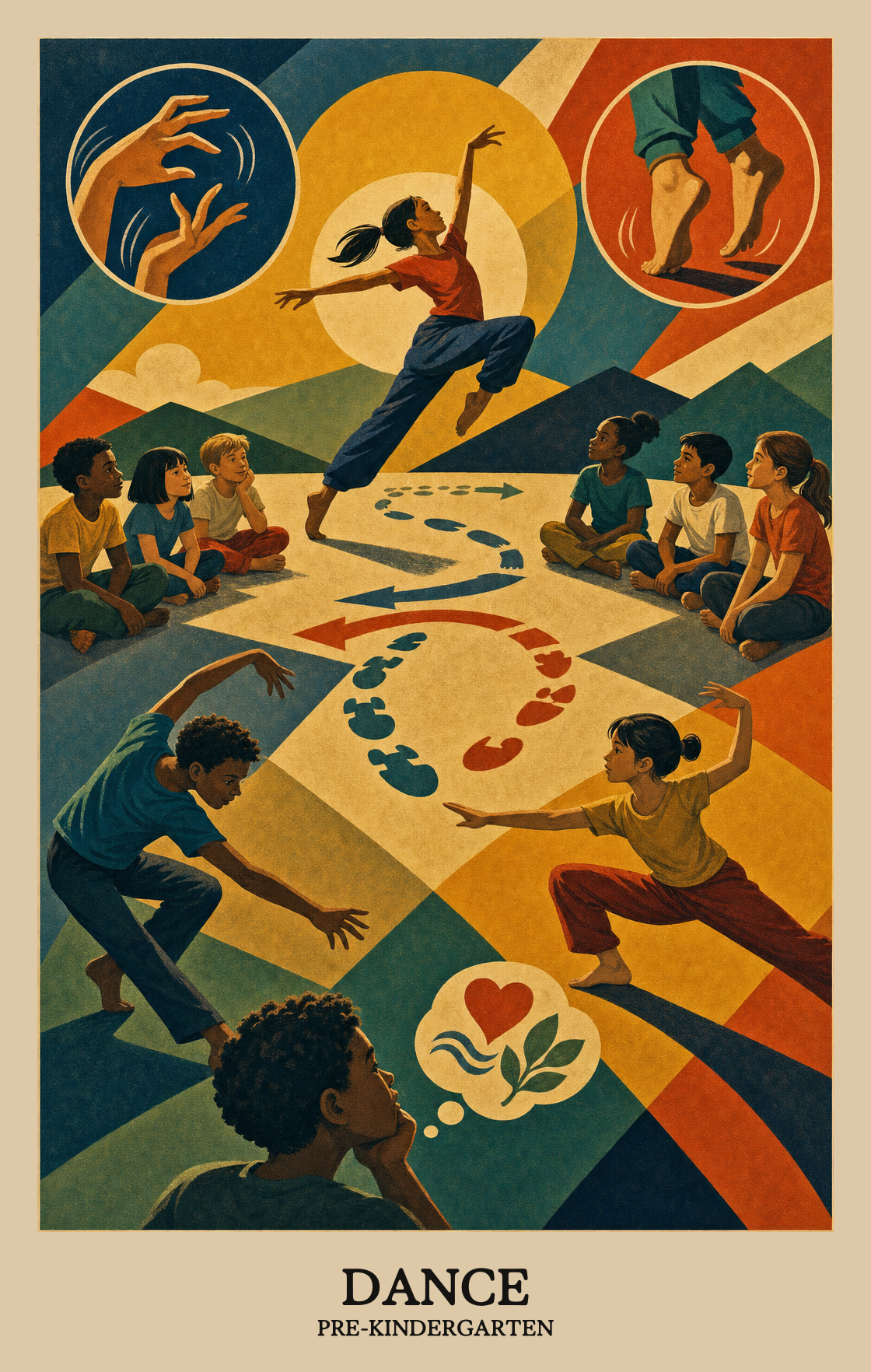
Students try out different ways to move their bodies. They explore fast and slow, high and low, and learn what their arms, legs, and feet can do in an open space.
Students start making up their own short dances. They pick movements that go with a feeling, a song, or a picture book, and string a few moves together.
Students try movements from different cultures, family traditions, and stories. They notice how people dance for celebrations and what those dances might be about.
Students practice a short dance to show classmates or family. They learn to watch others dance, share what they noticed, and say what they liked about a friend's dance.
Students connect something they know or have felt to a dance they make or watch. A memory, a feeling, or a story from real life shapes how they move.
Dancing connects to real life. Students explore how movement and stories in dance come from the places, people, and traditions around them.
| Standard | Definition | Code |
|---|---|---|
| Dance and what you know | Students connect something they know or have felt to a dance they make or watch. A memory, a feeling, or a story from real life shapes how they move. | DA:Cn10.pk |
| Dance from different cultures and times | Dancing connects to real life. Students explore how movement and stories in dance come from the places, people, and traditions around them. | DA:Cn11.pk |
Students come up with their own ideas for movement and dance, deciding what their body could do or express before they begin to move.
Students pick a few movements they like and put them together into a short sequence they can repeat and share.
Students pick a movement they like and keep practicing it until it feels just right. They learn that making something takes more than one try.
| Standard | Definition | Code |
|---|---|---|
| Coming up with dance ideas | Students come up with their own ideas for movement and dance, deciding what their body could do or express before they begin to move. | DA:Cr1.pk |
| Moving and making dance ideas | Students pick a few movements they like and put them together into a short sequence they can repeat and share. | DA:Cr2.pk |
| Finish a dance and make it better | Students pick a movement they like and keep practicing it until it feels just right. They learn that making something takes more than one try. | DA:Cr3.pk |
Students pick a movement or short dance to share with others, choosing something they feel ready to perform.
Students practice a dance move again and again to get it ready to show someone else.
Students share a dance they made and show what they were trying to express, whether that is a feeling, a story, or an idea.
| Standard | Definition | Code |
|---|---|---|
| Choosing a dance to share | Students pick a movement or short dance to share with others, choosing something they feel ready to perform. | DA:Pr4.pk |
| Moving and practicing dance skills | Students practice a dance move again and again to get it ready to show someone else. | DA:Pr5.pk |
| Moving to share a feeling | Students share a dance they made and show what they were trying to express, whether that is a feeling, a story, or an idea. | DA:Pr6.pk |
Students look at a dance performance and talk about what they noticed, like a shape the dancer made or a moment that surprised them.
Students say what they think a dance is about and explain what made them feel that way.
Students look at a dance and say what they liked and why. They practice noticing what makes movement interesting or expressive.
| Standard | Definition | Code |
|---|---|---|
| Noticing what dance looks like | Students look at a dance performance and talk about what they noticed, like a shape the dancer made or a moment that surprised them. | DA:Re7.pk |
| What dances are trying to say | Students say what they think a dance is about and explain what made them feel that way. | DA:Re8.pk |
| Deciding what makes a dance good | Students look at a dance and say what they liked and why. They practice noticing what makes movement interesting or expressive. | DA:Re9.pk |
Students explore how their bodies can move through space by stretching, curling, jumping, swaying, and freezing. Most of the work happens through guided play, music, and stories rather than set choreography. The goal is body awareness and joyful movement, not polished routines.
Put on music and move together for ten minutes. Try moving high and low, fast and slow, or like different animals. Ask students to show how a storm or a sleepy cat would move. That kind of pretend play builds the same skills practiced at school.
No. Outside lessons are not expected at this age. What helps most is regular time to move freely at home, dance to music in the kitchen, and act out stories. Comfortable clothes and a small clear space are enough.
Start with body parts and personal space, then move into levels, directions, and tempo. Bring in shapes and simple patterns by midyear. Save short sharing moments and movement based on stories or feelings for the second half, once students are comfortable moving in front of others.
Two or three short sessions of about ten to fifteen minutes works better than one long block. Young students focus best in quick bursts with clear starts and stops. Movement breaks during the day also count and reinforce the same skills.
That is common at this age. Dancing side by side, copying a grown-up, or moving behind a scarf often feels safer than performing. Keep it playful and skip any pressure to show off. Comfort with an audience grows slowly over the year.
Personal space and stopping on a signal almost always need repeated practice. Matching movement to a beat is also tricky and develops slowly. Build short games around freezing, finding a spot, and moving with the music throughout the year.
By spring, students should move in their own space without bumping others, stop on a signal, and try out different speeds and levels. They should also be able to show a feeling or idea through movement and talk a little about what they saw a classmate do.