Reading closely and asking sharper questions
Students start the year by reading challenging texts and pulling out specific lines as evidence. They learn to mark where a text is unclear or contradictory and write their own questions about it.
This is the year reading and writing aim squarely at college. Students dig into difficult books, essays, and arguments, pulling out exact lines that prove a point and weighing whether the reasoning actually holds up. Their own writing gets sharper: real claims, fair treatment of the other side, sources cited cleanly. By spring, students can write a well-supported argument essay and lead a serious discussion about a complex text.
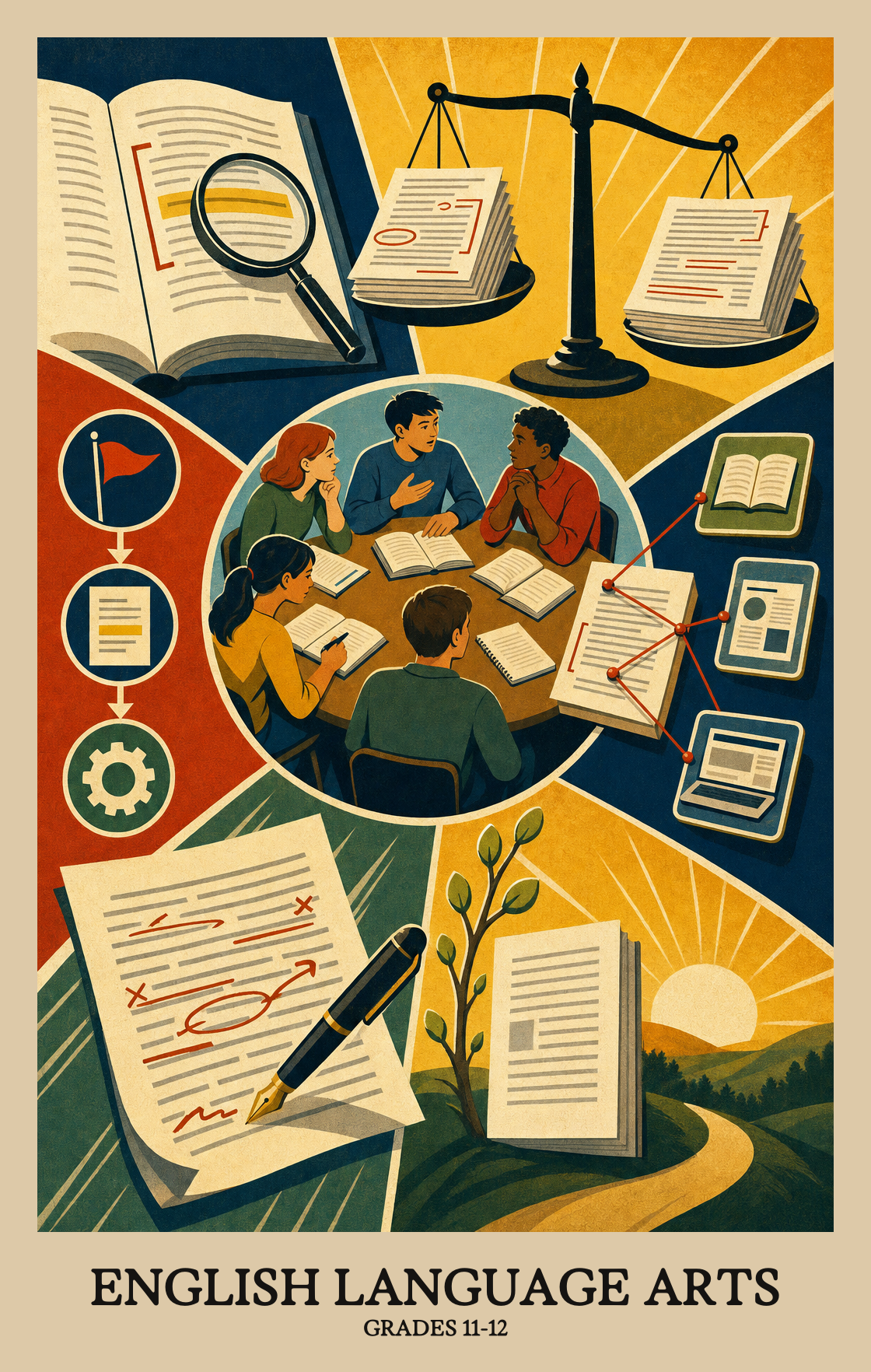
Students start the year by reading challenging texts and pulling out specific lines as evidence. They learn to mark where a text is unclear or contradictory and write their own questions about it.
Students follow two or more big ideas across a long work and notice how an author's choices shape meaning. They write short analyses that explain how a scene, structure, or shift in tone affects the reader.
Students write essays that make a clear claim, take counterarguments seriously, and back each point with relevant evidence. They also learn to spot weak reasoning and faulty logic in the arguments they read.
Students run their own research projects, weighing sources for strength and bias and pulling information from several places into one coherent piece. They cite sources in a standard format and avoid leaning on any single source.
Students lead and join discussions on hard topics, push back on ideas with evidence, and present findings with slides or other visuals. They practice adjusting their language for formal and informal settings.
Students close the year by writing narratives, poems, or other creative pieces that respond to a text, author, or experience. They focus on pacing, vivid detail, and an ending that reflects on what happened.
Students study how word choice, tone, and sentence structure shift depending on the audience and purpose of a piece of writing. Reading and listening get sharper when students recognize why a writer made those choices.
Students figure out what unfamiliar or tricky words mean by picking the right strategy for the situation: using context clues, breaking the word into parts, or checking a reference. The goal is knowing which approach to reach for.
Students interpret figurative language like metaphors and idioms, and notice how word choice shifts meaning depending on context. They read closely enough to catch the subtle differences between words that seem similar.
Students build a working vocabulary of formal and technical words, then use those words on their own in writing and discussion without being prompted. The focus is on the academic language that shows up in college courses and professional settings.
Students practice rearranging sentences on purpose to change how writing sounds or hits. They also use that same sense of sentence structure to figure out difficult passages when they read.
When students hit an unfamiliar word, they use the surrounding sentences and the word's place in the sentence to figure out what it means, rather than stopping to look it up.
Students learn to spot how a root word shifts when it changes form, for example, how "conceive" becomes "conception" or "conceivable," and use those patterns to figure out what an unfamiliar word means.
Students look up unfamiliar words in a dictionary or thesaurus to confirm spelling, pronunciation, exact meaning, or how the word functions in a sentence.
Students look up an unfamiliar word in a dictionary or test their guess about its meaning against the sentences around it, then confirm they got it right.
Students identify figures of speech like hyperbole and paradox, then explain what those choices do in the text. Why did the writer exaggerate there? What does the contradiction reveal?
Students study words that mean nearly the same thing and explain the subtle differences. For example, they work out why "thin" feels neutral but "gaunt" feels alarming, or why "bold" and "reckless" point in different directions.
| Standard | Definition | Code |
|---|---|---|
| Word choice for meaning and style Grades 11-12 | Students study how word choice, tone, and sentence structure shift depending on the audience and purpose of a piece of writing. Reading and listening get sharper when students recognize why a writer made those choices. | NY-11-12L3 |
| Figuring out unfamiliar words Grades 11-12 | Students figure out what unfamiliar or tricky words mean by picking the right strategy for the situation: using context clues, breaking the word into parts, or checking a reference. The goal is knowing which approach to reach for. | NY-11-12L4 |
| Figurative language and word meanings Grades 11-12 | Students interpret figurative language like metaphors and idioms, and notice how word choice shifts meaning depending on context. They read closely enough to catch the subtle differences between words that seem similar. | NY-11-12L5 |
| Academic vocabulary for college and career readiness Grades 11-12 | Students build a working vocabulary of formal and technical words, then use those words on their own in writing and discussion without being prompted. The focus is on the academic language that shows up in college courses and professional settings. | NY-11-12L6 |
| Sentence structure as a writing choice Grades 11-12 | Students practice rearranging sentences on purpose to change how writing sounds or hits. They also use that same sense of sentence structure to figure out difficult passages when they read. | NY-11-12L3a |
| Using context clues to find word meaning Grades 11-12 | When students hit an unfamiliar word, they use the surrounding sentences and the word's place in the sentence to figure out what it means, rather than stopping to look it up. | NY-11-12L4a |
| Word forms that shift meaning Grades 11-12 | Students learn to spot how a root word shifts when it changes form, for example, how "conceive" becomes "conception" or "conceivable," and use those patterns to figure out what an unfamiliar word means. | NY-11-12L4b |
| Using dictionaries and thesauruses to clarify words Grades 11-12 | Students look up unfamiliar words in a dictionary or thesaurus to confirm spelling, pronunciation, exact meaning, or how the word functions in a sentence. | NY-11-12L4c |
| Checking word meanings in a dictionary Grades 11-12 | Students look up an unfamiliar word in a dictionary or test their guess about its meaning against the sentences around it, then confirm they got it right. | NY-11-12L4d |
| Hyperbole and paradox in literary texts Grades 11-12 | Students identify figures of speech like hyperbole and paradox, then explain what those choices do in the text. Why did the writer exaggerate there? What does the contradiction reveal? | NY-11-12L5a |
| Shades of meaning in similar words Grades 11-12 | Students study words that mean nearly the same thing and explain the subtle differences. For example, they work out why "thin" feels neutral but "gaunt" feels alarming, or why "bold" and "reckless" point in different directions. | NY-11-12L5b |
Students back up their reading with specific quotes and details from the text, explain what those passages mean, and flag spots where the author leaves something unclear. They also write questions that push their thinking further.
Students find two or more big ideas running through a text, trace how details build and shape each one, and write a summary that reflects the whole text accurately.
Students look at how an author's decisions shape a story or argument. In fiction, they examine why characters, plot points, or settings appear where they do. In nonfiction, they trace how people, ideas, or events push each other forward across a text.
Students figure out what words and phrases mean in context, including what a word implies or suggests beyond its dictionary definition.
Students look at how a writer arranges a story, essay, or argument and explain why those choices matter. In a novel, that might mean analyzing flashbacks or chapter breaks. In an article, it means judging whether the structure makes the argument clear and convincing.
Students read closely to figure out why an author made specific choices, such as using irony or sarcasm, and what those choices do to the message beneath the surface of the text.
Students compare different versions of the same story or idea, whether a film, a painting, a song, or a written piece, and judge how each one changes the meaning or argument of the original.
Students read an argument and judge whether it holds up, using a specific framework (such as a logical fallacy check or a code of ethics) to decide if the evidence actually supports the claim.
Students pick what makes a piece of writing worth reading, then use those criteria to judge whether a text actually delivers. Think of it as building your own rating system before you review the work.
| Standard | Definition | Code |
|---|---|---|
| Finding and using evidence from texts Grades 11-12 | Students back up their reading with specific quotes and details from the text, explain what those passages mean, and flag spots where the author leaves something unclear. They also write questions that push their thinking further. | NY-11-12R1 |
| Finding and tracing themes in complex texts Grades 11-12 | Students find two or more big ideas running through a text, trace how details build and shape each one, and write a summary that reflects the whole text accurately. | NY-11-12R2 |
| How authors shape ideas and events Grades 11-12 | Students look at how an author's decisions shape a story or argument. In fiction, they examine why characters, plot points, or settings appear where they do. In nonfiction, they trace how people, ideas, or events push each other forward across a text. | NY-11-12R3 |
| Figurative and connotative word meanings Grades 11-12 | Students figure out what words and phrases mean in context, including what a word implies or suggests beyond its dictionary definition. | NY-11-12R4 |
| How structure shapes meaning in texts Grades 11-12 | Students look at how a writer arranges a story, essay, or argument and explain why those choices matter. In a novel, that might mean analyzing flashbacks or chapter breaks. In an article, it means judging whether the structure makes the argument clear and convincing. | NY-11-12R5 |
| Author's point of view and hidden meaning Grades 11-12 | Students read closely to figure out why an author made specific choices, such as using irony or sarcasm, and what those choices do to the message beneath the surface of the text. | NY-11-12R6 |
| Comparing adaptations and sources across formats Grades 11-12 | Students compare different versions of the same story or idea, whether a film, a painting, a song, or a written piece, and judge how each one changes the meaning or argument of the original. | NY-11-12R7 |
| Judging arguments against a real-world lens Grades 11-12 | Students read an argument and judge whether it holds up, using a specific framework (such as a logical fallacy check or a code of ethics) to decide if the evidence actually supports the claim. | NY-11-12R8 |
| Judging whether a text is well written Grades 11-12 | Students pick what makes a piece of writing worth reading, then use those criteria to judge whether a text actually delivers. Think of it as building your own rating system before you review the work. | NY-11-12R9 |
Students read or research the material before a group discussion, then use specific evidence from that reading to push the conversation toward sharper, more reasoned ideas. Showing up prepared is the starting point.
Students pull together information from several sources at once, like a chart, a speech, and a photo, and use all of it to build a fuller picture of the topic.
Students listen to a speech or argument and judge whether the speaker's reasoning holds up: Are the claims supported by real evidence? Does the word choice reveal a bias or angle? Students look past the surface to weigh how the whole argument is built.
Students give a prepared talk that states a clear position, backs it up with evidence, and addresses the strongest objection someone might raise. The structure and word choice fit the audience and purpose.
Students choose photos, charts, or video clips to make a presentation clearer and more convincing. The visuals support the argument rather than decorate it.
Students shift how they speak depending on the situation, using formal English in presentations or serious discussions and a more relaxed tone in casual conversations. They read the room and adjust accordingly.
Students help their group agree on ground rules, set a shared goal, and divide up responsibilities before a discussion or project begins.
Students ask follow-up questions that push past surface answers, press others to back up their reasoning, and bring new angles into the conversation rather than settling on the first conclusion the group reaches.
Students listen to different viewpoints in a discussion, then pull those ideas together into a clear response. They work out where opinions conflict, and identify what questions still need answering before the group can move forward.
| Standard | Definition | Code |
|---|---|---|
| Preparing for class discussions with evidence Grades 11-12 | Students read or research the material before a group discussion, then use specific evidence from that reading to push the conversation toward sharper, more reasoned ideas. Showing up prepared is the starting point. | NY-11-12SL1 |
| Reading visuals, data, and spoken sources together Grades 11-12 | Students pull together information from several sources at once, like a chart, a speech, and a photo, and use all of it to build a fuller picture of the topic. | NY-11-12SL2 |
| Judging a speaker's argument and word choice Grades 11-12 | Students listen to a speech or argument and judge whether the speaker's reasoning holds up: Are the claims supported by real evidence? Does the word choice reveal a bias or angle? Students look past the surface to weigh how the whole argument is built. | NY-11-12SL3 |
| Making a clear, well-organized argument out loud Grades 11-12 | Students give a prepared talk that states a clear position, backs it up with evidence, and addresses the strongest objection someone might raise. The structure and word choice fit the audience and purpose. | NY-11-12SL4 |
| Using visuals to strengthen a presentation Grades 11-12 | Students choose photos, charts, or video clips to make a presentation clearer and more convincing. The visuals support the argument rather than decorate it. | NY-11-12SL5 |
| Adjusting how you speak for the situation Grades 11-12 | Students shift how they speak depending on the situation, using formal English in presentations or serious discussions and a more relaxed tone in casual conversations. They read the room and adjust accordingly. | NY-11-12SL6 |
| Setting norms for group discussions Grades 11-12 | Students help their group agree on ground rules, set a shared goal, and divide up responsibilities before a discussion or project begins. | NY-11-12SL1b |
| Questioning ideas and challenging conclusions Grades 11-12 | Students ask follow-up questions that push past surface answers, press others to back up their reasoning, and bring new angles into the conversation rather than settling on the first conclusion the group reaches. | NY-11-12SL1c |
| Weighing all sides and finding gaps Grades 11-12 | Students listen to different viewpoints in a discussion, then pull those ideas together into a clear response. They work out where opinions conflict, and identify what questions still need answering before the group can move forward. | NY-11-12SL1d |
Students write a formal argument for a position on a real issue or text, then back it up with solid reasoning and specific evidence from credible sources.
Students write to explain a complex topic, choosing and organizing information carefully so a reader understands it clearly. The focus is on analysis, not opinion.
Students write stories about real or imagined events, choosing details that bring the experience to life and arranging scenes in an order that makes sense. The focus is on craft: how the story is built, not just what happens in it.
Students write a poem, story, play, or other creative piece responding to something they read or experienced. The work shows they can handle different creative forms with skill.
Students pull quotes and details from what they read to back up their analysis and research writing. The evidence has to connect directly to the point they are making.
Students pick a research question they care about, then dig into sources to answer it. If the topic turns out too broad or too narrow, they adjust the question before they go further.
Students research a topic using multiple sources, judge which information is trustworthy and useful, and weave it into their writing without copying or leaning too hard on any one source. They also cite every source in a standard format.
Students open a persuasive piece by stating a clear position, explaining why it matters, and acknowledging the opposing side. The argument is organized so each claim, counterargument, and supporting detail builds on the last.
Students build their argument by presenting the strongest evidence for their own position and then honestly addressing the opposing side, including where each argument falls short. Good writers think about what their reader already believes before they start.
Writing about complex topics, students choose words that fit the subject, including technical or subject-specific terms and literary techniques like imagery or irony, to match the weight and difficulty of the idea.
Students practice connecting big ideas with the right transition words and a mix of sentence structures, so the argument flows clearly from one point to the next.
Students write a closing paragraph that tells readers why the argument matters, not just that it's finished. The conclusion leaves the reader with a reason to care about the position taken.
Writing style and tone should fit the task. A persuasive essay sounds different from a personal narrative, and students learn to shift their word choices and voice to match what the writing calls for.
Students open an informational or explanatory piece by laying out a central idea, then arrange each paragraph so it grows naturally from the one before it, building toward one clear, connected argument.
Students pick the facts, quotes, and details that actually matter for the topic, leaving out anything that doesn't add to what the reader needs to know.
Writing about complex topics means choosing words that are exact, not just close enough. Students use subject-specific terms and literary techniques to say what they mean with precision.
Students choose transition words and vary sentence structure to show how complex ideas connect, contrast, or build on each other. The goal is writing that flows and makes the reasoning easy to follow.
The final paragraph of an informational essay should do more than stop. Students explain why the information matters, leaving the reader with a clear sense of what the topic means beyond the page.
Writing style means choosing words, tone, and sentence length that fit the piece. In a research paper, that sounds different from a personal essay, and students learn to keep that fit consistent from the first sentence to the last.
Students open a narrative by pulling readers in fast: setting up a real conflict or moment that matters, making clear whose eyes we're seeing it through, and introducing the people (or voice) at the center of the story.
Writers choose specific tools to bring a story to life. Students practice techniques like dialogue and pacing to shape how a scene feels, how a character comes across, and how events unfold on the page.
Students arrange scenes and details in an order that builds tension or feeling, so the story moves with purpose toward its ending rather than just listing what happened.
Students choose words that put the reader inside the scene. A telling detail, a specific sound, a sharp image does more than a vague adjective ever could.
Students write an ending that grows out of what happened in the story, not one that appears from nowhere. The conclusion feels earned because it connects back to the people, events, or ideas the narrative already built.
| Standard | Definition | Code |
|---|---|---|
| Arguing a position with evidence Grades 11-12 | Students write a formal argument for a position on a real issue or text, then back it up with solid reasoning and specific evidence from credible sources. | NY-11-12W1 |
| Informational writing with complex ideas Grades 11-12 | Students write to explain a complex topic, choosing and organizing information carefully so a reader understands it clearly. The focus is on analysis, not opinion. | NY-11-12W2 |
| Narrative writing: real and imagined stories Grades 11-12 | Students write stories about real or imagined events, choosing details that bring the experience to life and arranging scenes in an order that makes sense. The focus is on craft: how the story is built, not just what happens in it. | NY-11-12W3 |
| Creative writing inspired by a text or experience Grades 11-12 | Students write a poem, story, play, or other creative piece responding to something they read or experienced. The work shows they can handle different creative forms with skill. | NY-11-12W4 |
| Finding evidence in texts to support ideas Grades 11-12 | Students pull quotes and details from what they read to back up their analysis and research writing. The evidence has to connect directly to the point they are making. | NY-11-12W5 |
| Research that starts with your own question Grades 11-12 | Students pick a research question they care about, then dig into sources to answer it. If the topic turns out too broad or too narrow, they adjust the question before they go further. | NY-11-12W6 |
| Research from multiple sources, cited correctly Grades 11-12 | Students research a topic using multiple sources, judge which information is trustworthy and useful, and weave it into their writing without copying or leaning too hard on any one source. They also cite every source in a standard format. | NY-11-12W7 |
| Making a clear, well-structured argument Grades 11-12 | Students open a persuasive piece by stating a clear position, explaining why it matters, and acknowledging the opposing side. The argument is organized so each claim, counterargument, and supporting detail builds on the last. | NY-11-12W1a |
| Backing up claims and addressing counterarguments Grades 11-12 | Students build their argument by presenting the strongest evidence for their own position and then honestly addressing the opposing side, including where each argument falls short. Good writers think about what their reader already believes before they start. | NY-11-12W1b |
| Precise word choice for complex topics Grades 11-12 | Writing about complex topics, students choose words that fit the subject, including technical or subject-specific terms and literary techniques like imagery or irony, to match the weight and difficulty of the idea. | NY-11-12W1c |
| Transitions and syntax that connect complex ideas Grades 11-12 | Students practice connecting big ideas with the right transition words and a mix of sentence structures, so the argument flows clearly from one point to the next. | NY-11-12W1d |
| Concluding with why the argument matters Grades 11-12 | Students write a closing paragraph that tells readers why the argument matters, not just that it's finished. The conclusion leaves the reader with a reason to care about the position taken. | NY-11-12W1e |
| Style and tone that fit the task Grades 11-12 | Writing style and tone should fit the task. A persuasive essay sounds different from a personal narrative, and students learn to shift their word choices and voice to match what the writing calls for. | NY-11-12W1f |
| Building an essay that flows as one whole Grades 11-12 | Students open an informational or explanatory piece by laying out a central idea, then arrange each paragraph so it grows naturally from the one before it, building toward one clear, connected argument. | NY-11-12W2a |
| Choosing the right details for your argument Grades 11-12 | Students pick the facts, quotes, and details that actually matter for the topic, leaving out anything that doesn't add to what the reader needs to know. | NY-11-12W2b |
| Choosing exact words for complex topics Grades 11-12 | Writing about complex topics means choosing words that are exact, not just close enough. Students use subject-specific terms and literary techniques to say what they mean with precision. | NY-11-12W2c |
| Transitions that connect complex ideas Grades 11-12 | Students choose transition words and vary sentence structure to show how complex ideas connect, contrast, or build on each other. The goal is writing that flows and makes the reasoning easy to follow. | NY-11-12W2d |
| Conclusions that explain why it matters Grades 11-12 | The final paragraph of an informational essay should do more than stop. Students explain why the information matters, leaving the reader with a clear sense of what the topic means beyond the page. | NY-11-12W2e |
| Writing style that fits the task Grades 11-12 | Writing style means choosing words, tone, and sentence length that fit the piece. In a research paper, that sounds different from a personal essay, and students learn to keep that fit consistent from the first sentence to the last. | NY-11-12W2f |
| Opening a story that pulls readers in Grades 11-12 | Students open a narrative by pulling readers in fast: setting up a real conflict or moment that matters, making clear whose eyes we're seeing it through, and introducing the people (or voice) at the center of the story. | NY-11-12W3a |
| Dialogue, pacing, and description in stories Grades 11-12 | Writers choose specific tools to bring a story to life. Students practice techniques like dialogue and pacing to shape how a scene feels, how a character comes across, and how events unfold on the page. | NY-11-12W3b |
| Sequencing events for tone and effect Grades 11-12 | Students arrange scenes and details in an order that builds tension or feeling, so the story moves with purpose toward its ending rather than just listing what happened. | NY-11-12W3c |
| Vivid word choice in narrative writing Grades 11-12 | Students choose words that put the reader inside the scene. A telling detail, a specific sound, a sharp image does more than a vague adjective ever could. | NY-11-12W3d |
| Narrative conclusions that fit the story Grades 11-12 | Students write an ending that grows out of what happened in the story, not one that appears from nowhere. The conclusion feels earned because it connects back to the people, events, or ideas the narrative already built. | NY-11-12W3e |
An end-of-course high school exam covering reading and writing. Students typically take it in grade 11 and must pass this exam (or a state-approved equivalent) to earn a Regents diploma.
The annual test New York gives to students who have been identified as English Language Learners. It checks speaking, listening, reading, and writing in English and decides whether a student is ready to exit ENL services.
The placement test New York gives to students within ten school days of enrolling, when a parent survey suggests the student may need English language services. Results decide whether the student is identified as an English Language Learner.
Students read demanding novels, plays, essays, and historical documents, then write arguments and analysis that use specific evidence from those texts. They also lead discussions, give presentations, and complete research projects. The work is meant to look a lot like first-year college reading and writing.
Ask students to summarize what they read in two or three sentences, then ask what the author seemed to be getting at. If a passage is confusing, read a page aloud together and talk through what is literal and what is implied. Ten minutes of conversation about a book often beats an hour of silent struggle.
They practice making a clear claim, backing it with quotes or facts, and addressing the strongest opposing view rather than dismissing it. At home, a parent can push back on opinions at dinner and ask for reasons and evidence. That kind of back-and-forth is exactly what the writing asks for on paper.
Start with claim and evidence on shorter texts, then move to counterclaim work using paired sources. Save the longer research-based argument for later in the year, after revision habits are in place. Returning to argument three or four times across the year tends to stick better than one long unit.
Integrating quotes smoothly, analyzing evidence instead of just dropping it in, and handling counterclaims fairly are the common sticking points. Vocabulary in context and syntax for effect also need steady attention. Short, frequent practice tends to move these more than one-off lessons.
Students should pose their own question, find sources beyond the first page of search results, and judge which sources are actually credible. They should weave in evidence from several sources without leaning on any single one. Citation should be consistent in one standard format, MLA or APA.
Yes, but the focus shifts toward sentence variety, precise word choice, and tone that fits the audience. A short essay with sharp sentences will read better than a long one full of vague wording. Reading drafts aloud catches most of the awkward sentences.
Ask to hear the main claim in one sentence and the three strongest pieces of evidence. If either is fuzzy, the draft needs another pass before polishing. Avoid editing the words; ask questions and let the student do the rewriting.
Students can read a complex text, build an argument with strong evidence, address a counterclaim, and revise based on feedback. They can speak in a discussion using specific references to the text and adjust their language for a formal audience. That is the bar for college and entry-level career writing.