Quick addition and subtraction
Students start the year getting fast and accurate with adding and subtracting small numbers in their head. By the end of this stretch, they know sums up to 20 by memory and can solve short word problems.
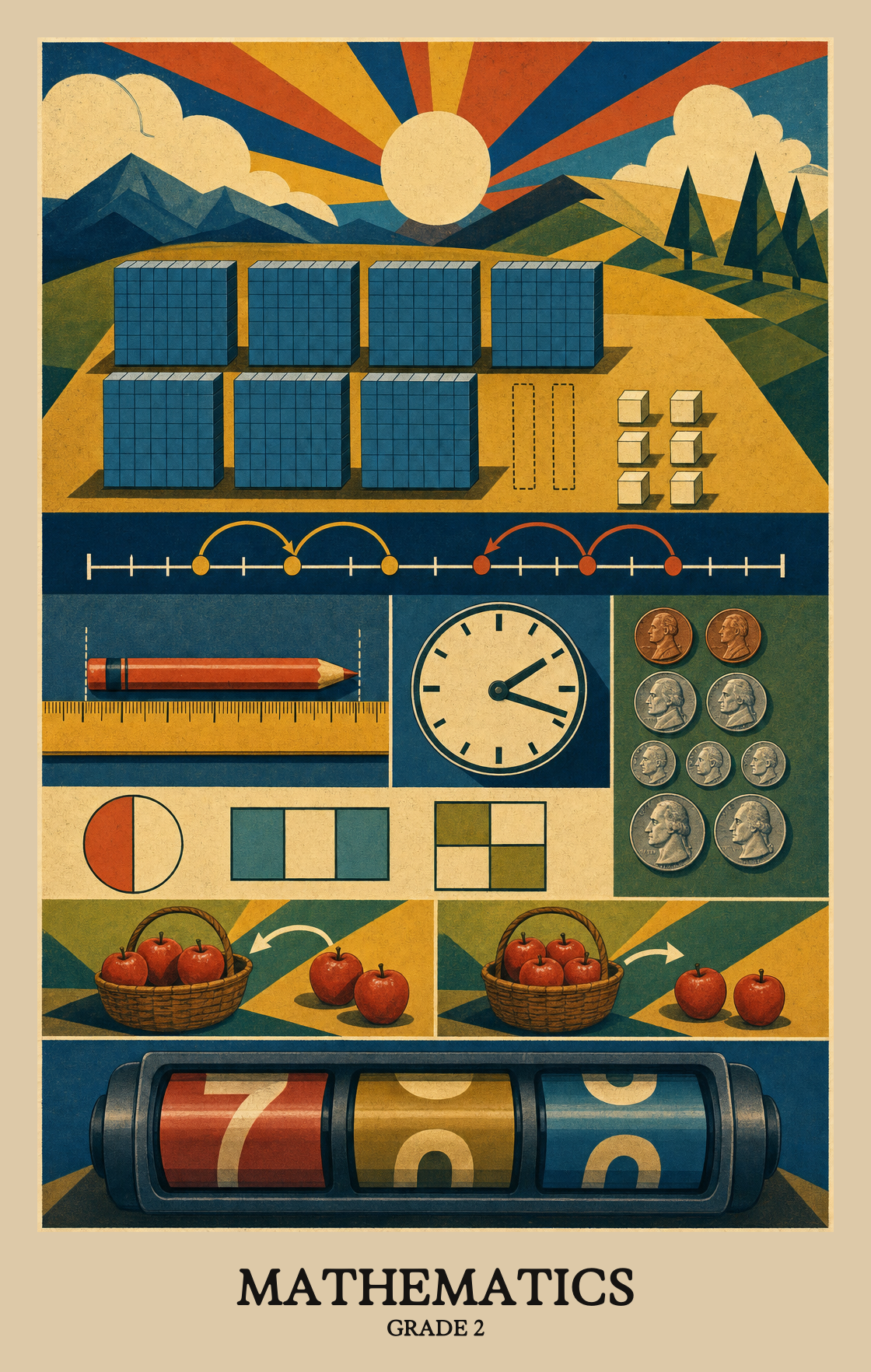
This is the year math grows into hundreds. Students learn that a number like 706 means 7 hundreds, 0 tens, and 6 ones, and they use that idea to add and subtract within 100 quickly in their heads. They measure with rulers, tell time on a clock, count coins, and split shapes into halves, thirds, and fourths. By spring, students can solve a two-step word problem and read three-digit numbers with confidence.
Students start the year getting fast and accurate with adding and subtracting small numbers in their head. By the end of this stretch, they know sums up to 20 by memory and can solve short word problems.
Students learn that a number like 706 is made of hundreds, tens, and ones. They count, read, and write numbers up to 1000 and compare them using the greater than and less than signs.
Students move from quick mental math to working with two-digit and three-digit numbers. They use drawings and place value to add and subtract, sometimes regrouping a ten or a hundred along the way.
Students pick up rulers, yardsticks, and measuring tapes and measure real objects in inches, feet, centimeters, and meters. They also estimate lengths and figure out how much longer one object is than another.
Students read clocks to the nearest five minutes and count mixed coins and dollar bills to solve money problems. They also organize information they collect into picture graphs and bar graphs.
Students name shapes like pentagons and hexagons and split circles and rectangles into halves, thirds, and fourths. They also arrange objects into rows and columns, which sets up multiplication next year.
Students sort and draw shapes by counting their sides and corners. They name specific shapes like triangles, four-sided figures, pentagons, and hexagons, and they recognize a cube by its equal square faces.
Students divide a rectangle into equal-sized squares arranged in rows and columns, then count all the squares to find the total. It's an early look at how multiplication and area work.
Cutting circles and rectangles into equal pieces, students name those pieces halves, thirds, or fourths and explain how the pieces make up the whole. Two equal shares of the same shape can look different and still be the same size.
Students partition rectangles into rows and columns of same-size squares and count how many squares fit inside. This builds an early picture of multiplication and area before those words even show up.
Students use what they know about place value to solve addition and subtraction problems, choosing the right tool for the job, whether that's a number line, base-ten blocks, or mental math.
Students measure lengths using the same unit throughout, like repeating a ruler end-to-end without gaps or overlaps. Getting that detail right is what makes a measurement mean something.
Students look at shapes or number patterns and spot the hidden structure, like noticing a rectangle is made of rows of equal squares. Finding that structure helps students solve problems without starting from scratch each time.
Students sort and describe shapes by their sides and angles, grouping squares with squares and triangles with triangles. They learn that shapes in the same category share specific features, like equal sides or right corners.
| Standard | Definition | Code |
|---|---|---|
| Recognize and draw shapes having specified attributes, such as a given number… | Students sort and draw shapes by counting their sides and corners. They name specific shapes like triangles, four-sided figures, pentagons, and hexagons, and they recognize a cube by its equal square faces. | CA-2.G.1 |
| Partition a rectangle into rows and columns of same-size squares and count to… | Students divide a rectangle into equal-sized squares arranged in rows and columns, then count all the squares to find the total. It's an early look at how multiplication and area work. | CA-2.G.2 |
| Partition circles and rectangles into two, three | Cutting circles and rectangles into equal pieces, students name those pieces halves, thirds, or fourths and explain how the pieces make up the whole. Two equal shares of the same shape can look different and still be the same size. | CA-2.G.3 |
| Model with mathematics | Students partition rectangles into rows and columns of same-size squares and count how many squares fit inside. This builds an early picture of multiplication and area before those words even show up. | CA-2.G.4 |
| Use appropriate tools strategically | Students use what they know about place value to solve addition and subtraction problems, choosing the right tool for the job, whether that's a number line, base-ten blocks, or mental math. | CA-2.G.5 |
| Attend to precision. to perform multi-digit arithmetic | Students measure lengths using the same unit throughout, like repeating a ruler end-to-end without gaps or overlaps. Getting that detail right is what makes a measurement mean something. | CA-2.G.6 |
| Look for and make use of structure | Students look at shapes or number patterns and spot the hidden structure, like noticing a rectangle is made of rows of equal squares. Finding that structure helps students solve problems without starting from scratch each time. | CA-2.G.7 |
| Look for and express regularity in repeated Develop understanding of… | Students sort and describe shapes by their sides and angles, grouping squares with squares and triangles with triangles. They learn that shapes in the same category share specific features, like equal sides or right corners. | CA-2.G.8 |
Students pick the right measuring tool for the job and use it to find how long something is. A short pencil calls for a ruler; a longer object might need a yardstick or measuring tape.
Students measure the same object twice using two different tools (like a paper clip and a ruler), then explain why the numbers come out different. The shorter the tool, the bigger the count.
Students guess how long something is before measuring it, using inches, feet, centimeters, or meters. It builds the habit of sizing up an object with their eyes before reaching for a ruler.
Students measure two objects with a ruler, then subtract to find the difference. They practice saying things like "the pencil is 3 inches longer than the crayon."
Students solve story problems about measuring lengths, adding or subtracting numbers up to 100 to find a missing measurement. They might draw a ruler or write an equation with a blank to show their thinking.
Students place whole numbers on a number line by marking equal spaces from zero, then use the same number line to add and subtract numbers up to 100.
Students read both kinds of clocks and write the time to the nearest five minutes, noting whether it is a.m. or p.m. They also learn basic time facts, like how many minutes are in an hour or days in a week.
Students figure out how much a mix of coins and dollar bills adds up to, then write the total with the right symbol, like 23¢ or $1.05.
Students measure a handful of objects with a ruler, record each length to the nearest inch or centimeter, and then plot the results on a number line. The finished chart shows how the measurements spread out across whole numbers.
Students collect data, sort it into up to four groups, and draw a picture graph or bar graph to show what they found. Then they use the graph to answer simple questions, like how many more or fewer items are in one group than another.
| Standard | Definition | Code |
|---|---|---|
| Measure the length of an object by selecting and using appropriate tools such… | Students pick the right measuring tool for the job and use it to find how long something is. A short pencil calls for a ruler; a longer object might need a yardstick or measuring tape. | CA-2.MD.1 |
| Measure the length of an object twice, using length units of different lengths… | Students measure the same object twice using two different tools (like a paper clip and a ruler), then explain why the numbers come out different. The shorter the tool, the bigger the count. | CA-2.MD.2 |
| Estimate lengths using units of inches, feet, centimeters | Students guess how long something is before measuring it, using inches, feet, centimeters, or meters. It builds the habit of sizing up an object with their eyes before reaching for a ruler. | CA-2.MD.3 |
| Measure to determine how much longer one object is than another, expressing the… | Students measure two objects with a ruler, then subtract to find the difference. They practice saying things like "the pencil is 3 inches longer than the crayon." | CA-2.MD.4 |
| Use addition and subtraction within 100 to solve word problems involving… | Students solve story problems about measuring lengths, adding or subtracting numbers up to 100 to find a missing measurement. They might draw a ruler or write an equation with a blank to show their thinking. | CA-2.MD.5 |
| Represent whole numbers as lengths from 0 on a number line diagram with equally… | Students place whole numbers on a number line by marking equal spaces from zero, then use the same number line to add and subtract numbers up to 100. | CA-2.MD.6 |
| Tell and write time from analog and digital clocks to the nearest five minutes… | Students read both kinds of clocks and write the time to the nearest five minutes, noting whether it is a.m. or p.m. They also learn basic time facts, like how many minutes are in an hour or days in a week. | CA-2.MD.7 |
| Solve word problems involving dollar bills, quarters, dimes, nickels | Students figure out how much a mix of coins and dollar bills adds up to, then write the total with the right symbol, like 23¢ or $1.05. | CA-2.MD.8 |
| Generate measurement data by measuring lengths of several objects to the… | Students measure a handful of objects with a ruler, record each length to the nearest inch or centimeter, and then plot the results on a number line. The finished chart shows how the measurements spread out across whole numbers. | CA-2.MD.9 |
| Draw a picture graph and a bar graph | Students collect data, sort it into up to four groups, and draw a picture graph or bar graph to show what they found. Then they use the graph to answer simple questions, like how many more or fewer items are in one group than another. | CA-2.MD.10 |
Students learn that every three-digit number is built from hundreds, tens, and ones. In 706, the 7 means seven hundreds, the 0 means no tens, and the 6 means six ones.
Students count up to 1,000 and practice jumping by 2s, 5s, 10s, and 100s, like counting nickels or dimes in a piggy bank. Seeing the pattern in those jumps builds the number sense students use in everyday math.
Students read and write numbers up to 1,000 three ways: as digits (325), as words ("three hundred twenty-five"), and as a sum that shows each part (300 + 20 + 5).
Students compare two three-digit numbers by looking at hundreds first, then tens, then ones, and write which number is greater, equal, or less using the symbols >, =, and <.
Students add and subtract any two numbers up to 100 quickly and accurately. They use what they know about tens and ones, not just memorized steps, to find the answer.
Students add up to four two-digit numbers at a time by grouping tens together and ones together. They use what they know about how numbers are built to make the addition easier.
Students add and subtract numbers up to 1000 by working with hundreds, tens, and ones separately. When a column has too many or too few, students regroup across place values and show how the written math matches what they did.
| Standard | Definition | Code |
|---|---|---|
| Understand that the three digits of a three-digit number represent amounts of… | Students learn that every three-digit number is built from hundreds, tens, and ones. In 706, the 7 means seven hundreds, the 0 means no tens, and the 6 means six ones. | CA-2.NBT.1 |
| Count within 1000; skip-count by 2s, 5s, 10s | Students count up to 1,000 and practice jumping by 2s, 5s, 10s, and 100s, like counting nickels or dimes in a piggy bank. Seeing the pattern in those jumps builds the number sense students use in everyday math. | CA-2.NBT.2 |
| Read and write numbers to 1000 using base-ten numerals, number names | Students read and write numbers up to 1,000 three ways: as digits (325), as words ("three hundred twenty-five"), and as a sum that shows each part (300 + 20 + 5). | CA-2.NBT.3 |
| Compare two three-digit numbers based on meanings of the hundreds, tens | Students compare two three-digit numbers by looking at hundreds first, then tens, then ones, and write which number is greater, equal, or less using the symbols >, =, and <. | CA-2.NBT.4 |
| Fluently add and subtract within 100 using strategies based on place value… | Students add and subtract any two numbers up to 100 quickly and accurately. They use what they know about tens and ones, not just memorized steps, to find the answer. | CA-2.NBT.5 |
| Add up to four two-digit numbers using strategies based on place value and… | Students add up to four two-digit numbers at a time by grouping tens together and ones together. They use what they know about how numbers are built to make the addition easier. | CA-2.NBT.6 |
| Add and subtract within 1000, using concrete models or drawings and strategies… | Students add and subtract numbers up to 1000 by working with hundreds, tens, and ones separately. When a column has too many or too few, students regroup across place values and show how the written math matches what they did. | CA-2.NBT.7 |
Students read short story problems and use addition or subtraction to find a missing number, working with totals up to 100. The unknown can appear anywhere in the problem, so students draw pictures or write equations to figure it out.
Adding and subtracting numbers up to 20 from memory, without counting on fingers or using a number line. Students also practice arranging objects into equal groups as a first step toward multiplication.
Students sort a group of up to 20 objects into pairs to decide if the total is odd or even. If everything pairs up cleanly, the number is even, and students write it as two equal parts added together.
Students count objects arranged in a grid of rows and columns, then write an addition sentence to show the total. For example, 3 rows of 4 dots becomes 4 + 4 + 4 = 12.
| Standard | Definition | Code |
|---|---|---|
| Use addition and subtraction within 100 to solve one- and two-step word… | Students read short story problems and use addition or subtraction to find a missing number, working with totals up to 100. The unknown can appear anywhere in the problem, so students draw pictures or write equations to figure it out. | CA-2.OA.1 |
| Fluently add and subtract within 20 using mental strategies.2 By end of Grade… | Adding and subtracting numbers up to 20 from memory, without counting on fingers or using a number line. Students also practice arranging objects into equal groups as a first step toward multiplication. | CA-2.OA.2 |
| Determine whether a group of objects | Students sort a group of up to 20 objects into pairs to decide if the total is odd or even. If everything pairs up cleanly, the number is even, and students write it as two equal parts added together. | CA-2.OA.3 |
| Use addition to find the total number of objects arranged in rectangular arrays… | Students count objects arranged in a grid of rows and columns, then write an addition sentence to show the total. For example, 3 rows of 4 dots becomes 4 + 4 + 4 = 12. | CA-2.OA.4 |
The grade 3 math test in the CAASPP suite. Adaptive computer-based questions plus a performance task covering the Common Core grade 3 math standards.
The state test for students with the most significant cognitive disabilities. Replaces Smarter Balanced math in grades 3-8 and 11 for the small group of students whose IEP teams qualify them.
Students should add and subtract within 100 quickly, know all single-digit sums from memory, and work with numbers up to 1000. They should also tell time to the nearest five minutes, count coins, measure with a ruler, and name shapes by their sides and corners.
Count coins from a jar, set a timer and ask what time it will be in 15 minutes, or measure household objects with a ruler. Ask quick questions like 47 plus 25 during car rides. Short and frequent beats long and rare.
Students should answer sums and differences up to 20 from memory, without counting on fingers. By spring, problems like 8 plus 7 or 14 minus 6 should come back in a second or two. Daily flashcards or a quick game at dinner works.
Build hundreds, tens, and ones with base-ten blocks before moving to written numerals. Once students can read and write numbers to 1000, layer in comparing with greater than and less than, then bring place value into addition and subtraction strategies. Save the standard algorithm for late in the year.
Regrouping across a zero in subtraction, telling time on an analog clock, and word problems with the unknown in the start position. Counting mixed coins also slips. Plan spiral review for these all year, not just in the unit where they first appear.
It is fine early in the year. By spring, students should know most sums within 20 from memory. If fingers are still the main strategy in March, practice fact families for five minutes a night and talk about doubles, near doubles, and making ten.
Students move from one-step problems to two-step problems, and the unknown can show up at the start, middle, or end. A problem might say someone had some marbles, got 12 more, and ended with 30. Drawing a picture or a simple bar model helps students see what is missing.
By June, students should add and subtract within 100 without counting one by one, read and write numbers to 1000, tell time to five minutes, and solve two-step word problems. They should also see a 3 by 4 array and write it as repeated addition, which sets up multiplication.
Arranging objects in rows and columns and writing the total as repeated addition builds the foundation for multiplication next year. A carton of eggs in 2 rows of 6 is a good real-world example. Ask students to write it as 6 plus 6 equals 12.