Listening with purpose
Students start the year by listening closely to songs and short pieces of music. They notice things like fast and slow, loud and soft, and start putting words to what they hear.
This is the year music shifts from simple play to making real musical choices. Students invent short rhythms and melodies, then rework them until a piece feels finished. They practice singing and playing with steady beat and clear sound, and they say what a song means and why it works. By spring, students can perform a short piece they helped shape and explain the ideas behind it.
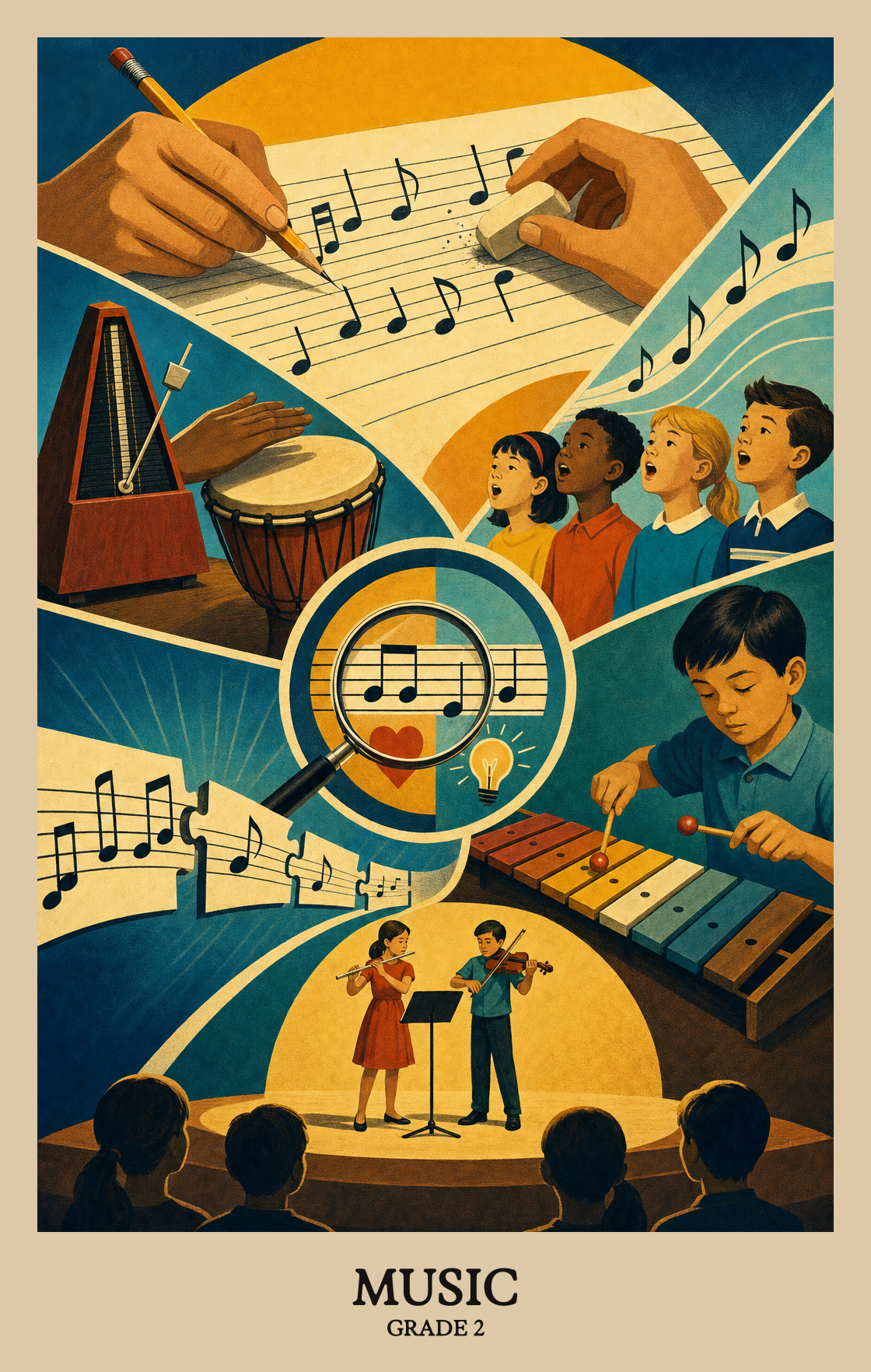
Students start the year by listening closely to songs and short pieces of music. They notice things like fast and slow, loud and soft, and start putting words to what they hear.
Students invent short rhythms and simple melodies of their own. They try out ideas, keep the ones they like, and shape them into a small piece that feels finished.
Students pick songs to share and work on singing and playing them well. They practice together, fix rough spots, and think about how to make the music interesting for an audience.
Students connect music to their own lives and to other times and places. They explore why people make music for holidays, stories, and everyday moments, and share what a piece means to them.
Students connect their own memories and experiences to the music they make or respond to, explaining why a song or sound means something to them.
Students connect a song or piece of music to the time, place, or culture it came from. That context helps them understand why the music sounds the way it does.
| Standard | Definition | Code |
|---|---|---|
| Making music from your own life | Students connect their own memories and experiences to the music they make or respond to, explaining why a song or sound means something to them. | CA-MU:Cn10.2.2 |
| Music from other times and places | Students connect a song or piece of music to the time, place, or culture it came from. That context helps them understand why the music sounds the way it does. | CA-MU:Cn11.2.2 |
Students come up with their own musical ideas, like inventing a short melody or choosing sounds that fit a mood.
Students arrange musical ideas into a short piece by choosing which sounds come first, which come next, and how the whole thing fits together.
Students revisit a song or musical piece they created, make small changes to improve it, and decide when it's finished and ready to share.
| Standard | Definition | Code |
|---|---|---|
| Coming up with musical ideas | Students come up with their own musical ideas, like inventing a short melody or choosing sounds that fit a mood. | CA-MU:Cr1.2.2 |
| Arrange a short musical idea into a song | Students arrange musical ideas into a short piece by choosing which sounds come first, which come next, and how the whole thing fits together. | CA-MU:Cr2.2.2 |
| Finish and polish a song | Students revisit a song or musical piece they created, make small changes to improve it, and decide when it's finished and ready to share. | CA-MU:Cr3.2.2 |
Students choose a song or piece to perform and explain why it fits the moment. They think about mood, difficulty, and what the music is trying to say.
Students practice a song or music piece repeatedly, fixing small mistakes in rhythm or pitch until it sounds the way they want it to before performing for others.
Students perform a song or rhythm and make deliberate choices, like tempo or dynamics, to express a specific feeling or idea to the audience.
| Standard | Definition | Code |
|---|---|---|
| Choosing music to perform | Students choose a song or piece to perform and explain why it fits the moment. They think about mood, difficulty, and what the music is trying to say. | CA-MU:Pr4.2.2 |
| Practicing a song until it's ready to share | Students practice a song or music piece repeatedly, fixing small mistakes in rhythm or pitch until it sounds the way they want it to before performing for others. | CA-MU:Pr5.2.2 |
| Perform music and show what it means | Students perform a song or rhythm and make deliberate choices, like tempo or dynamics, to express a specific feeling or idea to the audience. | CA-MU:Pr6.2.2 |
Students listen to a short piece of music and describe what they notice, like changes in speed, volume, or mood. They explain what they hear using simple musical words.
Students listen to a piece of music and explain what feeling or idea the composer was trying to share. They back up their thinking with something specific they heard, like a loud drum or a slow melody.
Students listen to a piece of music and decide what makes it good or not so good, using a short set of agreed-upon reasons like tempo, dynamics, or how well the parts fit together.
| Standard | Definition | Code |
|---|---|---|
| Listening closely to music | Students listen to a short piece of music and describe what they notice, like changes in speed, volume, or mood. They explain what they hear using simple musical words. | CA-MU:Re7.2.2 |
| What music is trying to say | Students listen to a piece of music and explain what feeling or idea the composer was trying to share. They back up their thinking with something specific they heard, like a loud drum or a slow melody. | CA-MU:Re8.2.2 |
| Judging music: is it good and why | Students listen to a piece of music and decide what makes it good or not so good, using a short set of agreed-upon reasons like tempo, dynamics, or how well the parts fit together. | CA-MU:Re9.2.2 |
Students sing, play simple instruments, move to a beat, and listen to short pieces of music. They make up their own short rhythms and tunes, practice them, and share them with the class. They also talk about what they hear and why a song might feel happy, sad, or exciting.
Sing along to songs in the car, clap a steady beat together, or tap a rhythm on the table and ask for it to be copied back. Talk about how a song makes someone feel and why. None of this needs an instrument or any music training.
No. Students work with simple symbols for long and short sounds and high and low pitches, but reading sheet music is not the goal. Most playing happens on classroom instruments like shakers, drums, and xylophones.
By spring, students can keep a steady beat, sing simple songs in tune, make up a short rhythm or melody of their own, and perform it for others. They can also listen to a piece and describe what they notice, such as fast or slow, loud or soft, happy or calm.
Plan for all three in most units rather than teaching them in separate blocks. A typical arc is listen to a model, make something small, refine it with feedback, and perform it. Responding sits inside each step when students talk about what is working.
Keeping a steady beat under a changing rhythm is the big one, along with matching pitch when singing. Short daily practice (two or three minutes of echo clapping or call-and-response singing) tends to move these faster than longer occasional lessons.
Students use a few simple criteria, such as steady beat, clear singing, and a clear beginning and end, to judge their own work and a classmate's. Anchor those criteria early in the year and reuse the same language so feedback gets more specific over time.
Students listen to songs from different places, times, and traditions, and talk about where a song comes from and why people sing it. At home, share songs from family, holidays, or childhood and talk about what they remind you of.
A ready student can keep a steady beat, sing a familiar song in tune from memory, make up a short rhythm or melody and perform it, and describe a piece of music with words like fast, slow, loud, soft, high, and low.