Finding ideas for movement
Students start the year by turning their own experiences, observations, and questions into ideas for dance. They try out movements and notice how a small idea can grow into something worth showing.
This is the year dance becomes a way to say something on purpose. Students take an idea, shape it into movement, and rework it until the meaning comes through. They also learn to watch dance closely and explain what works and why, using their own experiences and what they know about other cultures and times. By spring, students can plan and perform a short dance that tells a clear idea and give honest feedback on someone else's piece.
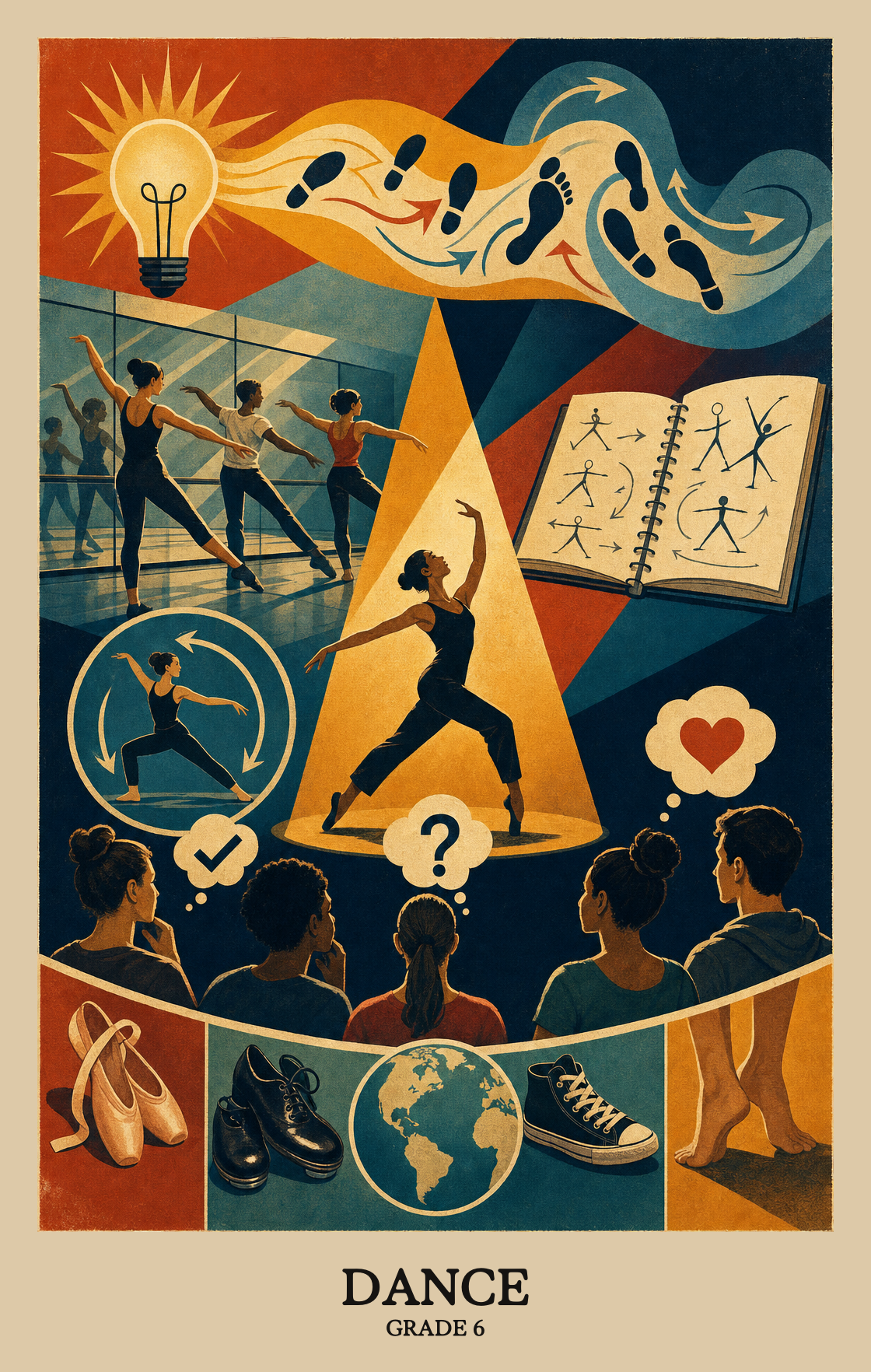
Students start the year by turning their own experiences, observations, and questions into ideas for dance. They try out movements and notice how a small idea can grow into something worth showing.
Students take rough ideas and build them into short dances with a clear beginning, middle, and end. They make choices about timing, space, and energy, then revise until the piece feels finished.
Students sharpen the skills a dancer needs in front of an audience. They work on control, balance, and clarity, and learn how to pick the parts of a dance that are ready to show.
Students perform their dances with intention, using expression and focus to communicate something to the audience. They think about what they want viewers to feel and adjust their performance to land that message.
Students watch dances closely and talk about what they see. They figure out what the choreographer might mean, use clear criteria to judge the work, and explain their thinking with specific examples.
Students connect dance to history, culture, and their own lives. They look at where different styles come from and notice how dance reflects the people and times that made it.
Students connect something from their own life to a dance they create or perform, using that personal experience to shape the movement choices they make.
Students look at a dance and connect it to the time, place, or community it came from. That context changes how they see the movement and what it means.
| Standard | Definition | Code |
|---|---|---|
| Using life experience to create dance | Students connect something from their own life to a dance they create or perform, using that personal experience to shape the movement choices they make. | CA-DA:Cn10.6.6 |
| Dance and its cultural history | Students look at a dance and connect it to the time, place, or community it came from. That context changes how they see the movement and what it means. | CA-DA:Cn11.6.6 |
Students brainstorm and develop original ideas for a dance, deciding what movement, mood, or story they want to explore before choreography begins.
Students take their movement ideas and shape them into a structured dance, making choices about order, timing, and how sections connect.
Students revisit a dance they've been building, make specific changes to improve it, and bring it to a finished form ready to share.
| Standard | Definition | Code |
|---|---|---|
| Coming up with dance ideas | Students brainstorm and develop original ideas for a dance, deciding what movement, mood, or story they want to explore before choreography begins. | CA-DA:Cr1.6.6 |
| Develop a dance idea into full choreography | Students take their movement ideas and shape them into a structured dance, making choices about order, timing, and how sections connect. | CA-DA:Cr2.6.6 |
| Finishing and polishing a dance | Students revisit a dance they've been building, make specific changes to improve it, and bring it to a finished form ready to share. | CA-DA:Cr3.6.6 |
Students choose which dances to perform and explain why those pieces best show their skills and ideas as dancers.
Students rehearse a dance piece, make specific improvements to technique, and prepare it to perform in front of an audience.
Students perform a dance to share a clear idea or feeling with an audience, making intentional choices about movement so the meaning comes through.
| Standard | Definition | Code |
|---|---|---|
| Choosing dances worth performing | Students choose which dances to perform and explain why those pieces best show their skills and ideas as dancers. | CA-DA:Pr4.6.6 |
| Refining dance skills for performance | Students rehearse a dance piece, make specific improvements to technique, and prepare it to perform in front of an audience. | CA-DA:Pr5.6.6 |
| Perform a dance that means something | Students perform a dance to share a clear idea or feeling with an audience, making intentional choices about movement so the meaning comes through. | CA-DA:Pr6.6.6 |
Students watch a dance and explain what they notice, describing how the movement, rhythm, and structure shape what the piece communicates. The analysis goes beyond personal reaction to look at how specific choices create meaning.
Students explain what a dance is trying to express and why the choreographer made specific movement choices. They support their interpretation with details from the dance itself.
Students review a dance performance using a set of standards or questions decided in advance, then explain in writing or discussion why the work succeeds or falls short.
| Standard | Definition | Code |
|---|---|---|
| Reading dance with intention | Students watch a dance and explain what they notice, describing how the movement, rhythm, and structure shape what the piece communicates. The analysis goes beyond personal reaction to look at how specific choices create meaning. | CA-DA:Re7.6.6 |
| Reading meaning in a dance performance | Students explain what a dance is trying to express and why the choreographer made specific movement choices. They support their interpretation with details from the dance itself. | CA-DA:Re8.6.6 |
| Judging dance using clear criteria | Students review a dance performance using a set of standards or questions decided in advance, then explain in writing or discussion why the work succeeds or falls short. | CA-DA:Re9.6.6 |
Students learn to create short dances of their own, perform them with better control, and talk about what dances mean. The year covers four areas: making dances, performing them, responding to dances they watch, and connecting dance to their own lives and to history.
Give students a small clear space and let them rehearse a short piece they are working on. Ask them to show you the dance, then ask what feeling or idea they were trying to get across. Five minutes of honest interest goes a long way.
No. Sixth grade dance assumes students are still building basic technique and vocabulary. Students who have never taken a class can succeed if they show up willing to move and willing to revise their work.
Start with short creating tasks tied to simple prompts so students get used to generating movement. Layer in technique and performing skills through the fall, then push interpretation and evaluation in winter and spring once students have shared work to respond to.
Refining and revising movement is the hardest part. Students often want to perform a first draft and move on. Build in short revision cycles where they change one element, such as level or timing, and dance it again.
Let students rehearse alone first, then perform for one trusted person before a larger group. Focus comments on choices they made, such as a strong shape or a clear pause, rather than on how it looked overall.
Students can build a short original dance with a clear idea behind it, perform it with reasonable control, and explain choices using dance words such as shape, level, tempo, and energy. They can also give specific feedback on a peer's piece.
Students draw on personal experiences, history, and cultural traditions to shape their dances. A piece might grow out of a poem, a historical event, or a family story, which makes dance a natural partner to language arts and social studies.