Building ideas for the stage
Students start the year by coming up with characters, settings, and short scenes of their own. They pull from books they've read and moments from their own lives to spark ideas.
This is the year theater shifts from playing pretend to making real choices as an actor. Students build characters on purpose, pulling from their own lives and from the time and place a story comes from. They rehearse scenes, take notes from classmates, and refine the work before showing it. By spring, students can perform a short scene with clear character choices and explain why a play means what it does.
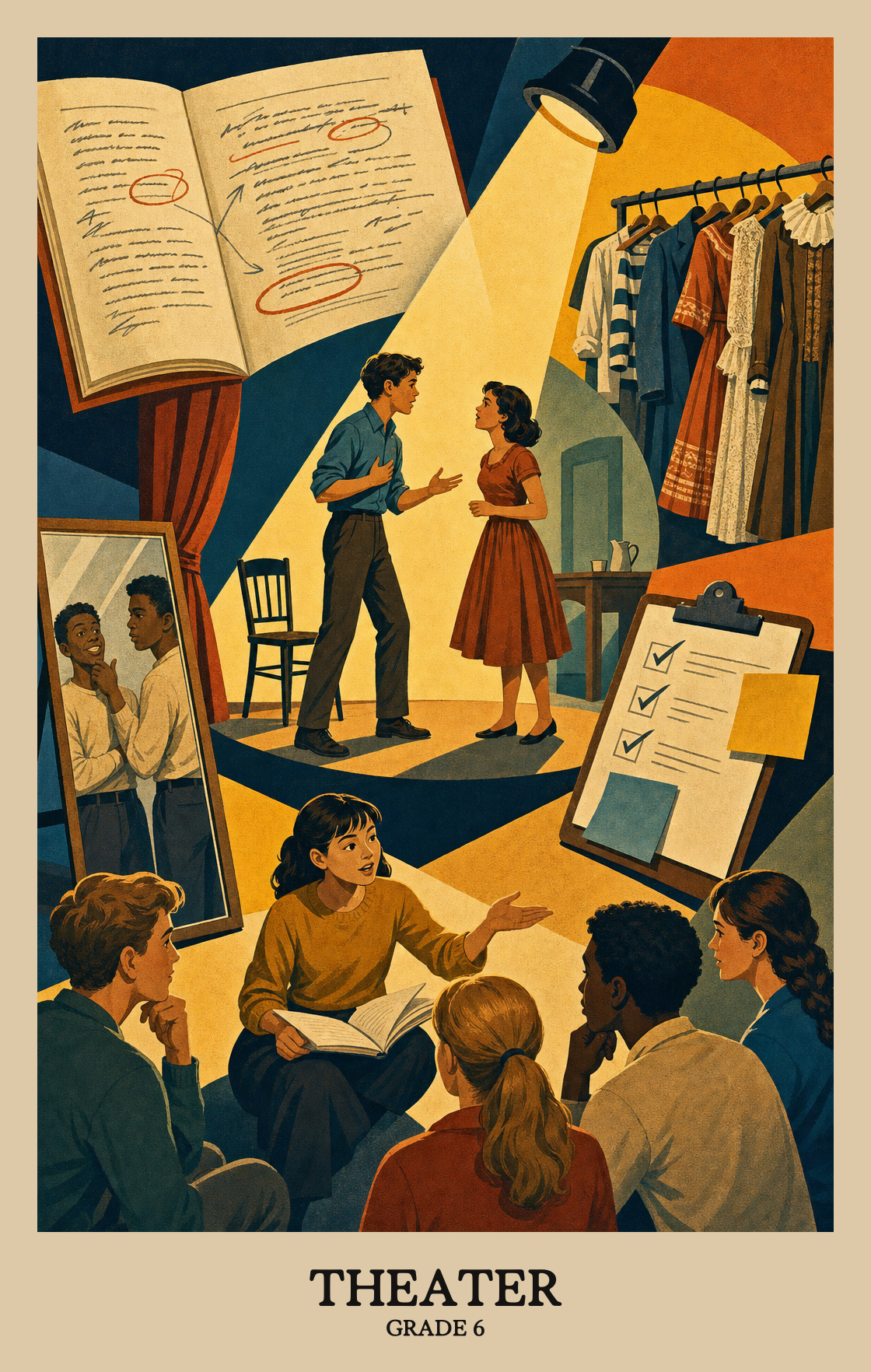
Students start the year by coming up with characters, settings, and short scenes of their own. They pull from books they've read and moments from their own lives to spark ideas.
Students take rough ideas and turn them into scenes that hold together. They make choices about what a character wants, how the scene moves, and what to keep or cut.
Students practice voice, movement, and timing to bring a scene to an audience. They pick which pieces to show and work on the small choices that make a performance land.
Students watch plays and classmates' scenes and talk about what worked and why. They learn to back up an opinion with what they actually saw and heard.
Students look at how plays connect to the time and place they came from. They compare stories from different cultures and notice what theater says about the people who made it.
Students connect something from their own life to a scene or character they're building. That personal detail shapes the choices they make in rehearsal and performance.
Students look at a play or performance and ask where it came from: what was happening in the world, who made it, and why it mattered to those people at that time.
| Standard | Definition | Code |
|---|---|---|
| Using life experience to make theater | Students connect something from their own life to a scene or character they're building. That personal detail shapes the choices they make in rehearsal and performance. | CA-TH:Cn10.6.6 |
| Theater through a historical and cultural lens | Students look at a play or performance and ask where it came from: what was happening in the world, who made it, and why it mattered to those people at that time. | CA-TH:Cn11.6.6 |
Students brainstorm original ideas for a scene or performance, then shape those ideas into a plan they can actually put onstage.
Students take a scene idea and shape it into something that can actually be performed, making choices about character, dialogue, and staging that hold the scene together.
Students revisit a scene or monologue they've been building, making specific changes to dialogue, movement, or character choices until the work feels finished and ready to share.
| Standard | Definition | Code |
|---|---|---|
| Coming up with ideas for a scene | Students brainstorm original ideas for a scene or performance, then shape those ideas into a plan they can actually put onstage. | CA-TH:Cr1.6.6 |
| Develop and shape an original theater idea | Students take a scene idea and shape it into something that can actually be performed, making choices about character, dialogue, and staging that hold the scene together. | CA-TH:Cr2.6.6 |
| Finish and polish a theater piece | Students revisit a scene or monologue they've been building, making specific changes to dialogue, movement, or character choices until the work feels finished and ready to share. | CA-TH:Cr3.6.6 |
Students choose a scene or monologue to perform, then explain why it fits the moment and what they want an audience to take from it.
Students rehearse a scene or monologue, then make specific changes to improve how they move, speak, and respond to other actors before performing for an audience.
Students perform a scene or monologue and make deliberate choices, like tone, movement, and timing, so the audience understands the story's meaning. The performance itself does the communicating.
| Standard | Definition | Code |
|---|---|---|
| Choosing scenes worth performing | Students choose a scene or monologue to perform, then explain why it fits the moment and what they want an audience to take from it. | CA-TH:Pr4.6.6 |
| Rehearse and refine a performance | Students rehearse a scene or monologue, then make specific changes to improve how they move, speak, and respond to other actors before performing for an audience. | CA-TH:Pr5.6.6 |
| Perform a scene with clear meaning | Students perform a scene or monologue and make deliberate choices, like tone, movement, and timing, so the audience understands the story's meaning. The performance itself does the communicating. | CA-TH:Pr6.6.6 |
Students watch a scene or performance and explain what they notice, describing specific choices the actors or directors made and what effect those choices have on the audience.
Students explain what a scene or performance is trying to say and why the playwright or director made specific choices. They look past what happens on stage to discuss the idea or feeling underneath it.
Students watch or read a piece of theater and use a clear set of criteria to judge how well it works. They explain what makes a scene, character, or performance succeed or fall short.
| Standard | Definition | Code |
|---|---|---|
| Reading a performance critically | Students watch a scene or performance and explain what they notice, describing specific choices the actors or directors made and what effect those choices have on the audience. | CA-TH:Re7.6.6 |
| Reading meaning in a performance | Students explain what a scene or performance is trying to say and why the playwright or director made specific choices. They look past what happens on stage to discuss the idea or feeling underneath it. | CA-TH:Re8.6.6 |
| Judging what makes theater work | Students watch or read a piece of theater and use a clear set of criteria to judge how well it works. They explain what makes a scene, character, or performance succeed or fall short. | CA-TH:Re9.6.6 |
Students build short scenes from their own ideas, rehearse them with classmates, and perform for an audience. They also watch plays and other performances, talk about what the artists were trying to say, and use clear reasons to judge what worked. The year mixes making, performing, and responding.
Give them small, low-pressure chances to perform at home. Ask them to read a picture book out loud to a younger sibling using different voices, or act out a memory from their day at dinner. Confidence grows from short, friendly reps, not from one big rehearsal.
Ask three quick questions: who is in the scene, where are they, and what does each person want. Two minutes of talking through those questions usually unsticks a blank page. Resist writing it for them; let them try a rough version and then ask what they want to change.
Memorization shows up, but it is not the main focus. Most work is short scenes students help write, plus rehearsed pieces of published plays. Practicing lines for ten minutes a few nights in a row works much better than one long session.
A common arc is to start with ensemble and improvisation work, move into devising short original scenes, then into rehearsing and refining a longer piece for an audience. Responding skills, watching work and giving useful feedback, run through every unit rather than sitting in their own block.
Two areas come up again and again: giving specific feedback instead of saying a scene was good or bad, and revising a scene after the first run rather than treating the first draft as finished. Building a simple feedback routine early pays off all year.
They look at where a play comes from, when it was written, and what was happening around the people who made it. A short research task before rehearsing a scene, even fifteen minutes, usually deepens their choices as performers.
By spring, students can take an idea from a brainstorm to a rehearsed short scene with a clear beginning, middle, and end. They can also watch another group's work and explain what the artists were going for, using evidence from what they saw and heard.
Look for three signs at home: they can describe a play or movie in terms of what the characters wanted, they will try a scene a second time after feedback without getting discouraged, and they can talk about a performance using specific moments instead of just liking or disliking it.