Generating original movement ideas
Students start the year by turning personal experiences, images, and questions into movement. They build short dance studies from their own ideas instead of copying steps from a teacher.
This is the year dance shifts from learning steps to making real artistic choices. Students build original pieces that say something, drawing on their own lives and on the history behind the styles they study. Rehearsal becomes about sharper technique and clearer meaning, not just memorizing moves. By spring, students can choreograph and perform a finished dance, then explain what it means and why it works.
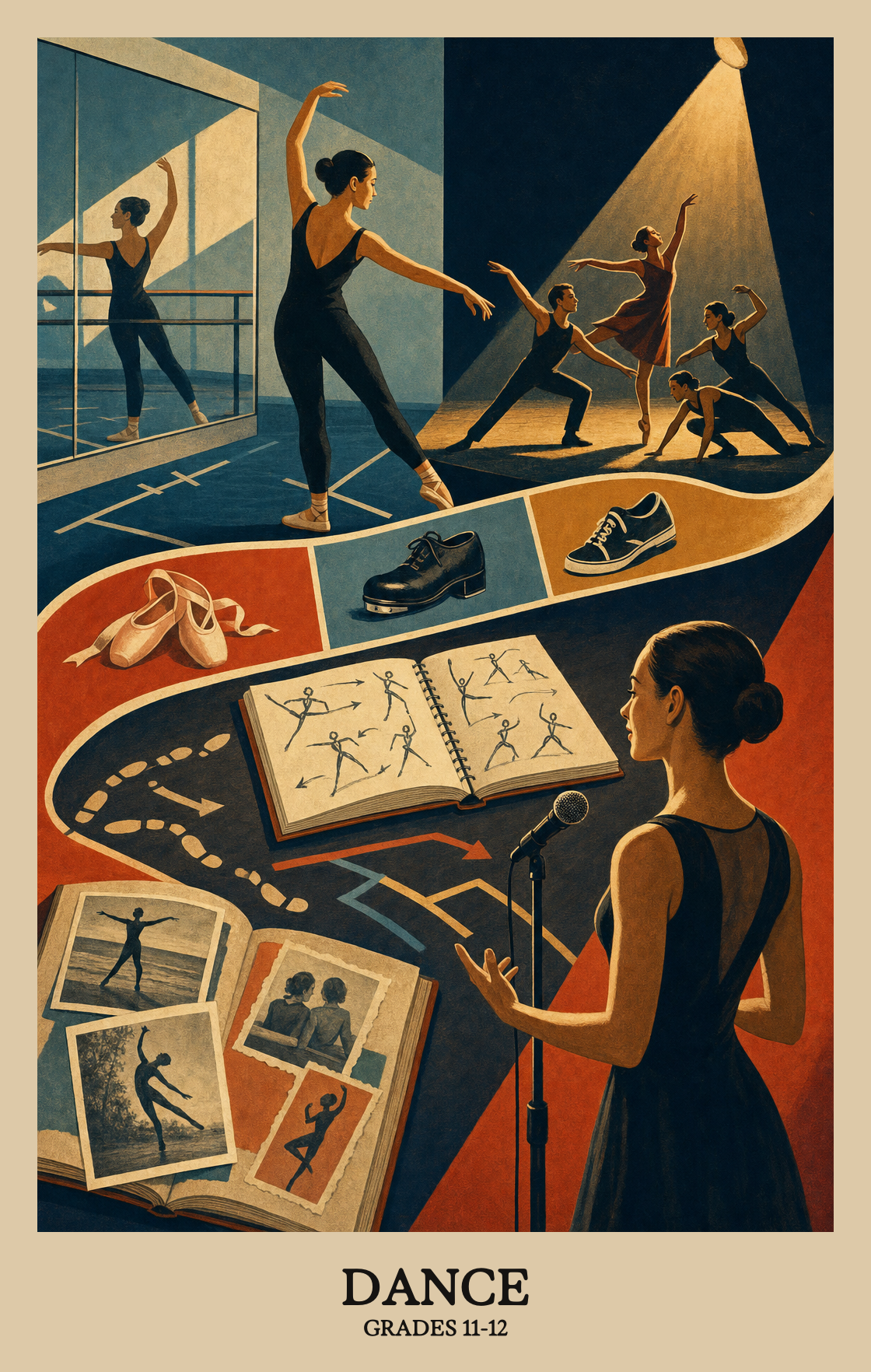
Students start the year by turning personal experiences, images, and questions into movement. They build short dance studies from their own ideas instead of copying steps from a teacher.
Students organize their movement into longer pieces with a clear purpose. They make choices about order, timing, and space so a viewer can follow what the dance is about.
Students study how dances connect to history, communities, and current events. They use what they learn to give their own work more depth and meaning.
Students sharpen their dancing through rehearsal and feedback. They work on control, expression, and the small details that make a performance read clearly to an audience.
Students learn to describe what they see in a dance and back up their opinions with evidence. They use clear criteria to evaluate their own work and the work of others.
Students finish and present polished pieces for an audience. They explain the ideas behind the work and reflect on what they learned across the year.
Students connect what they know from other subjects and their own life experiences to shape the choices they make when creating a dance.
Students pull from what they know, what they've read, and what they've lived through to shape original dance work. Personal experience isn't just background here. It becomes the material.
Students connect dances and choreography to the time period, culture, or community they came from, explaining what those outside forces shaped in the work.
Students study a dance piece alongside the historical moment or cultural tradition it came from, then explain how that context shapes what the movement means.
| Standard | Definition | Code |
|---|---|---|
| Connecting life experience to dance-making Grades 11-12 | Students connect what they know from other subjects and their own life experiences to shape the choices they make when creating a dance. | CA-DA:Cn10.11-12.HsAccomplished |
| Connecting personal experience to dance Grades 11-12 | Students pull from what they know, what they've read, and what they've lived through to shape original dance work. Personal experience isn't just background here. It becomes the material. | CA-DA:Cn10.11-12.HsAdvanced |
| Dance in its cultural and historical context Grades 11-12 | Students connect dances and choreography to the time period, culture, or community they came from, explaining what those outside forces shaped in the work. | CA-DA:Cn11.11-12.HsAccomplished |
| Dance in its historical and cultural context Grades 11-12 | Students study a dance piece alongside the historical moment or cultural tradition it came from, then explain how that context shapes what the movement means. | CA-DA:Cn11.11-12.HsAdvanced |
Students develop original movement ideas by drawing on personal experience, current events, or other art forms, then shape those ideas into a clear creative direction for a dance work.
Students develop original movement ideas and shape them into a dance concept, drawing on imagination, research, or personal experience to push beyond technique into real artistic thinking.
Students take a dance idea from first sketch to finished piece, making deliberate choices about movement, structure, and how the parts fit together.
Students take a movement idea and shape it into a finished piece, making deliberate choices about structure, sequence, and how the dance communicates something specific to an audience.
Students revise a dance they have made, sharpening movements and transitions until the piece is ready to perform or present.
Students revisit a dance piece, make deliberate changes based on feedback or new ideas, and bring it to a finished, polished state ready to share with an audience.
| Standard | Definition | Code |
|---|---|---|
| Develop original choreographic ideas Grades 11-12 | Students develop original movement ideas by drawing on personal experience, current events, or other art forms, then shape those ideas into a clear creative direction for a dance work. | CA-DA:Cr1.11-12.HsAccomplished |
| Coming up with new dance ideas Grades 11-12 | Students develop original movement ideas and shape them into a dance concept, drawing on imagination, research, or personal experience to push beyond technique into real artistic thinking. | CA-DA:Cr1.11-12.HsAdvanced |
| Shaping a dance from start to finish Grades 11-12 | Students take a dance idea from first sketch to finished piece, making deliberate choices about movement, structure, and how the parts fit together. | CA-DA:Cr2.11-12.HsAccomplished |
| Building a dance from your own ideas Grades 11-12 | Students take a movement idea and shape it into a finished piece, making deliberate choices about structure, sequence, and how the dance communicates something specific to an audience. | CA-DA:Cr2.11-12.HsAdvanced |
| Finishing and refining a dance work Grades 11-12 | Students revise a dance they have made, sharpening movements and transitions until the piece is ready to perform or present. | CA-DA:Cr3.11-12.HsAccomplished |
| Finishing and refining a dance piece Grades 11-12 | Students revisit a dance piece, make deliberate changes based on feedback or new ideas, and bring it to a finished, polished state ready to share with an audience. | CA-DA:Cr3.11-12.HsAdvanced |
Students choose dances to perform in front of an audience, then study each piece closely to decide how to present it with intention and skill.
Students choose which dances to perform and explain why each piece is worth presenting, weighing how the movement, meaning, and context hold up in front of an audience.
Students practice and polish their dance pieces until the technical skills and artistic choices are ready to share with an audience.
Students rehearse and refine their own choreography until it's ready to perform for an audience. The focus is on polishing the details that make a dance piece clear and intentional on stage.
Students perform a dance to communicate a clear idea or feeling to an audience, making deliberate choices about movement, timing, and staging so the meaning comes through.
Students perform original or rehearsed choreography with a clear intent, making deliberate choices about movement so the audience understands the idea or emotion behind the piece.
| Standard | Definition | Code |
|---|---|---|
| Choosing dances worth performing Grades 11-12 | Students choose dances to perform in front of an audience, then study each piece closely to decide how to present it with intention and skill. | CA-DA:Pr4.11-12.HsAccomplished |
| Choosing dances worth performing Grades 11-12 | Students choose which dances to perform and explain why each piece is worth presenting, weighing how the movement, meaning, and context hold up in front of an audience. | CA-DA:Pr4.11-12.HsAdvanced |
| Refining technique for performance Grades 11-12 | Students practice and polish their dance pieces until the technical skills and artistic choices are ready to share with an audience. | CA-DA:Pr5.11-12.HsAccomplished |
| Refining dance work for performance Grades 11-12 | Students rehearse and refine their own choreography until it's ready to perform for an audience. The focus is on polishing the details that make a dance piece clear and intentional on stage. | CA-DA:Pr5.11-12.HsAdvanced |
| Perform with purpose and intention Grades 11-12 | Students perform a dance to communicate a clear idea or feeling to an audience, making deliberate choices about movement, timing, and staging so the meaning comes through. | CA-DA:Pr6.11-12.HsAccomplished |
| Perform dance with clear artistic intent Grades 11-12 | Students perform original or rehearsed choreography with a clear intent, making deliberate choices about movement so the audience understands the idea or emotion behind the piece. | CA-DA:Pr6.11-12.HsAdvanced |
Students look closely at a dance performance and break down how the choreographer's choices, such as timing, spacing, or movement quality, shape the overall effect of the work.
Students break down a dance piece by identifying how specific choices in movement, timing, and structure shape the overall effect. They explain what they see with precision, going beyond first impressions to examine how the work is built.
Students analyze a dance and explain what they think the choreographer meant to say. They read movement the way a reader reads a paragraph, looking for emotion, story, or argument behind each choice.
Students analyze a dance performance and explain what the choreographer was trying to say. They look at movement choices, structure, and context to build a clear interpretation backed by what they actually see.
Students pick clear criteria, like technical skill or expressive choice, and use them to judge a dance. The focus is on backing up an opinion with specific reasons, not just saying a performance was good or bad.
Students set their own criteria for what makes a dance work well, then use those criteria to judge performances with evidence from what they actually saw.
| Standard | Definition | Code |
|---|---|---|
| Reading dance with a critical eye Grades 11-12 | Students look closely at a dance performance and break down how the choreographer's choices, such as timing, spacing, or movement quality, shape the overall effect of the work. | CA-DA:Re7.11-12.HsAccomplished |
| Reading dance with a critical eye Grades 11-12 | Students break down a dance piece by identifying how specific choices in movement, timing, and structure shape the overall effect. They explain what they see with precision, going beyond first impressions to examine how the work is built. | CA-DA:Re7.11-12.HsAdvanced |
| Reading meaning in dance Grades 11-12 | Students analyze a dance and explain what they think the choreographer meant to say. They read movement the way a reader reads a paragraph, looking for emotion, story, or argument behind each choice. | CA-DA:Re8.11-12.HsAccomplished |
| Reading meaning in dance Grades 11-12 | Students analyze a dance performance and explain what the choreographer was trying to say. They look at movement choices, structure, and context to build a clear interpretation backed by what they actually see. | CA-DA:Re8.11-12.HsAdvanced |
| Judging dance with your own criteria Grades 11-12 | Students pick clear criteria, like technical skill or expressive choice, and use them to judge a dance. The focus is on backing up an opinion with specific reasons, not just saying a performance was good or bad. | CA-DA:Re9.11-12.HsAccomplished |
| Judging dance with your own criteria Grades 11-12 | Students set their own criteria for what makes a dance work well, then use those criteria to judge performances with evidence from what they actually saw. | CA-DA:Re9.11-12.HsAdvanced |
Students work like young choreographers and performers. They create original pieces, refine technique over weeks, perform with intention, and write or speak about what dances mean. The focus shifts from learning steps to making artistic choices and defending them.
Give a clear space to stretch and move, and protect rehearsal time the way you would homework time. Ask about the piece they are working on and what choice they made that day. Coming to a showing or watching a recorded run-through counts as real support.
No. Outside classes help, but the course is built so committed students can grow from where they are. Consistent attendance, willingness to try new movement, and care in revising original work matter more than years of prior training.
Start with technique and movement vocabulary, then move into short choreographic studies, then a longer original work that gets refined over several weeks. Build responding and writing tasks alongside the making so analysis grows with the choreography.
A student can generate an original dance from a clear idea, refine it based on feedback, perform it with intention, and explain the artistic and cultural choices behind it. Accomplished students do this with guidance; advanced students do it independently and take bigger creative risks.
Revision is the hardest part. Students often want to finish a piece in one pass instead of cutting, reshaping, and trying alternate versions. Build in structured feedback cycles and require written reflection on what changed and why.
Start with a small prompt, such as a photo, a line from a poem, or a single gesture, and make eight counts from it. Movement usually unsticks thinking faster than planning does. Recording short attempts on a phone helps a student see what is working.
Grades come from rubrics that look at the artistic process, not body type or natural flexibility. Teachers assess how an idea is developed, how a piece is refined, how it is performed with intention, and how a student responds to other work.
They can take a creative prompt, build something original from it, rehearse and revise without being prodded, and talk about their work using specific language. Readiness shows up in independence more than in tricks or flexibility.